Wednesday, April 22, 2026

Cowboy Knives - Custom v Production


These days you can't hardly find anyone not carrying a knife, usually a folding knife with the ever recognized clip showing outside a pocket on their wranglers. Folders are very utilitarian excepting that maybe they are hard to open one handed by some people, especially when wearing gloves. Folders are safe too, providing you have a manual opening or spring assist mechanisms. The auto opening folders, using a push button to fully extend and lock the blade raise the potential of accidentally opening and cutting yourself, in my opinion, which comes from experience as I had one 25 years ago and spent hours at Urgent Care waiting to get my thumb sutured up. But then again, most people aren't as accident prone as me. In fact, sometimes I wonder why God hasn't just let me die yet for my ignorance.

Back to knives.....I have been carrying small fixed blade knives for practically all my life. I had a local custom knife maker build a couple of small fixed blades to my specifications. But Joe passed many years ago, however not before I sent several guys his way who rode with me and admired by knifes he made for them.


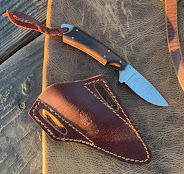
Between Joe passing and a couple years ago I had no option but to direct people to a couple custom knife makers, but many balk at $200 + price tags. Then I discovered a knife maker who makes several knives I found suitable for a cowboying knife. By suitable I mean a blade length of 2 7/8 to 3 1/2 inches (4 inches wouldn't be too long either), full tang and decent thickness for durability under rough use, and, forged from a steel that will hold an edge. These are the knives I offer on my site. Seven inch total length with a 3 1/2 inch blade, 1/8 inch thick for toughness, Damascus steel forged from 5160 and 4340 steel, finger groove for retainability when hands are slick or when wearing gloves, full tang blade with either cow bone or stabilized rosewood handle secured with five pins, and a lanyard hole where I rattlesnake braid a strip of leather to aid in drawing.


These knives are very reasonably priced at $60 and can be offered at that low priced because they are made from Damascus blanks and cut on CNC machinery, so they are not custom knifes, except maybe for the fit and finish, but they sure look it and perform as well as any knife I have owned.

I recently did a search of custom makers on the internet, which prompted Google to think that's all I wanted to see and be reminded of in the weeks since, but showed me many production knife makers offering alike knives at prices exceeding $250. However, there are other options that offer good value and a good knife. Cow Camp Supply has very reasonably priced quality knifes, fixed blade and folding, suitable for carrying horseback. One the knives that Sparky Wallace, the owner of Cow Camp, offers is a very popular palm knife. On the higher priced side there is the Montana Knife Company who offer very stunning small fixed blade knives suitable as well for the working cowboy, hunter or anyone else who finds a small fixed blade knife a tool they can't do without. A nice fixed blade knife is certainly a great tool to have on hand, as well as being a very nice gift to pass onto someone.


Thursday, April 16, 2026

Curly Zeke, Part II Questions on Lateral Flexion


Just a couple days after I published the article on working on lateral flexion on starting Curly Zeke, my coming 4 year old QH gelding, I received a call from Laura who asked me some great questions concerning Zeke and my improvement/non-improvement and issues with him understanding a soft ask for lateral flexion. These question made me think on how I was approaching the whole thing as I had to explain it. While I really don't care what other people think of me,......wait,.....the FBI. I do care what the FBI thinks of me. Or the IRS for that matter. Anyway, I do care what my horses think of me and if I can do something better for them, I need to find that way. Here are her questions, my thoughts and answers to her, and some self reflection on what I could have done different.

How much do you accept? Meaning when I am asking a horse, in this case Zeke, for a soft give to an ask for lateral flexion, how much bend in his head and neck, giving to the ask, do I need from him before I stop that lesson to resume another day, and how much lateral flexion do I need before I can ride him?

I should only ask what he can give at the moment. Going into working with him, I should not have precoceived ideas on how much I watn that day from him. But I'm guilty on not following that. I went back to just asking for a few degrees or inches of flexion, then buildig on that, slowly. Its actually a faster way, but more importantly its more accepting to the horse. WHat also is so important, is the pause givbene between asks. Again guilty of getting in a hurry, so I have to cognizantly recognize that trait in myself.


Laura said she understood the idea of letting the horse find the release when giving to the rider asking for lateral flexion, meaning waiting on the horse to give and find the release, but is there a point when you demand a give such as with bumping?

Demand is a big word. Not really a good word or thought to use with horses. Maybe insisting on a try, but even the thought to try is sufficient. I think poor or fristrated horsemen have an instinct to pull hard. Evne worsea a jerk. While bumping has it's place it's best used sparlingly and differenty on horse to horse. When Zeke braces for an ask for lateral flexion to the left, he like other horses has a tendancy to fade to the right. Sometimes I'll switch to an ask for right flexion and use my right leg to get him back on his line. Sometimes, I'll bump just a bit on that left rein and sometimes I change the angle of the rein slighlty higher as to lift his shoulder and ask for the left leg to step out and forward and use my right leg to reinforce the ask for flexion. You'll just have to experiment with your horse, and even on another horse, do something different. Helping the horse untrack in his hind end as shown in the video below is good for both getting a horse to follow a feel for lateral flexion and to help him untrack his hand end.


Friday, April 10, 2026

Curly Zeke Part II, Getting Lateral Flexion


Continuing with starting Curly Zeke, I have been working on him understanding and following the feel on the lead rope or reins when I ask for lateral flexion. He definitely has a weak side giving to the left with a brace, and on both sides he is tipping his nose and keeping his head low so his ears are not level. Obviously we would all like and need lateral bend of the head and neck in a horse where he keeps his ears mostly level, especially during forward momentum if we want a balanced horse.

I'll work him in halter and lead asking for lateral flexion but not more than he is ready to give. I think there is a tendency to get a horse bending his head and neck round way past 90 degrees, in effect touching his nose to his shoulder or to the stirrup, and that is more lateral flexion than I need or can use. I may change my opinion on that down the road as the horse gets more handy and soft. One of my other horses, a 13 years old gelding, is very responsive and soft when I ask and always gives me more than 90 degrees. I do not intentionally ask him for that much flexion, he just gives it to me. But again, 90 degrees is more than I need to turn or position up a horse, especially starting to ride a green horse.

The videos below of working Curly Zeke in a round pen asking for lateral flexion for circles and 180 degree turns at the walk and trot are pretty much what I have to have going on with him before the first ride out of the round pen, as well as being able to untrack his back end. So the same with any horse, being able to direct him or turn him and untrack his hand end. The four videos go from on the ground with Zeke in a snaffle bit, from the saddle, then at a walk and trot.


I try not to just drill, drill, drill on lateral flexion. I'm hoping the videos and description of starting Zeke will give people a basis for comparison so if there is any frustration people can see the issues and progression of Zeke and we begin to work through them. While I'm putting a ride on Zeke, first in the round pen, then later outside, I'll also work on the beginnings of good stop, backing up (but just a couple steps), and, bringing a front foot out to the side as in the beginnings of a turn on the hind end. And lastly before I've done really any of the above, I've got Zeke responsive and soft at untracking his back end while I'm in the saddle. He's doing very well with moving his back end that we could move to asking for the untracking and expecting him to pivoting with a front foot instead of taking a step or two forward.