Thursday, June 30, 2011

Help a Hero Win a Gypsy Vanner Horse


Lexlin Gypsy Vanner Horse Ranch is giving back to the military by donating horse to a worthy veteran. Help a Hero win a horse, Braveheart, donated by Lexlin Gypsy Vanner Horse Ranch of Rockwood, Tennessee by helping a veteran obtain the most "likes" on Facebook by midnight on July 3rd. Lexlin Gypsy Vanner Horse Ranch reports that Braveheart is a very sweet horse, and they will miss him, but are excited to see him find a new home with a deserving veteran.

http://www.facebook.com/GypsyVannerHorsesForSale

Click on the link above; Log into Facebook; then hit the "like" button to go to the voting site. If you have any questions please don’t hesitate to call Lexlin Gypsy Vanner Horse Ranch at 865-567-1653 or shoot an email to tmidyett@gogypsy.com

Remember to vote before Midnight July 3rd.


And if you are having trouble deciding which worthy veteran to vote for, please consider USMC Colonel, and my friend, John Mayer who was nominated by his 10 year old daughter Jesse. John has dedicated his life to service of this Country and currently he is helping wounded Marine Corps veterans get better through equine therapy. Col Mayer is truly a Great American and a deserving individual. That's his picture at left to help you find him.


Wednesday, June 29, 2011

Army Scout - Texas Jack Omohundro


"He was an expert trailer and scout. I soon recognized this and... secured his appointment in the United States service...In this capacity I learned to know him and to respect his bravery and ability. He was a whole-souled, brave, generous, good-hearted man...who was one of my dearest and most intimate friends.” --William “Buffalo Bill” Cody, 1910

John Baker Omohundro was born July 27, 1846 in Fluvanna County, Virginia where he grew up on horseback and was said to be a natural born hunter and crack shot, who loved adventure and danger.

When the war between the states broke out, Jack tried to follow his older brother into service but was denied until he reached 16 years of age. Finally accepted into the Confederate Army, Jack gained an exceptional reputation as a scout working directly under Col. J.E.B. Stuart's renowned Cavalry.

After the war, Jack worked his way west towards the great ranches in Texas, where he was eventually hired on at the Taylor Ranch becoming a foreman and being involved in local adventure where he and his famed ability with a rifle reportedly kept a kidnapping of a local woman from happening.

Omohundro participated in cattle drives on the famous Chisholm Trail where he saw the result on Indian attacks on small settlements and was involved in several Indian fights. Apparently it was as a Cowboy, driving cattle to Tennessee, where Jack received his nickname "Texas Jack".

On one of the cattle drives up North, Omohundro met Col. William F. Cody, a scout in the U.S. Army and more popularly known as "Buffalo Bill". Jack became good friends with Buffalo Bill, and Cody, admiring Jack's ability as a horseman, hunter and marksman, got him stay on as an Army Scout. Reportedly a special act had to be passed through political fiends of Buffalo Bill's to obtain a waiver for the ex-Confederate soldier to enlist as an Army Scout.

Omohundro was famous for learning Indian language and signs, was one of the few white men that Indians would trust. He became known to the Pawnee as "White Chief" who also called him "Whirling Rope" due to his ability with a lariat.
Incidentally, later on in life, Texas Jack taught a young man by the name of Will Rogers how to do tricks with the lariat.

Jack later joined Buffalo Bill Cody's Wild West show and toured the world giving insights to the Wild American West. Texas Jack Omohundro, War Veteran, Cowboy and Army Scout died in Leadville, Colorado, unexpectedly from pneumonia in 1880 cutting short a great life at the young age of 34 years old.

Monday, June 27, 2011

Trailer Loading and Butt Ropes


I receive what seems to be a lot of questions about trailer loading. In my experience horses don’t want to get in trailers for two reasons: 1 – because they have had a bad trailering experience, and 2 – they have learned that they don’t have to get in – that they can get away with balking to enter the trailer. And with some horses, getting in a box is just too frightening, especially for the first time.

When I was managing a large horse stables I had a boarder need help to load his horse to take him to roping. After the roping concluded he tried to load his horse back into the trailer, couldn’t get it done, so he had to ride the horse about 20 miles back to the stables. So the lesson learned here is that don’t go someplace with your horse unless you are sure you can get him back in.

I don’t know how many times I get asked to help someone trailer load their horse only to find out that they have tried for 4 or 5 days before they called me. Then the horse has learned pretty much that they don’t have to get in the trailer. So the lesson is not to try to load a horse, who has problems loading, if you don’t have the time to see it through. And when you get him to load, just don’t stop there, get him in and out a few times and see if he isn’t easier each time.

A new trailer can cause a horse to balk at entering as well as can competing interests for their attention while trying to get them loaded. If the trailer is old or otherwise has suspect flooring then the horse may have some anxiety associated with that. Sometimes it may be a lower height trailer and the horse has bumped his head.

When I lead a horse up the trailer I make sure I’m not in front of them but off the side and My body language reflects that I am expecting that horse to walk right up and into the trailer. If they balk, I’ll give them a minute and have them drop their heads to smell and look at the trailer floor then when I see their attention on the trailer waiver (you’ll see their head set and ears slacken), then I ask them to step up.

When I have trailered a young horse, that wasn’t necessarily really good at loading, out to a remote area and was on patrol by myself, I have had to use some props, a butt rope or lunge whip, to help that horse get back into the trailer, but for the long term it needs to be the horse’s idea to load and he should load easily. Even though I don’t like to use other aids like a butt rope or lunge whip, sometimes it is necessary to tap the horse on his butt to move up into the trailer. I have had success in really balky horses by tapping on the leg below the hocks. And I mean tapping, not hitting,…just a light, repeated tap until you see some progress. If they move forward even one step I removed the tapping (pressure and release), then start again. The horse learns that to move forward and continue to move forward into the trailer is where they find the release. In the trailer they find out that it ain’t the big trauma they thought and they are a better horse for it.

The below video shows how I position up and use a butt rope to help with getting a horse to move forward into the trailer.


Saturday, June 25, 2011

Introducing the K Rose Ranch of Saskatchewan


A Canadian Hello from Gerald, Cody, Reagan, and Kassidy Adamus, the owners of K Rose Ranch, located eighteen minutes northwest of Saskatoon, Saskatchewan, Canada. K Rose Ranch raises Quarter Horses, Paints, and Rodeo Stock. Their aim is to continue to raise top quality horses and Rodeo Stock for everyone's needs, through a wide variety of Champion bloodlines.


K Rose Ranch is also very excited to see their breeding program grow and improve every year. Please visit their website and look at our 2011 Foals, including this pretty little Sorrel and White Overo Filly out of Wranglers Pepto and Miss Steele Rock.


http://www.kroseranch.com/

Contact:
Gerald Adamus
Cody & Reagan Adamus
phone 306 283-4661
cell 306 717-7918
cadamus@sasktel.net
Langham, Saskatchewan, Canada


Thursday, June 23, 2011

Reader Question on Trail Ride Planning


I received this e-mail from a reader: ”I have been reading your site for a few months now and really enjoy the articles. I have leased a horse and am about to go on my first long trail ride in the National Forest with a group of friends. I am so excited! We are going to trailer in to a place then make a seven mile one way ride, through an old mine area, then onto a small lake then return in the later afternoon. What type of preparations and gear do you think I should take with me?” Lynn, Michigan.

Lynn, good for you. I understand that leasing horses is becoming a cottage industry. In regards to your question, I don’t want to over burden you with possible preparations, but.....

A fourteen mile trip at a leisurely pace is usually not a problem for most horses, but I have seen people over extend their horses. Riding a couple times a week should bring your horse into good enough shape not to be asking too much. Hopefully, at least one of your friends are experienced with trail riding.

Don’t know what the terrain looks like, but if your horse is not shod, then consider bringing some hoof boots in case your horses gets ouchy on his feet or picks up a stone bruise. Easy Boots are good, but kind of bulky. Hoof wraps are not as durable, but are much lighter and compact to carry. I always carry one hoof wrap even with my shod horses in case I have to pull a shoe.

Do you know about the mine you’ll be going by? I have an semi-active mine fairly close to my place that I can’t ride close to because of some toxic materials, like mercury on a ground as a by product of the mining and I don’t want to expose my horse to that. Be sure to know what to look for around mines such as vertical shafts and loose footing.

A first aid kit for both people and horses is a good idea. I carry wound dust, vet wrap, gauze bandage and tape in my saddlebags.

Any possibility of rain? I always carry a slicker. Not just for rain, I have used it to cover up my horses head during a short dust storm where I couldn’t see three feet in front of me. Don’t try and put on your rain coat for the first time when you’re in the saddle. I think maybe a small pocket poncho may work.

You and your group may consider dividing the necessary and emergency supplies. Meaning not everyone needs to carry tools such as a Leatherman or hoof pick,…you can share. I carry a small Plammer fencing tool. It came in handy one day when I had to cut barbed wire away from my horse’s legs.

Hopeful you have cell phones in case of emergencies….and I would suggest you are staying together or at least not violating the two person rule,...even better the three person rule where you are never in groups smaller than three people. This allows one to stay to help an injured person and the other can ride for help if need be. One the ride in, maybe you could check cell phone reception from time to time to know where you have to be to make a emergency call....the ability to describe where you are at would be important.

I would leave a map and trip narrative with someone, friend or family member, who is not going on this trail ride, just in case, …maybe also at any nearby Ranger station where you end up trailering to.

Other things I always carry are: a small fire starting kit; short, fixed blade knife; 2 quart canteen; 48 foot lariat; spare leather ties and Chicago screws.

Have fun and safe journey.

Monday, June 20, 2011

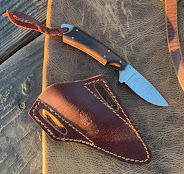
Cowboy Knife - Custom Knife by Joe Teague


I asked Joe Teague of El Paso, Texas to make another knife for me with a couple small design changes to the knife handle and sheath primarily. Joe is a modern Mountain Man who hand makes knifes of all sizes, period correct from the early 1800's through the late part of the century. He also make camp axes as well. He works in many different metals include Damascus and tool steel as well as using some of the prettiest hardwood available.

I asked Joe to use Tigerwood Maple hardwood for the handle, insert a lanyard hole in the end of the handle, and make a cross draw, pancake type sheath with belt loops for a right hand draw. I like the lanyard as sometimes I don't get quite a full grip on the knife so the lanyard, which I made out of cut down saddle strings, help me draw the knife.

I like a cross draw as it keeps the knife out of the way but accessible....and serves as a retainer for my gun belt which is a leather and canvas cartridge belt.

Two weeks later, Joe called and told me it was ready for pickup and when I did he
explained that he used German silver for the hollow pin for the lanyard hole. The sheath is as quality made as the best firearms holster available today.

Friday, June 17, 2011

Horse Injuries - Bowed Tendon


I received a question from Yvonne, a prospective horse buyer, who was told the horse they were looking at picking up had a previous tendon injury. Horses who are used in speed events or hunter/jumper type activities usually face a bigger chance at soft tissue injuries such as injuries to their tendons which usually occur when the tendons are stretched beyond the limits of their elasticity. This can really occur in any activity horseback. I would suggest paying for a vet check for overall health and soundness, however the prospective buyer can do a preliminary inspection of a horse to determine if they want to proceed.

Tendonitis is inflammation of a tendon, commonly occuring in the superficial digital flexor tendon behind the front leg bones, which is the tendon closet to the surface. Just behind the superficial digital flexor tendon is the deep digital flexor tendon, .....these are the tendons connect the fetlock and the knee are are the tendons that some people are taught to squeeze to cue the horse to raise his leg for cleaning the foot.

When that tendon is torn then healed, a “bowed tendon” appearance will be visual. This is a result of the tendon being torn then healing with scar tissue causing a lesion type thickening or knot on the tendon.


Smaller or less invasive injuries will also cause torn tendons and scar tissue, so ‘pre-buy” inspections should included feeling this tendon for evidence of previous injuries and build of of scare tissue. Manipulation and palpitating the joints and soft tissue to detect abnormalities, swelling and pain is a good idea. If you get a Vet to do a pre-buy check watch what they do and ask questions which is a great way to start to learn. Otherwise lameness issues and causes is a pretty complicated area, but an area that the aspiring horseman should work to learn. "Understanding Lameness" by Terry Swanson, DVM, available from Western Horseman books, is a very good resource to have.

Safe Journey and let the horse buyer beware.

Tuesday, June 14, 2011

Reader's Horses - Amanda's 12 year old Gelding


Knowing how people love their horses,...wish all people did,...I will post pictures of you and your horse(s) or just your horse if you prefer, if you send them to me. Thanks for the reading this site and more importantly, thanks for caring for your horses.


This is Amanda's 12 year old Gelding. Nice stout looking Roan. Notice she has him tied high to the tree and with a quick release.

Friday, June 10, 2011

New Equine Feed Supplement - HorseManna from MannaPro


Just heard about Horse Manna from MannaPro. In the past I have used Calf Manna, intended for cows, on horses to help them gain weight. And whether you are trying to put weight or take weight off a horse, go slow. I bought the horse in the picture, Roy , when he was 16 or 17, and he was maybe 150-200 lbs underweight, probably in body condition scale 2 or 2.5. I used grass and alfalfa hay, Calf Manna and corn oil to slowly put weight on him where in maybe 3 months he was looking good. Roy is now 27 or 28 years old and still doing good.

This is what MannaPro says about their new pelleted feed product, HorseManna :

Introducing the next generation of the Manna family: Horse-Manna™! We started with the proven science behind Calf-Manna® then added several nutritional features specifically for your horse. These added benefits, along with a complete fortification of vitamins and minerals equal the Horse-Manna Difference you will see and your horses will taste!

Horse-Manna includes multiple sources of high-quality proteins. These proteins provide a wide array of essential amino acids that promote growth and better muscle development in horses.

Supplemental Fat & Stabilized Rice Bran = Better Weight Gain

Horse-Manna has added fat to increase calories and help support weight gain and increased body condition.

Brewer’s Dried Yeast, Yeast Culture, Microbials = Better Digestion

These key ingredients in Horse-Manna help promote optimal digestion of the entire diet.

Flax and Linseed = Improved Coat Condition

Flax and Linseed Meal have been added to Horse-Manna and are rich sources of Omega-3 Fatty Acids which add sheen and luster to your horse’s coat.

Anise = Palatability

Ingredients like Anise provide Horse-Manna’s inviting, sweet smelling aroma and taste for horses. The great taste encourages horses to stay on feed during times of stress such as travel, illness, or environmental changes.

Vitamin & Mineral Fortification = Improved Health & Well-Being

The 26 vitamins and minerals in Horse-Manna ensure your horse is getting complete fortification for their overall health and well-being.

Guaranteed Analysis:
Crude Protein Min 25.00%
Crude Fat Min 6.00%
Crude Fiber Max 7.00%

Horse-Manna will be available at your local retailer in June 2011. To find out more about Horse-Manna, Manna Pro, or to find a local dealer, please visit www.mannapro.com


Sunday, June 5, 2011

Reader with Horse and Snaffle Bit Problems


D.K. wrote me and said that she bought a horse who she had seen being ridden in a snaffle bit, but when she rides him he fights the bit, tosses his head and keeps opening (gapping) his mouth.

D.K. no offense but are you sure the bit you are using and the snaffle bit the horse was previously ridden in are the same? Even if they are both snaffle bits, there can be quite a bit (no pun intended) of difference based on the ring (fixed or hinged); diameter and shape of the bar; type and tightness of the curb strap; and, type of the headstall (one ear or a regular browband type headstall).

And then last, but not the least of it, is how you ride and manage the reins. Are you heavy handed? Is your timing on the release efficient enough for the horse to recognize the release with the pressure?

The true snaffle bit is a broken bit without any leverage, just rings either O or D shaped to attach the reins to. There is no leverage in a snaffle bit. One pound of pull on the reins provides one pound of pressure in the horse's mouth. And there are four places in the horse's mouth where pressure can be applied by a bit. 1 - the corners of the mouth; 2 - the bars or the space (gum covered jawbone) between the front teeth and the molars; 3 - the tongue; and, 4 - the roof of the mouth. A snaffle bit can apply pressure on the first three spots.

Snaffle's probably ought to be ridden in a regular browband headstall and not in a one ear headstall. A curb strap and not a curb chain is used, and really only used to keep the bit in place or keep the rider from pull it through or out of the horse's mouth.

Some people wrongly call all broken bits "snaffles". A broken bit with shanks extending from it is a leverage bit, not a snaffle. The one in the picture is sometimes called an "Argentinian Snaffle", but again not a snaffle at all, but just a leveraged broken bit. I have seen these used and have used them myself with curb chains. The chain has to be adjusted to apply pressure on the bottom outside of the jaw at the appropriate spot in the manipulation of the bit's shanks. But this article is not about this bit and frankly, I'll probably never use one again.


Be sure to check your horse for dental problems, like Wolf teeth still in place, in case this is affecting his acceptance of the snaffle. Make sure there are no sharp burrs on your snaffle and I think a sweet metal or copper inlay on the bars of the snaffle work best as the cause the horse to salivate therefore lubricating the bit.

Not last, really first, is checking how you are riding this horse in the snaffle. Horse's will gape their mouths when people (riders) are in that horse's mouth too much. Same with head tossing,..if there is no release from your hands through the reins to the horse's mouth, the horse will get frustrated because he can't figure out what you want, and he will try about anything to escape the pressure. And remember the reins are a small part of controlling your horse. Usually under forward movement, just to get the horse's head tipped in the direction you want to go. Try to ask as lightly as possible. I believe it is possible to lighten a horse over time even if that horses has been ridden under a heavy hand. I think you're just teaching it to expect something better.


Saturday, June 4, 2011

Cowboy Television Legend Dies - James Arness R.I.P.


James Arness, known far and wide as television's Marshal Mat Dillon on Gunsmoke, died 3 June 2011 at the age of 88 years old of natural causes. I grew up in the 1960's watching Gunsmoke among other television westerns. Marshal Dillon always stood for right over wrong, even in the face of overwhelming odds.

It is little known that James Arness served with the U.S. Army during World War II, being wounded in action at Anzio Beach during D Day. He is best known for being Marshal Matt Dillon on Gunsmoke, which ran from 1955-1975 and can sometimes be found on television. I also liked him in his role as a grizzled old Mountain Man in How the West Was Won.

By all accounts a wonderful man who suffered tragedy in his life with the death of his daughter and wife both from Drug overdoses, many of us was fortunate enough to see him on an interview with Bill O'Reilly where Mr. Arness expressed gratefulness on the full and rewarding life he was lived and no doubt influencing a lot of young boys along the way. God Bless and Rest in Peace.

Sunday, May 29, 2011

Horse Healthcare - Colic Symptoms


I'm not real fond of getting calls at night saying "I think somethings wrong with my horse". It's not the call or the time of night, it's just hard to talk to people over a phone and translate what they are seeing. With some Vet bills for a night or weekend colic call being several hundreds of dollars, several people I know call me or my wife to help.

Colic is always bad news because the symptoms are sometimes misread or misleading and the threat to the horse is high. I have always wanted to film a colic case, but usually have my hands full doing something else and too worried about the horse to remember about a camera. Plus it always seems like horse colic always starts on a Friday night through Sunday night, don't it?

"The horse don't seem right" is often the first indicator of colic. Sometimes the horse's action just seem different. Sometimes it may be listlessness that gets our attention. Other signs include: horse not interested in feed; standing stretched out like when a horse urinates; ears focused backward; biting marks on the side; laying down, standing up and laying down again; in bad cases with alot of pain the horse will throw themselves down on the ground and this of course can result in a twisted gut which without immediate surgery is almost always fatal.

Before they lay down or throw themselves down Horses will usually walk around in a circle with their head down....like they would when they are trying to find a place to roll. I have a horse who seems to get gas colic more often than other horses, so one day I was lucky enough to have a video camera nearby and had someone shoot film on the horse's action to better explain some colic symptoms.


Other symptoms include tail wringing which indicates aggravation; lack of gut sounds on the horse's barrel when you place your ear to the gut; and, overly sweating can also indicate the horse is in distress.

Treatment for colic may include calling the vet and relaying what you are seeing - the more accurately you can provide descriptions on what the horse is doing, the better decisions the Vet can make; getting a halter on the horse and walking it around but don't over walk it as you can dehydrate it more and take needed blood flow away from the gut. This also keeps the horses from trying to throw itself down and in bad cases the horse will balk under halter and try to go down, so you have to create a little energy to keep the horse upright. If they stop and want to stand quiet during periods of reduced pain then I'll encourage this.

Banamine which is a muscle relaxer, usually given as 1cc per 100 lbs of body weight, can help. Best to get it into the horse via a vein (IV) as opposed to into the muscle (IM). If your Vet tells you to give your horse a shot of Banamine, note the time and amount to relay to your Vet.

Offering the horse a chance to drink occasionally is a good idea. And if the Vet comes out, normal protocol after an exam is to put a tube through the nose to the gut and pump mineral oil and water into the stomach. The exam usually includes palpitating the last few feet of the horses digestive tract with a gloved arm to check for impaction or a twisted gut. Some Vets will also suggest an IV line into the horse to keep it hydrated and giving the horse a mineral oil/water enema.

The weather's getting hotter now. Here in West Texas it hit 99 degrees yesterday. Make sure to monitor your horse's water intake and always provide clean water and plenty of it to drink. Keep a barrier between your horse's feed and the ground especially if the ground is sandy. Keep your horses wormed on schedule. All this can reduce the chances of colic, but know what to look for because time is very important in the treatment. Safe Journey.

Friday, May 27, 2011

Cowboy Humor - Gun Powder and Longevity


A tough old cowboy from South Texas counseled his grandson that if he wanted to live a long life, the secret was to sprinkle a pinch of gun powder on his oatmeal every morning.

The grandson did this religiously to the age of 103 when he died. He left behind 14 children, 30 grandchildren, 45 great-grandchildren, 25 great-great-grandchildren, and,..............

.......a 15-foot hole where the crematorium used to be. Sorta brings a tear to your eye, don't it?

Monday, May 23, 2011

Reader Question on Saddle Fit


Received this question: Is there a way to fit a saddle that has full quarter bars to a horse that needs a medium bar without buying a new saddle?

I think we can all agree that it is impossible for one saddle to fit all horses. This is because the difference in the widths of the saddle-tree bars, their angle, length and flare. I also think we all have saddled horses with saddles and bars too narrow for the best fit....that's probably because most of us have saddles older than our horses.

Quarter horse bars are going to narrower in width and have a steeper angle than say semi-quarter horse bars (medium bars) and full quarter horse bars. Horses today seem to have shorter withers, bigger shoulders and flatter backs, hence the move away from older quarter horse bars fitting higher withered horses, to semi and full quarter horse bars.

You really should have a saddle that fits your horse, but money wise, this is unrealistic for most people. You can do a little bit to fit the horse through using the appropriate saddle pad and/or blanket, but you can't make up a really poor fit this way. Imagine piling up a bunch of folded blankets on a chair then sitting on it,....doesn't feel balanced at all, does it?

I use an Impact Gel felt saddle pad and a blanket on top between the pad and the blanket. I think my saddle pad is half inch thick, certainly no thicker than three-quarters of an inch. I don't like the real thick one inch saddle pads, not do I use anything but felt. A few months ago, I went to a much thinner, all wool blanket which helps reduce the space between the saddle and the horses back. Previous to this I was using a blanket folded in half which produced more bulk and weight.

Saddle pads have came along way in the last twenty years. It's common to find a pad with a cut out to protect the withers and a tented center than protects contact from the horse's backbone. I always tent the pad and blanket at the withers when I saddle so when I cinch up it's reduces any discomfort at the withers.
The pictures show the saddle, pad and withers relationship before and after tenting. I think it also allows a better saddle bar to horse withers and shoulder fit.


You can try to fit a better fit for your saddle using different pads and blanket combinations. Look to ensure the flare of the forward saddle bars fit the shoulders below the withers and fit the back at the same time. Look for two inches (or two fingers) of clearance in the gullet from the top of the horse's withers.

Maybe a neoprene pad may not slip as much, although I would hate to use a rubber pad as I think it reduces the ability to breath and gets hot faster than a felt, wool or fleece pad and I am describing the pad that makes contact with the horse's back. I find it kinda odd that a lot of pads are described by the material the saddle sits on as opposed to what makes contact with the horse.

Friday, May 20, 2011

Horse Health Warning - Equine HerpesVirus (EHV-1) Alert


Equine Herpesvirus (EHV-1) is in the news recently with an outbreak at a Utah Cutting Horse Competition. This outbreak caused in closures or postponements of other competitions. EHV-1 is highly contagious and can result in severe respiratory problems; abortion in mares; neurological disorders such as incontinence, ataxia or uncoordination, and fever. Even paralysis usually of the hind limbs.

EHV-1 spreads in the form of horse to horse contact. It is thought that it can spread from aerosol form, sneezing, but not over long distances, so quarantine of suspected cases or separation between horses of 100 yards should be sufficient protection. However, the virus can reportedly survive on inert objects like shedding blades, brushes and the like, so care should be taken not to use the same tools on affected and non-effected horses.

There is no vaccine for EHV-1, although there is a prototype being tested in the Infections and Infestations class of medicines and vaccines which includes anti-fungals, anti-virals, and anti-parasitics.

In 2006, there was an outbreak in Florida of EHV-1 which was thought to have originated from horses imported from Europe.

Tuesday, May 17, 2011

Rattlesnake Season is Here Again! Vaccine Now Available


I have been meaning to do a post about Rattlesnakes since last month, as Rattlesnakes were starting to come out of their winter dens around early April here in West Texas. As the weather gets warmer and then hot, Rattlesnakes become nocturnal, moving around mostly during the night hunting for prey. They will still lay out in the early morning and late afternoon Sun soaking up the heat.

I was out in the desert riding my horse Junior this past weekend during the middle of day and spotted a snake about 40 yards from us. I jogged Junior up to it hoping to find a Rattlesnake to train Junior that these snake are trouble. I was disappointed to find a Coachwhip, who are non-poisonous.....and Good Lord are those Coachwhips fast. Once the snake knew we where there, he was off to the races.

Best scenarios for trail riding are that you can see where your horses feet are going fall. In all the desert riding I have done, in open terrain, brushy vegetation and mountainous areas, I have only surprised no more than a dozen Rattlesnakes. Unless you almost step on them, or mess with them, chances of getting bitten are slight. However, I carry a two small lengths of rubber hose (like car fuel hose) about 4 inches long each, to place in their nose to keep the airway open, just in case one of my horse's gets bitten on the nose which is a common place to get bite as horses are curious and often lead with their nose to the ground to investigate a snake. Coating the outside of the hose with vaseline or Bag Balm then sealing it in a bag is what I do.

In the June 2011 edition of Western Horseman magazine, page 33, there is an article about Red Rock Biologics of Woodland, California who is making a Equine Rattlesnake Vaccine, called Crotalus Atrox Toxiod Rattlesnake Vaccine for Horses. It may be a good idea to talk to your Vet to see if they are going to carry it, or if you can get a script for it and vaccinate yourself if allowable in your state. May be a good idea if you live way out from Vet response and in heavy Rattlesnake country.

Apparently, like Rabies vaccine, this vaccine is supposed to develop "memory cells" to respond once they encounter the toxin again. The initial doses is a series of three shots given once a month for three months. So creating antibodies in your horses may just be in your best interest considering the cost of supportive Vet care if a horse is bit.

Safe Journey and watch for Rattlesnakes!

Saturday, May 14, 2011

Cindi's Appaloosa - Pushy and Feed Aggressive


Cindy wrote: “Hello, I would like to know your opinion about my 3 year old Appaloosa. He has been ridden for a year now, doing very well, but we are just now starting to ride him more aggressively, starting to take him to small shows this summer, so I wanted to increase his feed so he don’t lose weight, he is on the smaller side. I have noticed that since I have been feeding twice a day now, he is more aggressive then before? I know its because of the grain, he is food aggressive anyway, gets real pushy.. I heard about the weight builder? Would you recommend something like this? Thanks Cindy”

Hey Cindy,

Thanks for writing. Here’s some food for thought: Your Appaloosa (a gelding I assume) is a three year old. That’s relatively young. He may be just figuring out he’s a horse and that he’s bigger than most everything else. Plus he’s an Appaloosa. Most of the Appaloosa’s I’ve seen have been more aggressive than say a Tennessee Walker or Quarter Horse. Having said that it is true that most horse problems are people caused problems.

Sometimes there is a nothing better than a bunch of wet saddle blankets for a horse,… meaning a lot of work and keep him busy…..but not too busy as he is still a three year old. Feeding twice a day as opposed to once should not increase his feed aggressiveness. Maybe you are just seeing the aggressiveness twice a day rather than once. He needs to learn not to pushy when being fed....more on that.

Assuming your Appaloosa does not teeth problems or is wormy,...depending upon the type of feed and grain he gets, the grain could be increasing his energy. In the past I have seen alot of Thoroughbreds and Arabians whose bad behavior was, in part, influenced by heavy doses of grain, sweet feed, etc. If your horse gets sufficient forage (pasture or hay) he would not necessarily need grain. High protein and high carb content feeds can help him to be a little hyper.

On underweight horses, usually rescue horses, I have used Calf Manna and/or Pelleted feeds with Corn Oil to build weight on underweight horses,...adding this to their diet very gradually. However, it is generally safer just to increase the hay gradually. Can't emphasize this enough - anytime I change or add feeds I do so ever so gradual to accustomed their system to the new or higher levels of feed.

I would get your horse Vet or another opinion on his weight. I have never used weight builder, and I can’t remember if anyone I know has ever used it.

What is more concerning to me is him being pushy and feed aggressive. If he is stalled six days a week, then on day seven he'll have a lot of pent up energy - back to wet saddle blankets. In fact, I still lunge most of my horses before I take them out of the range,...not just to get their kinks out and release some of that energy, but to see if they have any problems,..lameness, whatever. But if does help to release some energy, but know that no amount of lunging will take the buck of a horse.

Correcting his manners under halter is where I'd start. I like to use voice commands with physical cues, so if I'm with a loose horse in a pen I can get them to back or move over with my voice. Again, this starts under halter. Some people may neglect ground training cause it's not as fun as riding and going fast. But I think this is where you and the horse learn the most and again it's where everything starts.

Don't let him crowd your space - he has to respect your space. Don't let him crowd you when you feed. You should be able to back up him to give you room to feed.

Start with short times to make him wait, then increase. He'll learn that shortly after your throw feed, he'll be fed. I explain a little more in the video below. Good luck Cindi, and safe journey.


Friday, May 13, 2011

Cowboy Humor - The Cowboy and the Bus


Visiting New York City (reluctantly of course) a Texas Cowboy was waiting at a bus stop hoping he was about to get on the right bus, when a very attractive lady in a tight skirt arrived at the bus stop. When the bus pulled up, the Cowboy, being from Texas and having decent manners, said to the lady “Ma’am, please,….” And indicated that she should board the bus before him.

As the lady tried to step up and into the bus she became aware that her skirt was too tight to allow her leg to come up to the height of the first step of the bus. Slightly embarrassed and with a quick smile to the bus driver, she reached behind her to unzip her skirt a little, thinking that this would give her enough slack to raise her leg.

Again, she tried to make the step only to discover she still couldn't. So, a little more embarrassed, she once again reached behind her to unzip her skirt a little more. For the second time, she attempted the step, and, once again, much to her chagrin, she could not raise her leg. With a little smile to the driver, she again reached behind to unzip a little more and again was unable to make the step.

About this time, the Texas Cowboy, who was still standing behind her, picked her up easily by the waist and placed her gently on the step of the bus. The woman (she is no lady),…well, she went ballistic and turned to the would-be good Samaritan and screamed "How dare you touch my body! I don't even know who you are!"

The Texas Cowboy, just looked at her, smiled and drawled, "Well, ma'am, normally I would agree with you, but after you unzipped my fly three times, I kinda figured we was friends."

Tuesday, May 10, 2011

"Buck" - Documentary on Buck Brannaman


Cindy Meehl has completed her documentary on Buck Brannaman the model for the horse trainer in the excellent 1998 film, "The Horse Whisperer" starring Robert Redford.

This film will be out for public view on or about 17 June 2011 and has already won awards such as the Documentary Audience Award at the Sundance Film Festival this year.

Buck is well know by horse people in the United States and interestingly enough was also a boy wonder trick roper growing up. It was Buck's father's abusive upbringing that helped form his philosophy that has enabled him to work wonders with horses. I think Buck would be the first one to tell you that most horse problems are people problems

Buck's autobiography, "The Faraway Horses", is one of the best books I have read. It contains Buck growing up with an abusive father; his early roping demonstrations and yet many people associate Buck Brannaman with roping, probably due to his book "Ranch Roping", as opposed to horse training for which he is so well known within the horse community.

With so many exceptional horse trainers, some call them "clinicians", in the U.S. today, including Martin Black, Craig Cameron, Chris Cox, Julie Goodnight, John Lyons, Ken McNabb, Bryan Neubert, Pat Parelli, Monty Roberts and many others, Buck Brannaman is at the top of this list. I hope to some day attend one of his clinics.

I am not going to put any of Buck's quote's or stories on this post. People really need to read his books,..he wrote another book entitled: "Believe", about how horses made differences in people's lives. His training DVD's, available on his web site, are something you'll watch again and again. Go to: http://www.brannaman.com/

Again, the film opens on June 17. See the trailer of "Buck" below:


Sunday, May 8, 2011

Bluebonnet Equine Humane Society Adpot-A-Thon


Bluebonnet Equine Humane Society (BEHS) is an organization that helps starving and abused horses across Texas. BEHS is having an Adopt-A-Thon on May 14th, 2011 at the Bar Cross Cowboy Church in Alvarado, Texas . They hope to have 20 - 30 horses on hand to meet prospective adopters.

Pre-approved adopters can come meet many available BEHS horses, adopt and take the horse home that day. Anyone who adopts the day of the event will receive 25% off their adoption fee. Prospective adopters who are not already approved can apply to adopt the day of the adopt-a-thon. If they adopt within 30 days, they’ll receive 25% off their adoption fee.

A silent auction is also be conducted. BEHS is a 501(c)3 non-profit organization and donations of used tack, other horse related items and, of course, money is tax deductible.

BEHS can be contacted at (888) 542-5163 or through their web site,
http://www.bluebonnetequine.org/