Saturday, September 23, 2023

Good to know knots - for the Arena Challenge


I used to tell people that when I was growing up, as a condition of being fed supper, my Pa would make me tie knots. The truth is that yes, I often had to tie knots before supper, but he never withheld the evening meal. If he did, I would look like an Ethiopian refugee, so poor I was in the early days of tying knots. I am glad that later on I learned the value of knowing how to tie a few knots and I am truly amazed that many people can only tie 'granny' knots.

We face situations several times a week where building good knots would come in handy. Whether it's tying up boxes or hay bales; anchoring a guideline for a tarp; tying open a gate or tying it closed due to a broken latch; tying two different diameter ropes together to make the length of rope you need; or securing reins to the saddle horn to name a few.  I'm sure each of you could think of several other things right off where a good knot would be useful.    

In this year's Arena Challenge Stockhorse Division, competitors will have to tie several knots. I usually do several clinics leading up the challenge, but in case some can't make it or want a guide to practice, I'm including a couple of those knots below. And I'm not above also having a surprise knot for competitor to tie. I'm also putting a video at the bottom on what Stockhorse competitors will likely see at the Challenge.  

Sheet Bend

This knot is commonly used to connect two different diameter ropes, usually in order to make a longer rope when needed. It can be used on ropes of the same diameter as well.


Bowline

This non slip knot can be used at the end of a rope, or in the middle, but for horsemanship purposes the end of the line bowline is more common. Among the many uses are to tie at the end of a rope and create a honda for an expedient lariat or to fashion a halter. I have used this many times for a catch rope or what some call a neck rope, to bring horses in from a pasture, or even to pony a horse when the rider couldn't ride or walk the horse in and I didn't want to pony that horse using reins connect to a bit.


Clove Hitch

I ride pretty much exclusively in mecate's so when I free lunge horse or put him into a pen to rest a bit when saddled, I'll used the close hitch to tie up the lead part of the mecate to the saddle horn. The Clove Hitch is a common way to secure an end of a tarp to an anchor stake so that it can be easily tightened or released. And one great way to have fun with the clove hitch is to set the knot up and loop it over an unsuspecting person's feet then clang some pots together or otherwise make a racket and watch them standup in a panic and try to move.


Friday, September 15, 2023

National Day of the Cowgirl - September 15th


The National Day of the Cowgirl was created in November 2021 by Durango Boot Company, according to the National Day Archives, to take place every September 15th. Created to celebrate to the spirit, wisdom, strength and resiliency of the American Cowgirl, these are the women, known and unknown, who raise and tend livestock (and families for that matter), rodeo for a living or just for fun, or those who simply live the Western life of self responsibility, independence, integrity and will.

If a woman was writing this she would likely include those women who clean up the messes and fix the mistakes that men make - that would be true and accurate. And would probably agree that raising girls on horseback, respecting people and animals alike, and teaching them to rely on themselves and not be dependent upon men, is the best way to ensure the American Cowgirl continues to exist.  So let people know about this day so it can continue to grow in popularity. 


Wednesday, September 6, 2023

2023 9th Annual Functional Horsemanship Arena Challenge


Our annual Arena Challenge, the 9th year in a row, will be held 14 October 2023. This event is a little unique in horse competition for non-Pro riders as       we try to blend different facets of multiple disciplines into an event where all riders can ride   and compete be they Cowboys, Dressage riders, Eventers, Team Ropers, Trail riders, and yes even Barrel Racers can compete on an even of a playing field as I can make it. Although the former has to keep their yippy dogs home. Sorry, I kind of always make the joke.  No offense to Barrel Racers!


My objective in this annual event, other than for competitors to have a safe and fun event, is to promote horsemanship and the desire to increase knowledge and abilities. The focus on horsemanship is paramount. I try to design each competitive division (Stockhorse, Open, Intermediate and Novice) course as a safe but doable challenge the horse and rider. Each course is a combination of basic, intermediate or advanced maneuvers and obstacles as appropriate to the competitive division. Common maneuvers and obstacles that have been used in the past and may be used this year include: turn on the hocks; turn on the forehand; backing straight; backing in a serpentine; backing in an L shape; backing in a circle; trot through serpentine cones, move bending through switchback vertical poles; crossing a bridge; trot around a short circle using the Garrocha pole; trotting tight figures 8's; go through a cowboy curtain; retrieve ball from bucket and place on cone; open/close a gate; cross a tarp; retrieve and put on a slicker; dismount/remount; ground tying; backing a horse in hand; trailer loading; crossing ground poles; leg yield; shoulders in; transition from slow walk to fast walk; transition from slow trot to faster trot; canter departures on designated lead; simple lead changes; walk to trot transitions; trot departure to a canter transition; side passing straight; side passing in L shape; and side passing with front feet on platform; and blind folding a horse and leading on ground are just representative of some of the tasks that a competitor may see.


I use some the same tasks over several years in a row to stress certain performance. One year the riders were required to dismount, stand in a box and back their horses using just a feel on their reins or get  down rope, then drop their reins/lead and walk away to demonstrate their horse ground tying. The next  year the same was required and an observer could   see who worked on it and who did not. Another task was draping a towel over their horse's head and leading their horse blindfolded, such as bringing a horse through the smoke of a fire or out of a burning barn.  

Photo at above right is Paola Talamas, who won the Horsemanship Award in the 2022 Challenge trotting her horse over the cloverleaf obstacles on a nice loose rein.  
It can be challenging for a working cowboy to have to cross an arena on a leg yield or a shoulder's in maneuver. Likewise, when a Dressage competitor has to draw a   slicker off the fence and put in on, or, open and close a gate, may be challenging as well. Some may find an 8 foot turn around box hard to do on their horse with forward momentum, and yet others crossing a long narrow bridge difficult. A canter departure on a given lead will be easy for some, while others may find backing their horse in a circle or a serpentine is something they may need to practice.  Photo above is Celeste Hudgens who ran away with the Open division honors.  

In the Stockhorse division rider’s will be required to throw several loops on roping dummies and perform other roping and ranch horse related tasks. Most rider's in this division can throw head shots and heel trap loops - it's their stock in trade for Cowboys and Team Ropers. But I'll ask them to something different like throwing a loop to their off side and pivot their horse underneath the loop facing up on the roping dummy. Stockhorse competitors may al.so have work their horses on a Pro Cutter flag.  Other tasks may include dragging a heavy log; throw a loop around a barrel and trot around the barrel feeding out their slack and wrapping it around the barrel; and, trailer load their horse. Photo above is Don Carpenter, a retired rancher from Arizona and competitive team roper, who has previously won Stockhorse Division in past years.


We like to stress that the rider is really evaluating 
him or herself and not competing. In fact, it's nice 
to see someone complete their run and tell tips to others yet to compete. And in the lead up to the 
Arena Challenge, I'll out on several weekend clinics for registered competitors. These clinics are not practice for the Challenge, but are really problem solving sessions, working on getting horses softer 
and handier. I try to limit entries to this Challenge 
to 28 and usualy have 8-10 people on a list in case 
a competitor drops out at the last moment to open 
up a slot.


We are thankful for the great support in the past from many companies. Notable supporters for past Arena Challenges include the Cashel Company, Covenant Special Projects, Tractor Supply Company, Animal Health International, VCM Equine Management, Starr Western Wear, The Edge Equine Co., Camel-Bak and Hoof Wraps. When the awards ceremony has ended and everyone has been fed lunch and collected awards and prizes, I'd like to think that each and every competitor believes they value for themself and their horse when competing this event. 


Tuesday, August 29, 2023

Riding Good Circles


One of the things I work with my horses is trying to ride good circles. Its tougher than it sounds but getting better at  it also helps with straightness. In clinics and the annual Arena Challenge I put on, there is almost always riding in    a circle as a task. This year's challenge will likely be no different - there will be a circle to trot. 

Riding circles is such a good exercise as so many things need to come together in order to ride that near perfect circle. If there was an actual circle on the ground the horse's head would be directly over that line and the rider would be able to see the corner of the horse's inside eye, while the horse's tail does the same at the back end. The rider needs   to use his/her legs judiciously to keep the horse's barrel  over the line of the circle.

I like to use both a circle to ride around so you have a visual of a circle, which will be to your inside, as well as ride inside a circle as in a round pen, where the circle will be to your outside. Out in the desert circles can be ridden around large mesquite mounds or smaller Yucca bushes. They all help. I'm pretty sure I haven't ever ridden a perfect circle, but it doesn't keep me from trying.

And when trying to get that perfect circle there are several rider caused problems. Using the reins too much or with too much pressure causing the horse to bend his nose too much to the inside or outside, and slowing momentum especially when too much pressure on the reins is used. What works best for me and my horses are to use the inside rein, slightly higher than the outside rein, to tip the horse's nose inside enough so I can see the corner of his eye. I set it up so the inside rein is loose once the horse achieves this. If his nose moves to the outside of the circle he bumps into the rein. The idea is to get him to seek the loose rein which is when his nose is tipped inside.

The outside rein is used in case he tips his head too much inside, but that is not really common. I mostly use the outside rein to signal for softness when I get when the horse's poll to bend and his nose gets more vertical. I like to have his poll even with his withers or close to that, but I have been guilty until fairly recently for asking for too much of a lower head set. I suggest not making my mistake and accepting the level of softness that the horse will give you.      

Less likely, at least for me, but still a fairly common problem is too much pressure with the inside or outside leg pushing the barrel or backend of the horse off the line of the circle. I try to ride with my inside calf so it is used to bend the horse around the circle, but it is very light, touching his side really, while the outside leg is just a bit further back and used when necessary to keep forward momentum and the horse's barrel from swinging too much to the outside - we are talking a difference of inches, but in the beginning you may have to exaggerate this for the horse to understand your leg pressure. What helps with the control of the back end before trying to trot perfect circles, is the doing those exercises in controlling the back end when in the saddle when you can ask for just a shift in the balance on the hind end to asking for and getting a complete turn on the front end.

Anyway, I hopes this helps someone reflect on any issues they may be having riding circles. One more thing that helps me is when I having a little problem keeping the center of the horse's head over the line of the circle (where I can see the corner of his inside eye), is that I'll trot smaller circles until the horse will feel more comfortable on his own with the proper head position. This is useful for the rider to feel how the horse is balanced and try to carry that forward into larger circles.


Thursday, August 3, 2023

Night Latches and options


I don't often get phone calls but I had a pleasant conversation recently with Jim who called to ask about using tie rings then asked me what I thought about using night latches. He said he found out that the horn isn't always the easiest thing to hold onto when going up and down hills. 

A night latch is generally a strap with a buckle, like a short belt, that goes between the gullet of your saddle to give the rider something to hold onto when a horse goes to bucking. The name came from riders watching a herd at night would grab ahold of the night latch with one hand in case they fell asleep in the saddle. Yes, it happens - I've fallen asleep riding. Also, Night Latches are useful to hold onto when a horse bolts, or when moving up or down a steep hill.

There are some riders who find holding onto anything, like a night latch or the saddle horn, distasteful or even amateurish. I don't at all. Unless you are riding bucking horse in a ranch rodeo, I don't see anything demeaning about holding on to the horn or a night latch when you think it is needed. When riding downhill I often put one hand against the horn to brace myself. 

The problem is that the horn of a saddle generally requires a palm down kind of grip which places your elbow out and away from the rider's body where they are weakest. The bigger the horn in diameter, the harder it is to hold onto to, including hard for me as I have Wade Saddles with fairly big diameter horns. The Night Latch requires a palm towards the rider grip which turns your elbow in towards the body and allows the rider a stronger hold.

I have a Night Latch from Craig Cameron which is made out of stout harness leather with a really good roller buckle.  See photo at right.  They are sold at thi link: Craig Cameron Night Latches.

There are also any makers who make similar night latches, and perhaps the best design I saw was one with a rolled leather section making it easier on the hand to hold onto.  

Years and years ago, when I used to pony my daughter around, I used an old pants belt I had cut about 2/3rd length off, then punched buckle holes in, and ran it through the gullet of the saddle so she had something to hold onto. So, if anyone wanted to try out using a night latch, an old belt can be modified quite easily for that purpose. 


Now having wrote all that about night latches, I just use my lariat as a hand hold when I need it. It kind of depends on the type of rope strap you are using. My saddles all have rope straps secured to the right side below the horn - see the photo at the top right if this article, also acting as an anchor point for the mule hide horn wrap. I wrap the rope strap tight, with four or five wraps then the end of the strap goes across the saddle to a buckle on the left side. It's secure enough and easy to grab. Your palm won't really be facing you, but still turned in somewhat keeping your elbow closer to your body to make your hold stronger.


Saturday, July 22, 2023

The National Day of the Cowboy


National Day of the Cowboy is celebrated on the fourth Saturday in July- this year being 22 July 2023. Recognition of the American Cowboy with a dedicated day for reflection and celebration started 
in Wyoming in 2005 and I believe Arizona was the first state to declare a National Day of the Cowboy. 

 In any event, this day as well as the lifestyle, skills and legacy of the Cowboy are celebrated and practiced all over the world. Many of best horsemanship clinicians, Buck Brannaman and Randy Rieman among many others, routinely conduct clinics in Europe and especially Italy and Germany are sponges for skills of the Buckaroos.

Cowboys and Buckaroos represent the calling to be free to follow your heart, placing what's good for your soul over making money. And most of them if not all of them would simply say they feel blessed to live and work that way.

The iconic Cowboy hat is recognized all over the world, and I mean everywhere.  And while some people lump all western movies into the category as Cowboy movies, some of the more famous movies bear small resemblance to the Cowboy life. The current television series "Yellowstone's" best moments are when the cast is moving and working cows, and showcasing working and performance horses. There was a quote in this show where one of the actors says words to the effect that "someday no one will ride horses." Well, I'm old enough to know that day will be long after I'm in the ground, but it's still sad to think of that day may be coming. By the way, if someone wants to talk movies, the remake of "Monte Walsh" with Tom Selleck is about the best Cowboying movie yet made. If you haven't seen it, then you really should.

Recently, friends of mine called to elicit my help finding a good home for their father's horse. I said "I can't imagine you dad giving up his horse" They replied "Well, we haven't approached him about it yet, but he is getting too old to ride." I said "Please don't do that to him. Even if he doesn't ever ride again, but just visits with the horse, it's worth the time, money and labor. He can just rub on that big stout but aging Quarterhorse, and talk to him in a soft voice about what they used to do together. That's what Winston Churchill meant when he said "the outside of a horse is good for the inside of a man."
 

Tuesday, July 4, 2023

God Bless America


On this hallowed day I hesitate to write anything that does not uplift this Great Nation or our founding ideals and principles as well as the people who so tirelessly believe in those. But its hard not watch the news on what is going on around us and not lose at least a little faith in the belief that our Country's greatest days are still ahead of us. 

Much is made out of how divided this country is. From the people who do not want to work and instead have the government provide for them, to the people who want to wrest control from the parents of school age children, and to the government institutions that seemingly favor one group of people over another. 

We have been bitterly divided before - half the colonies did not support independence in 1776 and in fact the For Independence Group and Against Independence Group routinely killed each other; 80+ years later we again had half the country trying to kill the other half during the civil war; and, of course some of us remember the anti-government, anti-war protests of the 1970's. But I take solace in the fact that the majority of the people, whether the polls say so or not, believe in freedom and individual responsibility....about the importance of having a higher power in our life whether you call him God or not,....and about family...always about family.

This country will right itself and be better off for the lessons learned. Keep the faith and lean forward. God Bless these United States.

.

Tuesday, March 21, 2023

Reviews on the Cowboy Knife


About every person I know carries a knife. Town people usually carry a folding knife with a clip that slides down over a pocket opening, but people involved with horses sometime have one hand occupied where a fairly short fixed blade knife comes in handy. I had a very competent custom knife maker who made me several knifes with features I liked, but sadly he passed away and similar custom knives can run $150 to $300. Too much for most people especially in this age of skyrocketing feed and Vet bills. So since then I have been looking for a well made, but economical cowboy type knife as several people I ride with were interested in the knives I am seldom without.

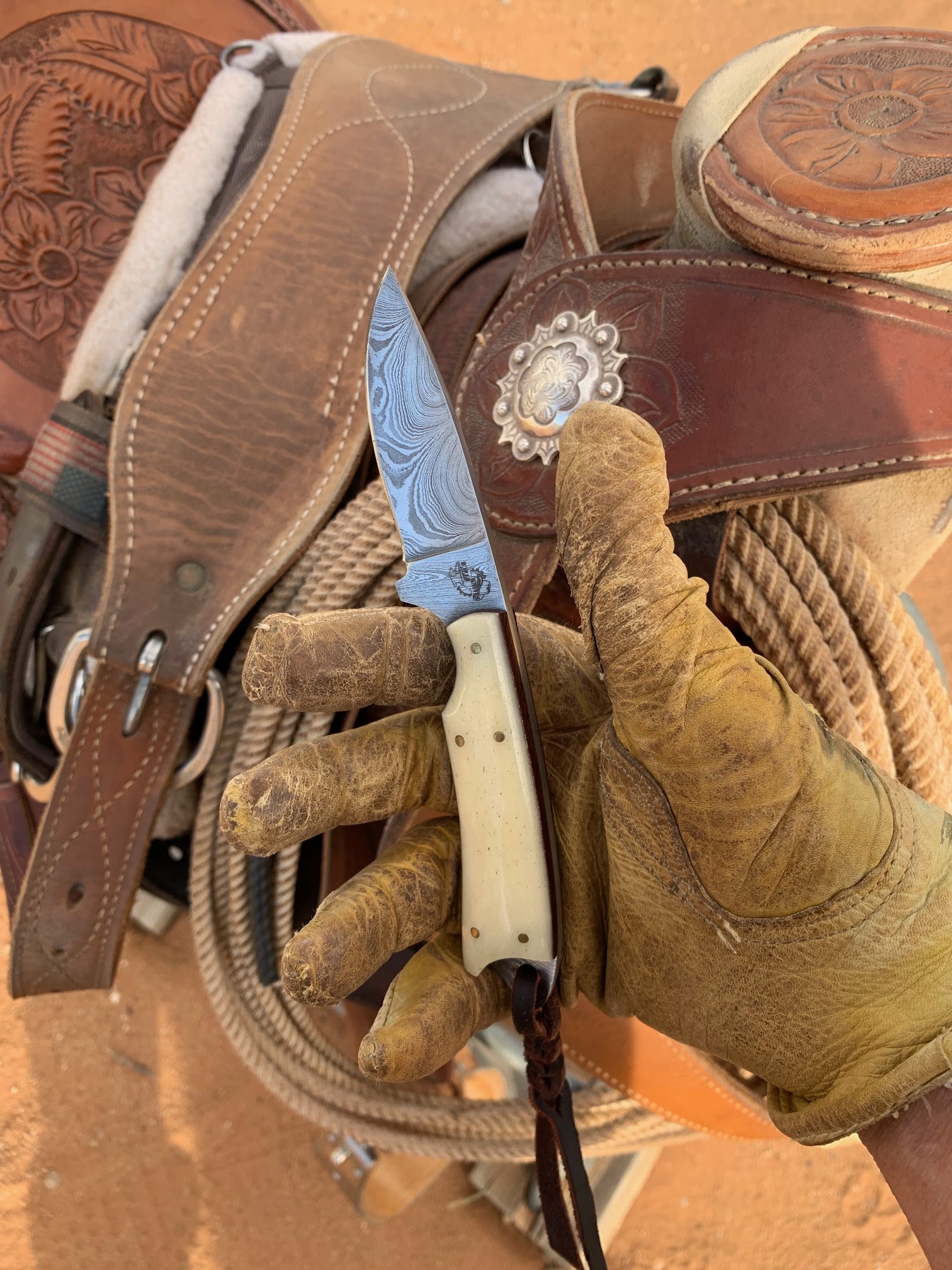
About 9 months ago I found a maker of short fixed blade knives at a reasonable price. They aren't custom knives but instead made on CNC machinery from Damascus blanks. They are fairly hard knives meaning they hold an edge pretty good. I bought two, gave one of them to an old Cowboy buddy, and kept one to use and try out. I think it's a good knife design, good material and at a really good price, so I bought a few more and started to offer them. The Cow Bone handled, 3 inch fixed blade with cross draw shealth, pictured below, is available here.


These Damascus knives are made from AISI 5160 steel, also known as 5160 spring steel, and AISI 4340 steel (UNS G43400). AISI 5160 high carbon steel has excellent toughness, ductility and fatigue resistance and is commonly used in industrial applications as well as in the automotive sector for many different heavy duty spring applications, especially for leaf springs. 5160 carbon steel is also used to make knives and swords. AISI 4340 steel is an ultra-high strength medium carbon low alloy steel, which combines deep hardenability, high ductility, toughness and strength, and has high fatigue resistance.


Since I started offering a version of a Cowboying knife, I have sent out nine and have received three reviews or comments on this knife, below. The Stabilized Indian Rosewood handled, 3 inch fixed blade with cross draw shealth, pictured at above, is available here.

Will B. wrote: "Nice knife and easy to carry. Like the cutout so I can hold the blade up and cut rope or twine." Note: The "cut out" he is referring to is commonly called the 'choil' which is a groove or cut out between the handle and where the knife blade begins intended for the user to establish a more secure grip and to protect the hand from sliding up onto the blade. You can see the choil next to my index finger on the photos above.  

R.G. wrote: "I almost bought a Moore Maker roughly the same size but 4 times as expensive until I bought the knife you sell, the one with brownish red handle. I really like it. I will buy another." Note: The handle he is referring to is the Stabilized Indian Rosewood handle.

Jimmy T. wrote: "The knife is very good, but I wish the sheath was just a bit narrower and made from harness leather (it will last longer). The angle is good and it is reversible so there is that. I have other knife sheath from a similar knife I lost and the knife fits okay into that. To answer your question on price, it's a good value for $60."


Sunday, March 12, 2023

How do you stop a horse from bucking when lunging?


Jerry M asked about how do you stop a horse from bucking when you are lunging him. "Hello, I am writing to see if you have any insight on my horse who almost always has to buck several times when I am lunging him. I lunge him at liberty to get him warmed up and to dimmish chances of him bucking with me in the saddle. A friend of mine told me that I can't let him get away with bucking because it'll carry over when I am riding him. If that's true, I don't see how I can stop him. It if matters, he is a 12 year gelding, I bought a few months ago when my trusted old horse passed away. Any help would be appreciated!"

There are some variables Jerry did not articulate such as how much this horse is being ridden, and if it's standing in a stall for days on end. I've seen 20 years old horses penned up for a few days and then taken to turn out just run, buck or kick out, what seems to me just for the fun of it or happiness to be free. I would also eliminate any potential problems such as being cinched up really tight, or a poor fitting saddle, or, anything else causing discomfort. When I free lunge a horse (what you call lunging at liberty), I don't worry too much about him bucking a few times, especially if he never does it with me in the saddle. Colts, especially when started, will often buck because of the unfamiliar weight on his back and the cinch around his barrel. For all we know horses may likely have this deeply ingrained instinct on something on their back similar to a Mountain Lion attacking. Anyway, colts will soon figure out it that it doesn't do them much good and they don't actually need to buck.

As far as stopping a lunging hose from bucking,...well, good luck with that. I don't think you need to try to stop it if he bucks one or twice then settles down. There is at least one widely recognized horsemanship clinician who says you can't let them buck, but I didn't see much success from him trying to shut it down. And besides a young horse bucking from that first saddling is frantic enough without someone chasing him around trying to get him turned or stopped from bucking. I think that is a colt bucks when lunging him after his first saddling, then settles down, he has learned that he doesn't have to panic and its a learning moment for them.

Interestingly enough, a handler not directly handling a horse can change a horse's behavior when they are doing something that you don't want them to do. I have a horse who started pawing the ground when tied to the trailer or hitching rail. After trying several things like pawing chains, I ended up changing that behavior by sitting in the shade, about 20 feet away, with a flag and whether he would lift a foot to paw I would flop that flag creating a noise that interrupted his beginning to paw. I must have flopped that flag 20 times or more the first day, and fewer times the second day. I don't know if he reconciled his pawing with a noise he didn't like, or I just changed his thought process just before he started to paw, but the resuts were the same, he stopped pawing.

I think turning his butt to you when changing direction, or kicking out at you are more egregious behavior, but I also think when I'm lunging him, it's his time to warm up and get relaxed. What I do when a horse turns butt first or kicks out, is first not to make it a federal offense, but instead change direction and make several fairy successive changes of direction. Sometimes on a horse turning his butt to you, you may have to get in his outside eye to get him to turn into you. A flag is handy for that.

Maybe one more thing. On yet a different horse, when I saddled him and warmed him up, he would be in a hurry and pretty tight for awhile. One day after I saddled him I just sat on my trailer step and petted on him for more than a few minutes saying (more for my benefit than his I reckoned at the time) and was talking to him saying "what's it going to take to get to calmed down sooner?" Anyway, then when I led him off and warmed him up he was a different horse right off the bat. This is a lesson I've learned several times (nobody has ever called me a quick learner) that giving the horse some peace and rubbing on him really pays off. But you can't fake it, you really have to have some feeling, some empathy for the horse. I hope I gave Jerry and maybe someone else something to think about.


Thursday, February 23, 2023

Giving Horses Paste Products


Over a given year there are many opportunities for a horse to receive paste products via the mouth, namely wormers (de-wormers), Bute (think horse aspirin) and paste pro-biotics. There are other less common paste products that some horses receive such such as products intended to calm the gut and reduce ulcers, and electrolytes. Usually wormers are pretty easy to get a syringe load into a horses mouth as the plunger is not hard to push and the same with the Pro-Bios brand of probiotics. Bute and Banamine paste on the other hand are usually hard and slow to push so this requires the handler to keep the nozzle end of the tube in the horses mouth for a longer period of time - basically this is where a handler needs 3 hands or a helper.

A Equine Supply Company gave me some big tubes of probiotics to evaluate that were supposed to have a much larger dose of probiotics per dose than the common Pro-Bios probiotic. Even after soaking these big tubes in hot water for 4-5 minutes I could not get a dose into a horses mouth as the plungers were just too hard to push in even using two hands. So I told the company that whoever formulated the paste and the syringe has likely never gave a horse a paste products, and that they may sell people a tube, but not likely a second one - so difficult the using end of the deal was.

Bute paste is much the same,....hard to use even with two hands on pushing a gram or two into a horse's mouth even with a helper holding the horse's head. Harder yet when the horse is uncooperative. Years ago when I ran a large public stables I woud have owners ask me to help them give their horse a dose of Bute. So I took to squeezing the dose, usually two grams, onto my index finger (the picture below is my finger with two grams of Bute), then use my middle finger into the corners of the horse's mouth in order to get the horse to open his mouth, then I would time it so when the horse opens his mouth I would slide my index finger with the Bute paste the corner of the mouth and wipe it off on the inside of the horses mouth. I have given Banamine paste this way as well.


Before I give paste products to a horse that is uncooperative, I'll put a rope halter on and hold the halter at the nose side knot to keep the horse from flinging his head my way. But before I try to give the horse the paste product, I'll rub on his forehead, get hm to soften his face, gently rub a circle around his eye getting him more relaxed.

Some medicine come in powders (antibiotics, muscle relaxers), Bute can come in a powder, and are often best given by mixing the dose with a little unsweetened applesauce then putting that mixture into a old wormer or probiotics tube that you have saved. I usually put a bit of straight applesause into the tube syringe first so that's the first thing the horse will taste as you trying to get a dose into his mouth.

Wormers such as Invermectin, Fendbendazole, etc., are like I said earier - pretty quick easy to. If you have a horse that is really difficult on taking wormer, it may be a good idea to give him a syringe of straight applesauce a few times and take your time as it pays off. My horses will cooperate with all paste products because I don't make it a battle.

I'm convinced that some owners don't worm their horses because they have made it difficult. I think wormers cn also have some positive side effects, as reserch the last couple of years articulate that Ivermectin also has anti-viral properties and Fendbendazole has anti-fungal properties. In the desert Southwest, Valley Fever which is a fungus found in the soil is present. Many of my dogs have been diangosed with fungus which the Vets tell me is hard to distinguish from cancer until a bioposy is done.

Anyway, the point of this article was to offer a tip on preparing horses for paste products - getting them soft in the face, and a technique that may work for you when giving hard to push paste products.


Monday, January 30, 2023

Horses feel both Physical and Mental Pressure


In the fall last year, I was giving horsemanship clinic where I asked the riders to do various things using pressure and release, working on their timing and trying to use as little pressure as necessary. One of the rider's asked if pressure was always physical in nature, if it was always a push or pull on the horse. The fact that the person asked that question,  showed me they knew the answer already. But great question and I said "no, I believe mental pressure affects the horse as well, but as riders or handlers, I think we have much more influence on physical pressure."

The first example I gave them was that years ago, I would stand at my horses' feeders and wait for them to back up before throwing their feed. In the beginning it took a bit for the horse to figure out that he was not getting fed just standing there. The horses accumulating mental pressure would seek to do something different, usually moving forward and I would back away from them a step or two. Evenually they would take a step back then I would throw feed then walk away. Then build on that. In short order during feeding times they would back up without delay then I would throw feed.

 
I stopped doing that a few years back as I became not very fond of the horse moving without an active cue from me. Now my horses approach the feeder and if they are too close, I asked them to back a step or two then throw feed. If as I throw feed a horse begins to approach the feeder, I don't make a federal offense out of it - I'll just pet on him then walk away. Sometimes after I throw feed, a horse will hestiate to move forward until I ask him to, which I do immediately anyway. This all occurrs in a few seconds and again I stopped doing what I did previously as I did not want a horse to move his feet without a cue from me.

During this same clinic there was a rider who problem was her horse would not stand still for anything more than a few seconds. She was using her reins, and her reins alone to stop her horse and when stopped she would reduce the pressure (meaning lessening the pull or tension on the reins) but was still applying some pressure to the horse's mouth via the bit. I had her very delibertly put her hands forward so the reins became slack. The horse would stand for a bit longer but move forward on her own. We loosened the headstall up so the bit wasn't creating wrinkles in the corner of the mouth, then asked the horse to stand still on loose reins. The horse would stand still for longer but eventually start to move forward. I believe this was mental pressure the horse developed from being pulled around by the bit and expecting it to happen.

I asked the rider to ride forward, stop the horse by sitting deep in her seat first followed by the tightening of her reins, then when her horse was stopped, give him a loose rein. Then repeat but be conscious of the horse preparing to move off on his own, and try to ask him to move forward before the mental pressure caused him to. Then build on that, and the time he will stand will increase.

Lastly, another example would be a horse that is in the 'pre-spook' phase preparation. We have all ridden horses that will stop on their own, heads up, ears forward, body tense and usually looking quickly left and right. Then the pressure builds,....may only be a few seconds....then the horse will turn and bolt. This is again mental pressure. Sometimes we can influence in a negative way by preapring for the horse to bolt and they can feel our tenseness.

There are many, many more examples. What I also suggest sometimes is getting the horse's attention in a postive manner, petting them, removing them from what seem's to be causing that mental pressure. I rode a horse back into my property and he saw or sensed something he did not like. This is a path we have taken many times and I couldn't figure out what was different and causing him concern. Before the mental pressure built up on him, I askd him to get soft, reached down and rubbed his neck. and did it afain a few seconds later. We stayed right there, until he relaxed then I asked him to move forard but stopped him before he stopped on his own and I repeated the process. Then soon we rode straight off once he became relaxed enough.

Often, I have seen horses spook either in hand or with a rider, and it's not always the right thing to move that horse with energy, like in a tight circle, as that may sometime increase the mental pressure he is under.  Sometimes a different method of releasing that pressure may work for the horse better.  


Monday, January 16, 2023

Casting about for Horsemanship knowledge


Every eight weeks I look forward to a visit from my horse shoer, as while he trims and shoes horses we discuss a lot on different topics from raising children, to the economy, to his problem clients and horses, and many others. I don't think we solved any of the world's problems, or even any of ours, but this past visit was particulary good as we discussed human nature where it seems many people, in whatever choesen field they are in, are only going through the motions and not seeking to master their craft. He talked about his early years as a horse shoer and how he had to actively seek experienced farriers out, often traveling a lot of miles to ride with them and learn. And sometimes despite the time and the costs in each trip he felt fortunante to learn one little thing that made a difference. We agreed that the whole process is recognizing and building on those moments of clarity and knowledge, but you can't get them without seeking them out as they seldom drop into your lap.

There are lots of different ways to learn. Perhaps the best is in person coaching, but most all discoveries are brought about by or started through verbiage - a person speaking to you. Maybe something a clinician will say that will mean something to you - turn a light on so to speak. Of course you have to be open and ready to receive that wisdom. And that moment of learning doesn't have to be brought about a top hand, as it could just as easily be from virtually anybody.

But on the top of my list is learning from watching someone who is really handy. This readily apparent in ground training as we can learn a lot from how someone really good with horses approaches communicating to a horse from his/her body position and cues, to timing and accuracy. Because of a string of days with bad weather, I was getting ansty about not riding so searching about I checked out one of the Martin Black virtual clinics. This one was a back and forth with Nick Dowers another accomplish horseman and competitor. Martin Black hosts these usually 2 hour sessions via signup on his website and link to a zoom call. You get a re-watch link and it's helpful to watch and listen at your own conveinence. I usually stop the video then start back up where I left off. And you can rewind to re-catch what was said. I recommend checking out Martin Black's site and virtual clinics.

This is how the last virtual clinic helped me......I have a new horse who was very green when I got him months ago. The story told to me was that this horse was intended to be a tied down roping horse but was undersized and the breeder was downsizing. I picked him up from Central Texas and brought him home. I started riding him right off and we went through the normal issues - bracy in the head and body being one of them. I don't know if him being started in a tie down had anything to do with it, but he was not the easiest horse to get soft. Anyway, I was not getting him to give me a soft feel with his poll equal to or just lower than his withers. Listening to Martin Black talk about competing in ranch horse events with his working horses and being docked in points for not having his horse's poll set low enough with the nose vertical, and his response (words to the effect) that he didn't care about the points and wasn't working his horses for competition, but for ranch work, and his horse's head would be positioned where the horse needed it in order to be balanced.

Well, the proverbial light went on in my head and I realized my issues with this new horse getting soft was that I was trying to get him to accept and perform a certain head set when what he was giving me was enough. I got caught up in this mental template I had about head set, and did not look at what the horse was giving me and how he was performing.


That right there, those 2 or 3 minutes worth of talk on virtual clinic, was worth a lot to me. I don't know if I would have self corrected myself, or just would have went on asking that horse for something he didn't need to give me. In figure 1 and 2 above, after I get vertical softness going, I ask for a soft feel at the walk, beginning for just a step and progressing to a point where he can keep it for a few strides, then build on that. You can see from Figure 1 and 2 that when I am asking him for a soft feel that his poll is not level, but just above a line with his withers - thats what I need to accept. In the Figures 3 and 4 (below) he'll turn around maintaining a soft feel and you can see the slack in the leading rein. I think the tail swish in Figure 4 was because my Antolian Shepard was was behind him. Or it was me offending him a bit. Anyway, my whole point is that widening the net and seeking knowledge from many sources helped me in a situation I should have knew better but it took someone saying something for me to get it. And now I'm cognizant of asking too much of him in other things as well.


Friday, December 30, 2022

Iconic Cowboy musician Ian Tyson passes


If you are a fan of Cowboy music then you know by now that Ian Tyson passed away yesterday. Born in September 193, Ian was 89 when he passed on 29 December 2022 on his ranch in Longview, Alberta Province, Canada. As my wife and I would may trips to horse events, more often than not one of his music CD's would be playing in the truck. His music and persona will live on as long as there is one Cowboy left. I am included my favorite song of his in the music video below....it would be nice if the news of his passing, sad as it is, prompted a resurgence of his music.

Wednesday, December 21, 2022

The Season for Giving - Supporting our own in need


I think everyone believes that Christmas is the season for giving. We can give in many ways - prayers, time, attention and of course, money. There are several people from our community, and I mean the community of the horse, that are in need. The latest tragedy happened to Josh & Anna Meyers of Meyers Silver, and their two young children.

The Art of the Cowgirl Facebook page posted the following yesterday:

Tragedy struck the Western Arts Community. There are multiple personal auctions going around to help this sweet family, and we plan on hosting our own in the upcoming days. Below is more information on how you can help the Meyer's in their time of need.

As many of you may have learned today, Josh & Anna Meyers of Meyers Silver need our help. This past Saturday, December 17th, their home in northern California burned to the ground- losing everything. Praise God the four of them are safe and thankfully have wonderful neighbors allowing them a warm house to stay in for the time being.

Now is the time for our ranching and artist/maker community to come together and do what we do best- help others. I have been talking with Anna and she has given me permission to share her Venmo and Paypal. If you are able to help this family and dear friends of mine this Christmas season through monetary donation, it would mean the world.

Venmo: Anna-Allen-2
Paypal: horsecountry66@mac.com

Additionally, while there is not yet a group formed to support the Meyers, there will undoubtably be Makers and Artists in the Art of the Cowgirl and extended family that will be making/selling their creations to raise money for the Meyers. Emily McCartney, the creator of the this Facebook message and owner of Road Runner Gallery will be listing an auction item in support

"My command is this: Love each other as I have loved you." John 15:12


The Art of the Cowgirl Event is held annually and this year from January 18-22, 2023, at Horseshoe Park & Equestrian Centre, Queen Creek, Arizona. 

Tammy Pate, the better half of Curt Pate, founded this event to showcase women in the horse and related industry. Or as they say "showcase through an annual gathering that celebrates cowgirls and their artistic contributions to western lifestyle. And raising the necessary funds to support emerging artists in expanding their knowledge and skills via fellowships with master artists in their field." The Art of the Cowgirl hosts a trade show, women's ranch rodeo, horsemanship clinics and demonstrations, roping and cow dog competition, music, art and horse sale.


Tuesday, December 13, 2022

National Day of the Horse


I hope everyone enjoys and reflects on the National Day of Horse. These wonderful creatures that God gave us have meant so much to so many over the centuries. Horses have taken us into battle; tilled fields for crops; pulled wagons and carts; and many, many other tasks.

On average horses haven't been treated that well by humans. But those of us who have horses in our lives move that ledger more in the horse's favor. Really, all they want from us is a fair life....they give us so much more in return. And to quote an old saying "If there aren't any horses in Heaven, I don't think I want to go."

Thursday, December 1, 2022

Cowboy Knives


I have often been asked where someone could obtain a sheath knife they see me carrying. And over the years I sent a few local people to my knife maker. Unfortunately, he passed away a couple years ago. Since then I have referred people to several other makers or sites who carry custom maker's knives.

However, recently I found a company who makes really nice Damascus knives of the style I like. I bought a couple of them earlier this year and have used them to cut hay twine, rope, boxes, plastic buckets and scrap salt blocks. They held up well, although I am not testing them like you see on the television program 'Forged in Fire' where they beat knifes in car hoods and cow skulls. I have yet to ever have to do that with a knife. But I did think highly of these knives to buy a couple more and put them on the prize table for the Arena Challenge I ran a couple months ago.

Recently I obtained several more of them and will offer them through this site. I have added a coule to the store. These are not custom made knives. They are production knives and that is why I can offer them at so affordable a price. Anyone who has any questions on these knives can contact me at: brad@functionalhorsemanship.com

Update:  These knives are now added to the store, click here to go to the store.

Each knife will cost $60.00 plus shipping 


Both knives are of the same design, but I have two options on the handle. These are of a full tang design with 7 inch fixed blade having a blade cutting length of 3 inches and a thickness of 1/8 inch. One has Cattle Bone scales (handle) with a fiber liner (see top photo). The other knife has stabilized Indian Rosewood scales with a fiber liner (see bottom photo).

Both come with 45 degree canted sheaths that are reversible for right hand or left hand draw. This design has a finger choil which is handy keeping it positioned in your hand even wearing gloves.  These knives sit low in the sheath like I like them and I braid a leather popper style tail for easier draw.