Showing posts with label Pressure and Release. Show all posts

Friday, April 10, 2026

Curly Zeke Part II, Getting Lateral Flexion


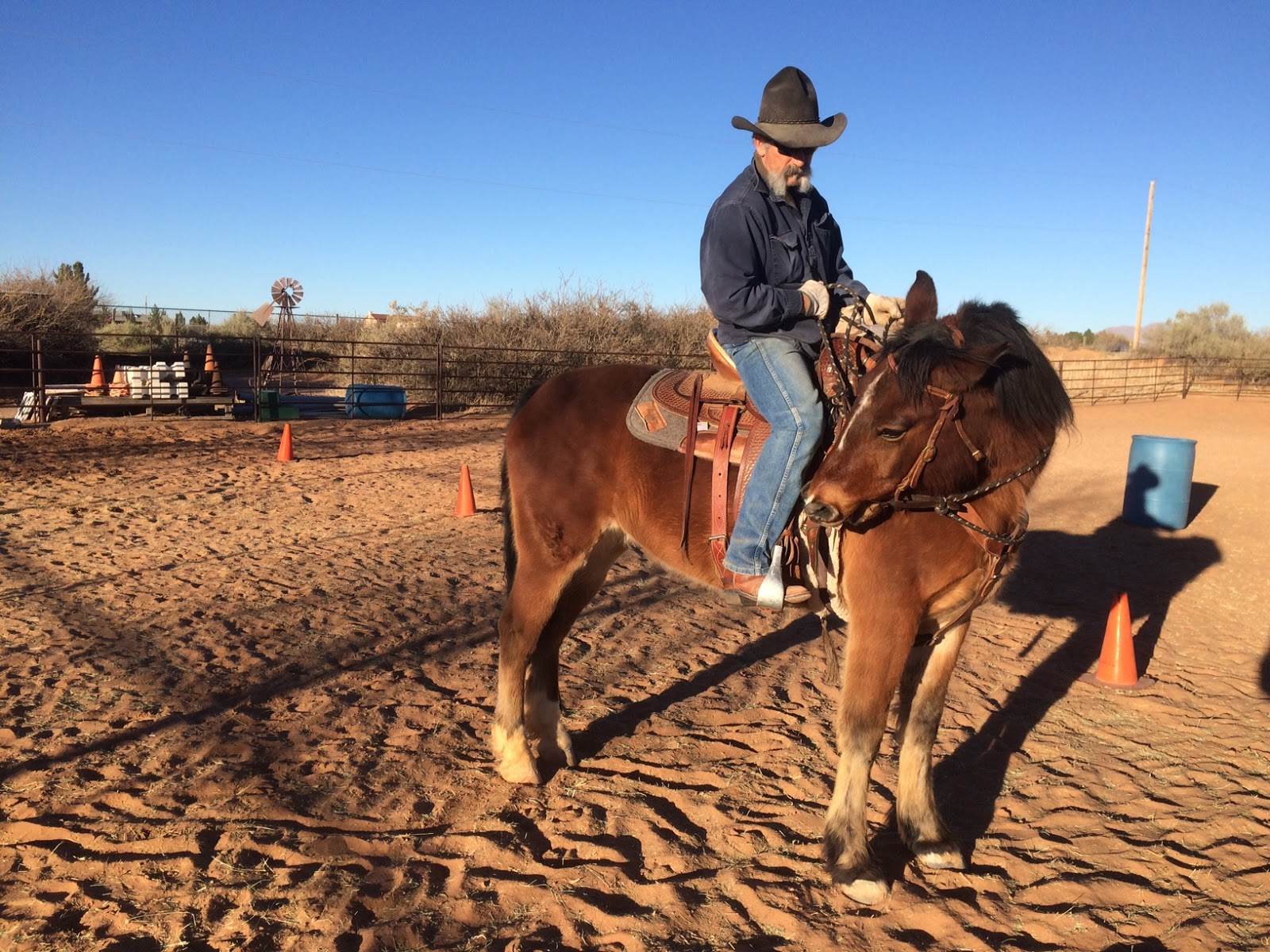
Continuing with starting Curly Zeke, I have been working on him understanding and following the feel on the lead rope or reins when I ask for lateral flexion. He definitely has a weak side giving to the left with a brace, and on both sides he is tipping his nose and keeping his head low so his ears are not level. Obviously we would all like and need lateral bend of the head and neck in a horse where he keeps his ears mostly level, especially during forward momentum if we want a balanced horse.

I'll work him in halter and lead asking for lateral flexion but not more than he is ready to give. I think there is a tendency to get a horse bending his head and neck round way past 90 degrees, in effect touching his nose to his shoulder or to the stirrup, and that is more lateral flexion than I need or can use. I may change my opinion on that down the road as the horse gets more handy and soft. One of my other horses, a 13 years old gelding, is very responsive and soft when I ask and always gives me more than 90 degrees. I do not intentionally ask him for that much flexion, he just gives it to me. But again, 90 degrees is more than I need to turn or position up a horse, especially starting to ride a green horse.

The videos below of working Curly Zeke in a round pen asking for lateral flexion for circles and 180 degree turns at the walk and trot are pretty much what I have to have going on with him before the first ride out of the round pen, as well as being able to untrack his back end. So the same with any horse, being able to direct him or turn him and untrack his hand end. The four videos go from on the ground with Zeke in a snaffle bit, from the saddle, then at a walk and trot.


I try not to just drill, drill, drill on lateral flexion. I'm hoping the videos and description of starting Zeke will give people a basis for comparison so if there is any frustration people can see the issues and progression of Zeke and we begin to work through them. While I'm putting a ride on Zeke, first in the round pen, then later outside, I'll also work on the beginnings of good stop, backing up (but just a couple steps), and, bringing a front foot out to the side as in the beginnings of a turn on the hind end. And lastly before I've done really any of the above, I've got Zeke responsive and soft at untracking his back end while I'm in the saddle. He's doing very well with moving his back end that we could move to asking for the untracking and expecting him to pivoting with a front foot instead of taking a step or two forward.


Monday, January 30, 2023

Horses feel both Physical and Mental Pressure


In the fall last year, I was giving horsemanship clinic where I asked the riders to do various things using pressure and release, working on their timing and trying to use as little pressure as necessary. One of the rider's asked if pressure was always physical in nature, if it was always a push or pull on the horse. The fact that the person asked that question,  showed me they knew the answer already. But great question and I said "no, I believe mental pressure affects the horse as well, but as riders or handlers, I think we have much more influence on physical pressure."

The first example I gave them was that years ago, I would stand at my horses' feeders and wait for them to back up before throwing their feed. In the beginning it took a bit for the horse to figure out that he was not getting fed just standing there. The horses accumulating mental pressure would seek to do something different, usually moving forward and I would back away from them a step or two. Evenually they would take a step back then I would throw feed then walk away. Then build on that. In short order during feeding times they would back up without delay then I would throw feed.

 
I stopped doing that a few years back as I became not very fond of the horse moving without an active cue from me. Now my horses approach the feeder and if they are too close, I asked them to back a step or two then throw feed. If as I throw feed a horse begins to approach the feeder, I don't make a federal offense out of it - I'll just pet on him then walk away. Sometimes after I throw feed, a horse will hestiate to move forward until I ask him to, which I do immediately anyway. This all occurrs in a few seconds and again I stopped doing what I did previously as I did not want a horse to move his feet without a cue from me.

During this same clinic there was a rider who problem was her horse would not stand still for anything more than a few seconds. She was using her reins, and her reins alone to stop her horse and when stopped she would reduce the pressure (meaning lessening the pull or tension on the reins) but was still applying some pressure to the horse's mouth via the bit. I had her very delibertly put her hands forward so the reins became slack. The horse would stand for a bit longer but move forward on her own. We loosened the headstall up so the bit wasn't creating wrinkles in the corner of the mouth, then asked the horse to stand still on loose reins. The horse would stand still for longer but eventually start to move forward. I believe this was mental pressure the horse developed from being pulled around by the bit and expecting it to happen.

I asked the rider to ride forward, stop the horse by sitting deep in her seat first followed by the tightening of her reins, then when her horse was stopped, give him a loose rein. Then repeat but be conscious of the horse preparing to move off on his own, and try to ask him to move forward before the mental pressure caused him to. Then build on that, and the time he will stand will increase.

Lastly, another example would be a horse that is in the 'pre-spook' phase preparation. We have all ridden horses that will stop on their own, heads up, ears forward, body tense and usually looking quickly left and right. Then the pressure builds,....may only be a few seconds....then the horse will turn and bolt. This is again mental pressure. Sometimes we can influence in a negative way by preapring for the horse to bolt and they can feel our tenseness.

There are many, many more examples. What I also suggest sometimes is getting the horse's attention in a postive manner, petting them, removing them from what seem's to be causing that mental pressure. I rode a horse back into my property and he saw or sensed something he did not like. This is a path we have taken many times and I couldn't figure out what was different and causing him concern. Before the mental pressure built up on him, I askd him to get soft, reached down and rubbed his neck. and did it afain a few seconds later. We stayed right there, until he relaxed then I asked him to move forard but stopped him before he stopped on his own and I repeated the process. Then soon we rode straight off once he became relaxed enough.

Often, I have seen horses spook either in hand or with a rider, and it's not always the right thing to move that horse with energy, like in a tight circle, as that may sometime increase the mental pressure he is under.  Sometimes a different method of releasing that pressure may work for the horse better.  


Monday, June 19, 2017

Lateral Flexion - How Much is Enough?


I gave a client a series of things to do with her horse as a warm up or pre-ride check, not only to check to see if her horse with her before she rides but to continue getting her horse softer and more responsive. One of the things was to ask her horse for lateral flexion. I showed her how to ask it for it during ground training while her horse is in a halter, and when that gets good it transfers to when in the saddle, however from horseback she'll have to ask for lateral flexion with the reins, whether she is riding in a bit or a hackamore.

After working with her horse she got back to me with some questions which are likely pretty common so I am including them in this article.

"Why does my horse do well (giving softer to the feel on the rein asking for lateral flexion) for a couple times, then start to be harder to pull around?"   While you want to get to the point that you can barely pickup the rein to get your horse to give laterally (or vertically when asking for that), sometimes in the beginning when you pickup the rein, if he doesn't bend, you will have to bump him (short tugs)  as a stronger suggestion to get him to give. As soon as he gives and is not pulling on the rein then release, but you need to hold until he does give - meaning no tension on the rein.

I like to wait a few seconds before asking again even if asking on the other side. This gives him time to absorb the lesson about giving and getting a release. If you rapidly ask and release, ask and release, ask and release, then there may as well be no release because that's likely the way he see's it.

"How far should I bend him (how much lateral flexion is enough?)"   I know some people want the horse to give all the way so his nose is touching your stirrup or leg. All horse's are different so there are some that this would be physically hard to do. I don't see the point in it anyway. I can't think of anything I do with my horse where I need this over extended flexion. If a horse gives you, say around 100-110 degrees each and every time you ask, then how much more do you need?  In the photo at right, my horse is giving me well over 90 degrees. I can use that much lateral flexion.  In the photo at the top right of this article, the horse is giving me somewhat less than 90 degrees - I need a little bit more than that. 

I know some people are going to write me and say horse's should be able to give all the way so their nose is touching their barrel.  Yep, I see horses bite their sides and do other feats of equine gymnastics all the time, but that doesn't mean I need for them to do that when I'm in the saddle. 

In the diagram below,  I tried to draw a horse display straightness and then lateral flexion - BTW I'm not artist and I know that surprises few people, but if we can't agree that the picture below looks like a horse from above, then we simply can't be friends - anyway in Figure 2 below, it's supposed to show the horse giving to around 90-100 degrees of lateral flexion. Figure 3 shows a horse gives much more than that, somewhere around 150-160 degrees lateral flexion and again, some people actually want their horse's to touch their nose to the rider's boot or the horse's shoulder. While I'll admit I don't ride high end performance horses, I can't see any point to asking for such lateral flexion.  Let me re-phrase that,......I see some trainers really cranking on a rein to get the horse to give laterally as much as physically possible.... I while I can see asking for as much as the horse can give, I just don't see the point in demanding it. 


Thursday, April 27, 2017

Obstacle Preparation Clinic


I did a demonstration for a Horseman's Association Expo a few weeks ago, talking and demonstrating how one may go about preparing a horse for an obstacle challenge. I posted a pre-event article on the basis for the demo and mini-clinic.  As I began, I said most of us have came to understand the process called desensitization and while some people don't like the word desensitization (I'm not sure I do after all these years) as it connotes dulling a horse, but I asked everyone to think of it as not taking something away from the horse, but instead giving the horse some time - just trying to put a pause in the fear reflex.

We go about desensitization through use of Pressure, Release and a pause in between before starting to apply pressure again. I went about explaining that the pressure we put on a horse is usually physical but it's always mental pressure as well. That's just fine because what we are trying to do is to get through to the horse on a mental level, to get him to think - again a pause, in between receiving a stimulus and acting out of pure instinct which is usually to be wary if not outright fearful and sometimes that results in spooking or bolting. And the timing in the release is critical to getting the horse to understand what he did in order to get the release, and a pause after the release of pressure is critical as well for the horse to understand that lesson.

One easy way to explain pressure, the release, the timing of that release, and a pause to get that settled in a horse is though getting a horse good about handling his head and dropping it on cue. On a halter broke horse it only takes a minute or two to see a big difference in the horse and that's something observers can understand pretty quick as well. This keeps their interest while I can get horseback and demonstrate asking a horse to drop his head - get his nose vertical. I ask for softness a couple times showing an accurate timing of the release then explain that if the release wasn't timed right the horse won't understand how he got that release.

Then I ask the viewers to watch what happens when I don't give a release. So I'll ask the horse for vertical flexion again and stay in contact with the horse's nose (or it can be the bit if you are using a bit - I was riding a hackamore). Most horse's not well acquainted with vertical flexion will root their nose out. If that happens I'll release contact and ask what the horse learned, and that of course was that he can root his nose out to escape the pressure. Then I ask the horse for vertical flexion again, staying in contact, and even if the horse gives at some level I don't give him a release and make him search for the answer.  Usually horse's will start to back out of the pressure.  I release then then ask again what the horse learned. Obviously the horse thinks that backing is the right answer - that's where he got the release.   One more time I'll ask the horse for vertical flexion as he tries to root his nose out then backing to escape the pressure.  I'll stay in contact, he will eventually stop backing and seeking the right answer will drop his nose to some degree - that's where I'll give the release.  I explained I'll give him 10 seconds or so to think about it and try it again a few times, each with a pause in between, and have the crowd watch closely as the horse rapidly gets better about getting soft when I ask him for it.  I think is a effective way to demonstrate pressure and release.    

I explained that it is common problem where people are handling horses to put pressure on a horse and when they get a different reaction then they want they'll release the pressure to get a better position or to choke up on a rope or reins, only to not realize that they have already began getting the horse to learn something wrong.

It's helpful to demonstrate lateral flexion as well in the same manner as vertical flexion.

Overall I spent about 90 minutes demonstrating how pressure, release and a pause may be used and I went into initial rope training a halter broke horse; introducing a slicker to a horse; getting a horse to accept something draped across his head blocking his vision (blindfold training); crossing a ground tarp' and dragging a nylon bag full of tin cans. I spent some time explaining that before you go about dragging things, the horse has to be good about the feel and friction of ropes across his butt, hocks and heels.

All along I thought that most of the people attending the Expo would have heard about Pressure and Release at some point, and have their own opinions on desensitization.  I thought that I would likely be just presenting a slightly different way to look at it and just maybe some methods they could use, but the amount and type of questions I received afterward as people came into the arena made  me think that the foundations of natural horsemanship still have a long way to go before they are common knowledge for average horse owners.

I left the crowd with asking them to never to punish or jerk on our horses for spooking or having fearful behavior - they are just doing what they think they need to, and that we all owe it to our horses to give them the time to necessary to accept things. In the long run it's going to make a better, more confident and safer horse.


Sunday, February 12, 2017

Can the Horse Train Itself to Trailer Load?


I received this question but am leaving the sender's name off: " Have you heard about backing a trailer up to a horse stall and feeding the horse in the trailer so that the horse has to go into the trailer if it wants to eat? A friend of mine did this and the horse is now comfortable at entering the trailer. I have been told this is a common technique so I was thinking about this safe and painless way to train a horse and would like to know if you have other applications for getting the horse to 'train herself', of course in a safe manner."

Not only I have heard about people, setting things up so a horse has to enter a trailer in order to eat and in effect teaching itself to trailer load, I have seen it several times. I had to shut it down one time when a boarder at a large public stables that I ran, about 15 years ago, tried that very thing and it went for two days without the horse loading itself and eating, so I had to intervene. While I did not see any evidence of it, I suspect other boarders were feeding that horse after hours.
 
I think if you just have to do this, then place the feed at the edge of the trailer and gradually place the feed deeper in the trailer so that the horse becomes more and more comfortable entering the trailer rather than an all of nothing approach, but I would still recommend getting your horse truly broke to lead.    

The concept of pressure and release used to build a relationship and train a horse are common place now, thanks to Tom and Bill Dorrance, Ray Hunt and all the guys and gals that are carrying on that legacy, hands like Buck Brannaman, Bryan Neubert, Martin Black, Craig Cameron, Chris Cox and many others. But pressure and release is much more than that, as it is how the pressure is applied and particularly the timing of the release is critical. That's were all the aforementioned names likely have the greatest value to us, in trying to teach us the nuances and timing of using pressure and release. I'm living proof that you can embrace these concepts and 20 years later still struggle.
 
I can see how backing a trailer up to a stall and offering feed if the horse steps into the trailer would appeal to people thinking that the horse controls his own stress and gets the reward of feed once it overcomes it's fear, or maybe more correctly, once it's hunger is greater than it's fear. But later on, when wanting to load and go someplace, how are you going to ask the horse to load? Just throw a flake of hay upfront and hope he goes for it? As far as trailer loading goes, I think a handler needs to be able to lead or send a horse into the trailer.  In the past, I have used butt ropes and even a crop to tap the horse's butt to get him to load, but it wasn't until I heard someone say words to the effect "that if your horse is truly broke to lead then you should be able to lead or send him into the trailer."    

I think the human needs to be a participant in most everything with the horse. I can think of just a few things, standing tied comes to mind, where I would set it up for the horse to explore and learn on itself, then walk away, but I would never be too far away,....the horse is not staying tied for 8 hours or so......in fact, standing tied would be something I would start with a small amount of time on and build on that gradually, about like anything else you do with horses.

I had a lady whose horse was scared of plastic bags that she was using on the end of a stick as a flag. The horse did not like the flag, so she tied a bunch of plastic bags all around a halter then turned the horse loose in a round pen (thankfully it was a round pen!). All I saw on the short video was about 15 seconds of the horse running full out around the pen and I was told that he did it for about 45 minutes. I think maybe the time was exaggerated - a horse running full out for that long,..well, it ain't good. I don't know any other method other than the pressure has to be controlled by the human in order to have an effective timing of the release so the horse has a chance to think and learn. After all you are wanting the horse to do something based on a cue from a human.

The idea of a horse being exposed to something (gradually) and getting used to it is valid and useful. But when applied to something that can adversely affect the horse's health and safety, like eating and gut movement, or the lack of it and subsequent increase in the chance of colic, kinda seems like throwing a 5 year old in the pond so he can teach himself to swim. There are usually some exceptions and I don't harbor any ill towards for my Pa for throwing me in the pond to learn to swim. The fact that he told me there were alligators in there likely shortened my learning curve to swim, but I wouldn't recommend the swim or die approach for horses.

Tuesday, March 3, 2015

Halter Broke


Justin wrote to ask "Thanks for writing the information and videos.  They help me fine.  What exactly is meant by a horse being halter broke.  I am looking on classified ads for horses and I see ads saying the horse for sale is halter broke."

One of the first things you notice Justin, is that the more people and horses you are around, the greater the differences you'll see in definitions. We all make fun how people use terms to describe their horses, especially if they are selling them. But the term "halter broke" certainly competes with them all for the widest description.   The bottom line and the best circumstance for an ad describing a horse as halter broke, is that it is a very green horse, it is not gentled to ride.

But your question brings up a good topic - what is halter broke?  While fueling up last year in late winter, I ran into a rancher I knew from my Range Rider days when I worked a gather in the grazing unit he leased from the BLM. He told me he had several horses who needed to be halter broke so when he brought cowboys in at springtime, they could ride and gentle them. Apparently the person who previous halter broke his horses had moved on. He said he pay me $100, $20 more than he paid the women, to halter break four horses, ranging from coming 2 to 4 years old, which pretty much told me his idea halter broke was pretty much just getting, and leaving, a halter on the horse.

While I had to think about it. I thought maybe I could show him a good way, and make it easier on the horses when some young men got ahold of them in a few months, but I had to say no.....I now wish I would have asked him what he expected from those horses once "halter broke", but I'm pretty sure his idea halter broke was pretty much just getting, and likely leaving, a halter on the horse.

If I would have taken up his offer, I would have planned to spend a couple days with these horses, getting them used to a halter going on and coming off, accepting a rope or a lead touching them all over especially on their backs, legs and hocks, and under their barrel.   Then progressing to leading.  I just can't associate being halter broke without being broke to lead.


One of the first things I do when the horse is accepting of the halter is to get it used to giving to pressure on the poll (behind the head).  The pictures at left are me applying a little downward pressure on the halter heel knot with my left hand and using my right hand to put a little downward pressure on the poll.  I'm not applying a lot of pressure, just giving a suggestion to the horse.  Once the horse gives me anything (dropping his head), I release that pressure and give him a moment or two to think about it. Then I'll try it again. 

Each time, if your release is exact and complete, the horse will give you more (drop his head more) and they'll be quicker about it too.  This is teaching him pressure and release which is going to be the basis for you continuing on to gentle him to lead in hand - that is leading him on the ground by a lead rope connected to his halter.

Progressing to actually leading starts with giving to pressure from the lead line,  I first start out asking a horse to give to off line pressure and giving me a step.  By off line I mean you are of to the side of their head,  then taking the slack out of the lead and having them give me a step.  When they are good with this pressure from the front and having them get soft and giving you a couple steps at a time is good progress.   If you can get all this down on a green horse, then I think you can move on to actually leading, but I wouldn't call it broke to lead until the horse can lead up properly without being pushy or invading your space.   He should stop when you stop and still be paying attention to you.  I think broke to lead would also include having a horse follow the lead so you can direct him past you which comes in handy loading in a trailer or going through a narrow gate.  

Just because I get a halter on a dead broke horse, I don't take him having basic manners nor believe that leading up right foremost in his mind. When I get a halter on a horse, I pretty much always get them to give to poll pressure, not lead off until I'm ready, disengage the front end then the back  Then I'll usually ask the horse to back.   I have the horse lead off a few steps then have them stop.  I pay attention to them giving me attention, and if they get distracted, I'll gently remind them to give me both eyes.

I have heard professional clinicians say that "if you can't load your horse in a trailer, then he ain't broke to lead".   I not going to argue with my betters, but I am sure there are horses functionally broke to lead well enough that still have problems loading, but you can't get to trailer loading until the horse is halter broke and that means broke to lead safely. 

Tuesday, May 7, 2013

Lonnie's Horse Won't Back Anymore


Lonnie wrote me about her horse who is getting worse on backing up. As she tells it "Hello, I often read your site and decided to write about my horse Yankee. He is an 5 year old gelding who I bought 3 years ago but only really started riding him again late last year. He and I are both still rusty, but he is safe to ride. He re-learned quickly but within the last couple of months he is getting slow or stubborn on backing up. Not only is he slow to backup but now stops after a steo or two and throws his head up.ccCould this be a phase where I need to go to a different bit?"

Hey Lonnie, before you try some different leverage in your horse's mouth, I would start over teaching him to back on the ground then in the saddle. It may be that when you are asking him to back you are not providing enough release so your horse gets confused with what you are asking then just stops - the head tossing is a sign of frustration. It is pretty common actually, not providing a clear release, the late timing of the release or a inadvertant release where you acidentally teach the horse that the wring thing is the right thing.  

I would try to use as little pressure as I could and release upon his try. Be unmistakable on the release.  Then ask for alittle more. Give him time to think between asking.

Your timing on the release is key here. Once a front foot leaves the ground moving to the rear, release the pressure you have on his mouth through the bit. Same with your legs, if you are using them to help move his feet, release the pressure as he starts to move back.

Your release can be subtle and still provide your horse a understanding that he is doing the right thing. Again, this is common.....not providing a release and confusing the horse. Another mistake is the timing of the release as when we do not provide a release, then the horse just plain stops, then we release - we are actually teahes him that he id the right thing by stopping and not continuing to back.

Let me know how it's working out for you and Yankee. Safe Journey.


Friday, January 18, 2013

Rope Halters Are Not Cruel


Rhonda from Pennsylvania wrote to ask about halters: "Hi. I used to ride quite a bit as a kid, now 30+ years later I find myself as a owner for a half Quarter Horse, Half Arab mare. I love her to death, but sometimes she is a little pushy. My friend's farrier told me to get rid of the halter I use and get a rope halter. After the farrier left, my friend told me not to get a rope halter as that is cruel to the horse. I don't know what to think now. Do you have any recommendations?"

I'm predisposed to use rope halters. It's just a personal preference. I think generally it's not the tool that is cruel or harsh to the horse, it is how it is used. Quick or forceful hands can make a lot of common horse handling tools harsh to the horse.

The rope halter because of the small diameter of rope making contact on the horse's nose and poll (think the bridle path behind his ears) puts more pressure than a wider web halter would, so that is probably why your friend thinks a rope halter is cruel. Again, if you use it correctly I don't believe it is cruel.

The idea is still Pressure and Release. If your horse pulls away while under a halter he is going to be putting pressure on himself via his poll, and depending on his head set, maybe the nose. Once he stops pulling that pressure is released. Same as teaching your horse to give to pressure.

I'm sure you understand that it's hard to train a horse if you can't get him to move his feet. So imagine ground training with a halter where you maintain pressure via the lead line on the halter. As the horse moves in the direction of the pressure, you release that pressure and he starts to understand how he gets his release. While I think the rope halter provides a more clearer signal, there are thousands of exceptional horsemen and women who use web halters.

There are some innovative halters out there. One is a web halter that uses an elastic material for the webbing over the poll. I think the idea here is that when when a horse pulls away the pressure is gradual and once the horse quits pulling, and figures out his release, then that release is instant - a lot more quicker than a handler can provide. This is a pretty smart idea but I'll stick to the rope halter and judicious use. This elastic type web halter is from Paul Ortuno of Mane Horsemanship. This is not an endorsement, as I don't own one of these elastic halters. I just list it for your information. Again, I'll stick with quality rope halters from Double Diamond or Craig Cameron.

http://manhorsemanship.wordpress.com

Tuesday, July 31, 2012

How Much Pressure?


Judy R wrote and asked a very good question: "When I am asking my horse to do something using pressure often she ignores me then until I guess the pressures builds and she blows up. An example if trying to teach her to side pass. I'll try to push her over with my leg as I have been taught using the ask, ask then demand with more pressure and tapping her with my leg and boot (I don't wear spurs). I do have to hold her to keep her from moving forward. With other things like trailer loading where sometimes I need to tap on her back legs with a lunge stick to get her to move forward she does fine without freaking out. I'm trying to figure it out but getting totally frustrated. Any insight?"

I know that frustration Judy. With your side pass example it's hard to answer that without watching you and your mare. I would go back to ground work and get your mare to move her front end and back end over independently of each other, and for her to do it well and when asked without a big deal, before you ask her to start side passing. It may also help to incorporate a reason for your side pass like moving to or away from a gate or fence.

When in the saddle, and asking for a side pass, make sure you don't keep your inside leg (leg that is in the direction of the movement) on her which would make her feel blocked in and want to move forward. It helps to tip and hold her head slightly outside as you use your outside leg to ask her to move over. You could also be leaning in one direction which normally makes the horse move in the opposite direction,.....even then there are some horses who may want to move to square up or move into the weight. The ground work first should help.  And make sure your timing is good, so when you get a try from her, you immediately release the pressure.

Your bigger question seems to be "how much pressure is too much"? I am not from the school of making your horse doing something, because forcing her to do something when is extremely anxious is counter productive.

 I think that any pressure that creates more anxiety in general and certainly more anxiety without any positive changes in your horse, are too much. You know your horses better than anyone, so I suggest being a good student to learn when that anxiety is too much which would make acceptance and learning difficult or impossible,....then back off before you get there.  Make sure you reward her slightest try, again with an immediate release of pressure and give her a pause, as pauses will help her relax and that’s a place where they learn. Then build on that. Hope to hear back from you on what you learn is working for you. Safe Journey. 


Thursday, February 23, 2012

Pausing to Learn


Aaron wrote,....you told me words to the effect to put time between each obstacle so the horse can calm down, can you say it again and why?

Aaron, I can't remember exactly what I said but I'm sure it was in the context of this: lets say you take a horse up to an obstacle, not letting him back up or away, but cue him forward and push him over an obstacle. You may not really be achieving much especially when you immediately take him away onto another obstacle that causes anxiety or frightens him. I think you run the risk of over stimulating the horse. He may just be learning that he was justified having that anxiety.

Instead try taking him up to an obstacle, don’t let him give to his anxiety but don't increase it either by pushing him closer until he is ready. When he is ready, he'll look ready,.....body will feel less tense, head will drop, eye's will blink, ears will go from straight forward to moving around. If you talk to him an ear will turn back to you and he’ll look away interested in other things,....you’ll see and feel it. Then you can move him forward and repeat,...pretty soon he’ll be touching the obstacles with his nose and relaxing. Now here’s an important part – give him time to absorb that lesson, the lesson on learning to think rather than just reacting. Give the horse a break and he will learn. This is pressure release just a different kind of it.

After all I think the idea is not to get him over or through the obstacle just for the sake of completing an obstacle, because if he does it scared he won’t be learning much from it, nor will he be better for it. In fact, he may be worse for it. Instead, I'd be looking to allow the horse to learn that he can think through a scary situation and not have to just relax.

To give you an example of what not to do, years ago I was riding a horse back from the round pen, just after the Sun went down. On the way back to the barn, I detoured to a large water puddle thinking I’d get my horse to walk through it. Well, he didn’t. I was in a hurry and I made several mistakes: 1 – trying to teach a horse anything without having the time to see it through, and 2 – trying to push him ahead through that water puddle before he was ready to move forward. That puddle could have looked like a hole to China to him for all I knew. I didn’t give him any chance to get used to the idea. All I did was increase his anxiety and prove to him he needed to be scared. I just pushed him forward until he jumped the puddle. Even though nobody was watching I embarrassed myself and more importantly took some of that trust away between me and him.

I should have not attempted to cross that large water puddle unless I hard to time to work on it. I should have made it his idea to move forward, to and through the puddle, and given him the time to do so. Lastly if I would have done that, I should have paused to let his mind slow down and absorb that obstacle, then do it a few more times to build his comfort level and make him a more confident, braver horse. Kinda of a long answer Aaron, but hope it works for you.

Wednesday, June 2, 2010

Horse Training – Patience, Pressure and Release


A couple nights ago a friend, we’ll call him Ben, called me just madder than a wet hen about not being able to get one of his horses into the trailer to take him to an overnight stay to get shod the next morning.

Ben spent about an hour trying to get the horse into the trailer without success. He tried a long whip, tapping on his hocks and rear end; he tried a butt rope – all efforts did not work. He put the horse back into the stall and called me.

I made the 35 mile drive and got to his place about 30 minutes before sunset.

I told Ben, don’t start nothing with a horse unless you have time to finish it. For all your yelling and pressuring him, he might be thinking you are teaching him that the trailer is a dangerous place to go.

Another issue is that every time you put him in the trailer, you take him some place that is not comfortable for him and make him work. He’s no dummy, he’s figured it out. Every time you loss your patience with him, you are causing him to have anxiety and therefore justifying his fear of whatever it is you are trying to make him do.

I told Ben this is what I’m going to do: do alittle bit of ground work to get the horse listening to me and establishing that I’m the herd boss right now; only ask him to do things that he will be able to do in short order; use pressure and release where he gets a release from pressure when he even tries to do what I ask him to do. And above all use patience,…be firm,….but be patient.

This horse is a big Throughbred, about 16.3 hands tall, and is a decent trail horse but has not received a lot of ground training. I ask the horse to walk off, stop then back, doing that several times. You could tell by the horse’s demeanor that he’s doesn’t get ask to do this much. I asked him to disengage his front end, stepping one foot over the other and within a minute or so, he was doing this well. I then asked him to do the same to the back end, telling Ben all the time that the horse is learning that when he does what I am asking him to, he gets release from the pressure – he learns on the release. Horses may learn something from punishment, but it is much better off for the horse and rider to teach with patience and learn from release.

I told Ben these easy ground exercises are good to get the horse listening and focused on you. I also told Ben he needs to handle his horses for 5 to 10 minutes every night, when he isn’t riding them, to re-enforce these lessons. If you have to feed your horse, then you have enough time to handle them for a few minutes if you don’t have the time for a full blown training session.

Anyway, after getting the horse to move his front end and his hind end over. I ask the horse to travel in a tight circle at a jog while on the lead line. When the horse would slow to a walk I would pressure him to go back to a jog. I did this in both directions a couple of times, for about 3 or 4 minutes, then walked the horse into the trailer.

I told Ben to put him in the trailer every night for a month so that each and every time he gets in the trailer he’s not getting taken some place and made to work.

I left Ben with a final word – don’t lose your temper, be patient and give the horse a fair deal with the release of pressure.

I don’t know how many times I have had people asking me to get their horse in a trailer, usually only after these people were unsuccessful for hours if not days. A bad habit is harder to change than to teach a good habit starting out, but there is the ingredient patience – can’t get there from here without it