Showing posts with label Rope Halters. Show all posts

Tuesday, January 27, 2015

Rope Halters


Jennifer wrote in with a question on rope halters - "Great site! Can you address your thoughts on rope halters with the extra knots on the nose? You mentioned chains as being a no-no, but I thought I'd ask about this particular alteration of the rope halter. I have a clinician-style stiff halter with the knots as well as the floppy rope kind. The knots definitely offer more bite, but just because it 'works' doesn't mean it's ideal. I just don't want to hurt her. Thanks!"

Hey Jennifer, I appreciate that you are considering your horse and searching for information so you can make your own decision on rope halters. Rope halters have a bad name with some people, and granted the smaller diameter of the rope adds more pressure to the horse's nose and poll than a conventional web halter when the horse pulls against it, but as far as being painful, the handler would have to intentionally jerk hard on the lead rope. And as for cruel,...well that's a choice of the handler and if he's doing it with it rope halter, he likely also be doing it with the bit and spurs.


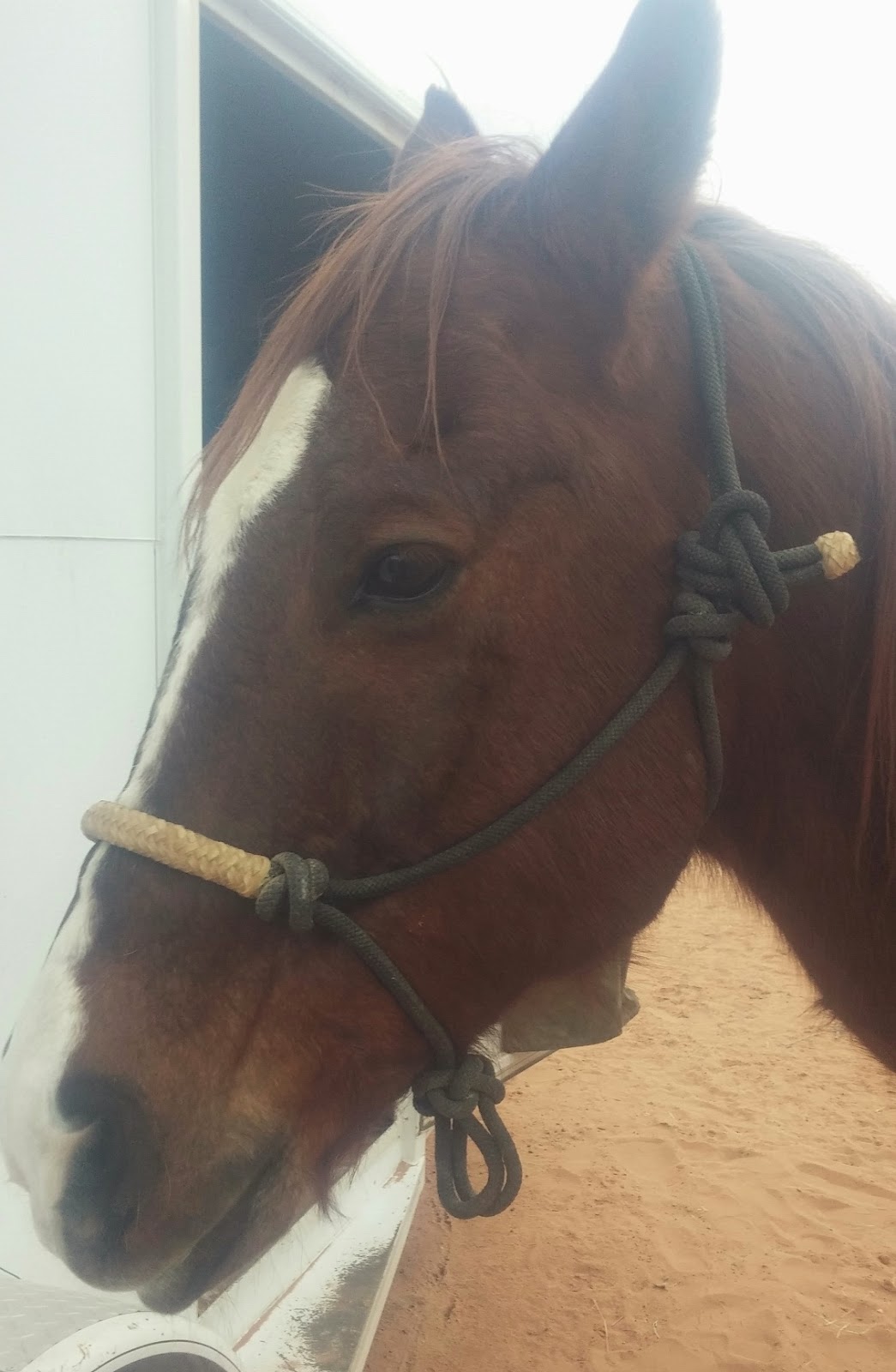
I use 5/16th inch (8mm) polypropylene rope halters.    Like the one on Junior in the picture above - he's sticking his tongue out cause he saw me with a camera.  Most of mine are from Double Diamond Halters but a few are from Craig Cameron. Same type of quality. I don't have nose buttons (knots) on my halters,..no particular reason, but I haven't seen a need to go out and get a halter with nose buttons. Besides I would think that the pressure of the rope halter on the horse's poll (on the top of his neck behind his ears) is sufficient enough to make nose buttons redundant. Just my opinion. There are probably people who think highly of rope halters with nose knots and maybe I just haven't yet met the horse who can benefit from knots on the nose band of the halter.

On a small scale I make one piece roping reins, mecate reins, lead lines and lunge lines but I don't make rope halters simply because I can't make them to the quality or the fair price that Double Diamond makes them. You can get rope halters in many different sizes: 1/8th inch (4mm) diameter, 1/4th inch (6mm), 5/16th inch (8mm), 3/8th inch (9.5mm) and 7/16 inch (11mm). The smaller diameter halters are mostly used underneath headstalls so you can tie your horse up or dismount and lead your horse with a lead rope to the halter as opposed to leading from the reins.

While I almost exclusively use 5/16 inch polypropylene rope halters with a tied on 14 foot lead line (no snaps or hardware at all), I do have a rope halter with a rawhide nose band - see picture at right.   I've only use it a couple of times.  The rawhide is harder than the rope so it provides more pressure,  more of a bite on the nose. Again, while it's all in hands of the handler, the rawhide can dry out and become prety rough on the nose, whether it's a rawhide nose band or just a couple of rawhide buttons where halter nose band knots would be. So I suggest that if you use a halter with rawhide nose band or knots then to periodically check it for roughness or sharp edges. I use raw hide cream to keep them conditioned.

If I could only have one piece of equipment, I would choose a rope halter with a lead line over anything else, including a saddle, because I could use it for ground training and could ride in it.    

Good luck to you and safe journey.


Friday, January 18, 2013

Rope Halters Are Not Cruel


Rhonda from Pennsylvania wrote to ask about halters: "Hi. I used to ride quite a bit as a kid, now 30+ years later I find myself as a owner for a half Quarter Horse, Half Arab mare. I love her to death, but sometimes she is a little pushy. My friend's farrier told me to get rid of the halter I use and get a rope halter. After the farrier left, my friend told me not to get a rope halter as that is cruel to the horse. I don't know what to think now. Do you have any recommendations?"

I'm predisposed to use rope halters. It's just a personal preference. I think generally it's not the tool that is cruel or harsh to the horse, it is how it is used. Quick or forceful hands can make a lot of common horse handling tools harsh to the horse.

The rope halter because of the small diameter of rope making contact on the horse's nose and poll (think the bridle path behind his ears) puts more pressure than a wider web halter would, so that is probably why your friend thinks a rope halter is cruel. Again, if you use it correctly I don't believe it is cruel.

The idea is still Pressure and Release. If your horse pulls away while under a halter he is going to be putting pressure on himself via his poll, and depending on his head set, maybe the nose. Once he stops pulling that pressure is released. Same as teaching your horse to give to pressure.

I'm sure you understand that it's hard to train a horse if you can't get him to move his feet. So imagine ground training with a halter where you maintain pressure via the lead line on the halter. As the horse moves in the direction of the pressure, you release that pressure and he starts to understand how he gets his release. While I think the rope halter provides a more clearer signal, there are thousands of exceptional horsemen and women who use web halters.

There are some innovative halters out there. One is a web halter that uses an elastic material for the webbing over the poll. I think the idea here is that when when a horse pulls away the pressure is gradual and once the horse quits pulling, and figures out his release, then that release is instant - a lot more quicker than a handler can provide. This is a pretty smart idea but I'll stick to the rope halter and judicious use. This elastic type web halter is from Paul Ortuno of Mane Horsemanship. This is not an endorsement, as I don't own one of these elastic halters. I just list it for your information. Again, I'll stick with quality rope halters from Double Diamond or Craig Cameron.

http://manhorsemanship.wordpress.com

Monday, October 24, 2011

More on Rope Halters


I received a comment from Miguel: "Oh, wow. Exactly what I need to know today. Just got my colt back [in his mind, he is still] and I now have two broken brass clips on the standard leads. He also slipped out of the flat nylon halter. He doesn't get out of the rope halter, more concentrated pressure on the poll? Have also read that you can get more control on the nose if you tie a couple of buttons there. Was hoping you would show us how to build the halter itself. I also like the rope halter because I know I can cut it in a hurry if there's a storm. Which we had during the first saddling. He went clear down, eyes back, stiff legged. But he lived through it and he's a much better horse now. Glad to be alive. Can you show us how to build the halter? I have done it twice, but still confused when I think about it."

Miguel, thanks for that comment. I have never had such a rank horse where a rope halter wasn't sufficient. I would be careful about having too much pressure or impact from a knot or button on the nose band as it could slip down and injure the cartilage of the nose.

I know I have seen halters with knots on the side of the nose band where that danger would be lessened. In fact, I think Clinton Anderson markets one.  In the picture above, I have braided rawhide over the nose band of a rope halter that I use that lunging a green broke or less than broke horse for the first time. And I used it on my Mustang who was fond of coming off the ground and pawing at me with his hooves. I seldom use it anymore, but it certainly has more bite than a rope halter. I don't think I would put anything hard, like buttons, on the nose band of a rope halter. How harsh you are with any equipment has a lot of do with it. 

I have never built a rope halter from a length of rope. It's much easier for me just to buy a professional halter, Double Diamond makes excellent rope halters.  Craig Cameron offers excellent rope halters also.  

I always carry about a 12 foot length of 3/8 inch cotton rope, with one eyelet braided into it, for use as a get down or lead rope when I need one when out in the desert or back country. I always have a lariat rope with me as well, and I can use that as an field expedient halter as well.   So I really don't have a need to be able to tie a rope halter.  Sorry partner, not only I cannot construct a rope halter, I don't think I'll even try. I can see myself all tied up in knots yelling for my wife to come and cut me free. Knowing her, she would take pictures of me before she cut me free.

I have seen Craig Cameron tie a halter from scratch on RFD Television. He has a Knot video out, called "What Knot to Do". I have not seen the video but have been meaning to buy one, so I don't know if he covers constructing a rope halter in this DVD, but I think it's worth a chance.

Here's a link to his Knot DVD.


Sunday, July 31, 2011

Tying a Rope Halter


The other day I stopped into a neighbor's place to take a look at a cut on his horse's leg. He had his horse tied to post with a rope halter. I was glad to see him using a rope halter as I had introduced him to that several years ago, but I noticed that he had it tied wrong. I thought others may do the same so here is something to consider about tying a rope halter, which is a great tool.  I use Double Diamond Rope Halters and tied on lead ropes, rather than a lead rope with a metal snap.   


I like to tie the end of the rope halter as it comes over the bridle path to the loop on the throat latch end by half hitching it through the loop and not tying the throat latch back onto itself. I know this is confusing so here are some pictures showing the beginning and end of the correct knot for a rope halter. The photo at bottom right shows the knot that will be complete once it is clinched up a little.


Although the knot in the photo (right) is intentionally loose so you can see how it is tied, if you tie the end of the rope halter, that goes over the bridle path, back onto itself it can tighten into a hard knot if the horse pulls back.  This in my opinion is the wrong way to tie a rope halter.  


Tuesday, May 3, 2011

Remedies for a Horse that Pulls Back


I received this reader question from Amanda via e-mail....."Hi - Would appreciate suggestions for 12 yr old gelding that will not tie. It is not a fear issue and he does not paw or dig. He might stay tied 10 minutes, or an hour, but when he decides he wants to leave, he just leans back and breaks the tie and walks away. He will walk right up to me and allow himself to be caught. Previous owner tried using a Blocker Tie Ring and worked on the problem for 2 months, then sold him to me. Other than this he is a *great* horse and does not have any other issues. Thanks."

Amanda, your 12 year old Gelding knows he can pull back and break the halter or tie at will. He has to learn that he can't break it to stop this problem. I don't know if you are using a rope halter, but a good rope halter and lead line is harder to break than a conventional lead line with a snap. Additionally, the rope halter, due to it's smaller diameter strap over his poll adds more pressure there on the poll when the horse pulls back. If he pulls back, he'll get pressure in his poll - when he stops pulling back he'll learn to get a release.

In the old days we'd take a horse and tie them up tight to a snubbing post with his head higher than normal so he can't round the back, set his read end and get more leverage,..... and keep him there for hours. I don't condone this as there are better ways for a horse to learn to stand tied, and fairer ways at that.

In the video,....I know I ramble on,.... but I show the ring devices with the same principle as a Blocker tie ring so a horse can't pull back and break anything. However, you can't tie a horse and walk away with this rigging as he will pull the lead rope out of the ring,....or he will pull enough lead line through then get his front legs tangled up in the lead rope slack.

So we are back to a rope halter which I think you should try. I use nothing but Double Diamond as they are quality halters. I make my own lead lines and generally use 12 to 15 foot lengths as I use them for short lunge sessions or to sack the horse out of ropes around his feet....just a more usable length for me.


Hope this helps and safe journey.

Saturday, February 6, 2010

Halters and Safely Haltering a Horse


Horse people are pretty particular about their equipment and the most basic of horse equipment is a halter. Halters are generally of two types, webbing halters with metal or brass hardware using a buckle to secure the halter on the horse and rope halters which are tied to secure it. I like minimal hardware so I exclusively use rope halters.

I also use tied in lead lines,…. that is lead line without a snap. Snaps usually have a spring loaded mechanism that eventually gets caked full of sand plus springs can lose their strength. When using a lead line with a snap, that snap becomes the weakest part of the halter and lead.

I have seen people put halters on standing directly in front of the horse. It’s only a matter of time before that horse’s head comes up and gives you some free dental work if it doesn’t knock you out. Instead approach from the side holding the halter under the neck, reach over the horse’s neck and bring the long line of the halter over the horse’s neck across his poll (behind the ears), then slip the nose band of the halter over his nose, snug it up and tie the halter. When you tie the rope halter, use a half hitch and ensure the end of the halter long line is facing to the rear – towards the horse’s butt,….that way the horse can’t move his head quickly and end up poking himself in the eye.

You can see a demonstration in the video below.