Showing posts with label Ground Training. Show all posts

Sunday, June 16, 2024

The Power of Petting Horses


I recently had a discussion with a lady who asked me if I thought petting and rubbing horse would create a pushy, spoiled horse. She told me people at her barn warned her about that would give her horse bad manners. Over the years I come to believe that men, for the most part, are really much more likely not to be as hands on petting and rubbing horses as women are. Men make not have that type of contact with a horse foremost in their mind, or may think that's it's not very manly or such. I don't. In fact, I get a lot of ribbing like "you sure do like petting and rubbing your horses." But as far as petting and rubbing on your horses, I believe it's much in how you do it. It's like riding with spurs. If you use spurs judiciously and softly, they can help you and the horse, but used wrong, just to gouge or punish the horse, then you and your methods are going to be detrimental. Same as petting on your horse - do it in a manner that encourages pushiness is not good and getting the horse's head where it can smack you could be dangerous.

There is a secret, really several, on petting and rubbing horses,  but it basically come down to, yes it can help calm and horse, and 2 - no amount of petting will replace getting a horse to understand what you are asking, or what most people would say, training a horse. Two weeks ago, I brought home a 2 year old gelding from a horse auction. As you can imagine, he was very nervous being trailered to a new home absent of the other 2 year old geldings who had been his paddock mates for his young lifetime. Once I got him in his new pen and before I took the halter off, I rubbed on his nose and cheeks until his demeanor changed just a bit and I got his head to soften. It was just replacing his anxiety with some comfort, just changing his perspective for a bit.  And his first inkling that I was there to take care of him and he can trust me.  

Another time I was in the arena judging an event when a man rode his horse in to make his run. This horse, being in place without the support of the other horses, became very scared and would not continue move forward. After a few minutes, which probably seemed like an hour to the rider, the rider said he was going to dismount and lead the horse out. I asked the rider to wait a minute, then I approached the horse and petted on him stroking his nose then putting a hand on his poll and hand on his nose and getting him to soften a bit. After a short time, I told the rider, when I walk away he may follow, and if so, just give him his head and let him follow me. So I walked away and that horse followed me from one obstacle to another. I think I changed his thinking from being troubled with being by himself without his buddies to liking what I had to offer him and wanting to buddy up with me. It did not change his perspective on being by himself from here on out, it just was one small step in the process of letting him accept new things.

Like the 2 year old gelding I just brought home and the horse I described above, this is one of the first things I'll do with a horse to introduce softness in their head and neck. It's hard to do when they are scared and focused on the new environment or situation, but it can help get a change in the horse. But between rubbing and petting on their nose, around the eye socket and poll, I'll stop with one hand on their nose and the other on their poll and put just a bit of pressure until they drop their head. I always have a hand in position to block and discourage movement that is pushy or could be dangerous.


In the beginning, I'm just looking for the head to come down a bit. It may come down slowly and they may be bracy at first, but in just a few times that improves much. And like I said, in between the asking for softness, I do the rubbing and petting. Again, this is where you can encourage or preempt pushiness. A horse will likely turn his head towards you and you need to be prepared to block that. You want your hands and forearms in a position where you can block that. So one or both hands and forearms are always between your face and the horse. This is especially true if your horse likes to put his lips on you, nibble or even bite you. And I told MH that while it feels good to us to pet and rub on a horse, our enjoyment can't be the primary purpose.....it has to be good for the horse and used to relax the horse and change his thinking to create a window for learning. You can feel that change when the tension or rigidness goes out of them....that's the time to get out of there, before they get bracy.

I remember a very well known and universally respected horse trainer who said never rub or pet on your horse while they are feeding. I disagreed then and now, with the caveat that it's how you go about doing it. While a green or new horse is relaxed and feeding, I'll use that time to touch and rub him to see if he has any trouble areas. Sometimes a horse will pull his head up, turn and look at me, but they rapidly go back to their feed. By the time I pull that horse to do ground work or saddle him, he has already been touched about everywhere.

The often repeated saying. “There’s something about the outside of a horse that is good for the inside of a man”, which has been attributed to various sources, including Winston Churchill and Ronald Reagan, to me isn't necessarily limited to riding a horse. The feeling we get, and especially the joy that people new to horses get, is just good for our souls. When riding back from open country and crossing a road to see a vehicle stop and people watch me, I never hesitate to ride over to them and have a chat which almost always results in the people getting out to pet my horse. One of my favorite stories was when I saw a car stopped and rode up to find a lady, probably in her late 30's, with her elderly mother to had Alzheimer's in the front seat. She said she was just driving her mother around to change her routine and decided to drive into the country. Her mother was wheel chair bound so she couldn't get her out of the car on the shoulder of the highway, so I asked her to roll down her window. I rode around to the passenger side and had my horse stick his nose into the car. I'll always remember the look of joy of that elderly women's face as she raised a hand an touched my horse's nose.

So yes, petting and rubbing on horse's is good for us and it can be good for the horse. Make it so.


Friday, May 31, 2024

A Horsemanship Epiphany on Patience


Webster's Dictionary gives the following definitions of an 'epiphany': "a usually sudden manifestation or perception of the essential nature or meaning of something"; " an intuitive grasp of reality through something (such as an event) usually simple and striking"; "an illuminating discovery, realization, or disclosure"; and, "a revealing scene or moment".

Having the practice trying to set up a situation where a horse can gain an understand of what you are asking of them, I recently came a roundabout way of getting an new understanding myself of this. One morning when reading a daily devotional sent out by a friend of mine about not asking God to give you patience, but rather ask Him for a chance to practice patience.

I recently brought in a highly bred, two year old gelding. Still nursing a back injury I thought I could begin some progress on my new horse, barn name 'Zeke", so hours later when I was in a pen with him, I had him on a lead rope and was trying to get him to follow a feel. I really like this little sorrel horse. He's small at 14.2 hands and will likely top out at 14.3, but his chest is decently wider and he has good bone structure and feet.  He has a good, curious mind and I look forward to many years and miles with him, but it all starts at the beginning. And like always, I hope and try to do right by him.   

I first try to get a horse to come to me on a lead rope with gradually increasing pressure then moving to use a little bumping on the lead until the horse's body weight shifts forward. I give the horse a pause to absorb what he did to get the release of a taunt lead line, then ask again and build on that so then he moves a foot, then again a release. Then all four feet, and again another release - always with pause. Then before you know it, the horse will follow that feel to me. Once I have that going for us, I work on backing a couple steps. Using the fiador knot of the halter I apply a bit of backwards and side to side pressure until his body weight shifts. Then same as moving forward, I work for a foot to break loose, then a couple feet. Eventually, the side to side and backwards pressure just becomes a wiggle of the lead, first when standing by his side, then standing in front of him. So that description on beginning to follow the feel of the lead rope was necessary to get on with the story.

So the two year old was not getting the idea of coming forward. He was not getting troubled, jut not understanding. Sometime when this happens and I'll change my position relative to his head slightly. I take a step right or left and end up at the 11 o'clock or 1 o'clock position relative to the horse. Anyway, he was not sorting it out. I could have used a flag to create some energy so he would move forward, but I wanted him to concentrate on the feel of the lead rope and react to that as opposed to reacting from a flag at his flanks or behind him just scaring him forward. And then I remember the message of that morning - 'don't ask for patience,...ask for an opportunity to practice it".


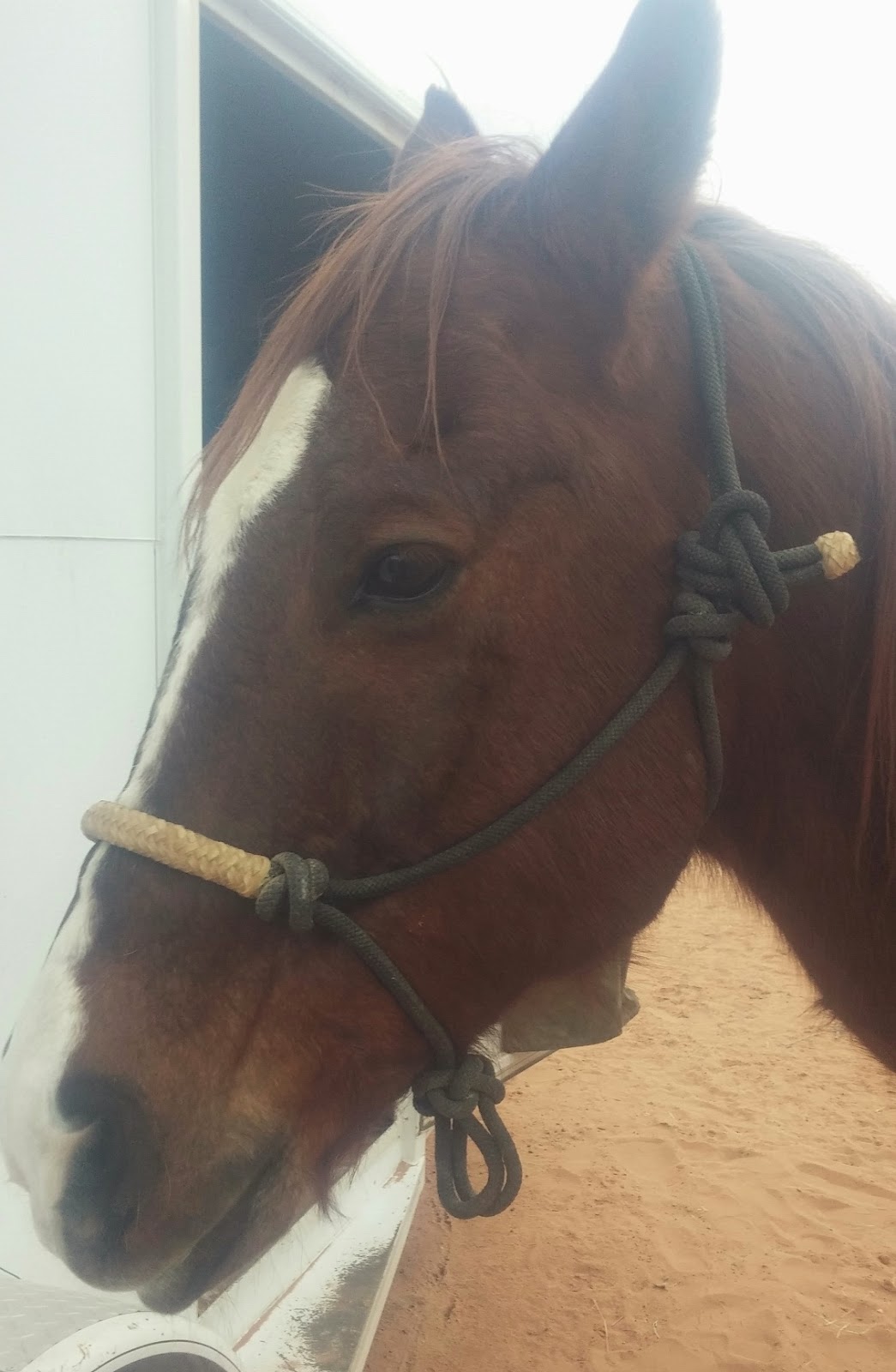
So I thought it's as much for me to sort out as for him. So every time I would ask him to move forward and he started to step sideways, I would make a noise and he would stop and look at me as I continued asking him to follow the feel of the lead. Then we would begin again. He got it. Look at the change of his expression above before he takes steps forward. So my opportunity in patience was realizing that each time he failed to understand was actually necessary to his understanding. I have heard some people call this failing forward, meaning you have to have failures before you get success. Anyway, works for me. We were both better off for it. So next time I ask for something, it'll be the opportunity and not the result.


Thursday, January 30, 2020

Comments on the Functional Tie Ring and Horses Pulling Back


I receive e-mails when comments are posted on any videos I upload. Rather than answer each individual comment on YouTube, I'm choosing to use this website to answer many of the comments concerning using my Functional Tie Ring (FTR).

About 20 years ago I ran a large public barn, next to a military airbase with lots of activity including dogs, children, vehicles, hay deliveries, horse shoers,....you get the idea.  That's where in helping people with their horses I encountered many horses who pulled back, a lot due to unpredictable or controllable activity.  There was even a horse who flipped over on the shoeing stand when hard tied to cross ties.  So I started using a tie ring that became the FTR with these horses.  With many people wanting it, I started offering it commercially.  Even then, I made people aware that the FTR isn't designed to replace ground work or train your horse to stand. Your horse has to have learned how to give to pressure.

In a perfect world, the FTR is a solution to what is essentially a non-existent problem......for most horses,..........if sufficient ground work is done. Even then, the most bomb proof horse really isn't.  The whole idea is to give the horse the tools and experience to make that spook as benign as it can be.  However, most people can't or won't devout the time to establish solid ground training. A horse needs to know where "neutral" is on the lead rope - no feel on the lead at all and he learns that by accepting the changing feel of the lead to be able to move forward and back up. If you extend the ground training, which is really just a logically place to take it, a changing feel of the lead rope can further connect to the horse's feet and you can move his front end over in each direction and even draw his back feet to you. But before I would tie a horse, that horse has to be able to give to pressure.

The comments below were concerning a video where I tied a horse using a Functional Tie Ring and used a flag as a stimulus to spook him so he would pull back. The lead rope I was using starts to feed through the FTR at 15 lbs of pressure (pulling back), even then I didn't like doing this, and only did it once - no rehearsals or retakes, because basically that red roan horse in the video is never used, never tied and he is just living out his days with us after having been left by the owner.  He gets handled every day, but not ridden, although years ago I checked him out for the owner and ended up sacking him out to flag, among other things and riding him.

Anyway, Here are some of the comments, both good and bad, and my response:

"I can't get past him even THINKING of doing this without knowing how his horse handles a flag"
I pretty much knew how the horse would react to a flag, but more importantly how I presented it. That's why I used it, and used it only once in this case. Clinton Anderson demonstrates this often (with the Aussie Tie Ring), flagging a horse so the horse spooks and backs away. However, he carries this through many repetitions, each time with the horse reacting less and less.

"What I got from this video is someone teaching his horse to back up while tied. Not something I would want to teach my horse just so a video could be taken."
Teaching that horse to back up while tied, however not hard tied but tied with the FTR, that provides a controlled friction release, was what I was seeking. When a horse is spooked, his head come ups to gain elevation for observation to see the threat - it's akin to our startle reflex. If he is tied and the halter strap behind the poll becomes taunt (putting pressure on his poll) he will panic and pull back harder. With a tie ring, depending upon the diameter of the tie ring and the lead rope used, a horse spooking or backing away will get a greatly reduced presure on his poll. See my response to the comment below where I explain where and how the horse's find the release.


"The cowboy has his timing off. I agree with many others. You stay where you are and keep waving the flag (stimulus) until the horse relaxes.He is releasing the stimulus too soon. "
Actually, the comment about my timing is correct, however my intent was spook the horse into backing so the viewer could watch the relationship between the lead rope and halter and the point of suspension in the horse's feet. While some horses will back in a walk, a spooking horse will generally back at a trot which is a 2 beat footfalls on his diagonals. Momentarily, in between those feet hitting the ground and the next ones pushing off, there is a moment of suspension of the feet and reduced pressure to the horse's poll from the halter. When the horse back's and slows a bit, that reduced pressure is accentuated.


When I say that a horse should to give to pressure during ground training, he learns this by the handler getting into contact with the lead rope - in other words, the lead rope is taunt - then the horse leans into the lead rope reducing the pressure of the halter on his poll, and you build on this on. When I back one of my horses up from the ground using the feel of the lead rope, when that lead rope goes taunt the horse steps forward one step alleviating that pressure. That is giving to pressure.  In the beginning, once you get in contact with the lead rope, the horse will resist.  His head will go up. There is where people lose their temper and jerk on the lead rope, just making things worse.  If you start with very light contact and when the horse drops his head or nose then give him a release, you are teaching him that when he gives to pressure, he gets the release.  Your timing has got to accurate and you build on this.    

"very dangerous method I Will never use that EVER."
I hope the only people who use the FTR, or any tie ring for that matter, do their ground work and get the horse giving to pressure first. On a green horse once the lead goes taunt and the horse feels the pressure on the poll, the horse's head goes up increasing that pressure if the lead remains taunt. In an extreme case, some people leading a horse into a trailer will try to hold a horse when he trys to back out. Well, not even the Hulk can hold a lead line and keep a horse from backing away, and once that horse pulls the leads from your hands, his head jerks up and can hit the trailer roof. Some people even put those padded hats on horse's to keep them from hitting their head, when they should just get their horse's more soft and giving, and, broke to lead.

Anybody who has been around horses for a minute has observed, or maybe even did it themselves - as I have did - to my shame - a handler pulling and jerking a lead rope, which causes the horse's to learn to expect something bad when he feels pressure on the poll and then panic. Now, if my horses feel pressure on their poll they will drop their head a bit, or they will lean into the pressure (just a shift in their body weight) both relieving the poll pressure.  If those horse's were still alive, I'd formally apologize to them for ever jerking on the lead.  

I have had three local clients that told me the same thing: that "they would never use a tie ring'. That stayed true until their horse's spooked while being tied solid at events, one of them being hurt so he couldn't be ridden for a year. They all started using the tie ring. One of them bought seven of them. I have a client that competes at AQHA shows and every time I see her, she thanks me that the FTR she bought years ago. I was just on the phone with yet another client, who called and ordered his third FTR.

"Get a rope the same as you have there; put a Honda in one end; put the lasso around his girth; tie him up to a solid post or rail; give him a good tap on the nose; then watch him grunt when he tightens the rope right up around his girth (just make sure that the rope can readily loosen The pressure comes off); Do that a few times and that’ll stop his farting in church!"
I have had someone tell them they used a method similiar to what is described. I would not be comfortable doing something like that. The whole thing would end up with me being drug across the open desert.  I'd be digging cactus spines and goat heads out of my back and butt for weeks.  

"EXCELLENT teaching tool - gonna get a double ring asap"
I have had only one FTR returned. A lady bought one for her husband. He said "I don't need it." She sent it back and I refunded her plus the cost of shipping it back to me.

"Thank you for this video. I have several horses but one mare that sits back. The "sitting back" is a serious and dangerous problem. I use the blocker tie ring for saddling but need something more secure for trailer tying. I will be ordering one. Thanks again! "
I have been using the FTR to tie horses to the outside trailer D ring and inside the trailer when hauling. One of the questions I get about using the FTR is that - "if someone uses it for a long period of time, will their horses be un-learned or unable to be hard tied?" No, not in my experience. I reckon that one of my horses has been tied using the FTR for 6 or 7 years, pretty much exclusively, just because it easy to use. When I hard tied him for over 3 hours in a pen with a bunch of recently branded calves, he stayed tied, did not pull back despite all the commotion. I wasn't watching him the whole time, as we had bulls to haul to the next pasture, but I imagine he pulled back a little, a time or two, then step forward to relieve the pressure - after all that's what ground work and the FTR taught him. On another horse that I hard tied...he bent his head down to search the ground and when he brought his head up, the lead rope snagged on something. Feeling the pressure on his poll, he pulled up hard, but then dropped his head to reduce the pressure and waited for me to unhook the lead rope.

"I've got a horse no one on earth can fix. When tied, his eyes get three times normal size, and he shoots back like a Howitzer shell going off. Everything a horse can muster in a thousandth of a second. BAM!!! surprised he hasn't broken his own neck. it is not defiance or he doesn't want to work, it is sheer Terror that he is feeling. he thinks he's going to die horribly Untie him and all the fear of evaporates that moment and it's like nothing ever happened. it just shuts off like a light. I've had him four years and I tack him up just holding the lead rope. He's fine that way. I've tried at length to cure him but nothing will work. "
Had a couple horses like that. If I was to try to help your horse, I would use a halter and lead and while standing in front of him but off line a bit about 10 feet away, I would quietly and slowly take in the slack of the lead rope until it is taunt but not pulling on him. He may pull back. I'd begin again. I'd be looking for a change, however small, and at one point he would shift his weight forward and I would put slack into the lead rope and give him a pause to think about it. I'd start all over again.  At some point once you take in the slack of the lead rope the horse's head won't go up or the movement will be reduced. That progress is real evident.

The horses I worked with all got better. This does much more for a horse than just getting him giving to pressure.  As you continue a common issue will be the horse starting to buddy up (move to you) before you ask. Then you need to start working on him backing of a feel of the lead rope. On one difficult horse I was working with, rather than throw his head up and try to escape, he lunged forward and knocked me aside - good thing I was not standing directly in front of him, but off to the side a bit. I got him turned as he went past me. Then I started again. He was more of a difficult horse than normal, but in maybe 20 minutes he was giving to the lead, coming forward on and backing off a feel of the lead rope.


"You gonna get somebody hurt. All your doing is teaching him to be scared of your flag."
I used the flag in a manner to get a desired reaction. All my other horses would not give me a reaction of backing away like the little red roan.  Regarding flags, another common question I get is  - "I see you using a flag but how does the horse know when you want him to move his feet or stand still?" When I use a flag, I am either directing a horses feet to move or asking him to stand and accept the flag for which the movement and noise is scary in the beginning. The difference is the feel of the lead rope, your demeanor and body position relative to the horse. If the lead rope is in neutral (slack in the lead) I am asking the horse to stand. If the horse is moving when I want him to stand, I would maintain the movement of the flag until you get a change from the horse - that is standing, even momentarily, and build on that until he stands and accepts the flag. If you put a feel in the lead rope directing him forward or obliquely, the flag helps drive the horse in the direction.

For the record, I don't want anyone buying a Functional Tie Ring unless they have a need for it; are competent enough to use it; have a plan to use it; and, do the required ground work that every horse needs - most of the horses that receive good ground training won't need an FTR or other tie ring.
Safe Journey to everyone.    

Thursday, January 10, 2019

Backing and Drawing a Horse from the Ground


Why might you want or need to back a horse from the ground? By this I mean the handler standing still and moving the horse back using a voice command or a feel of the rein. Why would you need to be able to drop the reins and have your horse stand still while you walked away a bit? And why might you need to draw or bring the horse towards you using a voice command or a feel of the reins?

In the annual arena competition I have hosted for the past four years, this year I had a task where the rider had to dismount, step into a 2x2 foot box and ask his horse to back. Riders could use their reins, get down rope, the lead end of a mecate or even just a voice command to get their horse to back but they had to stay in the box. Then the rider had to drop the reins or get down rope and walk around a barrel maybe 20 feet away, demonstrating the horse's ability to ground tie (even if it is momentarily), then walk back to the box, pick up the rein and draw their horse to them. The riders had the option of tying the reins up after they dismount and solely use voice commands if they wanted.

There were 42 entries in this competition and I believe only 3, maybe 4 riders/horses could do all three - backing the horse; horse ground tying and not moving off; and drawing the horse back to you. No offense to the competitors, but a few of these tries were not pretty. Horse's flying backwards with head's high and pushing with their front end; horse not ground tying even for a moment; and even a few horse's not wanting to come back to their rider having the reins jerked to get them to back up. I didn't see alot of jerking on the reins but even once is too much and I'm going to address that in a different article.

The reason for not doing these things well is that some riders don't have a use for their horses to do this. While I consider it an extension of being broke to lead and necessary for my horses to stand still as you dismount and move forward, move to you on command or through the change in feel of a rein, and back up on command or through the change in feel of a rein when you have a loop on a calf and have to dismount to reposition the loop needing slack on the rope then having it re-tightened.

Backing a horse on the ground comes in handy when leading a horse to a gate and it opens towards you so you have to back the horse up. Or when you are throwing feed and the horse wants to hang his head over the feeder. Or when you are on the ground and checking someone else's saddle or bridle and don't want your horse pushing you into the other horse.....and there are dozens of other situations.

Having a horse ground tie is very handy when you are changing bridles or have to dismount to do something like check on a float valve. It is just a natural follow on from having your horse lead up well. In the video below I brought out a horse towards the end of a session with some riders that we were filming and one asked me if I could show her how I get my horse to back, ground tie and come to me on command. Getting a horse to back away from you on a lead line, or rein, is the easier part. Having them stand still - stay ground tied, and drawing them towards you on the change of feel on the lead/rein is just a bit more difficult. Young horses will want to come to you before you ask them. Don't make it federal offense if they come before being asked, just back them up and ask them to stand again. When drawing the horse towards you, try to see just how little pressure or difference in feel of that lead or rein it will take to get that horse to come to you. As with everything, reward the horse's beginning of that effort - don't give the horse a pause between your asking so he can absorb the lesson.


Sunday, February 12, 2017

Can the Horse Train Itself to Trailer Load?


I received this question but am leaving the sender's name off: " Have you heard about backing a trailer up to a horse stall and feeding the horse in the trailer so that the horse has to go into the trailer if it wants to eat? A friend of mine did this and the horse is now comfortable at entering the trailer. I have been told this is a common technique so I was thinking about this safe and painless way to train a horse and would like to know if you have other applications for getting the horse to 'train herself', of course in a safe manner."

Not only I have heard about people, setting things up so a horse has to enter a trailer in order to eat and in effect teaching itself to trailer load, I have seen it several times. I had to shut it down one time when a boarder at a large public stables that I ran, about 15 years ago, tried that very thing and it went for two days without the horse loading itself and eating, so I had to intervene. While I did not see any evidence of it, I suspect other boarders were feeding that horse after hours.
 
I think if you just have to do this, then place the feed at the edge of the trailer and gradually place the feed deeper in the trailer so that the horse becomes more and more comfortable entering the trailer rather than an all of nothing approach, but I would still recommend getting your horse truly broke to lead.    

The concept of pressure and release used to build a relationship and train a horse are common place now, thanks to Tom and Bill Dorrance, Ray Hunt and all the guys and gals that are carrying on that legacy, hands like Buck Brannaman, Bryan Neubert, Martin Black, Craig Cameron, Chris Cox and many others. But pressure and release is much more than that, as it is how the pressure is applied and particularly the timing of the release is critical. That's were all the aforementioned names likely have the greatest value to us, in trying to teach us the nuances and timing of using pressure and release. I'm living proof that you can embrace these concepts and 20 years later still struggle.
 
I can see how backing a trailer up to a stall and offering feed if the horse steps into the trailer would appeal to people thinking that the horse controls his own stress and gets the reward of feed once it overcomes it's fear, or maybe more correctly, once it's hunger is greater than it's fear. But later on, when wanting to load and go someplace, how are you going to ask the horse to load? Just throw a flake of hay upfront and hope he goes for it? As far as trailer loading goes, I think a handler needs to be able to lead or send a horse into the trailer.  In the past, I have used butt ropes and even a crop to tap the horse's butt to get him to load, but it wasn't until I heard someone say words to the effect "that if your horse is truly broke to lead then you should be able to lead or send him into the trailer."    

I think the human needs to be a participant in most everything with the horse. I can think of just a few things, standing tied comes to mind, where I would set it up for the horse to explore and learn on itself, then walk away, but I would never be too far away,....the horse is not staying tied for 8 hours or so......in fact, standing tied would be something I would start with a small amount of time on and build on that gradually, about like anything else you do with horses.

I had a lady whose horse was scared of plastic bags that she was using on the end of a stick as a flag. The horse did not like the flag, so she tied a bunch of plastic bags all around a halter then turned the horse loose in a round pen (thankfully it was a round pen!). All I saw on the short video was about 15 seconds of the horse running full out around the pen and I was told that he did it for about 45 minutes. I think maybe the time was exaggerated - a horse running full out for that long,..well, it ain't good. I don't know any other method other than the pressure has to be controlled by the human in order to have an effective timing of the release so the horse has a chance to think and learn. After all you are wanting the horse to do something based on a cue from a human.

The idea of a horse being exposed to something (gradually) and getting used to it is valid and useful. But when applied to something that can adversely affect the horse's health and safety, like eating and gut movement, or the lack of it and subsequent increase in the chance of colic, kinda seems like throwing a 5 year old in the pond so he can teach himself to swim. There are usually some exceptions and I don't harbor any ill towards for my Pa for throwing me in the pond to learn to swim. The fact that he told me there were alligators in there likely shortened my learning curve to swim, but I wouldn't recommend the swim or die approach for horses.

Saturday, January 28, 2017

Taking the Buck Out of a Horse


There is an old saying that working a fresh horse or a horse who has a tendency to buck in the round pen or on a lunge line won't take the buck out of him. There's a large amount of truth in this as if a horse wants to buck, he will. Besides why would someone intentionally get a horse who bucks until they get alot of that nonsense out of him. Melanie wrote in with the question: "I ride my horse mostly on weekends so by the time I take him out of his stall he has a bunch of pentup energy from being in his stall. I've been advised to round pen him to take the energy out of him but not only just this seem not to work very well, it takes away from my riding time. What else can I try to do? "

Melanie did not say how her horse demonstrates excess energy. It doesn't sound like her horse bucks or runs off with her, so I suspect that she needs her horse to look to her more as the leader. And warming him up before you rides can serve both - bleeding of some energy and getting him focused on you.   Sure, penning up young horse, or really any horse, for days on end is likely to make him want to go someplace.  And depending upon what you are feeding him - that could contribute a little bit as well.  But it's all going to come back to Melanie making herself the senior partner in this relationship.

Working a horse in a round pen before you ride him can help take the freshness out of him but it is really what you do and how you do it that will make the difference. Before you get him into the round pen, you can do things with him in a halter and lead to get him listening and looking to you. If he crowds you when you get in the stall, move him off; make him drop his head so you can get the halter on; if he gets distracted, bump him back to focus on you; you may want to go 15-20 seconds of lateral flexion while on the ground, before you move off; gets his front and back ends to disengage independently; as you lead him off see how little feel or change of weight in the lead line it takes to get him to move his feet; make him lead up correctly; stop him, back him again on as little pressure as it takes, but a much as you need.

All of this is reminding him that you are the leader. You can think of these things as pre-ride checks. I do them all of the time, every time. It also helps me gauge where the horse's mind is - they have bad days too you know.

The purpose of working a high energy horse in a round pen or on a lunge line before you ride him is not only to bleed off some of that energy, but more importantly to get the horse responding to you, seeing you as the leader. You do that by moving his feet, not by just letting him move around at whatever speed and direction he wants. This is important. As I help riders correct things like a horse drifting of as they mount or really most bad habits you can think of, I have them move the horse's feet. Almost everytime in the beginning, it's like the rider is just meekly asking the horse to move...... you need to think of it as insisting that they move their feet.

Rider's who previously kind of passively handled their horses will see an immediate change in their horses as they start insisting on things. Sometimes you may get an initial dose of resentment, but they are just trying to figure out if you really mean it and if they have to do it. Same as in a corral with other horses. You'll see ears pinned, teeth showing, necks stretched out and one of the horses will move.

Almost everytime I ride, I'll warm a horse up. In the round pen free lunging, or on a lunge line or using the lead line of my mecate reins. This serves to warm the horse up and let me look for any elements of discomfort and lameness, and also gets that horse looking to me for direction. I change direction often; I'll bump them on the lead if they distracted with something else; I have them stop and roll the back end back over (disengage the backend); I'll have them face me up and back up on vibration or slight shaking of the lead line; and, I will have them change speeds. And in everything, I try to work on as subtle as a signal as I can. Start as soft as you can, but use as much pressure as you need to, otherwise that horse is going to learn, and you can't blame him, that he doesn't have to comply or just comply with the least amount of effort. Kinda like your children when you get them to police up wind blown trash along a fence line.      

Lastly, if your horse is high energy under saddle, then re-direct that energy doing something. Make him move his feet. Back him with energy. Do circles. Double him against a fence. I think if you try all of the above you'll see a big difference, but understand being penned up for days on end is not the best thing for him mentally. Good luck Melanie and let me know how you are doing.
              

Tuesday, June 7, 2016

Fundamental Ground Training For Horses Often Forgotten


A client was bringing a horse over to work on putting a better handle on the horse. The horse was an older rescue horse that has likely seen many owners over his life. The client had owned it for just a couple years. When the horse showed up, his toes were as long as his heels so I remarked that he looked like he was overdue for a trim. The client told me that the horse had to be sedated for the shoer to handle and trim his back feet. From what I understand from the current owner that this was the last time the feet were trimmed.  I can see sedating a horse once or using Scottish hobbles once to get the feet trimmed, but before the next time the horse is due, he ought to good at having his feet handled if he is to be a riding horse, otherwise you are just putting off the problem. 

There are a few horseshoers that I have either known or heard of that horses, but Texas requires a Veterinarian do the sedating. But the problem wasn't legal in nature or getting an over worked Vet out to sedate and trim the feet, the issue was with people in this horses past trying to pick up the back feet and having the horse pulling his feet away or trying to kick, and learning in the process that he can do just that to get people to leave his back feet alone. How many times have you heard someone say "the horse don't like ____________." Insert, 'being tied', 'wearing a back cinch', 'swinging rope around him', or in this case - 'having his back feet handled'. 

So back to the client,....I said "Let's get a halter and lead on that horse and see if we can't get him good at his back feet being handled." Once we got a halter and lead on, it was apparent in about 3 seconds that this horse, although was rideable, was simply not broke to lead.

I actually think this is common. I've seen many horses who were ridden in competition but who were less than adequate when being handled from the ground.  So you see it in horses that start to walk off without a cue,......you can get them to stop, but then again they want to move off.  Sometimes you ask them to stop and they just gotta move their feet, always appearing distracted.  My client's horse was the same way and when I got a halter and lead line on him then tried to direct him with the lead he would put his shoulder in, swing his butt over the try to kick me.

I explained to my client that the horse needed to be able to walk on a loose lead, keeping pace when you change the tempo of your walk up or down, and stop when you stop. That you should be able to back him up using the lead, direct him towards you or in a different direction, move his shoulder in or over, or disengage his hindquarters all before much else is done. He need not be perfect, as you can work on that, but he should be pretty functional at all those things before you get on his back. This horse wasn't.  You have heard the saying that all new horses should be started over? Well, it's true. I still have one horse that I try to plug holes in because I did not start him over from the beginning.  Apparently I still haven't learned by lesson!  
 
 
Anyway, I lunged the client's horse on a 16 foot lead, keeping him at a trot, popping him on the shoulder or rear end with the poppers on the end of the lead rope as I needed to when he tried to either run into me or start to kick me. When he tried to break down (slow down and change gaits), I drove him on and it wasn't more than 5 minutes that his body language softened and he started licking and chewing. Sure, he still looked at me side ways since he previously had gotten away with his shenanigans.

I brought the client, who had never lunged a horse on a line, into the round pen and coached on how to lunge the horse and drawing the horse to a stop, so he disengages his back end and puts both his eyes towards you. Then changing directions and changing directions while moving.  So I sent the client's home with the idea that the ground work needed to be reinforced and done as often as could be during the coming week then to bring that horse back to me where I would show, then have the client, work the horse from the fence, get the horse sacked out to a rope, leading by a roped foot, having a line come across the butt and hocks, then get on with getting his back feet safe to be handled.  This is the best way I know how and when the horse is brought back over we'll work on getting a video of it.    

Tuesday, March 8, 2016

Question on Flag Training


QM wrote to ask about flag training. "I have watched several trainers use flags on horses. Hitting the horse with the flag to get the horse to stand still and some times using a flag to get the horse to move away from them. Can you explain or do a video on using a flag on a horse?"


You are actually describing someone using a flag for two different reasons. I can see how it confuses people, but the flag in and of itself isn't a cue to stand or to move unless you are using the flag to move new horses around a pen. In this case, the horses are concerned about the flag and you use that concern to get forward momentum out of them.

You probably shouldn't use a flag to move other horses around while you are horseback unless you first get the horse you are riding accepting of you using the flag from his back.  In the picture at left, I am riding a horse and sacking him out to me using a flag while on his back.

When you describe a trainer using flags in ground training, what you are likely missing is how the lead rope is handled when the human uses the flag. Likely, when the handler is flapping the flag around a horse standing still, he/she is holding the lead line loose and using the flag to desensitize the horse to a scary object - the flag. When the horse accepts the flag flapping around them, the flag is taken away. The flag is just an object used to teach the horse to think before reacting.


In the two pictures (above right) I am standing off 45 degrees from my horse's head which is a safe position if the horse bolts.  The lead rope is slack and my body posture is pretty neutral telling the horse I am asking him to stand.  I am bringing the flag up from the ground to over the horse's withers which is the easiest place for them to accept a moving, noisy flag at first.  I usually do this to a horse during initial ground training without a saddle and start with the flag much further away and wait until the horse accepts this before moving closer with the flag.  My next step would be the rub him with the flag on his shoulders, butt and then the neck. If the horse did not accept the flag and started moving, I would move with him still using the flag until he stopped and accepted the flag.  Then I would wait a few seconds then stop using the flag. If you do this, don't try to stop the horse from moving, just move with him and let him figure it out, but be sure to take the flag away once he stands for just a bit.......and give him some time to think about it.   

I have not used a flag on this horse (in the pictures) for many years and he had no problem at all with the flag.  it goes to show you how good horse's memories are, and how you can replace some of the instinct to act with thinking first.  The only thing with a better memory than a horse is a wife - now that's a fact.           


If a flag is used to drive or move a horse around, the handler is providing direction through the lead rope and his body position.  In the photos above at left, I am directing the lead rope telling my horse to move in the direction.  I have opened my shoulder, basically getting out of the horse's way.  If I working with a green horse I would be more careful about moving his shoulder away from me as I was directing him forward to give me more space.  Space can equate to safety, unless you are on the Space Station and the oxygen tanks have run out. 

I'll use the flag to move the horse as I need.  The flag is really just an extension of my arm.  I won't be chasing the horse around with the flag.  The flag is just to reinforce the cue of direction from the change in feel of the lead rope and to provide momentum. 

A flag can be a good training tool.  I think the major mistake some people will make with the flag is trying to get their horse to accept the flag too quickly then the horse get spooky and moves away,...maybe even bolts,....then they take the flag away. This is teaching the horse to fear the flag and to move away from it, as once the horse moved away, the flag is gone reinforcing that they did the right things.   

Hope this helps. Safe Journey.


Tuesday, January 27, 2015

Rope Halters


Jennifer wrote in with a question on rope halters - "Great site! Can you address your thoughts on rope halters with the extra knots on the nose? You mentioned chains as being a no-no, but I thought I'd ask about this particular alteration of the rope halter. I have a clinician-style stiff halter with the knots as well as the floppy rope kind. The knots definitely offer more bite, but just because it 'works' doesn't mean it's ideal. I just don't want to hurt her. Thanks!"

Hey Jennifer, I appreciate that you are considering your horse and searching for information so you can make your own decision on rope halters. Rope halters have a bad name with some people, and granted the smaller diameter of the rope adds more pressure to the horse's nose and poll than a conventional web halter when the horse pulls against it, but as far as being painful, the handler would have to intentionally jerk hard on the lead rope. And as for cruel,...well that's a choice of the handler and if he's doing it with it rope halter, he likely also be doing it with the bit and spurs.


I use 5/16th inch (8mm) polypropylene rope halters.    Like the one on Junior in the picture above - he's sticking his tongue out cause he saw me with a camera.  Most of mine are from Double Diamond Halters but a few are from Craig Cameron. Same type of quality. I don't have nose buttons (knots) on my halters,..no particular reason, but I haven't seen a need to go out and get a halter with nose buttons. Besides I would think that the pressure of the rope halter on the horse's poll (on the top of his neck behind his ears) is sufficient enough to make nose buttons redundant. Just my opinion. There are probably people who think highly of rope halters with nose knots and maybe I just haven't yet met the horse who can benefit from knots on the nose band of the halter.

On a small scale I make one piece roping reins, mecate reins, lead lines and lunge lines but I don't make rope halters simply because I can't make them to the quality or the fair price that Double Diamond makes them. You can get rope halters in many different sizes: 1/8th inch (4mm) diameter, 1/4th inch (6mm), 5/16th inch (8mm), 3/8th inch (9.5mm) and 7/16 inch (11mm). The smaller diameter halters are mostly used underneath headstalls so you can tie your horse up or dismount and lead your horse with a lead rope to the halter as opposed to leading from the reins.

While I almost exclusively use 5/16 inch polypropylene rope halters with a tied on 14 foot lead line (no snaps or hardware at all), I do have a rope halter with a rawhide nose band - see picture at right.   I've only use it a couple of times.  The rawhide is harder than the rope so it provides more pressure,  more of a bite on the nose. Again, while it's all in hands of the handler, the rawhide can dry out and become prety rough on the nose, whether it's a rawhide nose band or just a couple of rawhide buttons where halter nose band knots would be. So I suggest that if you use a halter with rawhide nose band or knots then to periodically check it for roughness or sharp edges. I use raw hide cream to keep them conditioned.

If I could only have one piece of equipment, I would choose a rope halter with a lead line over anything else, including a saddle, because I could use it for ground training and could ride in it.    

Good luck to you and safe journey.


Wednesday, April 9, 2014

No Time for My Horse


Dorothy wrote me with the following questions: "I think I'm like many people out there having a horse and not having very much time to ride her. My children and husband take up almost all of my time and sometimes when I get a chance to ride it's only for an hour or so. The lady who keeps my horse turns her out almost everyday, but aside from bringing her back from the paddock and feeding her 3 or 4 times a week and riding only a couple days a month, I wonder if I am doing her a disservice by keeping her instead of finding her a good home. A good home would have to include an intermediate rider as my mare has some issues, some of time, LOL. She has her own strong will and the short amount of time I can spend with her doesn't seem to be making that big of difference. "

Hi Dorothy, what mare doesn't have issues some of the time? It says a lot about you to consider your horse and her welfare. At least you are cognizant that your mare needs more time than you can give her. I hope she is being kept with other horses, either stalled side by side or in turnout with others as horses are social animals and most of them need contact with other horses for a good mental state. 

I see many horses not only kept singular, but also kept in small pens. I think keeping a horse in a small pen can be mitigated somewhat when the horse is put in turnout at least a couple times a week, plus has more human interaction other than just feeding once or twice a day.

Some people think if they don't have time to ride their horse then all they can do is throw feed. I think that needs to be looked at from a different angle.........how can you maximize the small amount of time you do have to make your horse better?

I'm convinced that even if you only have 5 minutes to spare, you can do 5 minutes of training or re-enforcement with your horse. Work on having your horse back up and stand still, away from you when you throw feed; get her to drop her head upon voice command or a cue. Work on directing her feet: have her move her front end over; have her move her back end over; have her back up. And these are things you can do with or without out a halter or neckrope.

With a halter leading her to and from the turnout, you can work on her leading up correctly: stopping when you stop; backing up. See how light you can make the cue before she reacts. See how light you can pickup slack in the lead rope before she moves out. Watch for her anticipating and correct her. And when you do stop, watch her to make sure she stays focused on you - giving you both eyes. If she gets distracted just bump her back to two eyes on you.

Under the lead rope you can work on vertical and lateral flexion, and again, moving her front end over or her back end over. Pick her feet up. You can lunge her to and from the turnout working on having her change direction by disengaging her back end and crossing over on her front end. You can get her good at positioning up on the mounting block or the fence so she'll be easier to mount from here.

I'm reading between the lines that your children are not involved with your horse. I know that some children while having a interest in horses when they are young often grow out of it in today's digital world, but getting them involved can at least teach them empathy for animals which is sorely missing in this country today.


Friday, January 18, 2013

Rope Halters Are Not Cruel


Rhonda from Pennsylvania wrote to ask about halters: "Hi. I used to ride quite a bit as a kid, now 30+ years later I find myself as a owner for a half Quarter Horse, Half Arab mare. I love her to death, but sometimes she is a little pushy. My friend's farrier told me to get rid of the halter I use and get a rope halter. After the farrier left, my friend told me not to get a rope halter as that is cruel to the horse. I don't know what to think now. Do you have any recommendations?"

I'm predisposed to use rope halters. It's just a personal preference. I think generally it's not the tool that is cruel or harsh to the horse, it is how it is used. Quick or forceful hands can make a lot of common horse handling tools harsh to the horse.

The rope halter because of the small diameter of rope making contact on the horse's nose and poll (think the bridle path behind his ears) puts more pressure than a wider web halter would, so that is probably why your friend thinks a rope halter is cruel. Again, if you use it correctly I don't believe it is cruel.

The idea is still Pressure and Release. If your horse pulls away while under a halter he is going to be putting pressure on himself via his poll, and depending on his head set, maybe the nose. Once he stops pulling that pressure is released. Same as teaching your horse to give to pressure.

I'm sure you understand that it's hard to train a horse if you can't get him to move his feet. So imagine ground training with a halter where you maintain pressure via the lead line on the halter. As the horse moves in the direction of the pressure, you release that pressure and he starts to understand how he gets his release. While I think the rope halter provides a more clearer signal, there are thousands of exceptional horsemen and women who use web halters.

There are some innovative halters out there. One is a web halter that uses an elastic material for the webbing over the poll. I think the idea here is that when when a horse pulls away the pressure is gradual and once the horse quits pulling, and figures out his release, then that release is instant - a lot more quicker than a handler can provide. This is a pretty smart idea but I'll stick to the rope halter and judicious use. This elastic type web halter is from Paul Ortuno of Mane Horsemanship. This is not an endorsement, as I don't own one of these elastic halters. I just list it for your information. Again, I'll stick with quality rope halters from Double Diamond or Craig Cameron.

http://manhorsemanship.wordpress.com

Tuesday, February 14, 2012

Bolting Warmblood


Auri wrote: Hi, I have a 16.3 hand Dutch Warmblood gelding with a bad habit of taking off that he learned from his previous owner (I was not aware of the problem). I have tried every form of ground training and there is some improvement but he will still take off occasionally. He is dangerous and one time left me with a broken jaw. From that time he also tore a lesion in his deep flexor tendon and is currently healing. Is there anything else I can do to help him?”

Hi Auri. I like the way you are asking if there is anything you can do to help your horse. A bolting horse can be dangerous, especially one as big as your Warmblood. You don’t say how old your Warmblood is, nor how long you have had him, nor how your jaw was broken. I am assuming that he is doing this both while you are leading him on the ground as well as in the saddle. He needs to learn that he has to be respectful of your space. I like to use a good quality rope halter, such as from Double Diamond or Craig Cameron, with a tied on lead line. This allows a quick jerk on the lead line to be transmitted and felt by the horse on his nose and somewhat on his poll. Your timing has to be right on this. Using a 12 or 14 foot lead line allows you to bring the end of the lead line with the leather popper around your body with the off hand to remind your horse to respect your space if he is leading up too close.

You had the good idea is to re-start your horse. I think this is always a good idea for new horses. Relearning ground training, teaching the horse good ground manners,.....that you are the leader and he needs to respect you. You have done this and say he still has the bolting problem. I am assuming you are riding him in a bit. Have you ruled out any teeth problems like erupting wolf teeth? Are you using too harsh of a bit? Does it seem like he bolts after fighting you or bracing against the bit? I can't help but think of a dressage rider I knew who would ride their horse on the trail, in a benign bit like a O ring snaffle, but would always be in contact that horse's mouth, causing that horse alot of anxiety since he couldn't do anything to get away from the bit pressure but to try and run away.

A horse bolting is sometimes caused by a buildup of fear until the horse thinks he has to run away. Sometimes a horse just has to bolt and run just to figure out that he doesn’t have to. I think sometimes it does more good to let them bolt, and when they want to slowdown, make them continue to run if it’s safe to do so.

If the horse is spooking (from an object) rather than bolting from pent up fear rather than a particular object, I would take him back to the object that set him off. In both situations you have to go at his pace, if you make him approach a scary object faster than he is comfortable with, or if you get onto him or try and lock him down when he bolts, in his mind his fear is justified.

Sorry I couldn't be of much help. Good luck and Safe Journey.

Monday, March 7, 2011

Reader Question on Horse that Can't Back


I received an e-mail from Mary who has a horse who won't back up. It's problematic for her as her horse trailers well, just wants to turn around to exit the trailer. Mary didn't give me too much to go on, but there could be several reasons for this horse not backing.....

Backing is an unnatural gait for them,....watch horses in the corral and you'll very seldom see them back more than a step before they turn;

Some people pull back on the halters and when the horse begins to move backward, they do not release the pressure. Without a release of the pressure, which is a reward for doing the right thing, the horse becomes confused and agitated.

Some people will pull down on the halter lead line and not give a clear
signal with rearward pressure on the lead line.

I haven't had a horse yet that naturally backed up well. They learn this through pressure and release. The better they back up, the better they do everything else, as well as backing being an essential ability to have on the trail and backing out of a trailer.

So Mary, I'll just bet that you are either pulling down on the halter lead or not releasing pressure when the horse begins to move backwards - both are confusing to the horse. If what you are asking is clear to your horse, you'll be backing fine in no time. In fact, I suggest each and every time you lead the horse you stop and back to reinforce this lesson....even years from now. You may be able to do this in your horse's pen or stall by putting your hand on the horse's nose and apply soft pressure and say "back" immediately removing pressure. Soon you'll be able just to command back and the horse will take a step or two backwards. Every time I feed my horses I make each one of them back a step after I throw feed in their buckets. Makes for well mannered horses.

Good luck and Safe Journey.


Saturday, June 12, 2010

Horse Training - Using Nose Chains


Some people use Nose Chains in conjunction with halters in order to control their horse through more 'bite" or pain. The user needs to understand the severity of using a chain and the potential injury you can cause to the soft cartilage in the horse's nose.

You see nose chains hooked to lead lines on halters for race horse. These horse's are kinda "bred to bolt" and run as fast as they can, as such they are hopped up on high energy feed and using nose chains in the hands of professional handlers makes sense. The average horse owner needs to be careful using nose chains.

I would much rather use a rope halter with a rawhide band across the nose if I had to go to anything more severe than just a plain rope halter. The solution to most of the horse that are hard to handle leading on the ground is more ground work.

If you are going to use nose chains, be real careful. Do not ever tie up your horse with a lead line hooked to a nose chain. If they pull back they will cause tremendous damage to their nose - and it will be your fault.