Showing posts with label desensitizing horses. Show all posts

Monday, March 18, 2024

Desensitizing Horses or letting them Learn


If you asked a dozen people about desensitizing a horse, their description would be alot closer to each other than if you asked the same people how does a horse learn. I realized this as I had a fairly long phone conversation with a lady named Marti about desensitization. She contacted me on email then we had a phone conversation discussing desensitization as she said she was (in my words) casting about to get many opinions on desensitization as someone advised her that desensitization would make a dull and unresponsive horse. I told Marti I would followup our phone call with some written comments about what we talked about, so here it is.

Desensitization, certainly had a bad name in some circles, but it is much like riding with a leverage bit (or any bit for that matter) - it's all about how you use it. And when I use the term desensitization, I am meaning getting a horse not to be scared, to accept a situation or stimulus. Much like using pressure and release to get a horse to understand what we are asking with cues, be it using the reins, our seat or legs, or really any kind of pressure, and providing a release of that pressure when the horse responds even just a bit - then building on that. We also come to understand that the horse needs time to process his response to the pressure that gains a release in order to figure out what he did that gained that release. The time or pause after the release is kind of understood by the handler, but to be clear about it I tell riders in clinics that we use 'pressure, release and pause' so it is understood that the horse needs that time after the release to understand. People will sometimes ask "How much time? How long should the pause be?" Well, I don't know,......more than a couple seconds, usually less than a minute, but the horse's posture and body language, head and ears, and position should give you an idea when he is ready again.

So, in being redundant (I'm not to insult anyone's intelligence) but we use pressure, release and pause when exposing the horse to a stimuli such as a flag, tarp or an obstacle. So, the most common error is to take the stimulus away or to take the horse away from an obstacle when the horse gets scared. Then he learns that he was justified in being scared of that object. I suppose we can expose a horse to a stimuli, an example would again be a flag, where we overuse the flag - don't use it in a meaningful or accurate way - and the it becomes not much of a signal anymore. I just don't think that happens much, at least not what I've seen. What I think is more likely is confusing a horse with a lack of use of cues and a lack of accurate timing of the release.

What Craig Cameron said over 20 years ago was one of our major responsibilities was to create a brave horse. I think about this practically daily. I try to apply the concept of letting a horse figure out the situation when he shows anxiety or fear. The latest example is that I had a horse tied to a trailer and I pulled out a metal tape measure to measure the length of a rear cinch I need to replace. My horse did not like the noise the tape measure made being extended or the crinkling sound that the metal tape made when bending. He did not pull back, just stepped back a couple steps as was very alert on the tape measure. So I extended the tape measure and laid it on the trailer fender. He was not about to approach it anytime soon. So I just left the tape measure there on the trailer fender, brushed him, got the saddle and bridle ready and let the horse generally get used to the tape measure being there. A few minutes later, I asked him to take a step forward and he did. I let him settle for a bit then asked him again to step forward. I finished saddling, got his snaffle bit in place and rode off. Coming back, we did it all over again. I also sat on the step to my trailer, held the extended tape measure in my hand and asked my horse to step forward to me. Soon I was touching him with the tape measure then using it to measure the circumference of his nose when a bosal would go - I really didn't need to do that, just wanted him to accept what he was skeptical of earlier. This is simply giving the horse think to think without alot of pressure. I can't tell you how a horse reasons, but it is obvious that they can learn to accept things as a non threat given adequate time. This is desensitization and learning at it's root.

When we are riding or even leading a horse in hand we have all experienced a horse stopping and tensing up, alert to some item or obstacle be it a trash can, a bucket or whatever. We have also all experienced the same when we have rode or led a horse to or through an area time and time again only for the horse to stop because there is something new. There is actually a term for this - coherant change detection - it comes from the military comparing imagery of terrain and things over a period of time to detect, even minutely, what has changed which could indicate enemy preparations of capabiities. In fact, this is what the horse looks at too.....what is changed and what threat does it present. So if we give the horse some time on such an obstacle, are we desensitizing him or giving him time to think and learn to figure things out?

I think we have all been successful at some point, whether intentional or not, when the horse stops at some perceived threat, and we don't get all worked up about it and give him some time, he'll move forward again towards that object. If we force him to move forward too soon then we build on that anxiety.  Just keep him straight. Give him some time and we're usually talking about a minute or two, the horse will figure it out and we now have a braver horse.                      


Sunday, December 8, 2019

Spooky Horse? Teach them to think


Melissa wrote to me about her 10 year gelding who is always spooking and what she could do as he is not getting better at it. I wrote back to her to find out more specifics and she elaborated that her horse is very sensitive to all new things, particularly loud noises, and, vehicles and horses coming into his view. She asked what desensitization methods should she try. It's always hard to give advice on a horse you haven't seen but this is pretty much what we talked about.

It's tough to have an overly sensitive and spooky horse. Sometimes we when we handle those horses we get anxious about their new big spook, expecting it at any moment, and the horse can feed off of our energy, making it more likely for them to expect something to scare them. I can't emphasize this enough - if you think he's going spook, he most surely will.

On desensitization of horses, there are as many different views as their are people. And I'm not really fond of that word to describe what I do, but it's pretty much accepted that desensitizing is exposing the horse to stimuli that would create fear or anxiety in the horse and letting him work through it.  I'm also not really happy with the title of this article "Spooky Horse? Teach them to think" because we are not really teaching then to think, just allowing them the time to find another way.  Desensitization is not about getting a horse to walk over a ground tarp then having that horse desensitized for all ground tarps in the future, anywhere you go. I like to think that exposing your horse to anything scary is just a opportunity on setting it up for that horse to learn to think before reacting.

It may be correct to say that if something scares a horse, they need more of it not less, but it is also correct to say it's how you go about exposing the horse to that scary thing that'll either help him or make it worse.

The sometimes a human's first instinct when something scares the horse it to take the scary thing away or to remove the horse from that environment. You see this with people flagging a horse where if a person shakes a flag and the horse shies or moves away, the human removes the flag from the equation.

I recently demonstrated this at a clinic I ran a few weeks ago where I had a horse in hand who had never been flagged. I was using a rope halter and a 12 foot lead rope. I stood holding the horse about one foot away from the halter and used my outside hand to shake a flag with a lot of energy. The horse spooked and I stopped shaking the flag. I told the attending riders that all I did was teach the horse that getting away from the flag was the right thing to do.

Then I again started shaking the flag with energy and the horse tried to get away. I kept shaking the flag as we moved around for about 20 seconds ago. I stopped moving the flag while the horse was still trying to get away and once I stopped shaking the flag the horse stopped, but this body position and head set was real obvious that he expected me to start back up again. I told the riders that if I quit now, I would have done nothing to help that horse, instead just reinforced to the horse that trying to get away removes the scary stimulus.

Then I demonstrated what I thought would be a better approach. I gave the horse about 8 feet of slack in the lead rope and started shaking the flag in a slower fashion. The horse was at first stationary but the mental pressure in him built up pretty quick and he started moving away. I kept shaking the flag until the horse had all four feet momentarily stopped, then I immediately quit shaking the flag giving the horse a release as I explained to the riders that once the horse gave me the response I was seeking, all four feet stopped, I gave him a release from that pressure, and most importantly, I am giving him a pause to think about what just occurred, which was his acceptance of the flag. But this is not a conclusion - it is the very beginning.

I started back up again and the horse moved off like just before, but he got stopped quicker than before and was licking his lips. I gave him 10-15 seconds of pause then continued and I gradually took in the slack on the lead rope until I was at the horse's shoulder and was moving the flag with energy off his body and touching the horse on the belly, back, neck and rump with the flag. So the difference was not going from 0-60 in seconds but instead taking the time it took for the horse to accept what you are asking. And if anyone had a stop watch on us they would see that really only maybe 10 minutes had passed. It you can't give your horse 10 minutes then what can you give him?

The exact same philosophy would help Melissa's gelding. If she is riding or leading him past some barrels or trash cans, or plastic bags, or a car, or even a bushel of dead racoons and the horse snorts, shies or backs away, then don't avoid that - instead use that and as much time as necessary to get the horse accepting of it. Just stand with the horse. Within 10-20 seconds or even 2-3 minutes the horse will take a step towards the scary thing - it seems like their curiosity trait just won't let them do otherwise. But the horse will stop again on it's own. But don't ask him to go forward, he likely will on his own accord - when he is comfortable. Repeat and soon the horse is all over the object understanding it's okay, building his confidence. You may have to do this 100 times,...maybe a thousands times on lots of different things, but it'll be worth it.

Something I heard Craig Cameron say 20 years ago sticks with me - he said that our job was to take the fear out of the horse. We can't do so by avoiding everything we think will scare him.

Thursday, April 27, 2017

Obstacle Preparation Clinic


I did a demonstration for a Horseman's Association Expo a few weeks ago, talking and demonstrating how one may go about preparing a horse for an obstacle challenge. I posted a pre-event article on the basis for the demo and mini-clinic.  As I began, I said most of us have came to understand the process called desensitization and while some people don't like the word desensitization (I'm not sure I do after all these years) as it connotes dulling a horse, but I asked everyone to think of it as not taking something away from the horse, but instead giving the horse some time - just trying to put a pause in the fear reflex.

We go about desensitization through use of Pressure, Release and a pause in between before starting to apply pressure again. I went about explaining that the pressure we put on a horse is usually physical but it's always mental pressure as well. That's just fine because what we are trying to do is to get through to the horse on a mental level, to get him to think - again a pause, in between receiving a stimulus and acting out of pure instinct which is usually to be wary if not outright fearful and sometimes that results in spooking or bolting. And the timing in the release is critical to getting the horse to understand what he did in order to get the release, and a pause after the release of pressure is critical as well for the horse to understand that lesson.

One easy way to explain pressure, the release, the timing of that release, and a pause to get that settled in a horse is though getting a horse good about handling his head and dropping it on cue. On a halter broke horse it only takes a minute or two to see a big difference in the horse and that's something observers can understand pretty quick as well. This keeps their interest while I can get horseback and demonstrate asking a horse to drop his head - get his nose vertical. I ask for softness a couple times showing an accurate timing of the release then explain that if the release wasn't timed right the horse won't understand how he got that release.

Then I ask the viewers to watch what happens when I don't give a release. So I'll ask the horse for vertical flexion again and stay in contact with the horse's nose (or it can be the bit if you are using a bit - I was riding a hackamore). Most horse's not well acquainted with vertical flexion will root their nose out. If that happens I'll release contact and ask what the horse learned, and that of course was that he can root his nose out to escape the pressure. Then I ask the horse for vertical flexion again, staying in contact, and even if the horse gives at some level I don't give him a release and make him search for the answer.  Usually horse's will start to back out of the pressure.  I release then then ask again what the horse learned. Obviously the horse thinks that backing is the right answer - that's where he got the release.   One more time I'll ask the horse for vertical flexion as he tries to root his nose out then backing to escape the pressure.  I'll stay in contact, he will eventually stop backing and seeking the right answer will drop his nose to some degree - that's where I'll give the release.  I explained I'll give him 10 seconds or so to think about it and try it again a few times, each with a pause in between, and have the crowd watch closely as the horse rapidly gets better about getting soft when I ask him for it.  I think is a effective way to demonstrate pressure and release.    

I explained that it is common problem where people are handling horses to put pressure on a horse and when they get a different reaction then they want they'll release the pressure to get a better position or to choke up on a rope or reins, only to not realize that they have already began getting the horse to learn something wrong.

It's helpful to demonstrate lateral flexion as well in the same manner as vertical flexion.

Overall I spent about 90 minutes demonstrating how pressure, release and a pause may be used and I went into initial rope training a halter broke horse; introducing a slicker to a horse; getting a horse to accept something draped across his head blocking his vision (blindfold training); crossing a ground tarp' and dragging a nylon bag full of tin cans. I spent some time explaining that before you go about dragging things, the horse has to be good about the feel and friction of ropes across his butt, hocks and heels.

All along I thought that most of the people attending the Expo would have heard about Pressure and Release at some point, and have their own opinions on desensitization.  I thought that I would likely be just presenting a slightly different way to look at it and just maybe some methods they could use, but the amount and type of questions I received afterward as people came into the arena made  me think that the foundations of natural horsemanship still have a long way to go before they are common knowledge for average horse owners.

I left the crowd with asking them to never to punish or jerk on our horses for spooking or having fearful behavior - they are just doing what they think they need to, and that we all owe it to our horses to give them the time to necessary to accept things. In the long run it's going to make a better, more confident and safer horse.


Thursday, September 20, 2012

Accepting and Learning v Desensitization


Haironhide, now that's a great on-line name.  I once knew a pair of chaps named that.  Anyway Haironhide wrote and said that his horse doesn't seem to be getting better at accepting obstacles such as trash bags flapping around inside of trash cans or a tire laying on the ground. Haironhide also commented that he had been reading that too much desensitization can be bad for a horse.

I think it is theoretically possible to desensitize a horse too much, but I can't say I've ever seen it,....even something close to it.  While I know of some top hand horse trainers who have said they don't like the term "desensitizing", I think Haironhide hit on a better understanding of what we are trying to do with our horses when he mentioned the word "acceptance".

When you horse get's accepting of something when he previously was showing anxiety or reluctance, then that horse is learning to think rather than just react. I wrote back to Haironhide and said when faced with a scary object and a scary person his back jabbing him in the side with spurs, if a horse is forced to approach or go to or by that scary object, it does not mean he is accepting it.

For all we know that horse may think the rider is pushing him past, then away from the object because it is a danger. But in any event it was not a positive learning experience for that horse. It was surviving as opposed to learning.  One of my many faults that I continue to try to correct is to not be in such a big hurry, and to use a pause to help the horse learn.  And what he is learning is that he can think a situation.  I think this is diferent than becoming desensitized to it.

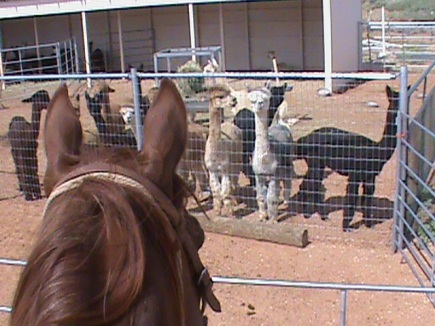
In the picture above I took Junior up to a pen full of Alpacas who he had never seen up close before.  You can see by his head set and ears forward that he had some concern about these strange looking, long necked creatures.  I asked Junior to step forward and when he was real uncomfortable, I allowed him to stop.  When his body language showed me his concern for these Alpacas was reduced, I asked him forward again.  This only takes a few minutes, if it takes that long.  But if it took longer than that, it's still worth it,..... letting your horse learn that he can figure things out,...learning that he doesn't always have to spook or bolt first then think secondly.        


Tuesday, March 27, 2012

Question on De-Sensitizing Horses


Aldoberto wrote to ask, “Can you set me straight on desensitizing a horse? My friend say's that (is) something we should not be doing. He says professional trainer(s) stay away from this.”

I can't set you straight Aldoberto, I can only give you my opinion. If you were in front of me, I would ask “what do you think desensitizing is?” before I would answer. There are some people who either do not like the term (desensitizing) or do not like what the practice of desensitizing is. I have heard Ken McNabb, who is a phenomenal trainer by the way, say (words to the effect) that he does not like to desensitize horses because he wants a sensitive horse in order to get the most out of him. I have heard others say that too much desensitizing will make a dull horse. I don’t know if that is possible or at least I haven’t done it yet.

I have used that term, “de-sensitizing” in the context of exposing a horse to different situations simply to teach the horse that he doesn’t have to react instinctively, but he can think through a problem. Such as flapping objects like flags, tarps or signs which can spook a horse causing him to react instinctively by fleeing. In fact, I think it would be difficult, even near impossible, to total de-sensitize a horse to all situations simply because their survival instinct is so strong.

I previously wrote a post about giving a horse time to think, or a pause between exposure from one situation to another. I think the time to relax, before being stressed again, is important to a horse's learning process. Hope this answered your question. If not, we can try again. Safe Journey, Aldoberto.