Sunday, July 31, 2011

Tying a Rope Halter


The other day I stopped into a neighbor's place to take a look at a cut on his horse's leg. He had his horse tied to post with a rope halter. I was glad to see him using a rope halter as I had introduced him to that several years ago, but I noticed that he had it tied wrong. I thought others may do the same so here is something to consider about tying a rope halter, which is a great tool.  I use Double Diamond Rope Halters and tied on lead ropes, rather than a lead rope with a metal snap.   


I like to tie the end of the rope halter as it comes over the bridle path to the loop on the throat latch end by half hitching it through the loop and not tying the throat latch back onto itself. I know this is confusing so here are some pictures showing the beginning and end of the correct knot for a rope halter. The photo at bottom right shows the knot that will be complete once it is clinched up a little.


Although the knot in the photo (right) is intentionally loose so you can see how it is tied, if you tie the end of the rope halter, that goes over the bridle path, back onto itself it can tighten into a hard knot if the horse pulls back.  This in my opinion is the wrong way to tie a rope halter.  


Thursday, July 28, 2011

Possible Foot Problems on Jared's Roping Horse


I received the following question from a reader in Kentucky . ”My roping horse is getting much worse when handling his hooves. My farrier gets mad when the horse pulls his hoof away. Is this something that should happens when horses pull their hooves away like where I can discipline my horse? How should I do that? Thanks. Jared.

Jared, You and your farrier need to be on the same page when he is underneath a horse and that horse acts up and needs to be corrected. Nothing like driving some nails through a shoe then have that horse rip his foot away to piss of a shoer.

How old is the horse and how much do you use him? Your question reminds me of a couple young guys who were sharing a 25 year horse for Friday night ropings. Each would get 8 to 10 runs on this horse then put him away until the next Friday. One of the boys asked me to look at his horse since the horse was pulling away his back left leg when they handled his feet. When I saw the horse I saw that the horse obviously had an issue with his other foot (the back right). It appeared to be ringbone, which is a calcification around and above the coronet band that made that foot uncomfortable or even painful when the opposite foot was handled placing all the weight of the foot with ring bone.

If a horse, who previously, stands well for shoeing starts pulling his foot away, I would think first that it is problem with the weight bearing foot. There are so many things that can go wrong with a hoof, from a stone bruise to side bone, to a puncture in the hoof to a navicular problem, to a problem in the pastern or even the hock or stifle. I even had an old roping horse break of the wing of a coffin bone, essentially one of the only bone breaks a horse can have in the foot and have a chance of being healed. A great horseshoer and 12 months of egg bar shoes made this horse sound again.


Now if I have a horse pulling on his feet when I’m cleaning them I won’t let the horse pull his foot away and I’ll only give him his foot back when he relaxes,…think pressure and release – getting his foot back when he does the right thing is his release and how he learns. Sometimes, the horse needs an open handed smack on his butt and a command to “settle down”. There are some horses that will will only raise their anxiety level. So all horses are alittle different in what works for them. But making the horse stand for picking his feet up and all, needs to be done before the shoer arrives or in other words it the responsibility of the horse owner to train his horse to stand quietly for the farrier.

Monday, July 25, 2011

Horses Eating Mesquite


I received a comment from Anonymous regarding a previous post on knowing the plant life in your area and effects on horses eating it. "We live near Phoenix, Arizona and have three mesquite trees in our horse pasture. Our horses LOVE the mesquite pods. They taste sweet. (FH note: see picture left). Some horses have become impacted from mesquite pods, but our horses have been fine eating the pods that drop from our trees in addition to their regular diet of bermuda grass and bermuda hay."

Thanks for your comment. If it wasn't for Mesquite beans a lot of cattle in West Texas would go hungry in this current drought we're in. Can't say as I remember any of my horses eating Mesquite beans, which are plentiful where I live. My horses have ate dried Desert Marigold plants, Chamisa (which is another cow staple), dried Yucca bulbs all without ill effects, however they eat very little of it at any given time....and it's not a feed I routinely let them have.

Several of my horses got out of the corral the other night and ate a row of corn that was about two feet tall and all that was left the next day was nubbins. I also noticed a number Cucumber plants conspicuously missing. I watched the horses pretty close for the next day or two and noticed no bad effects.

I think the key for horses eating any new feed intentional or not, especially in any quantity, is the gradual introduction of it. As you know changes in feed can cause a horse to colic and this goes for processed and natural grain, new cuts of alfalfa or grass as well.

Glad you are feeding Bermuda grass. I know what a pain it is to get sometimes, but I think horses are better off with a grass diet or a mixed grass diet. Again, thanks for the comment. Safe Journey.

Friday, July 22, 2011

Caitlin's Tennessee Walker - Jake


I received an e-mail from Caitlin who had boarded a couple horses and when she returned to pickup her horses she found them in degraded conditions (see picture left and video below). The property owner had also let a Mare die, who had just foaled, and Caitlin rescued the foal. Since then she is having behavior (buddy sour) problems with one of her horses.

Caitlin wrote “I recently came across some of your videos on you tube. They are so helpful and informative. I was particularly interested in the video about buddy sour horses. We recently moved our horses from a barn that was seriously abusing them. If you watch the video it will explain what they were stuck in and not allowed to get out. "


"But now since they have recovered and are at our place, my Tennessee Walker is incredibly buddy sour. I have tried the techniques you suggested. I have used these in the past when a horse has an issue. My walker has turning VERY headstrong. But now a horse that has never bucked and has never been flighty, is almost aggressive to get back to them. He is bucking when I try to correct his behavior or get too far from the others. Do you have any thoughts on this? Any resolutions? I love the horse so much and he was always such a pleasure to ride. Any help would be greatly appreciated. Thank you for being there to help people and horses! :)”

Caitlin, Excuse my language, but when I saw the video I was highly pissed off,….nobody should treat a horse or any other animal that way. You are lucky your horse did not founder. I hope everyone in your area knows about these abusers. I have seen many situations like that, mostly malnourishment, you never get used to it, and, you just can’t believe even a half smart human can do that. Good for you to rescue the foal and your horses when you did.

Glad to hear that your horses have recovered. A Tennessee Walker is a great horse. The paint horse in my website header was a Tennessee Walker and QH mix, and a great horse until I lost him. He too went to crow hopping and bucking when he was separated from other horses at first. There may be some other subtle issues with your horse as well. Does he try to walk off as you are mounting and/or before you get your seat?

I would start over,…..always a good place to go too. I would work him in the round pen each and every time before you ride him. Doesn’t have to be much, just to get him focused on you and for him to be seeing you as the leader. Some ground exercises,… lateral and vertical flexion exercises, disengaging his back end (which is essential to take away his "drive train") and other tasks and checks,.......like a pre-ride check.

I think this buddy and barn sour problem is going to be a bigger problem if you only ride him once a week. Then when you ride out either by yourself or with other horses try this:

By yourself. Ride him or even lead him in hand away from the barn and other horses and before he starts to show signs of buddy or barn sourness, turn him around and walk back. Control his gait and walk back. Turn him around and do it again. Maybe each time you get a little more distance away. If you let the horse hurry back, at a fast walk, trot or canter, then he make think you’re buying into his anxiety away from the herd. You may only make micro improvements. Again, harder to improve if you only ride him once a week. If you are feeding him yourself, then you can do this each day and leading him a roper halter may also work.

When you ride with others they have to be on the same sheet as you and considerate of what you are trying to impart to your horse. Anyway, stop your horse and let the group walk feet ahead of you. The group needs to stop before your horse gets too anxious. Then you walk, and I mean walk, not fast walk or trot, to the group. Keep doing this leap frog thing trying to increase the distance between you and group each time.

If you are correcting your horse while he is separated from the herd it is easy to get to the point where you are also increasing his anxiety,..so now he’s away from the herd and getting some pressure. The other day I was riding a horse who was a little buddy sour, so when we were separated from the other horses and started to move back to them, he wanted to trot,…..I would stop him and have him walk off again. I was trying the lightest pressure possible and he got his release when I let him move again, albeit at a walk. Pretty soon he figured it out that I wasn’t going to let him hurry up, and more importantly that he didn't have to hurry up to catch up.

Take a look at his feed too. Make sure he isn't getting too much protein or carbs/sugars....this can make him a bit hot and ansty.

Horse also have a great sense of direction, so if you and the group are cantering back to the barn you may also be giving in to their anxiety about getting back to the herd or barn. Do you trotting and cantering away from the barn, and go back at a walk.

Safe journey,

Postscript: The Colt that Caitlin rescued and her Tennessee Walker, Jake:


Sunday, July 17, 2011

Holsters for Horseback


I received an e-mail question from Cody asking "What type of holster do you wear when you are carrying your handguns?"

The gun and holsters in the picture (right) is a Ruger Single Action Vaquero in .45 LC carried in an El Paso Saddlery holster called the Shootist. If you notice, I am carrying it pretty high. It is actually on a canvas cartridge belt worn above my pants belt. When worn on the strong side, meaning the same side as the hand you would draw the gun from the holster, the higher the carry on the waist - the generally harder and slower draw is.

If you watch Mounted Shooters, they wear their belt and holsters around their stomach (above their normal pants belt line) and right in front.  They use holsters, called cross draws, slanting the handles or butts of their guns towards their strong side. This is for ease and quickness of a draw when in a seated position like being in the saddle.

When I was a Conservation Law Enforcement Officer, I carried a Smith & Wesson Model 686 .357 Magnum in a El Paso Saddlery No. 2 Thumb Break holster, which I had them make as a cross draw, worn on a 2 inch El Paso Saddlery River Belt. This belt was worn around my pant's belt and held in place with belt keepers. This was a comfortable rig and my handgun was very accessible. Cross draws were and are common for people who spend a lot time horseback.

The most common guns, holsters and belts I wear now are pictured below, from top to bottom: Ruger Vaquero .45 LC in the El Paso Saddlery Shootist Hoslter on a El Paso Saddlery Canvas Cartridge Belt; Smith & Wesson Model 686 .357 Magnum in a El Paso Saddlery No. 2 cross draw Thumb Break holster on a 2 inch El Paso Saddlery River Belt; Beretta Single Action .357 Magnum in a Ross cross draw holster which I sometimes carry on a canvas cartridge belt.


The reason I use Canvas Cartridge Belts for many applications is that I can carry the handgun holster on a belt that holds extra rifle rounds for the rifle I am carrying be it a Winchester Model 94 in .30-30 or .45 LC; a Marlin M1985 in .45-70 or a Sharps in .45-70.

You may be able to find decent and cheaper holsters in major sporting goods stores. On any holsters that uses Chicago Screws, consider putting locktite on the Chicago Screws. Most of the higher end holsters will use rivets or the holster will be made without any hardware. Here are some sources for modern and traditional western holsters:

El Paso Saddlery
http://www.epsaddlery.com/

Classic Old West Styles
http://www.cows.com/

Wolf Ears Equipment
http://www.wolfearsequipment.com

Frontier Gunleather
http://www.frontiergunleather.com

Kirkpatrick Leather Company
http://kirkpatrickleather.com


Saturday, July 16, 2011

Wednesday, July 13, 2011

Question on Saddle Squeaking


Received this question through e-mail: "Hi, my name is Connor and I finally saved up enough money for a new ranch saddle. Its an all rough out, association tree, ranch saddle made by Corriente Saddle Company in New Mexico. The problem I have with it is that the saddle squeaks horribly, so bad to the point its bothering the colts I have been riding. I have tried baby powder but it has done nothing. What are the other ways I could fix the squeaks and also what should I use to oil an all rough out saddle? I appreciate you taking the time to read this and hope to hear back from you soon. "

Hey Connor, thanks for writing. If you have been riding that sadle for awhile now, sounds to me like it's may be more of a tree issue, but maybe you can do something more about it other than baby powder. Corriente has a good reputation, so in no way am I trying to disparage their saddles.

I would get in touch with Corriente Saddle Company, of Anthony, New Mexico at (day) 915-525-9009 or (night) 575-874-3388 and ask them what they think. Of course, with a lot of use and sweat,... your and your horses',...... the squeaking may resolve itself.

Although I know boys who would never put oil or cream on a roughout, if it were my saddle, I would condition it using either pure neatsfoot oil or a paste wax based conditioner like Saddle Butter or Apache Cream. The roughout will absorb oil pretty quick and most likely darken it. It's a little harder to rub oil or cream into a rough out because of the exposed nap of the roughout. If you decide to oil it maybe try a piece of sheepskin to apply the oil. ...and maybe try a small section underneath the skirt first. When I use Saddle Butter, I usually use a rubber glove to rub it in.

Good luck and safe journey.

Sunday, July 10, 2011

Buck, The Movie - Go See It!


Had a chance to take my wife to see "Buck" this weekend. What a great movie. Actually a documentary type which follows Buck Brannaman around his clinic schedule, intermixed with pieces on how Buck grew up and came to be who he is, with interviews with his friends and family.

Go see this movie then tell me you didn't get a little teary eyed......maybe for one stud horse who didn't get a fair chance; maybe because of the moments where Buck makes a break through on a horse; or maybe because, like me, you're a little ashamed at losing your temper with a horse.

Go see the movie,...it's worth whatever the theater wants to charge you.

Thursday, July 7, 2011

Trail Riding Etiquette


I received this e-mail from Collette: ”Thanks for the article on Trail Riding planning. I ride almost every weekend with my friends and we’re all girls. One of the boys from the barn and sometimes two of them will ride with us but they are always doing things to make us nervous. Sometimes without warning they will race ahead of us or they will go off the trail then come back behind us and race towards us. Two of the girls are fairly new and get really nervous and their horses become nervous as well. Are our horses going to get better (less nervous) where they will ignore this? Should we not be accepting this behavior? Or should we talk to the boys about being more careful around the newer riders? None of us are leaders so it sort of hard to figure out what to do.”

Hey Collette, your horses are acting just like horses…and those boys,..well, they should be schooled in trail riding manners. If you are riding in a group, I think the group should be riding at the comfort level at the least experienced rider. Probably best to talk about this and agree on what your group is going to do and not going to do before you ride out. Over time and with a lot of wet saddle blankets your horses will get better as will the riders.

In a trail riding group it is not acceptable to do anything to place the other riders or their horses at risk. The last thing you need or want is a horse and rider suddenly galloping off and possible spooking another horse, and not riding away then coming back at the group, especially from behind, at a high speed.

When you ride in a group it is a good time to help your horse accept being separated from the group. One way is to stop your horse and let the other riders ride a distance away but still in sight,.....say 50 yards to begin with, then stop. The separated horse and rider then moves toward the group. The separated horse may get anxious and want to increase his speed to get to the group, because they are herd animals and see safety in a group. If so, the rider rates him keeping him at a walk. This is where you have to be a leader. You are leading your horse to a conclusion that he can trust you; that he can be away from the herd and be okay.

As your horse becomes sacked out on being away from the herd when he away from the barn, you can increase the distance and even be out of line of sight. The graduation exercise is where you can ride him alone. Although if you ride alone let someone know where you are going, the route you are taking and when you will be back....having a cell phone is good idea too.

To tell you the truth I had a hard time understanding your questions and I hope I did a decent enough job answering them. But to re-cap, your trail group needs to have a group wide understanding and agreement of safety and how you are going to ride. It would be polite to ask everyone, “everyone feel like loping off?” and if someone is uncomfortable,....well then, you ride to the lowest comfortable level. This is just basic communications,....you communicate with actions to horses and verbally to your fellow riders. Talk to each other as you encounter possible problem spots in the trail and make each other aware of where you are at.

Those boys are also needing to get some manners and maybe you can give them that look,....you know that look at woman are so good at giving menfolk when we get out of line.

Good luck and Safe Journey.

Monday, July 4, 2011

July 4th - The Beginning of a Nation of Freedoms


It's appropriate on July 4th to show this Country's colors. The presentation of the Colors in the photograph below, are courtesy of the 10th Calvary Regiment,... ....the famed Buffalo Soldiers.  


Please take a moment to think about the Second Continental Congress adopting the United States Declaration of Independence on July 4, 1776,...the courage and wisdom it took,...and what that has meant to this Country, as well as the rest of the World for the past 235 years. God Bless and Safe Journey.

Saturday, July 2, 2011

Question on Spurs


I received these questions from David regarding the use of spurs: ”Sir, could you explain to me the reasons why the use of spurs and what type of spurs you use? I am beginning to learn how to team rope and am riding a borrowed horse. The owner and other people he lets ride this horse all ride with spurs. I have let to buy any and am wondering if I need them, why and what kind so I need.” Thank you, David

David, I do use spurs and I like to think that I use them judiciously, meaning I don’t gouge the horse or stay in his barrel with them. I have had a comment or two from people, seeing me with spurs on videos, telling me that I should learn how to ride without them. I think that if they are used correctly, spurs can be a good aid to a rider, without making the horse suffer.

I have also seen horses get really desensitized to spurs from riders who are too heavy legged. I use spurs because I can and because if I need a horse to respond to a cue in a bad situation, then I may need him to respond now and not hesitate.

I rode up a steep, rocky, stepped incline one day and when I topped out there sat a Bull Oryx. An Oryx is an African Antelope with straight horns, really a beautiful animal, but the first time this Paint Gelding, named Chance, ever saw an Oryx. Chance spun around once then started to back sideways towards this steep rocky incline, just a few feet next to us, I had just topped out on. Glad I had spurs to help me move him away from the edge or I may not be writing this to you this day. As it was the Oryx, stood up and meandered off and we made it through that lesson in one piece.


I really only have a couple sets of spurs. One long shanked set of jingle bobs which I long longer ride with but had used for ceremonial events; and a set each of short shank and medium shank spurs each with a 10 or 12 point blunt spur rowel of an approximate diameter of 1 and ¼ inch. The medium shank spurs are for when I need just alittle longer reach to rotate by leg and heel to be able to touch the horse’s barrel.

Although some spurs can be harsher than others, it’s more how they are used. Even with spurs you are still using your seat, your legs, your calf then if necessary the spur to provide the right cue to your horse.


Thursday, June 30, 2011

Help a Hero Win a Gypsy Vanner Horse


Lexlin Gypsy Vanner Horse Ranch is giving back to the military by donating horse to a worthy veteran. Help a Hero win a horse, Braveheart, donated by Lexlin Gypsy Vanner Horse Ranch of Rockwood, Tennessee by helping a veteran obtain the most "likes" on Facebook by midnight on July 3rd. Lexlin Gypsy Vanner Horse Ranch reports that Braveheart is a very sweet horse, and they will miss him, but are excited to see him find a new home with a deserving veteran.

http://www.facebook.com/GypsyVannerHorsesForSale

Click on the link above; Log into Facebook; then hit the "like" button to go to the voting site. If you have any questions please don’t hesitate to call Lexlin Gypsy Vanner Horse Ranch at 865-567-1653 or shoot an email to tmidyett@gogypsy.com

Remember to vote before Midnight July 3rd.


And if you are having trouble deciding which worthy veteran to vote for, please consider USMC Colonel, and my friend, John Mayer who was nominated by his 10 year old daughter Jesse. John has dedicated his life to service of this Country and currently he is helping wounded Marine Corps veterans get better through equine therapy. Col Mayer is truly a Great American and a deserving individual. That's his picture at left to help you find him.


Wednesday, June 29, 2011

Army Scout - Texas Jack Omohundro


"He was an expert trailer and scout. I soon recognized this and... secured his appointment in the United States service...In this capacity I learned to know him and to respect his bravery and ability. He was a whole-souled, brave, generous, good-hearted man...who was one of my dearest and most intimate friends.” --William “Buffalo Bill” Cody, 1910

John Baker Omohundro was born July 27, 1846 in Fluvanna County, Virginia where he grew up on horseback and was said to be a natural born hunter and crack shot, who loved adventure and danger.

When the war between the states broke out, Jack tried to follow his older brother into service but was denied until he reached 16 years of age. Finally accepted into the Confederate Army, Jack gained an exceptional reputation as a scout working directly under Col. J.E.B. Stuart's renowned Cavalry.

After the war, Jack worked his way west towards the great ranches in Texas, where he was eventually hired on at the Taylor Ranch becoming a foreman and being involved in local adventure where he and his famed ability with a rifle reportedly kept a kidnapping of a local woman from happening.

Omohundro participated in cattle drives on the famous Chisholm Trail where he saw the result on Indian attacks on small settlements and was involved in several Indian fights. Apparently it was as a Cowboy, driving cattle to Tennessee, where Jack received his nickname "Texas Jack".

On one of the cattle drives up North, Omohundro met Col. William F. Cody, a scout in the U.S. Army and more popularly known as "Buffalo Bill". Jack became good friends with Buffalo Bill, and Cody, admiring Jack's ability as a horseman, hunter and marksman, got him stay on as an Army Scout. Reportedly a special act had to be passed through political fiends of Buffalo Bill's to obtain a waiver for the ex-Confederate soldier to enlist as an Army Scout.

Omohundro was famous for learning Indian language and signs, was one of the few white men that Indians would trust. He became known to the Pawnee as "White Chief" who also called him "Whirling Rope" due to his ability with a lariat.
Incidentally, later on in life, Texas Jack taught a young man by the name of Will Rogers how to do tricks with the lariat.

Jack later joined Buffalo Bill Cody's Wild West show and toured the world giving insights to the Wild American West. Texas Jack Omohundro, War Veteran, Cowboy and Army Scout died in Leadville, Colorado, unexpectedly from pneumonia in 1880 cutting short a great life at the young age of 34 years old.

Monday, June 27, 2011

Trailer Loading and Butt Ropes


I receive what seems to be a lot of questions about trailer loading. In my experience horses don’t want to get in trailers for two reasons: 1 – because they have had a bad trailering experience, and 2 – they have learned that they don’t have to get in – that they can get away with balking to enter the trailer. And with some horses, getting in a box is just too frightening, especially for the first time.

When I was managing a large horse stables I had a boarder need help to load his horse to take him to roping. After the roping concluded he tried to load his horse back into the trailer, couldn’t get it done, so he had to ride the horse about 20 miles back to the stables. So the lesson learned here is that don’t go someplace with your horse unless you are sure you can get him back in.

I don’t know how many times I get asked to help someone trailer load their horse only to find out that they have tried for 4 or 5 days before they called me. Then the horse has learned pretty much that they don’t have to get in the trailer. So the lesson is not to try to load a horse, who has problems loading, if you don’t have the time to see it through. And when you get him to load, just don’t stop there, get him in and out a few times and see if he isn’t easier each time.

A new trailer can cause a horse to balk at entering as well as can competing interests for their attention while trying to get them loaded. If the trailer is old or otherwise has suspect flooring then the horse may have some anxiety associated with that. Sometimes it may be a lower height trailer and the horse has bumped his head.

When I lead a horse up the trailer I make sure I’m not in front of them but off the side and My body language reflects that I am expecting that horse to walk right up and into the trailer. If they balk, I’ll give them a minute and have them drop their heads to smell and look at the trailer floor then when I see their attention on the trailer waiver (you’ll see their head set and ears slacken), then I ask them to step up.

When I have trailered a young horse, that wasn’t necessarily really good at loading, out to a remote area and was on patrol by myself, I have had to use some props, a butt rope or lunge whip, to help that horse get back into the trailer, but for the long term it needs to be the horse’s idea to load and he should load easily. Even though I don’t like to use other aids like a butt rope or lunge whip, sometimes it is necessary to tap the horse on his butt to move up into the trailer. I have had success in really balky horses by tapping on the leg below the hocks. And I mean tapping, not hitting,…just a light, repeated tap until you see some progress. If they move forward even one step I removed the tapping (pressure and release), then start again. The horse learns that to move forward and continue to move forward into the trailer is where they find the release. In the trailer they find out that it ain’t the big trauma they thought and they are a better horse for it.

The below video shows how I position up and use a butt rope to help with getting a horse to move forward into the trailer.


Saturday, June 25, 2011

Introducing the K Rose Ranch of Saskatchewan


A Canadian Hello from Gerald, Cody, Reagan, and Kassidy Adamus, the owners of K Rose Ranch, located eighteen minutes northwest of Saskatoon, Saskatchewan, Canada. K Rose Ranch raises Quarter Horses, Paints, and Rodeo Stock. Their aim is to continue to raise top quality horses and Rodeo Stock for everyone's needs, through a wide variety of Champion bloodlines.


K Rose Ranch is also very excited to see their breeding program grow and improve every year. Please visit their website and look at our 2011 Foals, including this pretty little Sorrel and White Overo Filly out of Wranglers Pepto and Miss Steele Rock.


http://www.kroseranch.com/

Contact:
Gerald Adamus
Cody & Reagan Adamus
phone 306 283-4661
cell 306 717-7918
cadamus@sasktel.net
Langham, Saskatchewan, Canada


Thursday, June 23, 2011

Reader Question on Trail Ride Planning


I received this e-mail from a reader: ”I have been reading your site for a few months now and really enjoy the articles. I have leased a horse and am about to go on my first long trail ride in the National Forest with a group of friends. I am so excited! We are going to trailer in to a place then make a seven mile one way ride, through an old mine area, then onto a small lake then return in the later afternoon. What type of preparations and gear do you think I should take with me?” Lynn, Michigan.

Lynn, good for you. I understand that leasing horses is becoming a cottage industry. In regards to your question, I don’t want to over burden you with possible preparations, but.....

A fourteen mile trip at a leisurely pace is usually not a problem for most horses, but I have seen people over extend their horses. Riding a couple times a week should bring your horse into good enough shape not to be asking too much. Hopefully, at least one of your friends are experienced with trail riding.

Don’t know what the terrain looks like, but if your horse is not shod, then consider bringing some hoof boots in case your horses gets ouchy on his feet or picks up a stone bruise. Easy Boots are good, but kind of bulky. Hoof wraps are not as durable, but are much lighter and compact to carry. I always carry one hoof wrap even with my shod horses in case I have to pull a shoe.

Do you know about the mine you’ll be going by? I have an semi-active mine fairly close to my place that I can’t ride close to because of some toxic materials, like mercury on a ground as a by product of the mining and I don’t want to expose my horse to that. Be sure to know what to look for around mines such as vertical shafts and loose footing.

A first aid kit for both people and horses is a good idea. I carry wound dust, vet wrap, gauze bandage and tape in my saddlebags.

Any possibility of rain? I always carry a slicker. Not just for rain, I have used it to cover up my horses head during a short dust storm where I couldn’t see three feet in front of me. Don’t try and put on your rain coat for the first time when you’re in the saddle. I think maybe a small pocket poncho may work.

You and your group may consider dividing the necessary and emergency supplies. Meaning not everyone needs to carry tools such as a Leatherman or hoof pick,…you can share. I carry a small Plammer fencing tool. It came in handy one day when I had to cut barbed wire away from my horse’s legs.

Hopeful you have cell phones in case of emergencies….and I would suggest you are staying together or at least not violating the two person rule,...even better the three person rule where you are never in groups smaller than three people. This allows one to stay to help an injured person and the other can ride for help if need be. One the ride in, maybe you could check cell phone reception from time to time to know where you have to be to make a emergency call....the ability to describe where you are at would be important.

I would leave a map and trip narrative with someone, friend or family member, who is not going on this trail ride, just in case, …maybe also at any nearby Ranger station where you end up trailering to.

Other things I always carry are: a small fire starting kit; short, fixed blade knife; 2 quart canteen; 48 foot lariat; spare leather ties and Chicago screws.

Have fun and safe journey.

Monday, June 20, 2011

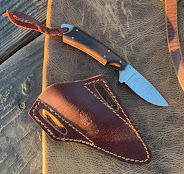
Cowboy Knife - Custom Knife by Joe Teague


I asked Joe Teague of El Paso, Texas to make another knife for me with a couple small design changes to the knife handle and sheath primarily. Joe is a modern Mountain Man who hand makes knifes of all sizes, period correct from the early 1800's through the late part of the century. He also make camp axes as well. He works in many different metals include Damascus and tool steel as well as using some of the prettiest hardwood available.

I asked Joe to use Tigerwood Maple hardwood for the handle, insert a lanyard hole in the end of the handle, and make a cross draw, pancake type sheath with belt loops for a right hand draw. I like the lanyard as sometimes I don't get quite a full grip on the knife so the lanyard, which I made out of cut down saddle strings, help me draw the knife.

I like a cross draw as it keeps the knife out of the way but accessible....and serves as a retainer for my gun belt which is a leather and canvas cartridge belt.

Two weeks later, Joe called and told me it was ready for pickup and when I did he
explained that he used German silver for the hollow pin for the lanyard hole. The sheath is as quality made as the best firearms holster available today.

Friday, June 17, 2011

Horse Injuries - Bowed Tendon


I received a question from Yvonne, a prospective horse buyer, who was told the horse they were looking at picking up had a previous tendon injury. Horses who are used in speed events or hunter/jumper type activities usually face a bigger chance at soft tissue injuries such as injuries to their tendons which usually occur when the tendons are stretched beyond the limits of their elasticity. This can really occur in any activity horseback. I would suggest paying for a vet check for overall health and soundness, however the prospective buyer can do a preliminary inspection of a horse to determine if they want to proceed.

Tendonitis is inflammation of a tendon, commonly occuring in the superficial digital flexor tendon behind the front leg bones, which is the tendon closet to the surface. Just behind the superficial digital flexor tendon is the deep digital flexor tendon, .....these are the tendons connect the fetlock and the knee are are the tendons that some people are taught to squeeze to cue the horse to raise his leg for cleaning the foot.

When that tendon is torn then healed, a “bowed tendon” appearance will be visual. This is a result of the tendon being torn then healing with scar tissue causing a lesion type thickening or knot on the tendon.


Smaller or less invasive injuries will also cause torn tendons and scar tissue, so ‘pre-buy” inspections should included feeling this tendon for evidence of previous injuries and build of of scare tissue. Manipulation and palpitating the joints and soft tissue to detect abnormalities, swelling and pain is a good idea. If you get a Vet to do a pre-buy check watch what they do and ask questions which is a great way to start to learn. Otherwise lameness issues and causes is a pretty complicated area, but an area that the aspiring horseman should work to learn. "Understanding Lameness" by Terry Swanson, DVM, available from Western Horseman books, is a very good resource to have.

Safe Journey and let the horse buyer beware.

Tuesday, June 14, 2011

Reader's Horses - Amanda's 12 year old Gelding


Knowing how people love their horses,...wish all people did,...I will post pictures of you and your horse(s) or just your horse if you prefer, if you send them to me. Thanks for the reading this site and more importantly, thanks for caring for your horses.


This is Amanda's 12 year old Gelding. Nice stout looking Roan. Notice she has him tied high to the tree and with a quick release.

Friday, June 10, 2011

New Equine Feed Supplement - HorseManna from MannaPro


Just heard about Horse Manna from MannaPro. In the past I have used Calf Manna, intended for cows, on horses to help them gain weight. And whether you are trying to put weight or take weight off a horse, go slow. I bought the horse in the picture, Roy , when he was 16 or 17, and he was maybe 150-200 lbs underweight, probably in body condition scale 2 or 2.5. I used grass and alfalfa hay, Calf Manna and corn oil to slowly put weight on him where in maybe 3 months he was looking good. Roy is now 27 or 28 years old and still doing good.

This is what MannaPro says about their new pelleted feed product, HorseManna :

Introducing the next generation of the Manna family: Horse-Manna™! We started with the proven science behind Calf-Manna® then added several nutritional features specifically for your horse. These added benefits, along with a complete fortification of vitamins and minerals equal the Horse-Manna Difference you will see and your horses will taste!

Horse-Manna includes multiple sources of high-quality proteins. These proteins provide a wide array of essential amino acids that promote growth and better muscle development in horses.

Supplemental Fat & Stabilized Rice Bran = Better Weight Gain

Horse-Manna has added fat to increase calories and help support weight gain and increased body condition.

Brewer’s Dried Yeast, Yeast Culture, Microbials = Better Digestion

These key ingredients in Horse-Manna help promote optimal digestion of the entire diet.

Flax and Linseed = Improved Coat Condition

Flax and Linseed Meal have been added to Horse-Manna and are rich sources of Omega-3 Fatty Acids which add sheen and luster to your horse’s coat.

Anise = Palatability

Ingredients like Anise provide Horse-Manna’s inviting, sweet smelling aroma and taste for horses. The great taste encourages horses to stay on feed during times of stress such as travel, illness, or environmental changes.

Vitamin & Mineral Fortification = Improved Health & Well-Being

The 26 vitamins and minerals in Horse-Manna ensure your horse is getting complete fortification for their overall health and well-being.

Guaranteed Analysis:
Crude Protein Min 25.00%
Crude Fat Min 6.00%
Crude Fiber Max 7.00%

Horse-Manna will be available at your local retailer in June 2011. To find out more about Horse-Manna, Manna Pro, or to find a local dealer, please visit www.mannapro.com