Showing posts with label slobber straps. Show all posts

Tuesday, November 24, 2020

Snaffles - Not just a starting point


First off, I spent several years chasing bits, trying to find the right bit that would bring about the change I was looking for in my horses. Until I was humbled enough to realize that the change had to come from me and not a piece of metal. I have apologized to my horses for my past approaches, much like I apologized to my daughter for taking her into town for one of those nasty McDonalds Happy Meal once a week when she was growing up. It's amazing that as we get older some things get clearer. It's just too bad that some people, and I'm in that group, won't live long enough and learn enough to make right decisions the first time, but sometimes, maybe everytime, on how learning takes place.

When riding a living, breathing animal four to six times our size and who can instantly move too quickly for us, or dump us on the ground, it is human nature to try and gain control and that most often leads us to more and more severe bits and headgear. But, it really is logical that in our and the horses development in the progression of training you would think we should tend to get softer, not only in our approach and how we use our hands (and legs) but in the bits/head gear we make our horses wear. Put in another way, as we and our horses get better we should be able to get by with less effort and harshness.

In the clinics I see all sorts of bits and headgear. Gag bits, mechanical hackamores, shanked bits connected to nose bands and tie downs. I've seen mechanical hackamores with really soft nose bands but with curb chains are pretty tight before the shanks are activated. And in the annual Arena Challenges I run, such as in this year's event, out of 27 competitors and horses, there were only two ridden in bosals and only two ridden in snaffles. To be sure, some competitors rode really soft in other bits, one rider in particular with a spade bit and several in leverage bits (having shanks). I was pleased to see more riders this year riding in a soft manner, with quiet hands and good communication with thier respective horses, however I had hoped to see less of the contraptions that try to control a horse through pain and not signal.

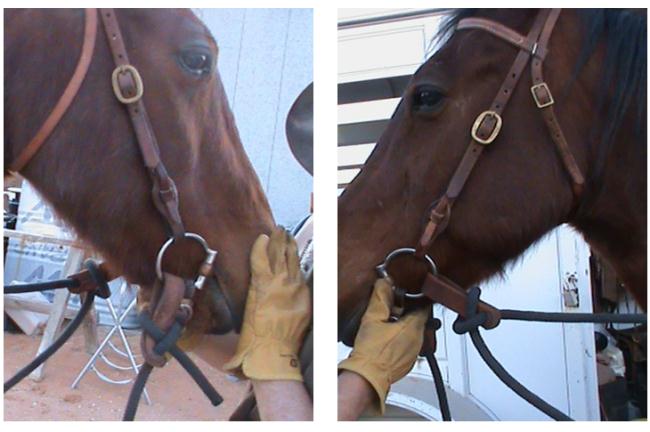
Over the years I am now in a place where I haven't used anything other than snaffle bits or bosals on my horses. On all my snaffle bit bridles I use slobber straps and have graviated to the longer slobber straps as I think they give a clearer pre-signal and quicker release. The two snaffles I use the most are the ones shown in the photo above. One regular snaffle with copper bars that really get the horse salivating and the other with a copper roller in the center.

The past week I had a gent come over wanting to see how I suggest he progress with a two year old colt he was going to pick up soon. The colt should have a dozen rides on him before this guy brings him home. This gent is no novice but it had been a long time since he has ridden green broke horses. I pulled one of my horses and rode him a snaffle showing him what things I would work on. Towards the end of the demo he asked at what point would I go to a shanked bit. He just thought that going to a leverage bit is the natural progression. While many of the best horseman (and women) in the country progress from a snaffle, to a hackamore (bosal) then to the two rein - riding with a bosal and a spade bit each with it's own reins, then eventually just in the spade bit, but there are many of us as well who can't get along well enough with our horses riding in a snaffle and being able to ride one handed, neck reining, controlling the front and back ends independantly from each other and getting horizontal and vertical softness....hence the draw of a leverage bit.

With the bosals and snaffle bit bridles, I can't remember using anything other than mecates as reins in the past 10-12 years. I think if more riders would give a snaffle bit a chance, riding several times a week on a particular horse, they'll come to find that they can not only get on just fine on a snaffle but actually see a better response in their horse. And the mecate reins, while seemingly may be complicated at first, is really a great tool. The photo above shows the snaffle bits with slobber straps and mecate reins. Maybe this will spark alitle interest in the snaffle bit as opposed to leverage bits. Safe riding everyone an Happy Thanksgiving.

Tuesday, April 9, 2013

Reins to Bit Connections


Austin wrote to say, "I found your site the other day and I have already read a good portion of it. I have read few horse blogs from time to time and I have found yours to be one of the best. You have some very good info and interesting opinions. Mostly though it is your approach that I really like. Anyway I was hoping that you would way in on what if any effect using metal rein clips vs something that doesn't vibrate like slobber straps. Does it bother the horse or affect command input? Or anything else that comes to mind. Thank you and don't squat with your spurs on. - Austin"

Thanks for your comments and the advice about squatting with spurs, Austin. I have done some dumb ass things in my life, but I have yet to impale my butt with a spur rowel.  Even when I was young where I would often hear my Pa say "Boy, you're so smart you must have two brains,....one the size of a pea and the other a little bitty thing."

Back to your question,.....I don't know if I'm that concerned about vibration, or noise for that matter, coming from metal snaps connecting reins to the bit. I think the biggest reasons people would use metal snaps to connect reins to a bit are that many reins they buy already have them as an attachment, and it is also a matter of convenience.

I would think that the weight of metal snaps connecting reins to a bit would serve as a preparatory signal as the reins are started to be picked up changing the feel of the weight of the bit to the horse. I think that slobber straps serve the same purpose. Look at the picture at top - right showing reins connected to a snaffle bit using metal snaps.  Notice that the reins are loose and the weight of the metal snap allows them to hang down with loose reins.  Once these reins are began to be picked up the weight shift of the metal snaps on the snaffle can be felt by the horse through the bit in his mouth.  So the weight change of the connecting metal snaps hanging down when the reins are loose, then going horizontal as the reins are picked up, would probably be less evident if the rider had really quick hands.    


While I have some reins with snap connectors of various types, they do have springs which eventually get oxidized and sticky, or the spring strength weakens or gets dirty - all of these impacting the integrity of the connection, but fixable with some routine maintenance - a small brush, maybe a can of compressed air and a drop of WD-40 would fix most connector issues.  I wouldn't try to clean my metal snaps with a can of compressed air while they were hooked to the bit in a horse's mouth, though....just saying....  In the picture above you see reins attached using snaps to a curb bit.  In the photo on left the rider has a little contact with the horse and as the reins are picked up the slack in the reins is taken out and the horse begins to collect.  I think the weight provided by metal snaps aids in the subtle signals to the horse.  By the way, that's my lovely wife on the other end of the reins and one of her horses, Charlie, above.
 

Slobber straps, in the pictures at left are normally used with round reins, like rope reins, or a mecate (also called McCarthy reins), and of course are less quicker to change out than reins with metal snaps. But I prefer slobber straps when I can use them.  You can see in the picture at far left the Slobber Straps are handing down with a loose rein.  Once the reins are picked up, the Slobber strap goes horizontal changing the weight on the bit, which is evident to the horse, so again a preparatory command.  


Tuesday, September 7, 2010

Tying Mecate Reins to Slobber Straps


Responding to a reader question on You Tube about how to tie Mecate Reins to Slobber Straps,.... Proudtobeafarmgirl made a comment on the Lariat is More for Just Roping post,....."great video, no static and not much wind. Thank you for showing how to make a halter from the lariat, handy thing to know. Can you or do you have a video on how to tie the macate reins on to a snaffle with slobber straps?" OK Proudtobeafarmgirl, I offer this post.

Mecate Reins are one piece reins traditionally made out of hair so that it is prickly to the horse neck which adds in cueing a horse for neck reining. Nowdays yacht or rappelling rope mecate's are as common as hair mecates.

Mecates, sometimes called McCarthy reins which is the bastardized english version of the Spanish term, are normally tied to bits using leather connector pieces, called slobber straps, that are designed to keep the expensive hair mecate's away from the horses mouth not only to protect against the horses chewing on them or his slobber from getting on the reins, as the name implies, but to keep the prickly hair mecate from bothering the horse's sensitive mouth and lips.

In the video, I explain how I have my mecates tied, using knots on both outsides of the slobber straps as I think this balances the bit better, but I have included a picture below to show the traditional method of tying the near side or left side mecate to the slobber strap.

Generally you would create an 8 foot one piece rein with the mecate and have about a 12-14 foot length for a "get down" rope to lead from the ground with. This piece is traditionally "S" rolled and tucked into the belt from the bottom up so it will pull out easily if the rider gets tossed. It can also be coiled and tied to a saddle string.


The photo below shows the traditional method of looping the mecate through the near side slobber strap and brining the mecate back through underneath itself to lock it down. Either way, the method showed in the video or the picture below will work just fine.