Happy 92nd Birthday to the United States Border Patrol. Founded on 28 May 1924 to patrol the border mostly on horseback to
prevent illegal entries across the border. Earlier on, there were mounted inspectors as early as 1904 operating out
of El Paso, Texas and actually had the primary duty of preventing illegal immigration by Chinese immigrants. While
the first Border Patrol station was built in Detroit 1in 1924, a second Station in El Paso Texas built one month later is
known as Station One.
Being the largest uniformed Federal Law Enforcement Agency in the U.S., Border Patrol agents exercise a wide range
of missions across many environments including manning a few internal checkpoints on U.S. Interstate and Highways.
Specialized Border Patrol units conduct arrest warrant service and manhunts like the missions hunting the
escaped prisoners in New York; perform search and rescues; are often the first law enforcement officers in
devastated areas such as in the aftermath of Hurricane Katrina to provide law enforcement presence, search for
missing and injured people and perform first responder and subsequent emergency medical treatment.
The Border Patrol, first under the Department of Labor then later under the Immigration and Naturalization Service
(INS) and lastly, now under Department of Homeland Security, continues to patrol the U.S. border with Mexico and
Canada as well as some coastlines and waterways.
While aerial patrols now fall under another agency, Border
Patrol agents to this day patrol the border in trucks, ATV's and on horseback. In fact, there are several hundred
horses in the U.S. Border Patrol performing daily duty protecting this country's borders from illegal entry not
just from immigrants, but from narcotics smugglers and potential terrorists.
Since 1904, counting the original mounted inspectors, the Border Patrol has lost over 120 agents in the line of
duty, more than any other federal law enforcement agency. The most publicized line of duty death was Agent Brian
Terry killed December 2010 in Arizona by heavily armed bandits who were out ripping off dope loads being smuggled
across the border. Some of the guns used by the bandits were traced to the Bureau of Alcohol, Tobacco and
Firearms (ATF) 'Fast and Furious" gun selling scheme.
It is not uncommon for narcotics smugglers to bring drugs across the border on pack horses, often traveling for a
few days to get to a "load up" site to transfer the drugs, then turn the horses loose when they
haven't been watered or fed for a couple days. At least the horses in the Border Patrol mounted unit, usually
Mustangs, are very well cared for and have a legitimate job getting agents into remote areas, best patrolled on
horseback, to detect and intercept illegal activities.
April wrote to say "I am trying to become a better rider, realizing that riding only 2-3 times a week makes it
difficult to be even marginally better. I really can't go to clinics as they are too far away and too difficult to do. There is a local dressage club, but that does not appeal to me. My question is what do you
work on or what can you do by yourself to refine your riding skills? Thank you. "
I think you an get some improvement by limited riding - it's likely how you approach it. As far as clinics, they
can be really useful but if they are not possible for you right now then there are many DVD's from tophands
available and they can help. Having someone watch you or even video taping you for later review can help as well.
Dressage may not appeal to you, me either, but auditing a schooling session or, better yet, riding with some of
those folks may help you become a better rider. The way I look at it, dressage riders have to know what they are
doing to sit in those tiny saddles! Some dressage clubs also offer Western dressage. I don't know much about it
though, so I might be negligent in saying it's just dressage in a western saddle,....likely it's a little more
than that, I just don't know. If the competition aspect of dressage (or other events) bothers you, so could just
approach that work from a training angle as opposed to just competing for ribbons or buckles. I know that
competition sometimes brings out the worst in some people, but it can also serve to illuminate shortcomings and
motivate others.
As far as becoming a better rider, I think I've always wanted to become a better horseman and never much thought
about just the act of riding until a fairly short time ago. I remember about 12 years ago I was riding with some
cowboys on a gather in a BLM managed grazing unit. One of the older cowboys said to me something to the effect
that I have slow hands - meaning that I was not trying to man handle my horse through the reins. It was meant as a compliment and I took it that way. He also said something to the effect that he was happy to cowboy with me. I replied that I was just trying to become a better horseman. He thought I
was trying to funny or something. I'm not saying that cowboys can't be horsemen or vice versa, just that my focus was getting
better at communicating with horses and riding is just a part of that.
I always thought I had a pretty good seat and rode in a balanced manner. I've been on some broncs (by accident mostly)
and have other horses bolt and take me for a ride. But now I realize that I could use some improvement when it
comes to simply riding horses as it pertains my seat, posture and balance. On that thought I brought in a noted
area dressage rider and teacher, Martha Diaz, to give a private clinic. We worked simply on circles and straight
lines where I was critiqued that I had a tendency to ride with my back a little too rounded, needing to be
straighter; that I was dipping my right shoulder when riding circles to my right; and when riding circles to the
left I was not riding the outside of my horse and also letting his outside shoulder drift.
I was basically unaware of these faults but now am cognizant of looking to correct these faults when riding.
Maybe an option for you April is to have one of the better dressage riders work with you one on one once a month
or so. Another option would be to video tape yourself riding which may help you see things in a different way
than from the saddle.
I'm sure this will be my first and last article on politics but I thought it appropriate to say just a couple
things about politics since this year is just plain crazy for politics at the national level. And at the local
level where I live, I have become involved to support a friend of mine running for County Sheriff...his name is
Tom Buchino.
Tom, like many of us, had very little desire to get involved in politics excepting to vote which is really just a basic
obligation. Many current El Paso County Sheriffs office employees, county citizens and neighboring law enforcement officers
had been asking, even pushing Buchino to run for the office for the past 18 months. Tom is a retired Green Beret
Sergeant Major and like the culture he served in and the men he led, when asked "who will go?", Tom replied "send me" and stepped up
to run a campaign, win the office and make the necessary changes to right a declining agency.
While I am not advocating sending money to politicians, I am advocating that everyone at some level needs to get
involved to help determine who we elect to office. Write letters or e-mails to your elected officials about the issues that concern you and the solutions
or platforms you would like to see them take. Get your family and friends involved as well. Talk about the issues
and get to the polling stations and vote.
We had a little fun and shot the short video below to support the Tom Buchino for El Paso County Sheriff campaign. We did
another one which I won't be posting as I am opinionating about some of the issues and this site is about horses. Well shoot, you talked me into it........What the hell is going on in this country? The absolute craziness of biological males using female restrooms with 7 year old girls in attendance? Does anyone really support that? What about the segment of the population who has chased God out of our school rooms and are now trying to run Him out of the country like a common horse thief. Please get involved and get in touch with your representatives at what ever level. After
all, these politicians work for us.
I'm not a horse racing fan, nor a fan of any equine competition where young horses are stressed through training and performance before they ever mature. I understand that for many there is pressure on performing and earning checks to keep everything from food on the table to hay delivery coming through the gate so it's necessary getting horses performing as soon as possible, but I just think there needs to be some regulating of putting stress on young horses.
Think about it. Horses competing as three year olds may only have a true age just over 2 years as they may be coming 3 years in the competitive year. That means they have to have been started (in training) well before becoming a true two years of age. So I was pleased to see a message posted from Cowboy Dressage World Switzerland that stated "Fantastic news for the welfare of horses coming out of Switzerland and Germany yet again! Their respective Quarter Horse associations have resolved to prohibit 3 year old horses from ridden competitions and futurities as of March 2016. Horses must be at least 4 years old before they are permitted to compete under saddle. The article states this is following a global trend and questions being raised about horse welfare. They also resolved that 4 year old and older horses can be ridden 2 handed in a snaffle or hackamore. Well done Europe!! Come on rest of the world!"
I ran a large horse facility for six years or so and we would get calls from several racing stable owners at the local racing track offering free horses, mostly always Thoroughbreds. Some of these horses weren't working out very well on the racing circuit and the owners just wanted to get these horses off their feed bill. More often than not, these free horses were young and had some sort of injury. I couldn't keep some of the novice horse owners from jumping at the chance of a free, well bred horse. Often I would often go down to quarantine to check in a new horse only to find it lame. Bowed tendons, damaged suspensary ligaments, non-specific problems in the stifle were common and would get worse once the anti-inflammatory and pain management drug protocols were no longer being given. Some of these horses had been pin fired as well.
Often other problems wouldn't become apparent for years such a detioriating joints, bog spavin in the hocks, or just odd footfalls at certain gaits.
The deal with starting horses in intense training while they are not physically (nor mentally) mature is that not only are injuries more common but physical stress and damage on developing bones and joints may create conditions that may not be apparent or become chronic until later years. I really like the idea of starting horses at two or even three years of age. Even though you may have been handling that colt since he was born, letting him learn pressure and release from a lead line, which is good for him, I mean starting in getting him broke to a saddle and getting a few short rides in the round pen. Turning that colt back out and starting again the next year continuing his training and starting to put a handle on him. Then at four maybe five he's being ridden a lot, and is what you call a using horse.
I am not going to change the industry, nor am I going to thin bad of all the trainers in those disciplines where horses are started, trained long and used hard while they are young. I think just in a perfect world horses are allowed to mature before we ask too much of them.
Jennie wrote to ask about fixing her horse's high head set: "Hi, I wonder if you have any experience or ideas for a horse who has a high head. It's like he is stretching out to see over the top of something, not really at the walk but at the trot. Other riders have given me various advice such as to use a tiedown or a head setting device that goes over their neck? My research has also made me consider a martingale. I have also seen competition where a horse is ridden and his head is down close to the ground. Is this called collection? What is the advantage of teaching a horse to ride like that? Any ideas or food for thought would be appreciated."
The competition you are likely talking about is reining and those horse's are being ridden with true collection - nose vertical to the ground, the poll is flexed, and the horse's back legs up underneath their body's, the stride is short and quick, rounding the horse's back. Basically this lightens up the front end where normally greater than 50% of the horse's weight is carried and transfers weight to the rear end in order to work on the back end which helps for better stops, transitions, lead changes and more.
Along with the reining you saw, you will also dressage horses ridden displaying vertical flexion. Sometimes you will see horses ridden with exaggerated flexion where their nose is very close to their chest. But just because a horse is flexing at the poll doesn't mean it is collected. In the picture above left I am riding at a walk and am asking my horse to soften his face, flex at the poll.
All this begins with the horse giving to pressure during ground training then progressing to vertical flexion in the saddle, then flexing at the poll during the walk from very short moments to longer times as he gets soft. Then begin again at a trot and so forth. You get collection when the horse's flexes at the poll and you drive the horse's back end up underneath him rounding the back.
For most people to enjoy their horses, pleasure and trail riding and even local competitions, it is likely not necessary to ride your horse with collection. However, getting your horse to soften and giving to vertical flexion has got to make a better horse and partner.
With your horse's high head set his back is hollowed out and the majority of his weight is on the front end. The center of his eyes are higher looking more further and forward. He can still see the ground and obstacles to his front as he travels as horses have great peripheral vision, but not as good as if he had a more horizontal head set.
In the photo at right, I am riding at a jog and my horse has a natural head set. There is a reason it is called a natural head set - it is simply natural for the horse. Watch a horse in a pen when something attracts his attention. His head goes up to the necessary height where he can look out of the center of his eyes to determine the threat.
So while you may likely need to work on getting your horse soft and giving in the face, working on vertical flexion, there is nothing wrong, and everything right about riding with a natural headset. But I'll give you my opinion on the rest of your question, concerning tie downs and other devices.
I'll assume you have eliminated your horse's teeth, the bit and how the bit is seated as a source for your horse's high head. But I am not a fan of, nor a user of tie downs or the head setter which is likely the "head setter device" that you were advised to try. A tie down is basically a type of cavason around the horse's nose and tied off to the breast collar, or through the breast collar ring to the cincha. The tie down limits how high the horse can raise his head. It is typically used in arena roping and thought to give the horse something to brace against upon the jerk of a steer on a rope. Virtually every team roper using one. I will defer to their experience as to the necessity of a tie down for roping.
The head setter is a combination nose band and rope over the poll which if the horse raises it's head or nose pressure is applied to the nose and/or poll. Some of the head setter devices are rope and some are even plastic coated cable. Effectiveness is dependent upon the horse bringing his head and/or nose back down to release or escape the pressure. Mikmar makes a bit with a rope tied from one shank of the bit, up over the nose of the horse then connects to the other shank. When the shank are activated, pulling on the reins, the rope over the nose tightens and the theory is that it provide a signal that is spread out fro the bit, to the curb and nose band tightening to the headstall applying poll pressure to the horse to drop his nose and lower his head to get relief. I have no experience using Mikmar bits, but their are obviously some riders who believe in them.
As far as Martingales, there are two basic types - a German Martingale and Running Martingale. I have never used a German martingale, but have used a running martingale which is a strap connected to the breast collar, or through the breast collar to the cincha, and has two legs, each with a ring for the respective rein to pass through then connect to the bit. See my diagram below and no wise cracks on my artistry please. There is usually a rope or a loop that goes over the horse's head and sometimes a strap that connects to the gullet of the saddle prevents the neck rope from running up towards the ears.
The running martingale is adjusted so that it provides a fulcrum (through the rings) when the horse head is at a certain height encouraging the horse to drop his nose. I made a German Martingale for a client and was asked to do a couple extras, but then I changed my mind about offering them to people as I think there was potential for people to get into trouble using them as a short cut to getting their horse soft.
So what I might do with you horse who has a higher natural headset, is to work on getting your horse soft and giving in lowering his head. Again, first on the ground, then in the saddle, then at a walk all before you ask for vertical flexion at the trot. There may not be anything wrong with riding a hors with a natural headset, but getting your horse soft and giving can only help both of you.
Now that I have used up my annual allocation of words, see if this helps you and let me know ho you and your hose are doing. Safe Journey, Jennie.
Received a call early Monday morning from a Texas Ranger friend of mine. Knew it couldn't be good news that
early, and it wasn't. A friend of mine, Roy 'Dean' Wood of Chaparral, New Mexico just passed away. Dean was a
Vietnam Veteran, itinerant Cowboy and I came to know him when we worked together as Army Range Riders, in which he
always said it was the best paying Cowboy job he ever had.
Dean, the son of one of the last of the Army Remount soldiers, was an icon in the Tularosa Basin. Everyone knew
Dean and if they didn't they would just describe him as that lean old Cowboy with the brown gus hat and big
mustache who could charm a rattlesnake into a milk jug. As he used to always tell the ladies as he took off his
hat to shake their hand...."the second time I see you, I'll need a hug." I wish I would have paid more attention
to his stories but I do remember when he told me its best to have a tall boot when gelding cats. Apparently he
had some experience as a boy shoving cats head first into one of his Pa's boots in order to geld those
tomcats.
I worked several thousand plus acre fires in BLM grazing units with Dean despite him having bronchitis
and being close to 70 years old then, there was no quit in him at all. Some people worried about his health as he
was "damn close to 70" as he put it, and suggested that he cut back on red meat. Dean would point to his mouth and say "Chicken
will never pass these lips." And according to Dean, mashed potatoes were a vegetable.
I'll never forget standing around a fire pit during a post wedding party with Dean, a local Texas Ranger Sergeant
and another gent and having Dean pull out and start passing around a bottle of Wild Turkey 101. Then seemingly
out of nowhere Dean's wife appears like a Choctaw ghost coming through the smoke of the fire, grabbing Dean's ear
(she had practice as she was a school teacher) and yanking Dean back to the truck for a short ride home - although
I'll just bet Dean didn't think it was such a short trip.
Dean being the elder Range Rider gave us all a scare a time or two, usually when he was riding the fenceline in
the Sacramento mountains looking for lost cattle or to cut sign of poachers and didn't make it back until late
because he had two flats on his truck or trailer and was out of radio range.
Another time, on a cold moonless December night I received a call from dispatch that a cattle hauler over turned
on the highway and they needed Range Riders to gather over 70 head that were loose and becoming a traffic hazard.
I called Dean and we decided to meet North of the accident site in the direction the cattle were heading and we
would unload our horses and push the cows to a break in the fence and have a local rancher meet us with some
portable panels. We got to the accident site, drove north and found the leading edge of the herd, then turned our
trucks around to use our headlights to light up the cows as we unloaded our horses, when a little sports car came
speeding down the highway and T boned Dean's rig as he was turning. Dean was shook up by the impact into his
truck, luckily the bed of the truck, and his first words were to ask about his horse which was fine. The sports car driver wasn't okay - we got
him an air Medevac to Las Cruces. Dean was back to work the next day or two, albeit with bruises up and down his
arms and madder than a wet hornet because of the damage to his Super Duty.
One of my fondest memories of Dean was when at the end of a shift I would get a radio call: "Range Rider 74, Tio
Jaime (nickname for a local Rancher and close friend of Dean's) would like you to stop at the 54 Ranch to have a
taste with us." Thankfully this was only a few times a year because it always resulted in the next day being hard
to get through. My saving grace was the ranch was adjacent to open desert where I could drive straight home and
only be a hazard to coyotes and jackrabbits.
I wish I would have made a better effort to get out to see Dean one last time before he crossed over. He sure as
hell would have gave me something to think about.
Molly wrote to ask if I stretch my horses out and what, if any, supplements I can recommend to her for joints and muscele health. "Hi, I looked all over on your site to see if you have any articles or videos on stretching horses or if you believe that does any good. Also, on a middle aged horse around 15 years old, what , if any, joint supplements or muscle supplements would you recommend?" Thank you for any consideration in answering this. Molly."
Yes, I do stretch my horses out, not all the time, but more often than not. From the ground I'll lunge a horse around at a slow jog to warm him up alittle and get the blood flowing to his extremities as I think stretching cold muscles increases the chance of an injury (muscle strain or tear) especially on older horses. Pretty much just like us humans. I think that if you have a horse chiropractor in your area, he/she may be able to give you some good stretches and other ideas on stretching horses. So I guess you can tell I also support equine chiropractic care in some cases and only if you get a good chiropractor.
Stretching the horse's legs out, when he is saddled, can help get the cinch sorted out and maybe more comfortable for the horse, as well as just continue the process of getting the horse gentled on having his legs handled which is good for your horseshoer and particular good if you ever get your horse tangled up in wire and you have to cut his legs out and move a leg or foot out of the way. If you stretch out the horse when he is saddled, go back and check the cinch.
On the ground, I'll bend the fore leg back and pull slightly up on the leg and hold for 10-15 seconds. This is much the same thing a Vet will do to check for leg injuries, stretching in the same manner then having you trot your horse of to see if there is any lameness that would be associated with a chronic leg condition. I know people also stretch their horses in this manner, and some also include a small shoulder rotating into it. I don't do that.
I'll also stretch the front foot out until the horse's leg is straight - like in the picture. I don't jerk on it, I just apply a little steady pressure until the horse fully gives me that extension. Many times after you extend that leg fully, the horse will pull down on his leg stretching it himself. Again, I'll hold for 10-15 seconds or so. When doing these stretches, I don't give the horse back his foot/leg until he relaxes, otherwise you are teaching him that he can pull his foot away he wants to. Your shoer will be grateful if your horse is well mannered and doesn't pull his feet away when handling them.
As I go from one side of my horse to the other I'll sometimes lift his tail straight up and not release it until he is soft about it. From the beginning you might hold the tail up for one second then release and build on that until he is comfortable with you holding the tail up for as long as you have a mind to. This is a routine handling thing as well tail brushing is so when I go about stretching the tail it is usually no big deal for the horse.
When I stretch the tail I'll grip the tail just above where the tail bone ends and pull straight back, not sharply, again just a steady pull. I'll hold for about 5 seconds, release, then do it again for maybe 10 to 15 seconds and lean back to put just a little more of my bodyweight into the stretch. Don't do this on a horse that is not soft about having his tail handled, until he is. But all this tail handling will pay off making your horse softer about his tail and safe for you taking his temperature with a rectal thermometer or if and when you get a rope underneath their tail - this is called rimfired, where the horse will clamp down his tail tighter than a Sister of Mercy in a Nevada cathouse.
For the back legs, I'll lift up a leg (see above picture at left) just like when your shoer puts the leg on a stand and hold for 10-15 seconds, then unflex the leg and pull it out directly behind the horse to full extension (see picture at right). Again, I'm not jerking just putting steady pressure until the horse softens and relaxes.
Once in the saddle, I will do what might be described as 'pre-ride checks'. This is when I'll ask my horse for lateral and vertical flexion to get him prepared to listen for my signals before we ever start moving. I don't do this all the time like I really should, just more often than not.
As far as supplements go, I don't use muscle building supplements. I gave used red cell before on really underweight rescue horses, but do not routinely use it.
I do have one horse on joint supplements. Glucosamine, Chondroitin and Hyaluronic Acid (HA) are the big three ingredients found in most joint supplements. Sometimes you'll see Yucca extract or MSM added for their pain relieving and anti-inflammatory properties. I think Glucosamine is the most important of the joint supplements. Talking over the years with human and horse nutrition researchers, many believe that Glucosamine likely works, but there is no empirical evidence that Chondroitin or HA works. That matches my experience on using human joint supplements. Many believe that Vitamin C is also as good ingredient in joint supplements to help the soft connective tissues to the joints. But whatever you use be sure of the quality, based on the raw ingredients, manufacturing process and subsequent certifications as these are probably key to the effectiveness of any supplement. Hope this helps Molly.
April is here and so is full blown Rattlesnake season. Although I have encountered as many as four rattlesnakes in the month of December, the spring is well rattlesnakes will exit their dens and remain above ground until the fall in most climates. I have yet to see one this year, but I'm sure I will soon.
Coming out of hibernation and hungry, rattlesnakes will be pretty active. Pretty easy to see and avoid in the desert, it becomes harder when the growth of grass and weeds start providing ground cover especially after a sporadic rain. But the last few times I have ridden with other people and have encountered rattlesnakes, they were in plain sight and almost walked on top of.
Movement is more easily detected, so objects not moving are often undetected. Your sub-conscious gets used to see mostly vertical lines and shapes from vegetation growing out of the ground, so often a horizontal shape of the snake draws our attention.
The good news is that rattlesnake bits are rarely fatal, however their venom, which differs from species of rattlesnake, has some nasty side effects. Oddly enough, I met a Vet last year who told me he had two cases of fatal snake bites to horses in a week or two span. Older horses or horses with immune system compromises would likely be at higher risk.
Horses are usually bitten on the legs, nose or head area. The nose is obvious as horse's are curious animals and this presents big danger as nasal passages can become swollen and closed off. I carry some sections of surgical tubing coated on the outside with vaseline or bag balm then vacuum packed in a small package with a food saver, just in case.
Rattlesnakes have different levels of hemo or neuro toxins which have different effects on the horse. Neurotoxins being more of a threat, given a large dose of venom, as it threatens the nervous and respiratory systems. I have some of my friends tell me that horses of theirs have been bitten in the legs by Western Diamondback Rattlesnakes, who carry a larger percentage of hemotoxins (affecting the capillary system and therefore the muscles), and the resultant toxins and swelling has greatly reduced blood supply carrying nutrients to the hooves and resulting in a horse foundering (laminitis).
There is a equine rattlesnake vaccine called Crotalus Atrox Toxoid that was primarily developed for protection against the Western Diamondback Rattlesnake bite. It is thought to also provide some protection against other specific closely associated with the Western Diamondback and may also provide a little protection against the Rattlesnake species with mainly neurotoxin venom such as the Mojave Green. As safe as the vaccine studies make it out to be, I choose not to immunize my horses to rattlesnakes only because I'm a little leery of the side effects to the vaccine, again even though they are reported to be limited. Plus it can be expensive.
But if your horse is bitten you need to get him to a Vet just as soon as you can. In most cases, I would get off him and walk to a point where someone can meet you with a trailer for transport to the nearest equine Vet. Being able to identify the species of rattlesnake would be help, but not to the point where you waste a bunch of time trying to catch and kill the snake and place yourself in danger of being bite. Depending on the timeline and with the Vet's concurrence, I may give my horses a Banamine injection. After bite care will likely include keeping the bite site clean, hydrotherapy to reduce swelling and giving your horse anti-biotics.
Just be careful when you are riding. Don't count on getting a warning, Rattlesnakes will not always rattle to warn off people or animals, in fact in my experience, more often than not you will not hear the rattlesnake rattle. Many times when riding in a file, it won't be the first but will be the second or third horse and rider who hear the snake rattle. Rattlesnakes will not always coil before striking either.
Baby rattlesnakes are even a bigger hazard than full grown mature rattlesnakes. The babies are born live in a thin egg like membrane material which they break right after birth. They are born with a full load of venom and have not learned to control the amount they inject into a bite meaning they will often give a full load of venom unlike a mature rattlesnake which often induced "dry" bites.
Hope it never happens to you, but just in case, have a plan on what you are going to do if one of your horses, or even you, get bite when on the trail. Always having a cell phone on you is a good idea so you can call for trailer support and call your Vet.
It's hard to compete in any obstacle related event where you don't have the requirement of trotting or even loping over ground poles. Some of the ground pole obstacles will have specified distances between poles, sometimes basing the distance between poles to the required gait they have to be negotiated at. And sometimes you may see ground poles arranged like the spoke of a wheel, much narrower space closer to the center of the wheel and also elevated to add to the degree of difficulty.
A year or so ago, I was demonstrating riding an obstacle course that had three ground poles laid out before you had to cross over a wooden pallet bridge. The horse I was on riding did just fine, not nicking any poles and crossing the bridge in stride. The riders asked me to explain how I got my horse to do so well. My reply was "well you'll have to ask my horse. All I did was give him his head, direct him forward on a loose rein and he did the rest." I got the impression they thought I was giving a flippant answer, but really all I did was just get out of his way, thinking that he would likely not want to step on this poles.
A few days ago at a horse show this topic came up again when I was asked by someone how to get their horse trotting over ground poles without clipping them with their feet. The person explained that no matter how many times they tried to go over ground poles her horse would clip the poles with his feet. She also asked what was the exact distance apart they should be putting these ground poles. What I told her was as far as distance apart, pole to pole, she should look at the rule books for the type of competition she was doing - sort of like rehearsing that obstacle. Otherwise I'd vary the distance as it's likely to improve the horse's thinking and timing. I asked them how much she practice traversing ground poles and she replied once or twice a week she would take her horse over the ground poles a few times, but her horse would clip so many of them she would stop not wanting to sore up her horse's feet.
I asked her if she was using 4 inch oilfield pipe for ground poles. She said they were PVC pipe, so I replied I wouldn't worry so much about your horse hitting the PVC ground poles, it's really only annoying the horse and that annoyance will work in your favor if you ask your horse to go over the ground poles more than a few times he'll get tired of hitting his hooves and have more attention picking up his feet and maintaining suspension over the pole.
She asked me what signals I'm doing with the reins and my legs to get the horse to pickup his feet. I told her that while I'm diligently working on connecting the reins to a horse's feet, I'm just not good enough to do to influence a horse when crossing ground poles. I just give the horse it's head via a loose rein, and use my legs and seat to keep his momentum up to maintain the gait across the poles.
Ground poles are something you'll likely have to do more than once a week to get good at, and just a few attempts at crossing these poles probably ain't enough either. I know ground poles are boring but they don't have to be. In the diagram below, I've attempted to depict crossing a set of ground poles, then adding a turn on the forehand or turn on the hocks to get set up for a repeat run over the poles.
You could also double your horse to bring him back over the poles. I'll just bet that after six or eight passes over the poles, the amount of times a horse clips the poles will decrease. I also like to mix up the tempo as well. After each pass over the poles and turn around, whether it's a turn on the forehand or hocks or whatever, sometimes I'll stop for 30 seconds or so before I ask the horse to go, and sometimes we'll move right out after the turn around.
Just remember that crossing ground poles is much harder for the horse when the rider is in contact with the horse's mouth as the horse needs to see what he needs to be stepping over. Riding over the poles on a loose rein, allowing the horse from freedom with his head or having a horse that will soften at the poll when asked is not only an asset, usually just plain necessary to negotiating the poles. Your seat and balance can affect the horse's timing as well. Bouncing around the seat, or being pulled forward if you are riding in contact as the horse drops his head to see the poles is not giving the horse the best chance either.
One pole obstacle that I have been doing lately adds small turns at the trot, stop, side pass one pole in one direction and another pole in another direction. It's kind of hard to pass up a chance to work on lateral movement.
So when training or if running an arena obstacles challenge consider adding tasks to that obstacles whether they are just ground poles or not. If you have an arena or field with an obstacle course you have probably figured out that it gets boring to both you and the horse to do the same obstacles, the same way all the time. Plus nobody wants to spend a lot of time setting up obstacles, so it becomes necessary to getting the most value out of each obstacle. Figure out different ways to negotiate the same obstacle, keeping your horse and you mentally fresh as well as challenging your leadership and the horse's abilities.
Bill and Melissa wrote in asking about "Thanks for putting together your site. Although my husband and I have owned horses before, now that we are retired we have our horses on our own small acreage property. When we boarded horses there was always some experienced people around to help with any sick horses and Veterinarian care was always available. We both want to be able to provide immediate medical care for our horses as time seems to be a big factor with horses especially when they colic. What do you think we should be able to do and what medications would you recommend we keep available? Our nearest Vet's office is about 45 miles away and we want to be as prepared as we can be. Thanks you for any consideration in replying. Melissa and Bill. "
Great question Melissa and Bill. I would first suggest talking to your Vet about your question. I'm sure your Vet will not look at it like you are taking business away from him. I will never hesitate to call my Vet if I think I need her, however I am the one responsible for my horse's health and condition and I am prepared to treat and report as best I can before I call the Vet, and before she arrives. Texting your Vet is also good. It seems to be less threatening than a phone call as far as committing a Vet to a farm call at nights and on weekends. And it does seem like most horse emergencies are on Friday, Saturday or Sunday nights now don't they?
I think the place to start is mitigating risks to your horses. Some of those risks and other things you may want to consider could be:
~ Horse getting hurt. Some horses shouldn't be penned or turn out with each other. You'll likely know if this is the case. Not putting your horses in situations where they will get hurt. Hard tying a horse that pulls back before you can get him better at not pulling back, and cross tying a horse before the horse is sound at it are common things I see or hear about going wrong.
~ Removing any potential danger to the horses. I am amazed as some of the ramshackle places people keep horses,...rebar sticking out, sharp splintered wood fencing, barbed wire, turning horses out with halters on, and many other dangers which can be eliminated by the owner. I know many people keep their horses in pastures with barbed wire fencing - I'm jut not a fan of using in for horse pens.
~Preventative health care is paramount. Keeping horse vaccinations up-to-date; routine dental care - likely once a year; routine worming - check with your Vet for what he/she recommends for your area. Inspect and clean your horse's feet regularly. Good, periodic (meaning on a schedule) hoof care from a good farrier is invaluable.
~ Provide quality feed and free choice clean water. Not only is quality forage important, how you feed it is important. When I ran a large stables many problems were from owners feeding large amounts of hay once a day. I feed both alfalfa and grass hay, so my horses were good as separating the hay and throwing the grass out on the ground to eat later, so until I started feeding my horses in deep feed bins which reduced the need for periodic doses of sand clear as a preventative for sand colic.
~ I also give some of my horses a weekly does of probiotics. Not all my horses, but the ones I think routine probiotics can help.
~ Learn how to read a horse's symptoms and vital signs. Gut sounds, heart rate, respirations. Have your horses okay with getting their temperature checked and having a good digital thermometer on a string is handy. Know how to check for dehydration - skin and gum capillary reflex test.
~ Know the signs of distress such as colic where a horse may be lethargic, not eating, standing spread or stretched out, ears back, biting at their sides, and trying to roll or throw themselves down. Be able to conduct a physical exam to determine inflammation and het such as a horse who is beginning to founder.
~ Be able to keep a timeline on horses in distress and report symptoms and behavior to your Vet over the phone or through text messaging.
~ As far as medications go, I keep a bottle of Banamine (FluMeglumine) muscle relaxer on hand for colic cases where an injection is indicated and I explain the timeline and symptoms over the phone to my Vet and get concurrence that an injection would be appropriate. I keep 12, 20 and 25 mg syringes and 18, 20, 21 gauge 1.5" needles on hand as well. A bottle of alcohol to wash down injection sites works for me better than alcohol swabs.
~ I keep a bottle of a product called Equi-Sure on hand which is a all natural solution, given orally, to reduced pre-colic or colic type symptoms.
~ A first class emergency medical bag handy is a good idea. Having Vet Wrap, bandages, and Nitroflurozone ointment, hydrogen peroxide and antiseptic cleaner is a good start. I also have some bandages that are gauze coated with a Blood Clotting agent - but you have to know when and how to use it. I ride in areas with cactus and mesquite. Sometimes a Leatherman tool comes in handy removing cactus or mesquite spines. By the way, I also keep some tampons handy as bandages as they soak up blood pretty well and fit into the occasional slicing type wound on a horse.
I would recommend the book "How to Be Your Own Veterinarian (sometimes)" - A Do-It-Yourself Guide for the Horseman, by Ruth B. James, DVM. My wife's 25 year old copy is dog earred and almost wore out as much as we have used it over the years. The book is available on Amazon.
Hope this helps. Safe Journey to the both of you and your horses.
One morning Big John was planning on heading to the horse auction hoping to find a decent broodmare for his small horse breeding operation. At breakfast he asked his 5 year old son, Little Johnny, if he's like to go along. Little Johnny replied with a resounding "Sure Pa!"
So one hour later Big John and his son were at the sale barn and Little Johnny followed his Pa around the pens, and every once in while Big John would go into a pen and look over a prospective mare, running his hands over the horse's butt, stiple, then down the mare's legs, feeling the tendon, then patting the horse on the rump before he took out his flyer and made notes.
This went on for several more horse's until Little Johnny said "Pa, can I ask you a question?" Big John, beaming with pride as his son seemed to be showing interest with the whole process, replied "Sure son."
Little Johnny then asked "Pa, why do rub your hands all over the horse's butt and legs?" Big John, seeing an opportunity to teach his son alittle something about horse buying said "Well son, I'm checking for good conformation as well as any deformities or sore spots in the horse,....after all I might want to buy this horse."
Little Johnny appeared to think for a bit, then he pursed his lips and said "Pa, I think the milkman wants to buy Mom."
I received two e-mails with alike questions about horses who are kinda nippy to their owners. Horses are curious and with most of them, when they are comfortable, they start exploring around and usually this is with their mouths. My horses, as do most horses, do things like play with a gate latch, nuzzle your pockets in search of treats things like that.......one of my horses can open a gate latch if I don't set it properly, so sometimes I just set it up for him to unlatch then watch him flip the gate open with his nose. Sometimes I'll spend 5 minutes playing this game with him where he gets the gate open, then I back him a step then re-shut it, and so on. I think it's good for his mind.
I generally try to let horses be horses when I can. One of my horses likes to put ropes in his mouth, like the picture at the below left, with him pulling on a rope I had hanging up next to him being tied to a trailer. Every once in a while, when I'm throwing a loop from horseback he will bend to the right and put the rope in his mouth.
He will also pull some slack out of the lead line attached to one of my functional tie rings, just enough so he can get to the alfalfa cubes bucket in the trailer door, in the photo above at right. He can open a bucket, push the lid off and get to the cubes. Sometimes he lifts the bucket with his teeth and drops it on the ground closer to himself. Basically in my way of thinking, he is displaying some intelligence and the ability to think, so I just let him do that sometimes.
Richard wrote: "I have a 8 year old Gelding. He's just used for trail riding. I'm his second owner. He's generally a good natured horse, but sometimes he can be a knothead. Sometimes he will bend around and nip or nuzzle at my boots, always on the left side. He never actually bites and takes ahold of my boot, he just nips. It usually catches me off guard and I flinch. He also picks up grooming brushes if they are too close to him and chews on the handles. Is this something normal and is there something I can do to negate this?"
I think it is normal for a horse to get curious and investigate things with his mouth. It sounds like your gelding is just bored and feels comfortable enough with you to bend around and play bite your boot or to grab brushes. This is sort of a good thing in that he is comfortable with you, but it is annoying and a distraction to him paying attention to you. The trick is to discourage this behavior without making it a federal offense. Don't set the brushes close to his head or mouth for instance.
Maybe the best strategy is to pre-empt the behavior of nipping at your boots. That means to be ready for it and with your response. As soon as you see his head bending towards your boot, try using your voice and be prepared for an immediate follow on re-direction of his head with a bump of the rein. You can also bump the toe of your boot on his nose. I don't mean kicking him in the face - I mean moving your boot in the stirrup forward a little as his head is bending so he makes contact a little sooner than expected. Timing is everything here as the idea is for him to connect bending around to bumping his nose. Again, I wouldn't make a federal offense out of it. I think sometimes it's mentally good for a horse to explore around as long as it isn't dangerous to him or you. So, I try not to limit everything my horses do that is not productive. You can also spend a lot of time trying to limit harmless behavior.....I keep telling my wife that same thing about my behavior.
Paula asked: " I enjoy your website because I can make sense out of what you write. I couldn't find an article on what to do about a horse (my 10 year Mustang) who turns his head seemingly trying to bite me when I am haltering him. It's almost like he thinks I am going to give him a treat. He is a good boy, but this drives me crazy. Once in awhile I reach up high to get a halter on him and sometimes when he turns his head to move his lips on my arm or hand and I'll lose my grip on the halter and have to start over. Can you give me some ideas on what to try? Thanks in advance"
Thanks Paula, for letting me know that I am making sense at least to you. I'm thinking about sending you my wife's phone number. Maybe you can convince her I make sense once in a while.
On one hand it's a good testament to your relationship that your Mustang feels at ease to play bite at your boots. It's likely a game for him. On the other hand this behavior can get out of hand and at first will likely manifest itself it what appears to be distraction when you are on his back. The trick is to discourage this behavior without making it a federal offense. If he is play biting then retreating he knows it is behavior that he is not supposed to do.
You cannot be his pasture mate. You have to be the strict lead gelding. In other words, be the leader both on the ground and on his back.
You can fix it up like I describes to Richard in the above response, but the horse should be running into your hand or forearm. Again, timing is very important, it needs to seem to the horse, that he is running into something. I would also use my voice as a warning also. I've had horses who want to put their mouths on me when I was haltering, so a quick bump with my palm followed by rubbing him on the nose was the way I handled it. Really, the same way you would correct a horse who has been routinely fed by hand and leads with his mouth when addressing you.
If he is mouthy when you halter or saddle, he may also be crowding you when you are leading from the ground. Be cognizant of him getting into your space and always back him off if/when he does this. I had a client with a horse who always wanted to be on top on the handler. I told him to always think 'what if the horse spooked?,....would you be in danger of getting over run?' Sometimes a tool like a riding crop or dressage whip can be used to remind the horse to stay out of your safety bubble....just use it with the lowest energy necessary. I think it's important if you drive a horse away and you also call him back to you so he can think about the different cues. Hope this helps.
Mustangs are such a uniquely American treasure. At least the Border Patrol thinks so. This article is from NBC News by Hannah Rappleye
ALAMO, Texas — Three mustangs stand at the edge of a cabbage field just after nightfall, poised to run. Their riders, all Border Patrol agents, have received word that a group of migrants are trekking across a levee that runs alongside the Rio Grande.
It is difficult to see much aside from the blinking red sensors in the far distance. Except for the cries of killdeer that carry over the farmland in this rural part of the Rio Grande Valley, the busiest sector of the U.S.-Mexico border is quiet. Suddenly, the radio chirps and the horses lurch forward. They streak across the field until they reach a dirt road, where two young men kneel, their hands up.
Twenty and 30 years old, the men unpack their meager belongings — a strawberry soda, an MP3 player wrapped tightly in a plastic bag — and peel off the life preservers they used to swim across the river. The 20-year-old stands beside the horse, and as an agent takes down his information, he explains why he left Rio Bravo, Mexico. "We have no future where we're from," he says.
Were it not for the MP3 player, a similar scene could have played out 92 years ago, when agents on horseback formed the ranks of the newly created U.S. Border Patrol. Despite the rise of high-tech tools like drones and infrared sensors, horses have once again become a key tool in border enforcement.
But the herd that the Border Patrol uses to police the borders isn't made up of just any breed. Many of the mounts are wild horses, also known as mustangs, culled from the hardscrabble rangelands of the American West. And in an ironic twist, the wild horses-turned-law-enforcement agents are trained by an unlikely group: prisoners.
"Here is an opportunity to give something back to somebody who has either fallen on hard times or certainly found themselves in the crosshairs of the law," said Raul Ortiz, deputy chief patrol agent of the Rio Grande Valley Sector, where a herd of about 40 horses, with 30 riders, made approximately 8,000 apprehensions last year. "It's not just a tool for us to use out there in the field. It's got bigger implications for the organization and for the country."
The unique program is part of a multi-million-dollar industry, where the captive labor of prisoners produces products from farmed tilapia to body armor. It is the result of a partnership between the nation's largest federal law enforcement agency, Customs and Border Protection, the Bureau of Land Management, and state correctional agencies from Colorado to Arizona. But rather than profit, the program was conceived as a way to humanely manage wild horse herds.
In addition to selling trained horses to the Border Patrol, prisoners also train horses for private adoption. The BLM estimates over 58,000 wild horses and burros roam public land from Nevada to Oregon, their lineage a mix of Spanish stock and domestic breeds. The federally protected herds remain a national treasure, a symbol of our wild past, but their numbers have to be carefully managed, as population growth has outpaced the ability of public rangeland to support herds.
The program wasn't necessarily conceived as a way to rehabilitate prisoners, said Randy Helm, the wild horse and burro inmate program supervisor for the Arizona Department of Corrections. But the nature of horsemanship, and of the wild horses themselves inevitably changes the lives of many prisoners who come through the program.
"Some of them come in with situations in life where I think they can connect a little more to where that horse is," Helm said. "That horse has to learn to adapt to an environment to be successful. That horse has to learn to deal with its past. The horse has to learn to deal with its fear….I'll try to emphasize to the guys out here, if you fail to learn from these horses, you're missing a great opportunity, because they can teach us a lot about ourselves."
As the dust settles in the shadow of concertina wire, Brian Tierce, 48, slowly brushes his palm down the neck of Justice, a colt born in the stables at Florence State Prison, in Florence, Arizona, about an hour and a half north of Tucson. Lanky and skittish, Justice doesn't quite yet trust Tierce, who is serving a seven-year sentence for aggravated assault. From drug possession to theft, Tierce has spent a cumulative 23 years behind bars. But just as Justice will eventually learn to trust him, Tierce has learned, finally, that he's good at something. "This is my silver lining," Tierce said. "I'm really good at this."
Like many of the prisoners in the program, Tierce's addiction to drugs -- methamphetamine in particular - led to a seemingly unbreakable cycle of incarceration. In 2011, he was convicted of assault after choking his girlfriend during a fight. Before he entered the program at Florence, he thought, "I'm going to be 50 years and four months when I get out this time. You know, it's like, 'Where do I go? What do I do?' I'm not skilled at anything except getting high."
But working with the horses gave him some faith, he said, and he became one of Helm's best trainers. "When I got locked up I had no belief in myself," he said. "I didn't think I could even go fill out an application to get a job…Now I actually have belief that when I get out of here, I can accomplish whatever I want to as long as I put the effort into it."
As Tierce ties Justice to a fence post to be groomed, men in orange jumpsuits work with the horses in pens and on obstacle courses, kicking up dust and, sometimes, tumbling into it. Prisoners working with more advanced horses toss water bottles and other objects their way, intentionally trying to spook them in order to replicate what the animals will experience in the field with the Border Patrol.
At least four other correctional agencies, including the Colorado and Nevada state corrections departments, have wild horse training programs. The first program began in Colorado about 30 years ago, while Arizona launched its program in 2012. Prisoners train and gentle hundreds of mustangs a year.
Supervising some 40 prisoners and more than 500 trained and still-wild horses is Helm, 61, a soft-spoken cowboy who took a few diversions in life. He served as an undercover narcotics officer in Texas, then became a chaplain, then went back to his ranching roots when he adopted a wild horse and became fascinated with the process of training. He began to devote his time to mastering the art of training wild horses, eventually running clinics at so-called "cowboy churches" and other events, and working with both horse and human victims of abuse.
He describes the methods he teaches not as horse whispering, but "natural horsemanship," or "low-resistance" training. A long way from the old ways of "breaking" a horse, Helm teaches prisoners to work with the nature of the horse, rather than against it. "What you're really doing is you're creating an atmosphere where the horse starts identifying you with peace," Helm said.
The wild horse is particularly suited for border enforcement, agents say. While horses were essential to the Border Patrol when it began in 1924 -- all recruits were required to own a horse and a gun -- over the decades advances in technology left the horse behind, and the number of horse patrol units declined.
But in the early 2000s, CBP began investing more money into its horse program. Today in the field, horse patrol units with wild and domestic horses work alongside helicopters, drones, sensors and other high-tech tools. Horse sense is an "old school" technology, said Bobbi Schad, operations director for the Tucson Sector. "Their sight's better, their hearing's better. They can travel further, a lot faster than we can."
The training doesn't stop once the Mustangs are received by a Sector, the individual agents sack their horses out based on their experience from enforcement operations on horseback. The short video below shows agents continuing training at a Station and just how fast a change can come in a Mustang.
Sure-footed and tough, wild horses are built to handle the harshest environments, from the rocky gulches and jumping cholla that cover the ranchland in Nogales, to the sweltering, thorny corridors of the Rio Grande Valley. "They'll give us 10 hours of good work in the south Texas heat," said Ruben Garcia Jr., horse patrol coordinator for the Rio Grande Valley. "And they won't skip a beat."
The horses work in an intense environment. On any given day or night, Border Patrol agents respond to a multitude of high-stress situations, from assisting sick migrants in the desert to apprehending frightened mothers and children, to facing armed and dangerous smugglers.
Agents can also find themselves galloping alongside screeching police cars in dense urban areas or careening through mesquite trees in the dark brush. "You have no idea the capability of these horses," said Joe Ghrist, an agent with the horse unit in Tucson, while sitting atop Geronimo, a product of the Florence program. "It's like the wild West out here."
On a recent Friday in the Rio Grande Valley, the horse unit was dispatched to the parking lot of Jack-in-The-Box in Hidalgo, Texas. A group of young men and teenage boys had been apprehended after scaling the levee with a ladder. They had traveled north for a month, from violent Central American countries like Honduras and El Salvador, before crossing into the U.S.
The group sat against a CBP van, their faces dejected. Helicopters swirled overhead. Without warning, agents galloped from the restaurant, down black tarmac, then cut toward a fenced lot full of semi-trucks. Flanked by horses, agents found another young man, hiding between the trucks.
Nostrils heaving, sweat rising off their flanks, the horses flattened their ears as he was led to a waiting van. "You simply can't replicate their natural instinct," said Garcia, Jr., "Pitch quiet, completely dark, and their heartbeat just accelerates."
QM wrote to ask about flag training. "I have watched several trainers use flags on horses. Hitting the horse with the flag to get the horse to stand still and some times using a flag to get the horse to move away from them. Can you explain or do a video on using a flag on a horse?"
You are actually describing someone using a flag for two different reasons. I can see how it confuses people, but the flag in and of itself isn't a cue to stand or to move unless you are using the flag to move new horses around a pen. In this case, the horses are concerned about the flag and you use that concern to get forward momentum out of them.
You probably shouldn't use a flag to move other horses around while you are horseback unless you first get the horse you are riding accepting of you using the flag from his back. In the picture at left, I am riding a horse and sacking him out to me using a flag while on his back.
When you describe a trainer using flags in ground training, what you are likely missing is how the lead rope is handled when the human uses the flag. Likely, when the handler is flapping the flag around a horse standing still, he/she is holding the lead line loose and using the flag to desensitize the horse to a scary object - the flag. When the horse accepts the flag flapping around them, the flag is taken away. The flag is just an object used to teach the horse to think before reacting.
In the two pictures (above right) I am standing off 45 degrees from my horse's head which is a safe position if the horse bolts. The lead rope is slack and my body posture is pretty neutral telling the horse I am asking him to stand. I am bringing the flag up from the ground to over the horse's withers which is the easiest place for them to accept a moving, noisy flag at first. I usually do this to a horse during initial ground training without a saddle and start with the flag much further away and wait until the horse accepts this before moving closer with the flag. My next step would be the rub him with the flag on his shoulders, butt and then the neck. If the horse did not accept the flag and started moving, I would move with him still using the flag until he stopped and accepted the flag. Then I would wait a few seconds then stop using the flag. If you do this, don't try to stop the horse from moving, just move with him and let him figure it out, but be sure to take the flag away once he stands for just a bit.......and give him some time to think about it.
I have not used a flag on this horse (in the pictures) for many years and he had no problem at all with the flag. it goes to show you how good horse's memories are, and how you can replace some of the instinct to act with thinking first. The only thing with a better memory than a horse is a wife - now that's a fact.
If a flag is used to drive or move a horse around, the handler is providing direction through the lead rope and his body position. In the photos above at left, I am directing the lead rope telling my horse to move in the direction. I have opened my shoulder, basically getting out of the horse's way. If I working with a green horse I would be more careful about moving his shoulder away from me as I was directing him forward to give me more space. Space can equate to safety, unless you are on the Space Station and the oxygen tanks have run out.
I'll use the flag to move the horse as I need. The flag is really just an extension of my arm. I won't be chasing the horse around with the flag. The flag is just to reinforce the cue of direction from the change in feel of the lead rope and to provide momentum.
A flag can be a good training tool. I think the major mistake some people will make with the flag is trying to get their horse to accept the flag too quickly then the horse get spooky and moves away,...maybe even bolts,....then they take the flag away. This is teaching the horse to fear the flag and to move away from it, as once the horse moved away, the flag is gone reinforcing that they did the right things.
With the rise in competitive trail riding, not to mention just trail riding for pleasure, some riders are looking for solutions to carry gear while on the trail. Sometimes a show or barrel saddle isn't set up very well to carry horn/pommel bags or even saddle bags, or may not have saddle strings behind the cantle to tie off a coat or slicker. The picture at right shows the concho behind the cantle. With a D ring emplaced underneath the concho, saddle strings can be added to give the rider a way to tie off bags, coats or slickers.
On one saddle brought to me, I removed the back conchos (behind the cantle) and emplaced a small D ring underneath (like in the picture above) which allows saddle string to be braided or fixed to the small D ring, but because this rider wanted the ability to remove the saddle strings for shows and doing so without going through the trouble of un-weaving the saddle strings, I used a combination O ring snap and split braided saddle strings into the O ring, to make a set of detachable saddle strings that can be snapped on and off the D ring under the concho. Some rider just like fixed saddle strings (below- left) while others may prefer a set of detachable saddle strings (below - right).
Saddle string braiding - see pictures below. We'll call this split braiding for lack of another term. Basically the concept is cutting small slots length wise on the saddle string and feeding the other end of the saddle string through that slot. Then cutting a slot in the saddle string you just feed through so that the first string can be fed through.
Braiding in this way, alternating slits and feeding the string through, allows for a pretty strong connection and it's useful as well. It's actually pretty hard for me to do slit braiding because I have to use a razor knife which if my wife catches me with it, I'll get in trouble because all she thinks of is a blood trail in the house which is usually the pattern of me using sharp instruments.
This is the same spilt braiding technique that I do on wider pieces of leather for leather poppers on the end of one piece roping reins, mecate reins or lead lines that I make. It is also the same way that makers, such as Double Diamond Halters, make poppers on their excellent lead ropes and mecates.
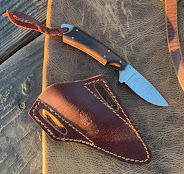
This split braiding is handy for other things as well. I also cut narrow pieces of leather string to feed through make grommets on my belt knives to make a pull strap to help get the knife out of the sheath when I'm drawing it - see picture at left.




 Posts
Posts


