Thursday, July 31, 2014

Cowboy Humor - The Blue Ribbon

Warning! This is PG-17 type humor. A Texas Ranger sent this to me. Since the Rangers are the most respected, honest and incorruptible law enforcement agency ever, I thought I could get away posting this.

The Blue Ribbon

A couple has a dog that snores. Annoyed because she can't sleep, the wife goes to the vet to see if he can help. The vet tells the woman to tie a ribbon around the dog's testicles, and he will stop snoring.

"Yeah right!" she thinks, leaving the vet and heading home.

Later that night just after going to bed, the dog begins snoring, as usual. The wife tosses and turns, unable to sleep. Muttering to herself, she goes to the closet and grabs a piece of red ribbon and ties it carefully around the dog's testicles.

Sure enough, the dog stops snoring! The woman is amazed!

Later that night, her husband returns home drunk from being out drinking with his buddies. He climbs into bed, falls asleep and begins snoring loudly.

The woman thinks maybe the ribbon might work on him.

So, she goes to the closet again, grabs a piece of blue ribbon and ties it around her husband's testicles. Amazingly, it also works on him!

The woman sleeps soundly.

In the morning, the husband awakes from his drunken stupor and stumbles into the bathroom.

As he stands in front of the toilet, he glances in the mirror and sees a blue ribbon attached to his privates.

He is very confused and as he walks back into the bedroom, he sees the red ribbon attached to his dog's testicles.

He shakes his head and looks at the dog and whispers, "I don't know where we were ... or what we did ... but, by God, we took first and second place."


Sunday, July 27, 2014

Raincoat Spooking Horses?


Deb has left a new comment on the post "Scary Objects and Spooky Horses": "I went out this am to feed my two mares in there stalls/runs and it was raining, I wore a dark windbreaker and hood, they both acted like I was bear! I spoke and petted but they both acted too fidgety for me. How best to work it out with them?"

Hey Deb, interesting comment and question you sent in. I think there is a lot about how horses see, especially concerning colors or at low light that people, or at least I, don't understand too well.

Are there some other circumstances like heavy sudden rain catching the horses out in the open? or heavy rain hitting a metal roof and making a God awful racket? I got caught out in the open in a heavy rain storm with a young horse once and he was still all worked up even after I got him underneath some cover. So is it possible that maybe your horses didn't see or hear you coming because of the rain and you caught them by surprise, much like the adrenaline we get when we narrowly avoid being in a traffic accident.

On the speculation on just how well horses see color and at night or low light - you can google it and see a lot of articles on this from scientific explanations or theories to experiments. Here are a couple article on the vision of a horse:

Understanding How Your Horse Sees

How Does Your Horse See?

A couple of years ago I did a short day light experiment where I place several things one of my horse's has never seen on the fence and road him up to each to see how he would react to each. Each item was close to be the same size and there was little to no wind so there was no scary flappiness going on. And before any of you write me and tell me flappiness is not a word,......if you know what I meant, then there is no need to bring my making words up to my attention - leave that to my daughter.

Anyway, back to my experiment. I used a folded blue tarp, a folded section of green canvas tentage and a yellow rain slicker. Which do you think my horse had the biggest issue with? It was the blue tarp. The green canvas tentage and the yellow slicker he had absolutely no problem with. But he was a little concerned with the blue tarp as he stopped and needed encouragement to approach it.

Another time I was looking for some cows that escaped a holding pen at night. I was moving along a dirt road next to railroad tracks and the moon has cast a shadow of a tree across the dirt road. My horse stopped and did not want to move forward. It took me a minute to figure out that he must have thought the shadow was a big hole. I just took the time for him to get comfortable where he was until I could get him to step up into the shadow.  Survival instinct for sure, but bad night vision?  I just don't know.    

Anyway, on your question on 'how to get them through being anxious when you approached in a dark wind breaker and hood',.....the way I'd approach it is like anything else new to them, present them with that situation again, dressed in a dark coat and hat/hood at low light, and see how they react, progressing as slow as you need to go until they are comfortable with your different looking approach.  Good luck and safe journey.   

Friday, July 18, 2014

Military Horsemanship and Animal Packing


The Marine Corps, recognizing the importance of horses for many different reasons, has built very nice horse facilities on both coasts for the stabling of service members horses as well as for  therapeutic horsemanship for wounded Marines, and running education programs such as Vet Tech courses and Horseshoeing program for veterans. The Army, perhaps having a harder time with funding, has taken the reverse course, and in some cases, closing down horse stables on military installations which force service members with horses to find local stables for their horses. I managed the last horse stables on Fort Bliss, closing it down in February 2007.

The story below came out in USA Today about the U.S. Marine Corps Packing Course and U.S. Army Special Forces soldiers (Green Berets) participating in the training. Actually, military pack animal training has been on-going for quite some time. In the 1970's and 1980's, it was common for Army Special Forces units to send "A" detachments to commercial pack animal schools or contracting guide services to run pack training.

Around 1987, the 5th Special Forces Group, at Fort Campbell, Kentucky, started up the 3 week Special Operations Animal Packing (SOAP) Course dedicating full time instructors which trained not only Special Forces team but other military units in animal packing not limited to Horses and Mules. Packing on llamas, dogs, goats and elephants was also taught under the supervision of Master Sergeant Larry Jones. The picture at right is MSG Jones with a sawbuck pack saddle.

The Special Operations Animal Packing Course spurred developent of modified Decker pack saddles, and packing techniques suitable for the loads and special equipment for Special Forces operations, as well as re-writing Field Manual 31-27, Pack Animals in support of Special Operations (Officially released in 2000).

After the initial U.S. invasion of Afghanistan following the 9-11 attacks, Army Special Forces team would rotate through Fort Bliss-El Paso Texas area to train in the desert and mountainous environment prior to deploying to Southwest Asia. Sometimes these deployments to Afghanistan would place an "A" detachment in remote areas where vehicles were sometimes impractical or not available, but Afghani horses were. I was asked to train several teams in horsemanship, so I developed what I called a Functional Horsemanship course for these teams, attempting to make them safe and operable with horses in a very short amount of time.

New horsepower for war zones: Special Forces saddle up

The men emerged over the crest of a ridge and guided their horses along a tree line, skirting a wide meadow. They picked their way along narrow trails, climbing higher into the Sierra until a panorama of snowcapped peaks and a broad green valley unfolded beneath them.

The men, Special Forces soldiers dressed in jeans and other civilian clothes, led their horses into a thick stand of pine trees, where they dismounted and let the horses drink from a clear mountain stream before breaking out their own rations.

At this remote training area high in the Sierra, the U.S. Marine Corps is reviving the horsemanship skills that were once a key part of the nation's armed forces but were cast aside when tanks and armored vehicles replaced them. The need to bring these skills back was driven home in Afghanistan in 2001, when the first Special Forces soldiers to arrive found themselves fighting on horseback alongside tribesmen in rugged terrain without roads. Many had never ridden a horse before.

"We don't want to reinvent anything," said Marine Capt. Seth Miller, the officer in charge of formal schools at the Marine Corps Mountain Warfare Training Center. "These are skills that were lost."

Marine instructors are teaching the students, most of them Army Special Forces soldiers, how to control horses, care for them and load packs. The students are taught how to calculate routes and distances for rides and what to look for when purchasing horses from locals. For example, checking teeth is a good way to determine age and avoid getting ripped off by a farmer trying to pass off an ancient mule or horse.

In a throwback to the old Wild West days, instructors are considering training soldiers in how to shoot from a moving horse.

No one is talking about bringing back the cavalry, but horses are an effective way for Special Forces and other small units to move around the battlefield, instructors said. They can travel long distances quietly and don't require the gasoline and massive logistics trains that encumber motorized forces.

For all its advantages in technology, the U.S. military has been dragged into the most primitive of fights in Iraq and Afghanistan, driving home the point that technology isn't always the answer.

"We get caught up with what's new and high-speed," Miller said.

On a recent morning, 13 students packed their mules and horses shortly after sunrise at base camp, preparing for a 14-mile ride that would take them high into the Sierra, mountains that were familiar to gold prospectors more than a century ago. Students ride a total of about 110 miles during the 16-day course.

"My butt's going to be sore," said Air Force Tech Sgt. Jeryd Leuck, who specializes in search-and- rescue operations, as he prepared to mount his horse, Chesty. Leuck said that before he started the course, his only equestrian experience was a childhood pony ride.

The students mounted horses and picked their way up a steep, shrub-covered slope that would take them out of the base camp. Six mules were part of the patrol.

The animals are remarkably efficient. Mules can carry several hundred pounds and walk up to 55 miles a day, requiring nothing more than grass and water. If required, they can survive several days without water and longer without food. They have no problem climbing to heights of more than 10,000 feet, at altitudes where some helicopters struggle because of a lack of lift.

"This has been proven to work," said Marine Maj. Sven Jensen, operations officer for the training center, pointing to a group of men resting by their horses and mules as sunlight streamed through the trees. "This has worked for the last 3,000 years."

The Marines Corps, which takes an almost perverse pride in a Spartan lifestyle and a fondness for low-technology solutions, has offered a mule-packing course here since the 1980s. It launched the horsemanship training about three years ago after receiving requests from Army Special Forces soldiers.

It's the only such course in the U.S. military, and demand is high.

USA TODAY was allowed unlimited access to observe training as long as it didn't identify by name or photograph the faces of the Special Forces soldiers taking the course. Because they sometimes conduct covert missions, Special Forces soldiers typically request they not be identified publicly.

The only requirement for students is that they are part of the special operations community, since they would have the most use for the training.

Tony Parkhurst, director of the horsemanship and mule packing course, built the curriculum by delving into old cavalry manuals and studying American Indian tactics and techniques. The equestrian sports of today, such as dressage or jumping, are too specialized to be of much use to the military. Instead, Parkhurst studied procedures that were popular when horses were used for transportation and plowing fields.

"The Indians were actually better than our cavalry," Parkhurst said. "They were phenomenal guerrilla fighters."

Cavalry officers in the 1800s had to calculate things such as how far horses could march, how much food they consumed and how best to pack them with equipment and weapons.

The pack saddle used for mules here would be recognized by Genghis Khan's army, Parkhurst said.

The Marines have stopped at nothing in an effort to recapture the skills lost when the military turned to mechanized warfare.

Not many people know how to shoot from a moving horse these days, so the Marines turned to Annie Bianco, who goes by the name Outlaw Annie and is a leading practitioner of the small but growing sport of cowboy mounted shooting. She fires a six-shooter at targets from a galloping horse. A couple of instructors from the training center visited her ranch in Arizona.

Bianco knows how to desensitize horses to the sound of gunfire. "Horses are flighty animals," she said. "Their first response from gunfire is to try and get away from it."

What instructors have discovered is the horses of today are softer than their ancestors, who plowed fields and carried riders over vast distances. "We've bred them and made them more athletic over time," Bianco said. "That's made it more difficult to find the well-rounded horse." Most of the horses used at the course are former mustangs, or wild horses, trained by inmates in the Northern Nevada Correctional Center. They are both well-rounded and cheap.

Although the Pentagon is turning back to age-old battlefield techniques, it is hardly giving up on technology. In fact, it's trying to make a robotic version of the mule. The $62 million program is called the LS3, or legged squad support system, and the Defense Advanced Research Projects Agency describes it as a "highly mobile, semiautonomous legged robot."

The Pentagon consulted with some of the instructors here to learn more about real mules. The instructors seem skeptical that technology can improve much on the real thing. Parkhurst said, "I can buy a whole load of mules for $60 million."

Saturday, July 12, 2014

Review of CSI Saddle Pad


Having worn out a couple Impact Gel saddle pads, I was looking to buy another good saddle pad. I have used about every type of saddle pad,...sheepskin lined, felt, and even neoprene saddle pads, which I used under a blanket and mostly for arena roping. I never liked the neoprene pads and how they build up heat under the saddle no matter how many air holes they had.

I did work with SaddleSkin, in developing a saddle pad from a non-natural material that is the same Cooling and Trauma Attenuation material and design that is used between body armor and the user's clothing, to reduce trauma from bullet impact to body armor being absorbed by the body, as well as to provide a cooling effect to the skin surface. The SaddleSkin worked as advertised, protecting the horse's back and keeping the Horse's back cooler through air channels and holes. I also found that the SaddleSkin also kept the saddle from slipping.   However, I just really like felt pads, so I was looking to get a felt pad replacement.

I have known about CSI Saddle Pads for a couple years now, but the price kind of put me off, so after a couple of months of getting used to the idea of spending that much money, I finally ordered one directly from CSI.

Much like the Impact Gel Saddle Pads, which uses a gel pad in between layers of felt to absorb and reduce trauma to the horse's back, the CSI Saddle pads uses what they call a "flex plate" to dissipate trauma from pressure of the saddle's bars on the horse's back. The flex plate is visible in the photo at left.


The CSI Saddle Pad is actually a two piece pad. The bottom piece is a traditional felt pad, available in 1/2 inch or 3/4 inch thickness and a top piece that is automotive carpet sandwiched around the flex plate. There is a thin line of velcro sewn into the bottom spine of the top pad (flex plate) so that it can mate with the bottom felt pad and not slip. The photo at right shows the two layers and you can see that the bottom felt pad is relieved to reduce bulk for the front cinch.


Both pieces have air holes that line up and are designed to let heat escape the horses back.    The photo at left shows the air holes in the spine of the pad.  The bottom felt pad is reversible as well, extending the using life of this pad.  And as you can see from the two top photos, the CSI pad is formed for the withers.  It fit nicely on the three horses with varying wither heights that I tried it on.  I don't think anyone would be disappointed with a CSI Saddle Pad.


CSI hosts a series of videos    on saddle fit, horse balance, back and health issues. In the video below, Rhonda Martin discusses how saddle fit affects the function of the horse.


Saturday, July 5, 2014

Saddle/Tack Tip - Saving your Blevins Buckle Keeper


Have you ever seen a Blevins Buckle come undone when someone is riding? It's usually caused by the blevins buckle keeper coming off or riding up allowing the blevins buckle to pop out of the holes in the stirrup leather. When this happens, it's possible for the rider to have enough weight in the that stirrup to cause him or her to lose their balance and come off, particular when riding to the inside.

Sometimes it can even be funny. Years ago I was working with my daughter and her friend running barrels and my daughter's friend's father, who was one of those guys who thought he could bend a horse (not to mention people) to his will, butted in because he didn't like his daughter uses both hands (direct reining) when riding - he was calling it "plough reining".    Anyway, he took over his daughter's horse to demonstrate what he wanted and as karma would have it, he went around a barrel, and lacking a stirrup hobble, the Blevins Buckle came undone, his stirrup fell off and so did he. He got mad and went away,.....I'm just glad he went away...the horse was glad too.

Most people ride with Stirrup hobbles on their saddles, not only to keep the stirrup leathers together, but to keep the Blevins Buckle keeper from sliding off the stirrup leather. On a couple of saddle's I not only use a stirrups bobble but I use a slotted concho and length of saddle string to create a button on the bottom of the stirrup leather to catch a loose Blevins Buckle keeper as a backup to the stirrup hobble. You can run the piece of saddle string through two of the holes intended for the blevins buckle, or you can punch a new hole new to an existing hole for the saddle string to be run through the slotted concho. The photo at right shows the blevins buckle keeper and the slotted concho I rigged at the bottom of the stirrup leather.


The photo below shows how this appears when the stirrup is turned when your foot is in it.  It does not interfere with my boot going in or coming out of the stirrup


I was in a Jackpot the other weekend when one of my partners lost her Blevins Buckle keeper. She did not have any stirrup hobbles, so when she eventually found it and got her saddle all sorted out, we ran a short piece of saddle string through a couple of the holes below the Blevins Buckle to catch the Keeper if it came loose again.  Always handy to keep an extra piece or two of leather strings around. 

Some of us short legged riders will also have the issue of too long of stirrup leathers producing a length of leather hanging down. Not necessarily a good idea to cut these off as it restricts lengthening the stirrups for longer legged riders.

Usually the excess length is wrapped around and kept in place with the stirrup hobble, but sometimes it's not long enough do that. On one of my saddles the excess stirrup leather was too short to wrap around so I punched three holes in the bottom of the excess stirrup leather and tied it into the stirrup hobble. The photo below shows how that is rigged and how that looks. Hope this helps someone out there that may have this similar problem.


Thursday, June 26, 2014

Safe Tying Solution - The Functional Tie Ring


Most of us had had a horse spook while tied. What normally happens, if the horse is tied hard and fast, is that the fear of whatever spooked him is exacerbated and/or replaced by the fear of being confined by the halter and the pressure of that halter on his poll (behind his ears), and sometimes pressure behind the jaw and on the nose if the halter is fitted right.

The weak spot in most halters is the metal snap connecting the lead rope to the halter - this usually breaks when a horse pulls back hard. If you are using a tied on lead rope, like on a rope halter, the halter itself can break.  Had that happen once.

If your horse is in a trailer when the halter or lead rope breaks, the horse can drive his head into the top of the trailer and sometimes with fatal results.

Have you ever seen a horse spook while cross tied? If the surface is slippery, the horse's feet can go out from underneath himself and a neck or leg injury is possible.

There are several tying devices on the market that allow the lead rope to be fed through a ring so when the horse pulls back a friction controlled release is obtained. The Clip is one such device. The reason I'm not fond if it, is that the ring (hole) that the lead rope is fed through is pretty small making it hard to fed larger diameter lead ropes through, and, one side of the clip has a rope channel with a knurled screw type device that is designed to be used to tighten the rope so it won't feed out if you prefer, but it can damaged lead ropes if you aren't careful or if the horse pulls back.

Another device is the Blocker Tie Ring or Aussie Tie Ring, which is pretty much the same purpose, but the design is a little different in that is uses a pivoting, magnetic arm for the rope to feed around.   

If you are not familiar with the Blocker or Aussie Tie Rings, it may be easier to go to the link to see them, but basically this device resembles half a snaffle bit. A lead line is fed through a ring and a pivoting arm is flipped up between the bite on the lead rope. A magnet on the pivoting arm holds the arm in place. I have seen a lot of these in use, but again the size of the hole is just a little bit small for my liking and it is possible to feed through a lead rope backwards so that when the horse pulls back the arm releases and frees the horse. To be fair, if someone isn't paying attention and "reverse ties" a horse then they probably have other problems as well. The main advantage with this tying device is that it can stay connected via a snap link while the lead line is fed through and the pivot arm flipped up into place.

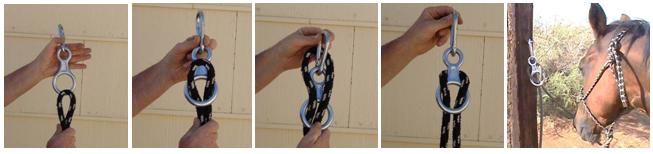
For about 10 years now I have been using a different tie ring and after being asked repeatedly to make it available to others, I applied for a patent and received a provisional patent on what I call the Functional Tie Ring.


There are other uses for the Functional Tie Ring other than to quick tie horses.  Using the Functional Tie Ring you can teach your horse not to pull back but putting some pressure on him and causing him to pull back where his body weight pulling back feeds the lead rope through the tie ring in a controlled manner giving him a release.  When you repeat this the horse will pull back less and less, figuring out that he doesn't need to pull back at all.

If you use thicker three or four strand cotton ropes for leads ropes, they are easy to fit through the big hole and loop around the Functional Tie Ring, more so than if you use another tie ring with a smaller diameter hole.  And the Functional Tie Ring is reversible - you can hook the snap link to the bigger diameter hole and use the smaller hole to feed smaller lead ropes through, like if you are using the lead rope or get down rope portion of mecate reins. 

I use my tie rings on the cross ties on my shoeing stand and wash stand.  I've had horses pull back once in while but it is a minor event compared to what usually happens when a horse pulls back then feels that pressure from the halter and panics. 

I also use the Functional Tie Rings looped through a rope from my trailer to a tree or pole creating a high line to picket my horses on.  This provides a loop to snap or tie your leads onto.  And lastly a note on bungee trailer ties.  These are bungee cords with snaps and both ends and are designed to provide the horse a release when they pull back.  I advise never to use these. I have seen twice, maybe three times where a horse has pulled back, breaking the bungee or the snap and having that elastic cord snap back and hit the horse in the face.    

The video below helps explain how I use the Functional Tie Ring.  You can click on the link here to purchase a Functional Tie Ring, and these is a static link on the left hand side of the website. 

Safe Journey to you and your horses.   


Tuesday, June 17, 2014

Do You Use Protective Boots on Your Horse?


One of the things that will drive your heart through stomach is the sight of a bowed tendon or any number of other leg injuries that potentially can make a horse chronically lame.  There are good products such as sports medicine boots and bell boots available that can help reduce these injuries. I think horse owners should consider whether their horse can benefit from protective equipment during the many different types of activities and riding environments they are using their horses in.

While splint boots and sports medicine boots are different,  some people have taken to using either term to describe both. I use what the industry calls sports medicine boots which are basically wraps, with a neoprene liner, and secured with velcro, that cover most of the pastern, cradle the fetlock and wrap around most of the cannon bone to provide support to those tendons and protection from trauma such as the horse clipping his leg with the opposite foot. If the horse is wearing shoes this can result in a pretty significant cut and damage to the flexor tendon.

Bell boots, also called over reach boots, protect the heel bulbs from the back feet over stepping and clipping the heel bulbs. Again, when wearing shoes this can be a pretty bad cut and usually lames up a horse. Sometimes when over reaching, the back feet can step on the back end of the front shoes and spring a shoe. Riding horses long enough and you'll experience one or the other, or both. Bell boots can protect your horse's front feet especially when riding in events or terrain that make over stepping more likely. While there are inexpensive pull on rubber bell boots, I prefer the wrap around bell boots that have a velcro closure in front and a raised guide in the back that fits between the heel bulbs to keep the boot from turning (called "no turn" boots).

Riding, especially in a lope, in deep sand can make over stepping more likely and cause an injury as can events which require direction changes at speed such as cutting or roping. I suppose jumping horses can be prone to heel bulb or tendon/ligament injuries as well, but I can't speak from experience on that as I only jump horses on accident which usually results in the horn of my saddle making contact to my gut, or, worse yet, other vital areas. 

While I didn't always put sports medicine boots and/or bell boots on my horses, now days I err on the side of caution and if I'm exposing or using my horses in certain events I'll usually put one or the other, if not both, to give my horse some protection.   


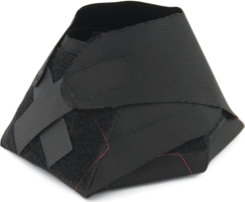
The other day I went to do some ranch sorting so I put sports medicine boots on my horse. When we got back and took off the boots I notice a tear in the inside left boot which indicated my horse catching his left leg with his right front hoof.   See picture at right.  

So somewhere between trailering him back and forth and sorting cows in the pens, this occurred. I was pretty much glad that I put those sports medicine boots on.

Professional's Choice and Classic Equine are two of the companies making hoof and leg protective gear.  A pair of sports medicine boots starting at around $65 and a pair of decent bell boots for under $30 can make a good addition for a safe ride - just give it a thought for your horse.
 

Thursday, June 12, 2014

Wild Horse Contraceptive Pilot Program


This is a report from the American Wild Horse Preservation Campaign (AWHPC) on a fertility control program on Wild Horses using the immunocontraceptive drug PZP. This drug is administered through a dart gun. This is a one shot vaccine which has an effectiveness of one year. Reported to be well under $30 a dose, this seems like part of a good solution to minimize the growth in Wild Horses herds. Maybe it’ll also keep the gathers down where rough handling and abuse is pretty much normal, and makes me just sick to see horse's treated that way.

The American Wild Horse Preservation Campaign, under the auspices of its parent organization Return to Freedom and in partnership with the Bureau of Land Management, has embarked on a pilot fertility control program for wild horses living in the Fish Springs area of Gardnerville, NV. The horses are living in a Herd Area adjacent to the Pine Nut Herd Management Area (HMA). Learn more about the program here.

AWHPC's Deniz Bolbol was in the field April 23-25 to remotely dart mares with PZP fertility control. She reports:

This project is a great opportunity to make Fish Springs a model pilot program of private-public partnership and community involvement of fertility control for wild horses. Like other BLM HMAs - Little Book Cliffs in Colorado, McCullough Peaks in Wyoming and others -- the local community is volunteering to help the BLM manage wild horses in the Fish Springs area of Gardnerville. The program is targeted to manage and reduce the number of horses in the Fish Springs area through humane fertility control and natural attrition. Had this pilot program begun in November or December 2013, as we recommended, we would have worked to immunized all mares. But the wheels of government turn slowly, and the project did not receive the go ahead until recently. As a result, we are doing the best we can with the situation this year, given the late start.

To date this year, 9 foals have been born. This not only makes those 9 mares non-candidates for fertility control (because they could have already bred back making fertility control efforts futile as PZP is safe and does not negatively affect or abort fetuses), but also complicates efforts to administer PZP because newborn foals are highly guarded by their mothers and families making the horses difficult to approach. To protect foals - the most vulnerable members of the family - mares are increasingly flighty and less tolerant of humans approaching them. This heightened protectiveness hinders the PZP darter's ability to get close enough to dart.

Our experience in the field this week resulted in the darting of a number of mares, and increased our knowledge base about the Fish Springs horses and the necessary ingredients for a successful fertility control darting program. We look forward to returning and working closely with the BLM and the local residents to humanely manage these beautiful wild horses.


Tuesday, June 3, 2014

Surviving the Heat - Horses and Humans


What prompted this post is the heat wave that many parts of the country is facing right now. Here in West Texas, after weeks of mid to high 90's in May, we are now experiencing 102 to 109 degree temperatures with no relief in sight. This of course poses the danger of dehydration and heat injuries to humans and horses alike. To horses there is not only an increases in the chance of colic, but kidney failure as well.

Dehydration happens when the horse or the human loses water and electrolytes, normally through sweating, and fails to replace it. The average horse owner can tell a horse may be dehydrated by excessively dry manure or even a lack of manure; general lethargy of the horse; decreased capillary refill of the gums; decreased skin elasticity; and a lack of saliva especially if you are riding with a bit that would normally help the horse salivate.  Horse can appear to be drawn up where their barrels met the haunches. You may not recognize it as dehydration, but you'll know something isn't right.       

I have a hard time telling the color of the gums or how fast the gum's re-fill after removing pressure with my thumb but I do use the skin pinch test. I'll use my thumb and fore finger to pinch loose skin on the neck (some prefer the back) and see how fast it lays back flat. If the loose skin fold stays tented it means the horse is dehydrated.

Another thing to look for is how often your horse urinates and how clear the urine is indicating the level of hydration. Just like human's yellow tinged urine can be a result of mineral or vitamin supplements if you feed those, but certainly your horse is having hydration problems if the urine is more darker than clear and appears to be thicker.

The key to preventing dehydration, and potentially a serious heat injury, is prevention. The horse needs access to fresh water 24/7. Fresh water is not just a stock tank with water - it is relatively dirt and debris free water. When I ran a large horse barn, the most common interaction I had with owners was the lack of adequate water for the horses they boarded there.  All horses are different in what they consume water wise in a given day, but is doesn't take long to figure out what is normal for each horse. 

Many like the automatic waters. Ritchie is the most common name in automatic waterers. I don't use automatic waterers as I prefer to be able to gauge the amount of water my horses take in each day. But these devices can certainly save time and are easier to clean than a large stock tank.

Horses also need at least a white salt block to replace the lost sodium. This is a very cheap solution as one $5 or $6 salt block will last a horse for along time.   For some horses, a mineral block is a better solution, although most of the cheaper mineral blocks are mostly salt. My horses won't lick these mineral blocks, so I keep a couple of salt blocks available to them free choice. If you are concerned about your horses getting the proper minerals then there are a couple of good choices on the market in the form of solid blocks: Redmond Rock advertises 60+ minerals in the Redmond Rock. ADM Alliance offers their Moormans Grostrong (Mineral) Quad Block which comes scored into fourths so a quarter can be broken off and placed in a horse's feeder if you have horses that are fed separately.

After abundant, clean water and at least a salt block is provided to the horse, I believe that to give a horse a fair life, a shelter where they can get out of the Sun (and rain) from time to time is necessary. It makes me angry at owners and sad for the horse when I see them day after day in pens without overhead cover or anything to provide shade, and especially so when these pens are small and cannot provide adequate room for exercise. In fact, that's a slow death for a horse - to be placed in a small pen, again day after day, and only have contact with another living being once or twice a day when the owner can be bothered to throw feed to the horse.

One more thing I do if I going to riding in really hot conditions is to let the horse eat water soaked hay out of a bucket.  Maybe you can't make them drink, but if they are hungry they will the wet hay getting a substantial amount of water. 

Humans need to be concerned about dehydration as well. Most of us wake in the morning in a state of slight dehydration. Drinking a diuretic like coffee then doing chores in the hot Sun without water creates a susceptibility for a heat injury. Some people, either because of embarrassment or maybe their horse are too tall for easy mounting, will actually reduce their water intake as they don't want to have to dismount and pee some place. These riders need to be aware that dizziness, headaches, fatigue, dry mouth, darker urine and/or decreased urine output are all signs of dehydration - you better then some water into yourself pronto.  I suggest drinking 8 - 12 ounces of water when you wake up, before your coffee.

And don't save your water for later.  If you want to ration something, ration your sweat and your direct exposure to the Sun.  Drink your water - it won't do you any good otherwise. 

Even in the winter time, I never head out on horseback without a canteen. And there are options other than the canteen looped around your saddle horn. Saddlebags are a good option to carry water bottles and a Camel-Bak or other hydration pack worn over your shoulders backpack style are good things to do to ensure you carry water ,.....now all you have to do is drink it. In fact, Camel-Baks are great since if you get throwed or if your horse runs off on you, you'll still have your water supply with you.


Monday, May 26, 2014

Memorial Day - 2014


On this Memorial Day, remembering those who gave the last full measure of devotion. If you ever think things are turning south for this country, all you have to do is take a look at those young men and women who gave the last full measure of devotion or those who left one or more limbs on far off battlefields to keep those real and dire threats as far away as possible from this Country, and you will know that this country still continues to produce great and selfless people.  God bless and care for our fallen and our wounded.   

John 15:13 "Greater love has no one than this, that one lay down his life for his friends".  
 

Tuesday, May 20, 2014

Cold Backed or Crow Hopping Horse


Paul wrote in: "First off I love your site and the education and advice you provide. My horse often gives me a hard time when I go to ride him. He's 17. He starts with crow hopping and sometimes light bucking and so far the only thing that works is for me to get off him and lunge him for 30 minutes or more and then he gets quiet. Any suggestions as it is becoming so time consuming when I want to ride and lose way too much time in the process. Thanks."

Thanks for writing Paul. Assuming no problems with the bit or saddle fit, you already have one part of your answer - when you lunge him he gets quiet. That's because you are making him work, directing him to move his feet. And I think this only works when the horse is engaged with you. If he is moving around and distracted, like with his head looking outside, then I would change directions, and change directions often.

So when I have a horse that wants to throw a little fit, I make him work. When we make them work it forces the horse to focus on us. You have heard the saying "making the wrong thing work and the right thing a release", so when you give them a break from work, it's noticeable to them. I think some people approach this from the other end, thinking the work is punishment and they want to horse to understand when they act up, they get punished with work, when it's actually wanting the horse to seek the release.

An example is when a person tries to mount and the horse moves off. Sometimes the rider will jerk on the lead line or reins and try to make the horse stand still which usually doesn't work, then tries to mount again. If that rider would move that horse around, moving his feet with energy, then allow the horse to stand, the horse feels that release and will most often now stand for mounting. The rider didn't get to this point by punishing the horse,...they got to it by moving the horse's feet then allowing the horse to feel the release.

The other thing is to get him to agree that you are in control. Again, we do this by making them move their feet. This can be lunging him or it can be backing him,...or, moving his hind end or his front end over. Practically anything where you direct him and he complies, accepting you as the leader. When I take a young horse or an older horse with an attitude, in hand (under halter), I stop him, back him, get him to come to me, move his front end over, and move his back end over. It is sort of like a pre-ride ground check.

And when you think about it, working and moving the feet are the same thing, or working is the idea and moving the feet is how to get there.

Having said all that, no amount of lunging will take the buck out of a horse, so when I lunge a horse before I ride it is to warm him up and let me check for any problems, and to reaffirm to him that I'm in charge by moving his feet under my direction.

But sometimes you just got to get to work and don't time to lunge a horse, so as I lead a horse from the corral to the tie rail, I'll stop him, back him, have him step out on a light lead past me, and roll his back end away and bring his front end over. I may throw the lead line over the side away from me and have him disengage his back end then bring his front end over. All this takes just a few minutes and serves notice that we're getting ready to go to work, kind of like a reminder that you are in charge.

One of my horses, who is coming 13, is really good as crow hopping early in the ride if I asked for a lope, or sometimes when I hold him back and he wants to run. I don't get down then lunge him, but I may do several different thing. I just may double him, rides circles, or stop and back him 30 feet or so then trot out,.....if I'm asking for a lope and he crow hops, sometimes I'll push him into a gallop and when he wants to slow I won't let him.

Your question is a common issue, and while I certainly don't have all the answers and I hope this helps. If it doesn't then keep seeking the answer. Safe journey.


Wednesday, May 14, 2014

Bosals and Hackamores, What's the Difference?


I have received two e-mails with these comments: #1: "I don't like a Bosal. I think they are too harsh on a horse. I prefer a Hackamore." #2: "What is the purpose for the rope underneath the horse's head for your Hackamore?"

I'm not sure how to answer the first question, other than it shows the sometimes confusion over a Hackamore and the Bosal.    What is pretty clear is about anything you place in a horse's mouth or over a horse's nose can be harsh and cause pain if you are too hard and fast with your hands operating the reins. Granted, there is a lot confusion concerning terminology on bosals and hackamores, but when I use the term Bosal, I mean the nose band by itself. I use the term Hackamore when the Bosal is connected to a headstall and reins.  In the picture above right, I have the headstall connected over the side button of the bosal as opposed to between the side buttons and the nose band. I like it this way so the headstall is not so close to the horse's eye.


Traditionalists and really good horsemen (I am neither) will use a Bosal with just a hanger rather than a headstall. A hanger is really a leather strap that goes over the horse's poll and sometimes a thin leather string will be tied from the Bosal to the horse's forelock to help keep the Bosal in place.


I use a regular browband headstall with a fiador (see the picture at right). The "rope under the horse's head" is the fiador which keeps the horse from shaking the headstall off his head and keeps the horse from shedding the headstall when you are on the ground leading with the rein portion of the mecate reins. The fiador needs to be pretty snug behind the jaw.  In the picture I am taking up slack in the left rein causing the slack in the fiador.  When pressure on the reins is released, the Bosal will drop back into place.    


The Mecate rein, also called McCarthy reins, are a one piece rein, usually 20-22 feet long, connected to the Bosal by tying it into the Bosal above the heel knot and using the excess as a lead line when leading the horse in hand. When riding, this lead line can be coiled and tied to the saddle using the saddle strings (see photo at left), tied to the saddle horn, or is fed up through the rider's belt so it can be fed out easily when pulled from the Bosal end - this way if you come off the horse accidentally, you won't be drug if the horse takes off on you.

The part of the Bosal over the horse's nose is called the nose button and there are difference thickness. Given the same quality of braiding on the nose button, bigger diameter nose buttons will spread out and therefore lighten the pressure on the nose more so than a thinner bosal. As a horse becomes more finished in the Hackamore, a lighter and thinner Bosal would normally be used.

A direct rein is normally used when riding a horse in a Hackamore, especially in the beginning as the mecate reins connect at the bottom of the bosal, just above the heel knot and direction can be unclear or confusing to a horse in the beginning. Neck reining can be introduced as the horse becomes good in the hackamore and be built upon.

Certainly an improperly positioned hackamore, too low on the nose and over the soft tissue and cartilage can hurt a horse, and being too harsh with your hands can be painful as well, but there is no reason to think a bosal is in and of itself a harsh tool. In fact, I think a horse that is normally bitted can benefit from also be ridden in a bosal if for nothing more than a break on his mouth.


Saturday, May 10, 2014

Wild Horse Rescued from River


A reader sent me this article from ReShareWorthy on a wild filly that was rescued from a swift river. Finally a article about Wild Horses with a good ending.

This Wild Baby Horse Was Totally Exhausted And Had Lost All Hope. Then These People Saw Her.......

I wasn’t expecting to see the wild animal rescued in this video turn out to be a baby horse, but that’s exactly the animal these wonderful people saved from drowning. The young wild filly had slipped down a river embankment and fallen into the raging waters of Trout Creek in Summerland, BC, Canada. The 6-month-old feral horse had probably been stuck in the ice-cold water for several hours when she was spotted by a woman while she was walking her dogs. She immediately called O.A.T.S. Horse Rescue, who got together a team of volunteers to go help the drowning horse.

When O.A.T.S. volunteers arrived at the river, the filly was clinging to the rocks. She was exhausted and suffering from hypothermia.

The volunteers were joined by the Summerland Fire Department and local Royal Canadian Mounted Police (RCMP). It was a difficult rescue as the rescuers had to battle the violent waters and slippery surfaces to get to the frightened horse. Not only that, but because the horse was wild, she was scared of human touch.

Eventually, they lassoed the horse and used a tarp and sheet of plywood like a stretcher to hoist her safely out of the water. Although she got scraped up, thankfully her injuries are all superficial and will heal. The rescued filly has been aptly named River. She’s currently recovering in foster care and when she is well enough she will be made available for adoption! That's her in the picture at top. What an amazing group effort! I’m so glad River was saved and will be looked after from now on.

If you would like to contact O.A.T.S. Horse Rescue, contact Theresa Nolet at bullterrier@shaw.ca

O.A.T.S. will accept pay pal donations at this address.  I sent them $25, if everyone reading this could send even $5, this rescue organization would be set pretty good for awhile.  Watch the awesome rescue in the video below and pass this story on.   


Sunday, May 4, 2014

Saddle Bags for the Trail


Ford wrote to ask "Where (did you get) and who makes your saddle bags?"

The two saddle bags I use most can't be found on the normal tack sites as one of them is not being offered anymore to my knowledge and the other one was custom made by a friend in San Antonio to match a saddle. The saddle bags in the picture above below are: At left - an older set that I have had for 15 years or so and even though they are well made from quality leather, I have had to repair the side stitching once or twice, due to rough use and not the craftsmanship. The saddle bag in the middle was made by friend of mine in San Antonio to match the carving on a old saddle; and the bag at right, actually a canvas cantle bag, was made by Sawtooth Saddle Company.

I think the saddle bags that Ford was asking about is the one at top left, and again this particular saddle bag is not offered anymore.  The good news is that there are many makers out there making great saddle bags.  I have posted pictures of two offerings of the same style as my old bags.


Sawtooth Saddle Company, well known for their excellent saddle also offers about every piece of custom tack you would want.  They mad the Cantle bag pictured at top right.  Cantle bags can be used by themselves or tied behind the cantle of the saddle after saddle bags are positioned.  One of the Sawtooth saddle bags available is the one pictured at right.  Everything they make is quality so you can't go wrong.  


Craig Cameron also offers a very nice saddle bag in the same style - small bag with single strap closure.  I really like the smaller bags since I can pack get everything I think I need for most day rides into the mountain.  I like to carry a Hoof Wrap, Vet wrap, compressed gauze (actually tampons), wound powder, binoculars (Leupold 8x42mm Acadia), small Plammers (fencing tool), small amount of spare wire for fence fixing, a couple foot section of saddle string for tack repairs, and usually a bag of jerky and some peanuts.  During snake season I'll pack greased up tubing in a sealed sack just in case.  All this will easily fit in these small saddle bags.  And like Sawtooth, everything Craig Cameron offers is high quality gear.    


  Check out both links and see if either will meet your needs Ford, and drop me a line if you find something.  Safe Journey. 


Tuesday, April 29, 2014

My Horse Needs to Lose Weight


Barbara wrote to ask about getting her horse to drop weight..."I spent about two months recovering from a broken ankle so I enlisted some friends to feed my horse. I left some detailed instructions and consistently talked to the two ladies who fed for me. Imagine my suprise whern I finally made it out to the barn and discovered my mare looking nine months pregnant! I usually feed alfalfa, smaller amounts of grass and one large coffee can of sweat feed which is about three pounds, but only in the evenings. Can you give me what your ideas would be on how to get my horse to safely drop weight? Thank you, Barbara."

Hey Barbara, I hope you are not writing me thinking I am an expert on horse feeds, because I am  not. I have just experienced many people impacting horses, usually in a bad way, by following feed routines and not knowing either why they are doing or what issues their feed practices can cause.  And many horse issues can feed issues.   

I don't feed sweet feed, primarily because of the high sugar content and chance of the feed to go rancid or mold, and I think my horses' nutritional needs are being met without it. I am not saying that Sweet Feed is dangerous for horses, I just don't use it, and think most horse's don't need it. I do use a pelleted feed from ADM called Patriot.


I'd make sure your horse is over weight, sometimes their looks will just fool you. If your horse can stand to drop some weight, there will normally be fat deposits on the neck and in the shoulder -above the shoulder area.

Other areas to look at would be the ribs - you should feel them with your hand and/or see them when the horse moves - if not your horse is probably over weight. Also the spine area where the fat may be higher than the spine, and the butt-tail head area where fat also usually deposits. The horse in the picture can stand dropping some weight. This mare, in the pictures and bottom right), falls between the fleshy and fat category and needs to lose some weight.    

To your question about getting your horse to drop weight,......safe weight loss is more about activity or exercise than feeds. The more exercise they get, the more calories they burn and given the same amount of feed they will lose weight. A moderate amount of daily exercise, riding, lunging or even turnout can be effective without changing your feed amounts, at least changing them too much.

Changing feeds and/or your fed routine is a gradual process. If you are planning on reducing your horse's feed, without increasing exercise, to get her to drop weight then I would suggest a very gradual reduction in her feed. I had a horse that was a little too heavy that I couldn't get to for a month or so, so I reduced his hay by about 1 to 2 lbs day and within a few weeks, maybe four weeks, I could tell he lost some weight and did so safely.

If you do decide to lower the feed amount, then gradually is the key. 

According to Equine Clinical Nutrition, by Lon Lewis, an average 1,100 lb horse needs 16.4 mega-calories (Mcal) of digestible energy per day just for maintenance. When light work is added that 16.4 Mcal can be multiplied by 1.25 and hard work can increase that factor to 2.0. That doesn't mean after a long hard ride that you need to give your horse twice as much feed, but I'm quoting Lon Lewis to pain the picture that added exercise will often solve the problem.

One more thing,...a good feed resource is a book called The Horse Nutrition Handbook, by Melyni Worth,...might help you pass the time as your ankle fully heals. Good luck Barbara.


Sunday, April 20, 2014

More on Ground Driving


I received a couple of questions on ground driving and thought I would answer them here to clear up any questions from the previous article on ground driving.


Yes, Jack, I think this is something you can do with your colt prior to your first ride. I would make sure your colt was giving to lateral pressure or following your reins or lead line when you ask him to tip his head to one side and the other. The pressure or pull coming from the driving lines, run through the stirrups to either a bosal or halter is going to be different as it comes narrower angle than when you are using a lead line and standing at the horse's shoulder asking him to give to the pressure because you are normally pulling at a much greater angle in a more lateral manner giving the horse a clearly signal.


Lynn asked is she would be able to use her  driving lines just by attaching them to the bottom part of the bosal? Or should be get smaller diameter bosal like I was using in the video? 

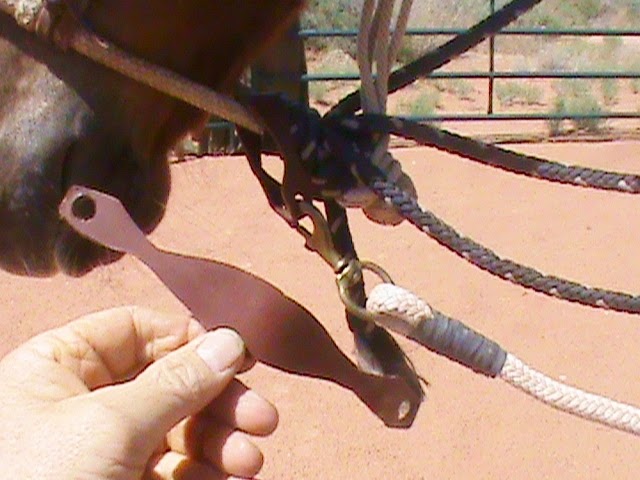
I wrote Lynn separately but did not include any pictures. Sometimes bosals are fairly thick where the bolt or other snap on driving/lunge lines can't connect to them,.....at least the size bolt snaps I use on the lunge lines/driving lines that I make.  So I was throwing feed yesterday morning, thinking about how I would connect driving lines to one of my thicker bosals, when I had what people back east call an epiphany. It's not like I get these often. In fact, I clearly remember my last epiphany when I caught my wife's favorite oven mitt on fire and my epiphany was that "I'm in big trouble."   I ended up blaming it on the cat (believe me - he deserved it) and everything was okay. But back to driving lines,....... I thought of making a small set of slobber straps to go around the bosal where I could connect the bolt snap of the driving lines to.   About 30 minutes later, using some scrap leather, I came up with the connectors in the picture above where you can see the bolt snap on the white driving line is connected to the mini slobber strap around the bosal just above the heel knot.        


As far as tying up the reins, if I had mecate reins, I would loop the reins part of the mecate around the saddle horn, then tie the lead line portion of the mecate around the horn. I use a clove hitch knot for this and snug it down.    

This keeps the rein portion of the mecate from bouncing over the saddle horn and becoming a problem such as the horse stepping through it.


If using spilt reins, I just tie the reins in a square know around the horn.  The picture at right is how I had the reins secured in the ground driving video.
 
However, if you were ground driving with as halter just remove the lead line.


Sunday, April 13, 2014

Ground Driving Your Horse


A computer crash did away with many questions people have sent to me along with pictures and videos that I intended to use to try and answer with. Someone wrote to me several months ago about ground driving their horse, which is basically moving and controlling your horse by using reins from a position on the ground and behind your horse. The first time I saw this was maybe 8 or 9 years ago when Craig Cameron demonstrated it.  It made sense to me then and ever since I have it in my tool bag to use when I think the horse can benefit from it.

Ground driving is something that can help a horse that is troubled by rein control under movement or having an issue with someone his back and trying to accept direction from pressure on the reins. It can be good preparation before that first ride or a tool on a horse that is still a little troubled after the first couple rides.

Using long lead lines or lunge lines, you feed the snap end of the line through the stirrups and connect to the halter. I would not use any bit when ground driving because there is a lot of rope to handle and an increased chance that the horse may get into trouble like stepping on the line and cutting his tongue. So I use either a halter or a bosal and I'll clip the bolt snap of the lunge line to the cheek piece of the halter or to the bosal just above the heel knot. I'm using 25 foot long lunge lines that I make from 1/2 inch diameter yacht braid rope putting a brass bolt snap on one end. Twenty Five feet is a pretty good length for an all around lunge line/driving line but some people ask me to make them shorter ropes in the 20 to 23 feet length,...just personal preference, but it needs to be long enough to allow you to stay at a safe distance from the horse's rear feet.

Before you start ground driving your horse be sure that he is okay with ropes across his butt, hocks and lower legs. Before I get to the point of ground driving a horse, I would have already sacked him out on ropes around his legs, hocks and butt. But it's important enough to check that he is good with it again before you ground drive him. If you have reins attached to a bosal like I do, either remove them or tie them up securely so it won't be an issue coming loose and having the horse step through them.

Make sure when you pickup the ends of the lines that you are far enough away from the horse not to get kicked - sacking him out on ropes across his butt and rear legs will help minimize a reason to kick, but be careful nonetheless. You are only really using one line at a time. The idea is to keep a loose line only putting a little pressure on one line to get his head tipped for a change of direction and using one line to flick it against his barrel, like you would use leg pressure, for a cue to go forward or to increase his gait. Start off at the walk and don't go to the trot until you and your horse are good at changes of direction and stopping at the walk.

Remember that if you or your horse gets into trouble at any time, let go of one of the lines and bend your horse to a stop with the other line.


Wednesday, April 9, 2014

No Time for My Horse


Dorothy wrote me with the following questions: "I think I'm like many people out there having a horse and not having very much time to ride her. My children and husband take up almost all of my time and sometimes when I get a chance to ride it's only for an hour or so. The lady who keeps my horse turns her out almost everyday, but aside from bringing her back from the paddock and feeding her 3 or 4 times a week and riding only a couple days a month, I wonder if I am doing her a disservice by keeping her instead of finding her a good home. A good home would have to include an intermediate rider as my mare has some issues, some of time, LOL. She has her own strong will and the short amount of time I can spend with her doesn't seem to be making that big of difference. "

Hi Dorothy, what mare doesn't have issues some of the time? It says a lot about you to consider your horse and her welfare. At least you are cognizant that your mare needs more time than you can give her. I hope she is being kept with other horses, either stalled side by side or in turnout with others as horses are social animals and most of them need contact with other horses for a good mental state. 

I see many horses not only kept singular, but also kept in small pens. I think keeping a horse in a small pen can be mitigated somewhat when the horse is put in turnout at least a couple times a week, plus has more human interaction other than just feeding once or twice a day.

Some people think if they don't have time to ride their horse then all they can do is throw feed. I think that needs to be looked at from a different angle.........how can you maximize the small amount of time you do have to make your horse better?

I'm convinced that even if you only have 5 minutes to spare, you can do 5 minutes of training or re-enforcement with your horse. Work on having your horse back up and stand still, away from you when you throw feed; get her to drop her head upon voice command or a cue. Work on directing her feet: have her move her front end over; have her move her back end over; have her back up. And these are things you can do with or without out a halter or neckrope.

With a halter leading her to and from the turnout, you can work on her leading up correctly: stopping when you stop; backing up. See how light you can make the cue before she reacts. See how light you can pickup slack in the lead rope before she moves out. Watch for her anticipating and correct her. And when you do stop, watch her to make sure she stays focused on you - giving you both eyes. If she gets distracted just bump her back to two eyes on you.

Under the lead rope you can work on vertical and lateral flexion, and again, moving her front end over or her back end over. Pick her feet up. You can lunge her to and from the turnout working on having her change direction by disengaging her back end and crossing over on her front end. You can get her good at positioning up on the mounting block or the fence so she'll be easier to mount from here.

I'm reading between the lines that your children are not involved with your horse. I know that some children while having a interest in horses when they are young often grow out of it in today's digital world, but getting them involved can at least teach them empathy for animals which is sorely missing in this country today.