Monday, June 29, 2015

Tack Tip - Clean Your Felt Saddle Pad


I have wrote about cleaning felt saddle pads awhile back, but it is a good topic for hot weather riding as the horse's sweat more and those saddle pads, wool felt, sheep skin or even the Neoprene rubber ones accumulate more dried salt from horse sweat and other gunk a lot easier.

While Neoprene is easier to clean, I just don't like Neoprene saddle pads or cinchas for that matter. The exception for me on a synthetic pad is the pad available from SaddleSkin because it removes the main objection on Neoprene pads and that is heat buildup. And while there are pads with holes, intended to release heat or prevent heat build up, I just don't think they work very well.

So if you are one of those Neoprene saddle pad user, you may want to give SaddleSkin a look - I think with it's air channels it allows much more air flow and does reduce heat buildup, as well as absorb or attenuate trauma (impact) to the horse's back, it also keeps the saddle from slipping when the horse is really sweated up.

Having said all that, I pretty much exclusively use felt pads. Previously I used a wide variety of felt pads including the Impact Gel pads, but nowdays I use CSI pads. CSI offers a rubber curry brush to use to brush and clean their pads however it doesn't work very well for me as it's not stiff enough to scrap the dried sweat and hair from the pad.

After a ride, I'll let the felt pad air dry, then usually as I'm saddling up for the next ride, I'll slap the pad across the sides of the trailer or a tie rail to loosen up the dirt and junk, then lay the pad upside down on my horses' backs or a saddle stand and lightly scrub the dried hair and sweat from the pad using a metal curry brush. If you brush too hard you will tear up the felt, so brush lightly using the teeth or flat edge of the curry brush. I'll run my hand over the pad to ensure there aren't any crusty, sharp patches that can make the weight of a saddle and rider bearing on the horse's back uncomfortable, then I'll take a soft brush and brush away any loose dirt, salt or hair.

There are several products that are offered to help clean felt saddle pads. While I'm sure they work to clean and disinfect, I haven't used any soap type product on my felt pads in probably 10 years.


If you haven't cleaned your pad lately, take a look at it and see if you would want a patch of dried sweat (basically salt) being rubbed across your back. You can see the sweat (salt) buildup on the pad in the picture at right. If the salt build up if not cleaned would be running on the horse's back and loins when the weight of the saddle and rider is applied and more so as the saddle normally twists somewhat during riding.

One more point is that if you can afford to do so, have a saddle pad to each horse rather than use the same pad for multiple horses. This pays off not just to reduce any skin contamination from horse to horse, but also allows you to have the best pad for fit on each horse.


Monday, June 22, 2015

More on Horse Dehydration and Water Needs


Mac wrote in regarding dehydration in horses: "Great article on dehydration in Horses and Humans. I know people can go a maximum of three days without water, so my questions are how much water does an average horse need for one day, how long can a horse go without water like in the heat of the summer, how can you get horses to drink more water?"

While it is true that 48 to 72 hours is generally considered to be the maximum time a person can go without water there are several factors that would extend or reduce this timeline such as ambient temperature, exposure to the Sun and the individual's physical condition. But well before that individual would actually die from dehydration, his or her ability to think coherantly and physically function would be greatly reduced. At some point, likely hours, before actual death from dehydration if someone found the individual, he/she would likely be too far gone to save with oral re-hydration.

So I think these questions are the revelant ones: 1 -  How long can a person or horse go without water before their physical ability and mental reasoning is signifcantly degraded; 2 - At what point or time without water does an individual or horse become on a shortr spiral to death without extraordinaty life savings measures; 3 - then the question of how long can an indvidiaul or horse go without water before dying becomes kinda non-relevant.

Someone sent me a chart or meme with a picture of a horse and a quote to the effect that horse's need eight gallons of water a day. I'm sure it was intended to make owners more aware of a horse's water needs, but eight gallons per horse per day is a minimal amount in my opinion, maybe excepting in cooler temperatures.

I know of four horses that have traveled 60 miles in 50 to 70 degree weather with heavy loads - saddle and rider on one horse, and saddles with a hundred and fifty pounds of marijuana on the other three horses - all without access to water, and at the end of the second day, the rider leading the string rode into a ranch and asked the people there to call the Border Patrol. The rancher took care of the horse, giving them water before turning them over to the Tick Rider, and all horses survived. If the temperature would have been twenty degrees hotter, then this story would have likely had a different ending.

Probably the closet I've came to testing one of my horses to his limit was chasing a someone's loose horse for 17 miles in over 100 degree temperature. Once I got my horse back to his pen he was more interested in feed than water, but once I had them cooled off, I'll give him a chance to drink for 30-45 minutes before feeding him. If he still has not drank and water, sometimes I'll soak some alfalfa in water and let him have that.

And you asked about how to get a horse to drink more water? I'd like to know myself. But what I do if one of my horses is finished eating, and I'm waiting on him, I'll lead him over to the stock tank. If I'm patient enough, he'll usually drink a little which makes me feel better about taking him out for some work.  In some cases if I'm needing to get him to work, I'll give him water soaked hay, like I mentioned above.  All horses are going to be a little different, watch them for a few hours and you can see what their tendencies are.

To address your question on how much water a horse needs daily, again you have to consider the horse, the activity, his physical condition and the ambient temperature. To give you an example using one of my horses, who is in very good condition, in temperatures from 76 degrees to 105 degrees this is his water use over two days:

Day One,
Midnight to 0530, my horse drank 2 gallons of water
0530 fed him
0830 saddled up, loaded and on the road
1000 horse unloaded and rode doing ranch sorting until 1300 then loaded back up and on the way home
1430 back home in the pen, offered water, horse drank maybe 1/2 gallon. I did a skin fold test - skin on neck stayed tented for 5-6 seconds indicating pretty well dehyrdated. I hosed him off with cool water then put him back in his pen.  The pictures at right show the skin fold test on the loose skin on his neck.  Sorry about the poor quality picture at bottom, but I think you can see the skin staying "tented" which is a pretty good indication that he is dehydrated to some extent. 
1450 horse fed
By 1800 the horse had finished his feed and drank almost 9 gallons of water
1830 fed again and by midnight he had drank more 4 gallons of water

Day Two,
Midnight to 0530 he drank another 2 gallons
0530 fed
0830 He had drank another gallon. I saddled him and rode about 5 miles in 90 degree heat and direct sunlight.
1100 He was back in his pen and I did another skin fold test with his skin staying tented for less than 2 seconds. So I left him to drink and wait until his mid-day feeding.
1330 Went to feed and noted that he drank 3 gallons
1330 Fed him
By 1800 He drank 5 more gallons of waters.
1800 to midnight, he drank maybe 1 more gallon of water.

So in two days, in day temperatures over 100 degrees with moderate work, this horse drank just a little more than 27 gallons of water.

Providing adequate amounts of clean water for horses is likely the biggest failure of most people I see keeping their horses in pens.  Getting asked to look at suspected horse abuse I most often see horses without adequate water at all.  I advise owners that they should plan on their horses needing 15 gallons of water, per horse, per day at a minimum. This is pretty consistent with my two days of measuring on one of my horses. All my horses have overhead cover to protect them from the direct Sun if they seek it. Many horses are kept in facilities without over head cover so I would think their water needs may be greater.

Saturday, June 13, 2015

Cowboy Humor - Commentary on Sagging Pants


Recently, a video has gone viral of a Cowboy recording his comments about today's youth and the disturbing habit of wearing your pants down around your knees.

This Cowboy was driving his truck when he spotted the "pants on the ground" posse walking down the street, so he pulled over and recorded his comments which are pretty dang funny.

As he starts out: “I was driving down the street the other day when I saw a trio of young men walking along the roadside clad in what has become a sort of uniform: pants hanging below their rear end, strung up loosely by a belt or held in place by their upper appendages,” he claimed. “The only covering for their private parts is whatever pair of underwear they care to rep that day.”

“They are waddling (when they walk up the street)...it looks like they are trying out for the Penguin part in the next Batman movie."........ "It looks like they were asleep when they were putting their pants on and when they woke up, they forgot to finish the process."

You gotta watch this Cowboy - I hope to see more of his videos and commentary,...I think you will too.


Monday, June 8, 2015

Riding the Badlands of New Mexico


When singer/songwriter Marty Robbins sang about getting into a gun fight over a girl then fleeing on horseback from El Paso into the badlands of New Mexico, I know exactly where he is singing about or at least what likely gave him the inspiration for that verse. He reportedly actually wrote this song while traveling from El Paso to Arizona in an automobile - that would
be known to you as a car, Bob.


The verse that I'm referring to verse actually went:

Out through the back door of Rosa's I ran
Out where the horses were tied
I caught a good one, it looked like it could run
Up on its back and away I did ride

Just as fast as I
Could from the West Texas town of El Paso
Out to the badlands of New Mexico

You can listen to Marty Robbins' hit "El Paso", which hit #1 in 1959, in the video at the bottom of this post.


My wife and I trailered a couple horses out to the "badlands" of New Mexico, just West of El Paso the other weekend, meeting with a couple of our friends for a several hours of riding on the big flat mesa, which in other parts of the country may be called "buttes".   Coming off the mesa, required find a cut, like a small canyon and avoiding Prickly Pear cactus, Fish Hook Barrel cactus, Cholla cactus, Mesquite and Creosote bushes and the Ocotillo which is the bush in the picture at right.  

The picture at top is on top is on the Mesa where sometimes you can get miles and miles of nothing but Creosote and you can lope or gallop pretty safely.  

This part of the country is actually owned by the Bureau of Land Management (BLM) and managed out of their Las Cruces office. It's just gorgeous out there, offering miles and miles of great riding and good land to train horses on. I'm glad that most of the other people pursuing recreation out here don't trash it so much like you find in areas closer to, or directly on the border wilderness areas where illegal immigration has taken a severe environmental toll.

Anyway, enjoy the Marty Robbins' "El Paso".


Monday, June 1, 2015

Hot Weather Riding - Dehydration in Humans and Horses


I usually write an article in the beginning of Spring to get readers thinking about the coming hot months and the threat of dehydration, for both you and your horses. I'm late this year as 90 degree plus weather has been in Texas for over a month, but here it is anyway. Dehydration, of course, if when the loss of bodily fluids, think sweat, exceed what we take in through drinking. Not only do people and horses sweat away fluids, we also lose a little through normal breathing. We also lose electrolytes, such as salt, as well.

Some people wake in the mornings after 6 or 8 hours of sleep, throw feed to thir horses, drink a cup of coffee (a dietetic), tack up then ride, and it may have been 12 hours or so since they last drank any water. And make no mistake, coffee, tea, soda pop, etc., are not replacements for water.

And not only that, most people do not take water with them when they are riding, but some people will go to the trouble of taking a energy drink or diet soda with them. Same as coffee and tea, but even worse, energy drinks and diet sodas are not replacements for water - they will dehydrate you quicker.

I rarely ride in the hot weather without a canteen looped around the horn or without a Camel-Bak. Camel-Bak are the makers of the original hydration packs and offer a huge selection from waist band packs to full size back pack with hydration bladders. When I'm working with Search and Rescue Team on a tracking course, I recommend that they carry hydration packs, and to consider Camel-Bak's in the rescue yellow color for visibility on the ground or from the air. Check out the offerings from Camel-Bak here.

Getting a headache, feeling tired or weak, and not having to urinate or having dark colored urine are all signs of the beginnings of dehydration. These symptoms can be reversed with the consumption of water.

When dehydration gets worse, dizziness and even fainting, having a pounding heart beat, and when you stop sweating are all signs that you are approaching a no return point. Medical intervention, usually through intravenous fluids are necessary. This is a medical emergency as severe dehydration will cause death.

Dehydration in our horses is the same excessive loss of water without replacement that we experience. In my mind it is usually caused when we do not provide clean drinking water, or work them too hard in hot weather sometimes after feeding them but not allowing the time if takes for them to get a drink.

Horses may show the same lethargy as humans when dehydrated. They may have a lack of saliva in their mouths and a dullness in their eyes. Other tells on a dehydrated horse can be a slower capillary refill response, higher heart rate, rapid and shallow breathing, and, lack of skin elasticity.


Slower capillary refill response can be determined by pressing on the gums with your thumb. This will push the blood out of the tissue area that you are pressing on, then when you release, the gum should immediately (within a second) go back to it's normal (darker) color as blood refills into that tissue. The longer it takes, the more dehydrated your horse is.  The picture at right shows the area of the gum above the front teeth, a good place to do the capillary refill test.  

Higher heart rate. A horse's normal resting heart rate is around 40 beats a minute, probably less for a well conditioned horse. A resting heart rate significantly above that, say above 50 beats a minute can be a tell for dehydration.

Rapid and shallow breathing. Often a sign of other distress, such as colic or pain, rapid and shallow breathing can indicate dehydration. If your horse is not in distress, a normal breathing rate is around 10-12 breaths a minute.


Lack of skin elasticity. This is the skin fold test. On the horse's chest or neck, pinch some skin between your thumb and forefinger then release. The skins should return to normal immediately. If the skin stays "tented" for any length of time, certainly more than a second or two, then your horse is more than likely dehydrated.  The picture at left shows pinching the skin on the neck to check for skin elasticity. 


I think it helps to know your horses eating and drinking habits. For example how much water they drink during the day during certain temperature conditions. And what their drinking habits are as well. All horses are different. I have three main saddle horses. Each usually takes around 2 hours to finish their morning feed, then they will usually rest for 15-30 minutes before they ever mosey over to the stock tank for a drink. I use stock tanks as opposed to an automatic waterer so I can tell how much they drink or even if they have drank. Sometimes, I can shorten this time frame but leading a horse to the stock tank and after a few minutes they will usually drop their heads to drink.

I think most people know that you don't allow a hot horse to drink or eat, until they have had a chance to cool down. Nor should you wash off a hot horse, although I'll often use a wet sponge on a horse, but only after he has had a chance to stand and get his respirations back to normal.  So keeping them tied to the rail while they cool down and you do your post ride grooming is always a good idea. And while horses also lose electrolytes as they sweat, a free choice salt and/or mineral block in their en is also something to consider. Safe Journey.

Sunday, May 24, 2015

Attributes of a Tracking Horse


David wrote to ask "What attributes would you choose in a horse that you are going to be tracking off of? If I get called out on a rescue, I know I maybe out over night, so hobble training is a no brainer. What else would you suggest I think about?"


Hey David, tracking or searching can be a slow and multi-day process. so I'd look for a horse with stamina that can be ridden all day for a couple days in a row. He would have to have sound feet and be a good trail horse. You don't want a anxious horse, a horse that is easily spooked.   Tracking exercises and search and rescue training and rehearsals would be a good place to train a horse like this.


If you are tracking or searching with a team on horseback you may need to ride away and follow a different track or jump ahead and look at a sign cut area so you don't need a buddy sour horse, who is always looking for the other horses and calling to them. But a good rule is the two person (or two horse) rule where no searchers go out by themselves is at all possible.  I was an Army Range Rider, where there was only six of us to cover 1.3 million acres, so sometimes on routine patrols, and in particular searches for missing or lost people, we often had to ride alone.  You may as well, so radios and cell phones, scheduled communications checks, as well as a search command center knowing your planned route or search area will be your lifeline.

You want your horse comfortable by himself just with you. A comfortable horse will often alert on things he can hear, smell or see where you may not. This is what the FBI calls a clue and can help draw something to your attention.

The picture at right shows the head set and ears forwarding facing when a horse alerts on something. A horse will do this quite often just checking things out.  Usually, if the alert posture just lasts a second or two, the horse was just assuring himself that there was no threat. If the horse sees or hears something then that alert posture will last longer.  When I was a Range Rider, my horse's ability to alert on moving objects came in handy when riding out to locate trespass cattle as well as people.  

You are right that having a horse that can be safely hobbled, for longer periods when you are out of the saddle or camping over night, is necessary. You may also need to dismount from time to time, to read sign or look at something more closely or carefully, where putting hobbles on and off are impractical, so your horse needs to ground tie or otherwise stay put with you on the ground moving around. 

I work with my horses to stand on a loose lead while I'm moving around on the ground and when the slack is taken out of the lead they move forward and lead up. This is also good for going through gates, especially wire gates. I saw a gent open a wire gate once and his horse moved forward before the gate was open enough and he stuck his foot over the bottom strand of barb wire on that gate. It startled the horse and luckily he did not panic so a bad wreck did not ensure,...but it could have.

Being able to direct your horse while on the ground and you are staying in place, such as backing him up or moving his front end over one way or the other, can be useful if his shadow crosses the sign you are looking at and you need to move him so you can see it better.

I hope this helps a little.  About anything you can do to expose your horse and get him comfortable to new situations and environments make your horse better for your search missions.  Good luck and thanks for serving in search and rescue.

Friday, May 15, 2015

Top 10 Nutritional Tips for Horses


I ran across this article from the American Society for the Prevention of Cruelty to Animals (ASPCA). While I think it's a pretty good baseline article for the care and feeding of horses, I have added some comments underneath each topic in italics.

From the ASPCA:  Remember that old nursery rhyme that begins, “Hay is for horses…”? As it turns out, that’s sound advice for feeding companion equines—as are the following tips from our experts at the ASPCA Pet Nutrition and Science Advisory Service.

1. Base Your Horse’s Diet on Grass and Hay.

A horse’s digestive system is made to process large quantities of grass, which is high in fiber and water. The basic diet for most horses should consist of grass and good-quality hay that’s free of dust and mold. As a general rule, companion horses should be able to graze or eat hay whenever they want to.

Forage (grass and alfalfa) first. That's the motto of ADM feeds and something that guides my feeding program. It would be nice to have horses on pasture but there is very little of it in West Texas.

2. Feed Several Small Meals a Day.

Because horses’ stomachs were developed for grazing, horses function better with a feeding plan based on “little and often.” ASPCA experts recommend that horses should eat several small meals—at least two, preferably three or more—in the course of a day. When feeding hay, give half the hay allowance at night, when horses have more time to eat and digest.

I  feed three times a day.  Grass, alfalfa and Patriot (a processed feed from ADM) in them morning; grass and alfalfa in the early afternoon; and Grass, alfalfa and Patriot in the evening.   

3. No Grain, No Gain.

Most horses, even fairly active ones, don’t need the extra calories found in grains. Excess grains can lead to muscle, bone and joint problems in young and adult horses. Unless directed otherwise by your veterinarian or other equine professional, it’s best to feed low-energy diets high in grass and hay.

Good point that most horses don't need grain. I don't feed grain but I do feed a processed feed from ADM called Patriot. My horses do well on this. They get about 3.5 lbs of this divided up into two of their three feedings. I feed this primarily for two reasons: to provide for vitamins and minerals they don't get in their grass or alfalfa, and to get their systems used to this processed feed so I can feed more to make up forage shortages when away from my barn.

4. Be Aware of Individual Needs.

Feed according to the individuality of the horse, including condition and activity level. Some horses have difficulty keeping on weight, and need more feed per unit of body weight. However, most horses should eat between 2 percent to 4 percent of their body weight daily in pounds of hay or other feeds. Your veterinarian can help you decide how and what to feed your horse.

Two percent is a good baseline number. For the average 1,100 Quarterhorse this would be 22 lbs of hay a day. Four percent is really quite a bit of feed. If a horse worked all day long, he would require additional feed to replace calories burned, but again 4 percent of a horse's body weight is a lot.

5. Water Works.

Plenty of fresh, clean, unfrozen water should be available most times, even if the horse only drinks once or twice a day. Contrary to instinct, horses who are hot from strenuous exercise should not have free access to water. Rather, they should be allowed only a few sips every three to five minutes until they have adequately cooled down.

Ensuring that horses have fresh, clean water is often over looked. Many places I visit have really dirty stock tanks and this does not facilitate the horses wanting to drink. Automatic waters are great at keeping a supply of fresh water available. However, they still need to be checked every day for function. I have also seen issues with automatic waters if they are not maintained.   I use old fashioned stock tanks. They allow me to see how much water my horses are drinking. I have to dump them once or twice a week to scrub them and re-fill. The wet sand I create when I dump my stock tanks allows my horses' hooves to soak up some moisture.

6. Provide a Supplementary Salt Block.

Because most diets do not contain mineral levels high enough for optimal health and performance, horses should have free access to a trace mineral and salt block. This will provide your horse with adequate levels of salt to stabilize pH and electrolyte levels, as well as adequate levels of trace minerals. As long as plenty of fresh water is available, you needn’t be concerned about overconsumption of salt.

It's been my experience that while most horses will lick a salt block, many horses don't like the conventional mineral blocks. There are different mineral solutions from powdered minerals that can be top dressed on your horses grain or processed feed, to newer type mineral blocks such as the ADM GroStrong Mineral Quad Block. I provide a white salt block for my horses and I break up a GroStrong mineral block and keep a piece in each horse feeder. 

7. Take it Slow.

Any changes in the diet should be made gradually to avoid colic (abdominal pain usually associated with intestinal disease) and laminitis (painful inflammation in the hoof associated with separation of the hoof bone from the hoof wall), either of which can be catastrophic. Horses are physically unable to vomit or belch. Overfeeding and rapid rates of intake are potential problems. Consequently, a horse or pony who breaks into the grain bin, or is allowed to gorge on green pasture for the first time since autumn, can be headed for a health disaster.

I change out from one cut of alfalfa to the next through a seven day period. Some recommend a gradual change through a longer period. Either way, different feeds and different sources of the same feed should be introduced slowly. 

I would describe Colic and Laminitis a little differently, Colic is distress of the intestines which can be caused by several issues, one of the worst being a blockage (called an impaction) of the intestines, and colic symptoms are almost always a medical emergency for that horse. Founder (Laminitis) is actually the separation of the hoof bone (the coffin bone) from the laminae which can caused the coffin bone to rotate in the hoof capsule and in the worst case (usually requiring euthanasia) causes the coffin bone drop and even penetrate the bottom of the sole.

8. Dental Care & Your Horse’s Diet: Chew On This.

Horses need their teeth to grind grass and hay, so it is important to keep teeth in good condition. At the age of five years, horses should begin annual dental checkups by a veterinarian to see if their teeth need floating (filing). Tooth quality has to be considered when deciding whether or not to feed processed grains (grains that are no longer whole, such as cracked corn and rolled oats). Horses with poor dental soundness—a particular problem in older horses—tend to benefit more from processed feed than do younger horses, who have sounder mouths and teeth.

This is an over looked routine health care need or horses. Some advocate a dental checkup once a year. I average about every 16 months. A checkup usually results in some dental work as the Vet has to sedate the horses in order to do the checkup, so may as well get some work done even if it is just minimal. Some horses will require shorter intervals between floating. Having a competent Vet do your floating, keeping good records on how much sedation each horse needs, is a blessing and keeps your horses healthy.

9. Exercise Caution.

Stabled horses need exercise. Horses will eat better, digest food better and be less likely to colic if they get proper exercise. Horses should finish eating at least an hour before hard work. Do not feed grain to tired or hot horses until they are cooled and rested, preferably one or two hours after activity. You can feed them hay instead. To prevent hot horses from cooling down too quickly, keep them out of drafts or warm in blankets.

Horses do need exercise.  They need a large enough pen to move around in.  A smaller pen is adequate if the horses are taken out to turn out or exercised by a human through ground work and/or riding. People who keep their horses day in and day out in a ten foot square pen are just slowly killing their horses in my opinion.    

10. Don’t Leave Home Without It.

Because abrupt dietary change can have devastating results on a horse’s sensitive system, you should always bring your horse’s food with you when you travel. Additionally, some horses will refuse to drink unfamiliar water, so you may also want to bring along a supply of the water your horse regularly drinks.

Again changing feeds suddenly can cause big problems - see paragraph 7 above.  Also, I've experienced horses not drinking strange water so this is absolutely true about some horses not drinking unfamiliar water. 


Saturday, May 9, 2015

Cowboy Wisdom: Barbershop lesson


A old cowboy went into town once a month for groceries and a haircut. The Barbershop was his first stop. The old Cowboy took a seat and asked for a haircut and his mustache trimmed. As the barber began to work, they began to have a good conversation. They talked about so many things and various subjects. When they eventually touched on the subject of God, the barber said: "I don't believe that God exists."

"Why do you say that?" asked the cowboy.

"Well, you just have to go out in the street to realize that God doesn't exist. Tell me, if God exists, would there be so many sick people? Would there be abandoned children? If God existed, there would be neither suffering nor pain. I can't imagine a loving God who would allow all of these things."

The cowboy thought for a moment, but didn't respond because he didn't want to start an argument. The barber finished his job and the cowboy left the shop. Just after he left the barbershop, he saw a man in the street with long, stringy, dirty hair and an untrimmed beard. He looked dirty and unkempt.

The cowboy turned back and entered the barber shop again and he said to the barber: "You know what? Barbers do not exist."

"How can you say that?" asked the surprised barber. "I am here, and I am a barber. And I just worked on you!"

"No!" the cowboy exclaimed. "Barbers don't exist because if they did, there would be no people with dirty long hair and untrimmed beards, like that man outside."

"Ah, but barbers DO exist! What happens, is people do not come to me."

"Exactly!"- affirmed the cowboy. "That's the point! God, too, DOES exist! What happens, is, people don't go to Him and do not look for Him. That's why there's so much pain and suffering in the world."


This story was sent to me by my old Range Rider partner, Charlie, a good man walking the path of good, and who God tests on a daily basis. Safe Journey, Charlie.

Sunday, May 3, 2015

Next Step with Green Broke Horse


Jordan wrote: "I have a four year old quarterhorse who I have trained myself. She is a pretty calm horse, has never tried to buck me off or kick me and turns pretty well even when I'm running her at the trot. She stops pretty good and I can back her up. I guess she doesn't give my farrier any trouble. While she has spooked at running dogs sometimes she is very safe. I'm kind of stuck on what else to teach my horse and I am looking for some ideas. This is my first horse and I'm self taught for the most part.  Can you tell me generally what things I should be teaching her now? BTW, I'm am not interested in roping or rodeo events."

Hey Jordan, it sounds like you are doing great. I'm hesitating to give you any advice as it may mess you up, but since you asked....here goes:

While people like you and me,...me anyway,....will never have the skills of a Buck Brannaman or a Craig Cameron, or a long list of other top clinicians, - meaning we will likely never have a truly finished horse. But that's good news as well, as we'll always have something to do and always have something to improve on with our horses. To me, the basics, or much what you and your horse have already accomplished are so important as it establishes a foundation for everything else.


So I reckon that if your horse is well behaved and you can walk, transition into a trot, then a canter - getting the lead you've asked for, without any disagreement or signs of anxiety from your horse, and you can stop, back, move the front end and rear end independently of each other and side pass as well, and your horse willingly giving when you asking her for lateral and vertical flexion, then you can use that foundation to do more advanced work.

I wouldn't forget the ground work, or continuing your ground work in things like leading and working off the lead line. Many horses that are being ridden daily by recreational riders aren't really completely broke to a lead rope. Your horse should lead up correctly following the feel of the lead rope, such as: following you off to the side and slightly behind you and keep the pace you establish even if you are walking slow, medium or fast; the horse should stop immediate when you do; you should be able to back your horse using the lead rope - I want the horse to back with me as well as back when I'm standing still when I signal the horse to back using the lead rope.

You should be able to send the horse, on the lead rope, ahead of yourself through gates, between you and obstacles (like a fence or rail), or around you like you are lunging him; You should be able to disengage his back end and have your horse give you his face (giving you both his eyes). I think that working on these things are important and these things can be largely worked on when you halter your horse to lead him to the tie rail, trailer, shoeing stand or another pen.

I would continue doing the basics and ensuring your horse is soft and accepting at everything you ask. I like several different exercises on horseback, that may be basics to some people, but are sometimes a challenge for me and my horses, among these exercises are:

Riding circles. Riding in large and small circles at the trot and canter, and intermittently asking the horse to get soft in the face, is very useful not only for your horse but for you as well. The objective is to ride in a perfect circle with your horse soft and giving - this is something I have problems getting done. Common problems I make are: my horse not getting soft or collecting when I ask for it; I'm posting on the wrong diagonal during the trot; I'll tend to look down at the ground just past the horse's head and my horse can feel that slight balance transfer and sometimes break from the canter to a trot. But all those things give me something to work on.

Neck reining. Even if you are riding in a snaffle bit or hackamore (bosal), designed to be ridden two handed, your horse should eventually be able to be ridden by neck reining. You may not always have both hands useable. What if you are holding a plate of nachos in one hand?

Negotiating serpentines such as a series of cones or buckets, usually about 8-12 feet apart, is an excellent obstacles and training tool for starting a horse at neck reining. You'll be able to gauge the progress of the horse as he/she gets smoother and more responsive to the neck rein when snaking around these cones. The serpentine course can be also be used for backing in series of arcs, side passing, then moving forward, then side passing the other direction through the cones as well. You can even used the cones to do leg yields, also called two tracking.   


Expose your horse to obstacles like a tarp or piece of plywood on the ground or practically anything he isn't use to seeing is also going to make him a better horse providing your never demand that she negotiate an obstacle but instead take the time to allow it to be her idea. Horses are naturally curious, so if we don't create anxiety for them, they will usually close with the obstacle or scary object.   Other obstacles you can try would be opening and closing gates, dragging a small log, or going over ground poles..       

Turning in a circle on the fore hand (front end). With your horse keeping his inside front foot on the ground move his back end in a circle around the front.

Turn on the back end (turn on the hocks). I struggle at turns on the back end. I think it is easier for the horse to learn a turn on the forehand as the majority of their weight is on the front end.

Work on backing in an arc or a circle. You will have achieved something when your horse can back smoothly, getting soft and in a collected and balanced manner. Backing in a circle to the left, then in a circle to the right, like a figure eight, is a good exercise and a task you'll sometimes see in arena obstacles challenges.

Trot small circles, then transition into a turn (continuing a circle) on the back end. Trot small circles then transition into a turn (continuing a circle) on front end.

Leg yields at the trot, what I've always called two tracking, is the horse moving forward and you ask for the horse to continue forward momentum while also moving obliquely to the left or the right. The front outside foot and the rear outside foot are going to alternate crossing over the inside foot. I find this very useful out in the desert riding where I'm trotting and there is an obstacles ahead of me and I can maintain the gait and move the horse around the obstacles.

Work on simple and flying lead changes. Being able to depart from a stand still into a canter, on the correct lead that you have asked, for is the basics you'll have to master before moving onto simple then flying lead changes. Simple lead changes are moving (at a canter) on one lead, say the right lead, then dropping to a trot and asking for the canter again on a different lead, in this case would be the left lead. Flying lead changes are cantering in a left lead for example, then asking the horse to switch to a right lead without breaking down into a trot.    From to never lack in finding something to get better on.

Jordan, you really asked a question that takes a book or two to answer. I would suggest that in everything you do, try to see how light you can ask for it.  I would also suggest getting some of the excellent training DVD's that are available. One that may give you the best bang for the buck could be the 7 Clinics with Buck Brannaman, available from Eclectic Horseman, who also produce a very good bi-monthly magazine, and worth a subscription.

I get it that you are to not interested in events like roping. There are many other diverse events that you can look at to see if it interests you. The great thing is that training for, and competing in these events almost always make your horse a better horse. Among these events are Western Dressage, American Competitive Trail Horse Association Trail and Arena Challenges, Extreme Cowboy Racing, Cowboy Mounted Shooting, Team Penning, and Ranch Sorting to name a few. Many of the skills that are needed for, and evaluated in these events are great ways to make your horse more supple, get a better handle and provide you with training ideas or expose things you have to work on.

One idea may be to get someone to video tape you to allow you to evaluating what you and your horse are doing. Video taping yourself is two edge sword. I occasional do videos and I recently reviewed one of these videos of me walking to my horse to mount, and I thought "Good Lord, I walk like a little broken old man, ha!" But all in all, video taping is good as it will allow you to see what you are doing from a different angle and it is worth the time and trouble to do.

So there you have it Jordan, a life time of things to do.   


I'd try not to get caught up in trying to perfect anything in a short amount of time. Be happy and accept the slightest improvement and build on that. Find a balance in training and just riding and enjoying your horse - my wife gives me this advice all the time, I'd be wish to take it.


Saturday, April 25, 2015

Don't Forget - Your Horse Needs Dental Care Too


Most horse owners, especially those using their horses in competitions, are usually pretty good about keeping their horses vaccinated. But after talking to several dozen rider over the past few months, across several different events, I've come to believe that many horse owners don't routinely get their horses teeth examined or floated. Usually I hear "My horses don't need it", or "I haven't seen any problems with their teeth."

Some of these problems they would expect to see wouldn't necessarily be traceable to a horse's teeth, like head tossing, avoidance of the bit, or getting bracey on the bit while riding. If your horse has these problems, especially if they are recently developed, you should consider a dental exam and floating to either fix the problem or rule out the teeth as a problem, as part of your solution finding.

Other problems that are obviously associated with teeth problems could be the horse dropping feed from his mouth, seeing undigested bits of feed in the manure, and, in the extreme, weight loss.

The horse's front teeth cut hay and the tongue pulls it back to the rear teeth (molars) where they grind the hay using a sideways motion. This is necessary to allow the feed to be ground down, swallowed and more easily digested. If a horse can't adequately grind up his feed, then the digestion process will be degraded and can even cause blockages or impaction colic.

During the sideways chewing and grinding of the feed, the back teeth usually become uneven, creating hooks and points on these teeth which not only will reduce optimum grinding of the feed for digestion, but these hooks and points can cut into the gum or tongue making pressure from a bit painful.    

The process of floating teeth involves sedating the horse. My Vet uses a mix of Xylazine and Butorphanol. The sedation lasts long enough to float the teeth and clean the sheath of the geldings, but the horses come out of the sedation pretty quick after that and while I can ride them, I usually give them the day off as they also get their spring vaccinations and sometimes their necks are alittle sore.

I asked my Vet if a decent enough exam can be done without sedation, she replied that "she cannot do a real good assessment of their teeth without sedation, and that likely 80% of the exams without sedation that show no major issues, will require floating once that horse is sedated." In other words, the best exam can't be done without sedation and while the horse is sedated you might go ahead and have his teeth floated.

While I have used non-Vets in the past who used the manual float method and did a good job, the modern method of floating uses a specialty power drill and a ceramic bit which is safer or less of an abrasive on teeth. That's the power drill, called "power floating", that you see my Vet, Amy Starr, DVM of Paws n' Hooves Mobile Veterinarian Services, in the picture at the top left.

Floating should result in, removing all the hooks and points and creating an even surface on the upper and bottom molars of the back teeth to grind feed against.  In the picture at right, you can see the hooks and the points on the molars.  This horse was floated about 13 months ago, so you can imagine how bad the teeth can get in a short amount of time.  He also had a few small cuts on the inside of his mouth where the sharp edges of his teeth cut him.

Floating is painless to the horse as the nerves for the tooth are well below the top surface of the teeth. There is a danger that heat built up of the file or ceramic bit on the tooth can damage the pulp of that tooth, but professional Vets or Equine Dentists trained in floating teeth would know this and eliminate that possibility.

Back to the people who think there horses don't need dental work,......... While the total cost of getting a horse's teeth floated (around $125) my seem like too much money, especially if you have several horses to do, wouldn't it seem like the costs of a Vet's farm call and colic treatment, which you would help prevent with floating, make it seem like a good investment? Not to mention eliminating performance or bit acceptance problems.

I think it's just something we owe the horse. I have had horses, and usually these will be older horses, who needed their teeth floated about every 8-9 months. But generally, I try to get my horses floated once a year, for me that's every April, so I can also get spring vaccinations and blood pulled for their annual Coggins tests.

Tuesday, April 21, 2015

Small Saddle Bag - Sanctuary Leather


Large conventional saddle bags are sometimes too big and bulky for recreational trail riders or endurance riders. And for some people, I imagine that routing the saddle strings through the saddle bags to hold it to the saddle in back of the cantle is time consuming.    I have also seen many show type saddles being used for trail events and competitions that do not have saddle string.  saddles.  But I have seen rider's with cell phone pouches on their saddles and also riders with a small horn bag for carrying a water bottle, human and horse snacks, and other incidentals.

Never a big fan of nylon tack, I asked a maker in San Antonio, Texas to build some small saddle pouches that I can use as gift's or awards in competitions I will run later in the year. Dennis Holloway, a disabled vet, owns and operates Sanctuary Leather making everything from handgun holsters, to knife sheaths, belts and a wide selection of small leather items.


I contacted Dennis and we went back and forth on some designs and led to a delivery of four mall  saddle pouches.  I asked him for saddle string slots at the top, so I can choose which one's to secure using saddle strings and which pouches to install a slotted concho and snap on the back to attach to either D rings for rigging or to the small D rings that sometimes are placed underneath the conchos.

The picture at top left is one of the small saddle/medicine pouches with a slotted concho and a saddle string holding a snap to attach it to a small D ring on the back of the saddle.    

If you are looking for a saddle pouch like this, or anything else, Dennis' turn-around time is pretty dog gone short and his prices are more than fair.

For the saddle pouches in the picture at rights, with your choice of a dark, medium or natural finish, Dennis charges around $45. He can also do carving and stamping as well.

 The saddle bags in the picture at right are 6 inches long, 5 inches wide and 2.5 inches deep.


Monday, April 13, 2015

Perceptions of the Hackamore


Over the past couple of months I have had several conversations centering around why I ride in a Hackamore and why don't I use a bit. Everything from people thinking I am against bits, to asking if my horse is broke to be ridden in a bit, to people saying your horse works pretty good for a Hackamore. So I wanted to take the opportunity to say a few things about Hackamores (and bits for that matter), but remembering that my opinion is just that - an opinion and likely not worth a great deal when compared to the opinions of thousands or tens of thousands of more accomplished horsemen.


And before I go much futher, when I say snaffle bit, I mean a true snaffle bit, not a broken bit with shanks. I am still suprised when people who appear to be experienced riders think they are riding in snaffle just because the mouthiece is broken. Anytime you add shanks, you add leverage. The bad thing of course, is that shanks make heavy hands worse.

I use leather slobber straps to attached my reins to the snaffle bit.  You can see in the photo at right how the weight of the leather slobber strap makes it hang downwards from the snaffle ring.  As I pick up on the rein there is a delay as I take the slack and the horse can feel this and prepare.  The weight of the leather slobber straps also allow the release to be felt sooner by the horse.    


When I say Hackamore, I'm talking about a bosal, attached to a headstall and a fiador. While tradionalists generally use a bosal attached to a hanger, without a fiador, I am more comfortable using a headstall and fiador. Even then, I have had a horse shuck off a hackamore when the fiador knot was tied way too loose.

I came to the opinion that when first working with a mature horse, it is usually best to start over. I don't have a set in concrete process where I start in a snaffle bit and go to a Hackamore, or vice versa. I use what I think the horse is going to accept better in the beginning, but I am more inclined to use the hackamore first as the signals are much alike the rope halter.  And with the rope halter you can get your horse used to being soft and giving to pressure so when you go to the hackamore things tend to go more smoothly. 

Starting over, for me anyway, lets me cover any gaps in the horse's understanding and keeps me from assuming that since the horse was broke to ride, he knows what he should know.

As far as whether it's more proper or advantageous to start a horse in a snaffle or a Hackamore, there is an good article, written by Tom Moates, in a recent edition of Eclectic Horseman magazine that provides insights from Buck Brannaman, Bryan Neubert and Martin Black on the question of starting colts with a snaffle bit versus a Hackamore, or vice versa. Anytime any of these top hands' say anything, its prudent to listen. And if you don't get the Eclectic Horseman magazine, I would recommend that you do.

Addressing if I'm against bits - no, I am not at all against bits,...maybe just how some people use them. I have a horse, Junior, that I ride in exclusively in a Hackamore. I used to ride him in a short shanked broken bit, but no more. Years ago I let someone else ride him in that bit and to make a long story short, we left our horses ground tied and a group of Mule deer spooked them. When we caught the horses about 20 minutes later, Junior's reins had came un- tied and he stepped on the reins pulling the bit and cutting his toungue. He is fine now but I have used a Hackamore on him ever since and always will.

I just don't have much to say to people who comment that they are surprised that a horse can work well, or as well, in a Hackamore as opposed to a bit. There are many things we (Junior and I) don't do very well at all, but I don't think a bit is going to change that.

Regarding graduating from a Hackamore to a bit. I'd like to have a horse that is comfortable, untroubled in both a Hackamore and a snaffle bit. I think it makes a better horse and you can change up what you ride in him from time to time to give him a break. While I have retained a couple shanked bits with broken mouth pieces, I don't have much use for anything but Hackamores and snaffles at this point.

While there are many exceptional horsemen who follow the Californio style of starting horses in snaffle, then to a Hackamore, then go to the two rein, and finally to a spade bit, I just never see myself getting to that to the level, and I'm okay with that.


Wednesday, April 8, 2015

Easter Trail Ride Event Idea


My wife thought that hunting Easter eggs on horseback would be great fun, so this past Easter weekend we tried it out. I rode out an hour and a half ahead of the group to hide Easter eggs around the obstacles we have on our extended trail course.  Picture at left is Junior and I heading out in the early morning with sacks full of eggs to hide.   

These weren't just regular Easter eggs with candy,....they were large plastic eggs containing stuff like rope halters, vet wrap, get down ropes, lead ropes, leather conditioner, boot socks, goats milk soap and even a stuffed animal (a horse, of course) in one of the eggs.....and there was also a smattering of candy in those eggs - wouldn't want anyone to feel cheated.

I hide one to three eggs around most of the obstacles, within a 75 yard radius.  The rules were after everyone had completed the obstacle, the group scattered to hunt for eggs. Once all the eggs around that obstacles were found, the group would move off down the trail to the next obstacle.


 Each rider could take home two eggs, so if a rider found a third egg, they had to give one of their eggs to someone who did not have more than one.   Nobody could open their eggs until we got back to the ranch for lunch. 

As it turned out everyone found two eggs and an eight year old girl on her very first trail ride found the big egg with the stuffed horse. The picture at right is Jenna, the 8 year old and her kinda nervous Mom.

Sure was a beautiful day to be horseback with friends on the day we celebrate the ever lasting life of Christ.


Monday, April 6, 2015

Chris Cox - Four Time Winner of Road to the Horse


The Road To The Horse competition, stood up in 2003 and hosted in Fort Worth, uses a two day format to pit well know clinicians competing against each other to see just how far they could take a un-broke horse in that short amount of time - Day One - starting them in a round pen and, Day Two - demonstrating their ability to ride in a arena obstacle course.

This year, the competitors were provided with two ranch raised geldings each, courtesy of the famed 6666 ranch. If you missed the event, or failed to see Day One on RFD-TV, you can still go to the RFD-TV On-line Channel and watch the videos which requires you to become a Road To The Horse member at a nominal annual charge. And you can watch Day Two this Wednesday, 8 April on RFD TV. Check your listing for the broadcast times but it'll show in the early evening.

Past Winner's are a partial who's who in the professional clinician world having Clinton Anderson, Craig Cameron, Stacy Westfall, Richard Winters, Guy McLean, Jim Anderson, and Trevor Carter. Chris Cox is the only four time winner, having won each time he has entered this competition.

Other well know clinicians who have competed have been Curt Pate, Martin Black, Mike Kevil, Tommy Garland, Ken McNabb, Van Hargis, Pat Parelli, John Lyons, Glenn Stewart and Jonathan Field.

In this year’s Road to the Horse, Chris Cox won the $100,000 prize and then showed his graciousness by giving $20,000 of his winnings each to the other two competitors, Jim Anderson and Trevor Carter.   Chris Cox is certainly one of America's most successful and highly sought clinicians,  He had more to lose than win by competing, but did so anyway.

I have read some commentary on-line that makes an argument that the Road To The Horse commercialization and competitive nature has no place in starting colts. And I would have to agree that the Legacy of Legends event where there is no competition, only demonstrations on colt starting, is something more suitable to my interests.

I would think like to think that the all three of the 2015 Road To The Horse competitors, and likely all of the competitors in the past, had to rationalize the artificial time constraints of a few hours time spread out over two days for getting a unhandled horse started and going well enough to compete an arena obstacles course.  After all, given the ability to control the environment, starting a colt and continuing that horse's training is going to take as long as it going to take. So say what you will about the Road To The Horse format. I like to look at the positives where more people were exposed to a better way of communicating with horses, and all of the competitors, even under the duress of those time constraints, demonstrated not only the highest levels of horsemanship but the patience necessary to put it into practice.

Monday, March 30, 2015

Backing in an Circle


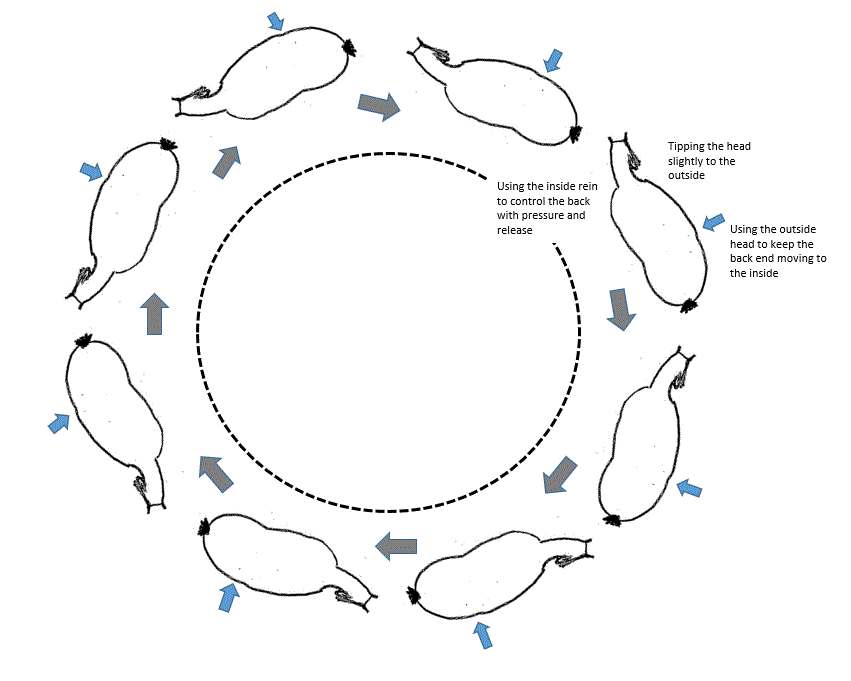
When some people start backing their horse in a circle I think they assume since they ride in a forwards circle in an arc,...... with the horse's nose slightly tipped in the direction of the circle and using the outside leg to push the horse around the inside leg,.... that they think they can do the same only going backwards to achieve the backing in a circle.  I sure as heck can't get it done that way.

At some point the rider will usually use his outside leg to move the back end into the circle and because the nose is tipped to the inside this slows the momentum, usually to a stop, and then the horse may make a large movement with the back end sort of like a roll back and his head comes up. The end result is that both the horse and the rider are frustrated as the horse can't figure out what you want and the rider....

When I back in a circle, I'll start with my horse straight then ask him for some softness and back him a step, and as he begins to finish that first step, I tip his head very slightly in the opposite direction of my circle or arc.

It's likely a good starting point to do this initial movement a few times giving the horse a short break in between each time so he understands that's what you are asking. And without much outside leg pressure, you also likely see the beginning of an arc.

In the beginning I had to have a light hold on outside rein to keep his head tipped slightly to the outside and with the inside rein I use pressure and release to get him to back, using my outside leg to apply a little bit of pressure on the rear of his barrel to keep the back end moving inside the arc.

You'll have to forgive my drawing above (I'm only slightly more advanced than drawing stick horses) as well as my narrative on how I back a horse in a circle. It's hard to describe accurately what you do in the saddle,.......probably easier to describe how to castrate a house cat, that's why I shot the video below, it should do a better job at explaining.

In the video below, while my horse is not backing in a collected manner (broke at the poll) as I'm not so much in contact with the bosal on his nose,....it's at the end of a long day, but he does have a natural head set and that's okay with me as long as he is not being bracey and keeps his momentum. 


Saturday, March 28, 2015

Horse Art, from an Eight Year Old


Olivia, one of the children who help us with Christmas Caroling this past December, drew a picture for us a thank you for the opportunity to ride horses and to sing.  I'm not sure too many people would call what we did singing, though.   I really hope that the object in the top right was not a nuclear mushroom cloud.


Friday, March 20, 2015

Young Horse With Gate Anxiety


During ranch sorting the other day there was an rider on a 3 or 4 year old gelding whose first time on cows would be that day. The rider was concerned that the horse would spook and bolt inside the pen. I had the rider and the horse stay right behind me and my horse as we approached the pens from the outside while the cows were being pushed into the sorting pens. As you can imagine the new horse's head was on a swivel watching and reacting to any move from the 12 Corrientes's in the pen. After a few minutes we rode away, then rode back to do the same. And each time that horse got better. He still had some anxiety about those cows, but it was time to get in the pens.

I was planning on using my first 90 second run with the new horse and rider just circling the cows to allow the horse to get some confidence about the cows moving away from him, and eventually did that, but when going to enter the pen through the 4 foot gate for the first time, that new gelding wouldn't get anywhere near the gate. Eventually, one of the ground crew led the horse through the gate and we commenced on our first run.

The new horse and rider did another 4 or 5 runs each time having to be lead on the ground through the gate. During a break I talked to the rider about how well the horse is taking to cattle and saying that I actually thought that little gelding probably had some cow horse bred into him as he was doing so well once he got into the pen, but still the gate bothered him and we should try to fix that. I took the rider and the horse over to the larger arena fence where it was also apparent that the sponsor signs on the fence bothered that little horse.

I had the rider ask the horse to move towards the arena and letting the horse stop when he needed to. The horse, being curious would soon become comfortable and take a step forward on it's own motivation. And while I was explaining that to the rider, the horse moved forward a step much to the rider's delight. Within a few minutes that horse was nosing the signs, licking his lips and starting to look around.

Then I dismounted and demonstrated moving the horse following the lead line between me and the arena fence, asking the horse to roll his backend over and bring his front end across and follow the lead between me and the arena fence.

I was using a Bosal and a mecate, while the rider was using a leverage bit, so the rider retrieved a halter then started doing this exercise with the new horse. And at first the new horse skitted through between the rider and the fence like something bad was going to happen in that confined space. After a few times of back and forth following the lead between the rider and fence the horse became much more comfortable and I had the rider, give the horse a break for a few minutes, then close the gap and continue. Another few minutes and that was old hat to that young gelding.

So then I had the rider ask the horse to stop between him and the fence then to rub on the horse. Then I had the rider continue at a slower pace and stop the horse mid way in each direction and rub on him. There as a big difference in that horse and the rider saw it. I said let's give it a go and see if he'll move through the sorting pen gate on his own. That young gelding moved through the sorting pen gate like he'd been doing it all his life.

The photos below show what I described above in having the horse follow the lead between you and the fence.  You may have to use a flag to help the horse go forward and the horse may hurry through it in the beginning.  Once the horse gets comfortable following the lead, rolling his back end away from the fence and bringing his front end over and going through again, you can have him stop between you and fence.  Giving him a release here.   They quickly become desensitized to the fence.   And in the case of the little horse at ranch sorting who was fearful of the sorting pen gate, the gate becomes a non issue.