Showing posts with label Tack Tip. Show all posts

Saturday, February 4, 2017

Tack Tip: Para-Cord Rein Connectors


I had a question from a reader on connecting conventional reins with trigger or other snaps to slobber straps, which of course you could do, you would just need a connector. No doubt someone has tied a loop with a piece of hay twine to a snaffle bit or to the shank of a leverage bit so they could snap reins into. Some likely did this to make it easy to change reins out, and others probably did it to eliminate the trigger or bolt snap's metal to metal contact with the bit.
 
See picture at right showing a para-cord rein connector between the trigger snap of the reins and the shank of the leverage bit.   In fact, somewhere I have seen riders using some sort of connector, other than just attaching reins to a bit using the water loops on the reins.

One aspect of slobber straps are to keep from having to connect rawhide or horse hair reins directly to the bit, saving the wear and tear of the reins moving against the bit and the horse's slobber from degrading or discoloring the reins.
 
Another benefit of slobber straps are that they add weight to the bit when the reins are loose so when the rider begins to pickup the reins the lightening of the weight of the connection between the reins, slobber strap/chains and bit were noticeable to the horse - sort of like a pre-signal. So, while not commonly done, attaching conventional reins with trigger snaps to the slobber straps can be done with a connector.

While I am not using connectors, I can see where they might be needed and can have additional uses as rein extenders for instance. If the reins were just a little short, 3-4 inch connectors of each sides of the bit can give the rider alittle more rein to work with.

I took some para-cord, also called 550 suspension line for parachutes, and went about making some quick detachable/re-attachable and re-useable connectors.  What I came up with is illustrated in the series of pictures below.  


I cut one 20 inch piece, and two 4 inch pieces of para-cord for each connector. I doubled up the 20 inch piece and tied an overhand knot combining the two running ends. I dressed down (tightened up) the knot then trimmed it. I melted the ends with a lighter.  See picture at left.


I took the smaller 4 inch pieces of para-cord and made girth hitches over the doubled up longer section.  I dressed up the knots, trimmed them and melted the ends together so the knot stays intact, but it will slide up and down the long piece of para-cord.  I'm calling these the girth knot keepers.  See picture above.
 
In the picture at right, you can see the over hand knot placed through the two pieces of the long section of para-cord.  Then you would slide the girth knot keepers up towards the overhand knot to tighten up against it and make a loop.  
 
You may be able to find beads that could replace the girth knot keepers and slide with enough friction to tighten up and make the overall loop.  It would probably look better too.     
 
In the picture below you can see how these para-cord connectors could connect trigger snaps reins to slobber straps if you were so inclined to used them.   


Wednesday, March 2, 2016

Tack Tip - Detachable Saddle Strings


With the rise in competitive trail riding, not to mention just trail riding for pleasure, some riders are looking for solutions to carry gear while on the trail.  Sometimes a show or barrel saddle isn't set up very well to carry horn/pommel bags or even saddle bags, or may not have saddle strings behind the cantle to tie off a coat or slicker. The picture at right shows the concho behind the cantle. With a D ring emplaced underneath the concho, saddle strings can be added to give the rider a way to tie off bags, coats or slickers.


On one saddle brought to me, I removed the back conchos (behind the cantle) and emplaced a small D ring underneath (like in the picture above) which allows saddle string to be braided or fixed to the small D ring, but because this rider wanted the ability to remove the saddle strings for shows and doing so without going through the trouble of un-weaving the saddle strings, I used a combination O ring snap and split braided saddle strings into the O ring, to make a set of detachable saddle strings that can be snapped on and off the D ring under the concho.   Some rider just like fixed saddle strings (below- left) while others may prefer a set of detachable saddle strings (below - right).
 

Saddle string braiding - see pictures below.  We'll call this split braiding for lack of another term.  Basically the concept is cutting small slots length wise on the saddle string and feeding the other end of the saddle string through that slot. Then cutting a slot in the saddle string you just feed through so that the first string can be fed through. Braiding in this way, alternating slits and feeding the string through, allows for a pretty strong connection and it's useful as well. It's actually pretty hard for me to do slit braiding because I have to use a razor knife which if my wife catches me with it, I'll get in trouble because all she thinks of is a blood trail in the house which is usually the pattern of me using sharp instruments.   


This is the same spilt braiding technique that I do on wider pieces of leather for leather poppers on the end of one piece roping reins, mecate reins or lead lines that I make. It is also the same way that makers, such as Double Diamond Halters, make poppers on their excellent lead ropes and mecates.     

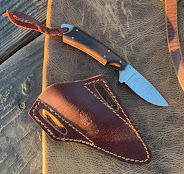
This split braiding is handy for other things as well.  I also cut narrow pieces of leather string to feed through make grommets on my belt knives to make a pull strap to help get the knife out of the sheath when I'm drawing it - see picture at left.


Monday, January 18, 2016

Tack Tip - Expedient Bareback Pad


One of my readers wrote to ask about riding bareback and how much of that would or could be detrimental to the horse. 

I would be concerned about too much bareback riding particularly on an older horse with the lack of back muscle that would support weight concentrated on a smaller area that would come from bareback riding as opposed to a saddle with bars to support and spread out the weight.

The friction from your pants or chaps sliding around on his back couldn't be good for him. But I think it all depends on how much and what type of riding you are doing. I have a hard enough time sitting a horse in a saddle to think about challenging myself riding bareback. I don't ride bareback much and haven't been bareback for more than 20 minutes over the past 20 years. And that would be cumulative minutes! But I recognize the training value of learning a bareback seat before moving to a saddle and some people, either because a lack of time or whatever, just like to pull a horse from a pen in halter and get in a quick bare back ride.

I thought of the John Wayne movie "Big Jake" where John Wayne's character's son was getting ready to mount a horse bareback and John Wayne said "put a blanket on that horse".  The son replied "I don't need a blanket", and John Wayne said "It ain't for you, it's for the horse!"
  
I have a very well made bare back pad which I bought at a Craig Cameron clinic for my wife - the picture at right. It's a contoured bareback pad made from suede leather stitched onto a 1" thick 100% wool felt pad. It has D rings and a latigo for securing the bareback pad to the horse's back, and a hand loop near the withers for safety. I would recommend anyone who rides much bareback should have a quality pad such as this one. However, it does cost $250 and that's alot of money to some especially if you don't ride bareback much.


An expedient bare back pad can be made from a old felt pad (a contoured pad likely works best), a cincha and a latigo - see picture at right.  I'm sure you can use other type pads, but a contoured pad stays in place better, less so on mutton withered horses.  A blanket covered wool pad would be my next choice, but again a contoured pad will work the best. 


Simply place the pad on the horse, configure one end of the latigo to one of the D rings on the cincha - you can see that connection in the picture above, then drape the latigo over the pad and connect to the other cincha D ring buckle on the other side - see picture at right.

You may have to punch new holes in the latigo to secure it to the cincha buckle.  Your latigo will likely have a lot of excess.  You can double it up and store it in the keeper on the cincha, or you can cut the latigo to a more manageable size.   


Once you use the expedient bare back pad, you will have an idea on what you need to do to make it more safe and/or easier to use. If you want to get fancy on it you could sew a latigo or an alike strap over the pad, and you could fashion an hand hold with a section of old belt or another latigo strap on the pad near the withers.


Wednesday, November 11, 2015

Tack Tip - Crusty Cinch Latigos


Here's a short tack tip on storing your cinch latigos (cinch straps) so they remain more pliable. Of course, we should be cleaning and treating our saddles and tack. But sometimes we (or maybe just me) are neglectful of our tack or the environmental conditions just get ahead of us.

I usually use a diluted mix of household dish detergent and a rag to clean my saddles and gear. Sometimes I'll need to use a dish brush on my gear as well to get the sand and dust out of the crevices.  Don't tell my wife I use dish brushes - I've been blaming the dog when dish brushes disappear from the sink.

Then I apply 100% Neat's Foot Oil to all the leather. On my latigos, this will keep them all soft and pliable.  But I also use this technique in the photos below to secure cinch straps, both on saddles I routinely use and those I have stored for longer periods of time.

Careful as you might be, sometimes the latigo drags in the dirt and combined with salt from the horse sweating, a cinch latigo may get stiff and crusty. So for the last 15 years or so, I have been in the habit of tying up most of my latigos in the manner shown below. It pretty much works to keep the latigo flexible and easy to weave though the cinch D ring and saddle D ring.


In the photos above:  Step one - I loop the latigo through the D ring twice, like you would to situate the latigo for easy pulling out and running through the cinch D ring.  Step 2 and Step 3 - I wrap the running end of the latigo around section looped through the D ring, and Step 4 - I stick the end of the latigo through the bottom.


This helps keep the latigo from getting loose and catching on something, or dragging in the dirt, and the whole process of bending and wrapping the latigo helps debris fall away from it, and keeps it pliable.  This is also a good way to store a  cinch strap on a saddle that may be put up for a while.  


Monday, June 29, 2015

Tack Tip - Clean Your Felt Saddle Pad


I have wrote about cleaning felt saddle pads awhile back, but it is a good topic for hot weather riding as the horse's sweat more and those saddle pads, wool felt, sheep skin or even the Neoprene rubber ones accumulate more dried salt from horse sweat and other gunk a lot easier.

While Neoprene is easier to clean, I just don't like Neoprene saddle pads or cinchas for that matter. The exception for me on a synthetic pad is the pad available from SaddleSkin because it removes the main objection on Neoprene pads and that is heat buildup. And while there are pads with holes, intended to release heat or prevent heat build up, I just don't think they work very well.

So if you are one of those Neoprene saddle pad user, you may want to give SaddleSkin a look - I think with it's air channels it allows much more air flow and does reduce heat buildup, as well as absorb or attenuate trauma (impact) to the horse's back, it also keeps the saddle from slipping when the horse is really sweated up.

Having said all that, I pretty much exclusively use felt pads. Previously I used a wide variety of felt pads including the Impact Gel pads, but nowdays I use CSI pads. CSI offers a rubber curry brush to use to brush and clean their pads however it doesn't work very well for me as it's not stiff enough to scrap the dried sweat and hair from the pad.

After a ride, I'll let the felt pad air dry, then usually as I'm saddling up for the next ride, I'll slap the pad across the sides of the trailer or a tie rail to loosen up the dirt and junk, then lay the pad upside down on my horses' backs or a saddle stand and lightly scrub the dried hair and sweat from the pad using a metal curry brush. If you brush too hard you will tear up the felt, so brush lightly using the teeth or flat edge of the curry brush. I'll run my hand over the pad to ensure there aren't any crusty, sharp patches that can make the weight of a saddle and rider bearing on the horse's back uncomfortable, then I'll take a soft brush and brush away any loose dirt, salt or hair.

There are several products that are offered to help clean felt saddle pads. While I'm sure they work to clean and disinfect, I haven't used any soap type product on my felt pads in probably 10 years.


If you haven't cleaned your pad lately, take a look at it and see if you would want a patch of dried sweat (basically salt) being rubbed across your back. You can see the sweat (salt) buildup on the pad in the picture at right. If the salt build up if not cleaned would be running on the horse's back and loins when the weight of the saddle and rider is applied and more so as the saddle normally twists somewhat during riding.

One more point is that if you can afford to do so, have a saddle pad to each horse rather than use the same pad for multiple horses. This pays off not just to reduce any skin contamination from horse to horse, but also allows you to have the best pad for fit on each horse.


Wednesday, November 19, 2014

Tack Tip - More Than a Get Down Rope


At the request of several people for smaller, lightweight ropes for emergency lead lines on the trail, I have taken 1/4 inch Poly rope with a nylon core, usually 12 foot long, and fraying the rope at one end with a flat waxed line knot and braiding leather poppers at the other end to make a Get Down rope.


I keep several of these around, one usually handy to use as a catch rope where I loop the rope around a horses neck and lead him from pen to corral and such. The advantage of this is that's its much quicker than tying a halter and I think it actually helps a horse understand and react to neck pressure before you introduce neck reining.


Some riders will put a bridle over a halter but don't know what to do with the lead line except take it off and carry it with them. With a 1/4 inch 12 foot Get Down Rope, you can leave the thicker and more bulkier lead line at the barn and still have a line to attach to the halter for leading on the ground.  Because of the Get Down usually being a smaller diameter rope, a good way to secure it to the halter is with a double round turn. 


The Get Down rope can be used in the traditional manner, as the name implies, by attaching the rope around the horse's neck with a non-slip knot and securing the other end to the saddle. Be careful not to use a slip knot for the obvious reasons. I would also not use a rope like this when working cattle as you don't need a cow's head or horns getting underneath the rope when you have one end tied around the horse's head and the other end secured to the saddle. I use a bow line knot to make a non-slip loop around the horse's head.  If you were planning on leading the horse from the ground, you would tie the loop closer to the horse's head so the loop won't slip off the head. The picture above right is a way to carry the Get Down rope in a fashion that cannot tighten up on the horse's neck.  

The other end of the Get Down rope can secured to the saddle. You can coil the end and tie it to your saddle using the saddle strings - see picture above right. Or you can tie off the excess line to the saddle horn using clove hitch or a quick release knot - see picture below.


I have found other uses for a Get Down rope. I used it to keep tie open an otherwise one way Arizona gate so trespass cattle can be pushed back to their own pasture. I have looped the rope over a pasture gate that opened towards me but the vegetation did not give me chance to open it by hand.

You can just carry the Get Down rope in a coil tied to the saddle strings next to or in back of the cantle. In fact, many trail rider prefer this method and even though I ride in Mecate reins, I'll usually carry a get down rope in this method in case I have to pony a horse or something.


Tuesday, October 28, 2014

Tack Tip: Prepared for Minor Tack Repairs on the Trail


If you ride enough, or if you ride with poorly maintained equipment, eventually you'll have some piece of equipment break. It's usually something like a rein connector, a leather string connecting the bridle dry rotting, or maybe even a Chicago screw backing out and dropping off into the dirt where you will never find it.

Some of the potential breaks in leather connector strings can be avoided by inspecting your equipment and conditioning it as necessary. I use 100% Neats Foot Oil, while I know that many people prefer other products.

Over the years I have occasionally fixed other people's broken bridles and rein connector straps with a little repair kit that I carried in my saddle bags. But now I mostly don't ride with saddle bags unless I think I may need the items I normally carry in. So I have taken to carrying extra leather strings fed through my off side rear cinch D ring and tied with a Girth Hitch.

I take a 1/2 inch wide Saddle string that is 12 inches long and split to 1/4 inch wide strips giving me 2 one foot long strings which I carry looped into back cinch ring - see picture at left. They are out of the way and don't catch on anything but are handy to repair a bridle or set of reins. Some riders will carry a piece of hay bale string looped into their D rings the same way, but hay bale string will fray and is harder to fed through connector holes and tie off.


If you don't have spare leather strings, maybe you have an extra long string that you can cut a section off. Maybe someone is wearing lace up boots and can give you a section of their boot lace.
 

Last year, I saw a rider's cinch latigo break,..well I saw the afterwards of it. I rode over to a gent standing by his horse looking at the saddle, trying to figure out how he was going to fix it so he could make the 4 or 5 mile ride back in. I watched him for a minute then mentioned he could use his pants belt as a latigo, or one of his split reins as a cinch strap and ride in one rein like a halter.  The picture at right is an example of using a pants belt as an field expedient latigo.  You'll probably have to punch a hole in the belt for the buckle to make it tight enough, but if you have a decent fitting saddle, this will work until you can get back to the barn.       


It is possible to lose part of a Chicago Screw, like some that connects a headstall to a bit.  If you don't change out bits on a bridle then you may want to consider using Loc-Tite Red threadlocker or a dab of rubber cement on your Chicago Screws to keep from losing them, but if you lose a Chicago Screw, a quick fix to get you back to the barn so you can rummage through that box of parts we all, is to pop out the remaining part of the Chicago Screw if its still there (see Diagram 1 below) and run a piece of leather string through the holes (Diagram 2) then loop the leather string around the bridge and tie it with a Clove Hitch and finish it off with a Double Round Turn (diagram 3). 


If you have some good fixes for broken equipment or other tips, send them to me with pictures and I'll post your suggestions.  Safe Journey.