Showing posts with label trail riding. Show all posts

Tuesday, November 19, 2019

More on Barn Sourness


I received another question on barn sourness. A reader wrote - "I have a really good trail broke gelding, but he has one vice and that is whenever we go out at some point he decides its time to turn around for home. I have been always able to work through it easily and we continue on, just wondering if you have a method or tips for stopping the behavior completely. Thanks!"

​ I have known some barn sour horses over the years. As far as a horse taking over and refusing to go forward or turning for home on his own, it's a lot more common to have a horse who jiggs on the way back to the barn. And some people add to this by not controlling the gait or speed going back. I've always tried to look past this as I need a horse to go the direction I want at the gait and speed I want.

As far as your horse, just deciding it's time to turn around, well, first I admire his initiative! It's likely some mental pressure builds and he gets his relief by turning for home. The fact that you can work through it is good, and that likely his thinking shares equal if not more so with his instinct.

The worst cases of barn sourness are when the horse just stops and will not go forward in a direction away from his home barn. And I had another case of a rider I know who's horse would brace against the rider and reins, always turning towards home.<br><br>

In first case this rider would really bang on the horse to try to go forward then spur him which caused the horse to come off his front end - that's when he brought the horse to me. I only had him a couple of days and rode him in the arena where the horse would eventually want to move to the gate which was close to the other horses, so I made that end of the arena (the gate end) the hardest work for him, letting him take a break at the far end. This is likely a common interpretation of Tom Dorrance's advice 'to make the right thing easy and the wrong thing difficult (or work)'.  And in a couple sessions this horse was much better and did not try to move to the gate. This rider picked up the horse and I did not see him again. I doubt he had much success with that horse as this particular rider only wanted the horse to see his perspective and not look at the way the horse saw things.

I would try this - once your horse decides it's time to turn around and go home, don't let him turn, instead back him then turn him (make backing and turning your idea) then go ahead and go in that direction towards home making it work,..stopping, backing and jumping out; trotting small circles. You'd be doing this with the horse heading in the direction he wants to go, but it's you that is directing his feet and I'd do this for a couple minutes.

I wouldn't double him because as you make those turns he'll be facing away from home. I think the circles are okay because as you ride a circle away from him, his head will be bent a bit towards home.

So after some work facing home, turn him and walk him away from home. He'll likely be fairly quick to stop and turn around for home again, so repeat the work facing home for another minute or two, then turn him away and walk him away from home. You'll likely need to go this several times. At some point when you are walking him away from home, turn him and walk him back home. It has to be your idea to turn for home at this point - don't let it be his idea, but don't ask for too much in the beginning.

Thursday, October 12, 2017

Don't get your horse snake bit


I have always thought that since a horse tolerates us being on his back, it's only fair that we are responsible for keeping that horse out of trouble. If your horse gets kicked by another horse, it's usually your fault for getting too close. If you can't see where you are riding and end up with the horse's front legs in a bog - then it ain't his fault now is it? The same with walking on top of a rattlesnake in most cases, and certainly in case where you are riding on a trail.

This time of year as the weather gets cooler, rattlesnakes are more active in the day time than they are in the heat of the summer. In a couple months they will be denned up, so they are hunting more often to sustain themselves when they brumate (sort of like hibernation). Always the exception though. As a Range Rider I've had been called in cold winter months to remove rattlesnakes posting a threat to work crews, but it was likely the construction drove them from their dens - in a less than happy state of mind after being disturbed from their brumation I reckon.

And also this time of year, the baby rattlesnakes, aren't much bigger than when they were when born alive, are a particular hazard as they are born with a full venom sack and can't control the amount of venom they put into a target thereby releasing a full load, and they don't have a rattle, just a button so they can't deliver a warning. In fact, my wife and I were riding out to meet some people on the Butterfield Trailhead and talking about rattlesnakes as our horse shoer was struck in the ankle last week, fortunately he had hiking boots ankle high and his bunched up wranglers provided a barrier that the rattler's fangs did not get through. Anyway, I told her that it is common for someone to be bit without the snake first giving that tell tale and hair raising rattling warning. I said many times I've walked or rode through the desert only to have the first 2 or 3 people go right past a rattlesnake and nobody knew any better until the snake rattled at the 4th person.

My wife knows that they don't always rattle as she has almost walked on top of a rattlesnakes in the past couple of years. I've also watched several people do the same. Not going to happen to me, or so I thought. With several riders ahead of me on a fairly wide trail about 2 horse's wide, I was talking to someone else about the fires that have devastated the West and how the smoke from Montana fires are blowing into Northern Colorado, when my wife calls out "Snake,..you're on top of him!" I goosed my horse into an immediate lope departure for a few strides then turned to look back. Sure enough, a Prairie Rattler was slithering away then coiling to face us. My wife thought my horse's immediate jump into a lope indicated he was bitten, but thankfully not so. And doubly thankful so as our lope departure was not particular well executed.

My wife later said that it looked like my horse's back foot either stepped on or just over the snake and flip him over as we moved forward. Again, thankfully not bit. So I checked the other riders position, gave them a warning and shot the snake with a .45 Long Colt Snakeshot round. Killing rattlesnakes puts me at odds with my wife when it is off our property or they are not an immediate danger to someone. It gives me no pleasure to kill anything, but many riders use these trails and bring their dogs with them, so I did what I did.

Venomous snake bites can kill a horse depending upon the type of snake, amount of venom injected, and health of the horse, but will certainly cause pain, likely swelling and will require immediate Veterinarian treatment which may include cleaning and caring or the wound, pain meds, a tetanus booster, anti biotics and even anti-venom. Horse's are often bit on the nose as they try to investigate the small creature in front of them. As horse's breathe through their nose, the usual swelling from a bite on the nose can occlude their airway so it is vitally important that the airway is maintained. If you get and your Vet get your horse through a snake bite, you will likely face complications down the road which you'll have to treat symptomatically. Hope you don't experience that. Hope I don't either so I be doubly careful from now on, hope you are too.


Friday, December 30, 2016

What to do about a Jiggy Horse


Samantha wrote to ask what she can do about her jiggy horse, "Hi. I was hoping you could help me with my horse Ulysses who just cannot walk or trot at a slow pace. When I take him out on the trails he walks very fast and when I turn around and start to come home he continually breaks into a trot. Please don't tell me to trot circles because I have done that and he just gets all sweatty and never walks. He does this when I ride alone or with friends so he is not buddy sour. He makes riding such a chore and I know he is not having a pleasant experience either. " 

Hey Samantha.  This issue of a horse wanting to set his own gait and speed has been one of the tougher problems to address for me trying to help a few riders with that issue. One of the reasons it is tough to address is that the horse is anxious and feels the rider's anxiety or frustration combined with the rider who usually maintains contact with the bit, maintaining tight reins, with further aggravates the horse.  Another reason is the rider is just a passenger and has not established any leadership over that horse, which is likely the primary reason and what fuels the rider's anxiety and therefore the horse's. 

Many of my horse will want to increase his speed at any given gait on the way back home, but I've really only had one horse who, when he was young, would constantly break into a trot from a walk.  He was around 4 years old and I was still building a relationship with him. What I did on him was ride him alot, going out on a long straight dirt road 13 miles long. When first heading out when he would try to break into a trot, I would stop him, back him with some energy then offer to let him stand on a loose rein. At first, I only had him stand for a few seconds before I picked up on the reins and cued him to move out.  At first you may only ask him to stand for two seconds; then 3 seconds, etc.   The idea is that you are trying to set him up to succeed, so don't ask him for more than he can give. 

When I'm offering the horse the chance to stand after backing, all pressure was off. The reins are loose and my seat is neutral.  Your timing has got to be good. As soon as the horse stops when you ask him, he needs to get that release. Or maybe think of it as 'as soon as he is stopping - meaning you can feel his momentum and feet slow, the reins should go slack'.


When he decided to increase his gait into a trot, I would repeat the process. Basically, I would not let him pick his own speed or gait. The best horseman out there call this "making the wrong thing difficult and the right thing easy." After a few time at this, I would cue him into a trot and we would trot sometimes a couple miles or so until he decided he wanted to walk, and when he would break gait (transition down) on his own, I would cue him into the trot again for maybe 50 more yards then stop him and offer him a chance to stand on loose reins. I would give him some time at the halt - maybe even a minute. But again, not letting him set his own speed or gait.

Sometimes if he broke into a trot from the walk, I would trot him in circles off the road onto the soft shoulders with deeper sand - more of a chore for him picking his feet up, therefore more work for him. If he slowed during these circles I would cue him to maintain the trot, until I was ready to stop.  These are the circles you are preferring not to be told to do!  The difference maybe is that I just did not turn my horse into a circle. I rode him with some energy in a circle.  It was my idea.  Then when I asked him to stop, that was my idea.  Then the standing with a loose rein was a rest for him.    

It wasn't all riding either. Alot of ground work too, so he experienced many chances to understand and do what I was asking of him where he was rewarded with a release of physical and mental pressure,....... and alot of rubbing, too.  He was one of the taller horses I've owned, at 15.2 hands, and seemed to be all legs and maybe part of his habit of picking his gait and speed problem were associated with his young age and his half Tennessee Walker, half Quarter horse breeding, but the bigger end of things changing had to do with him accepting that I was the leader .

I was riding out a couple weeks ago with a lady whose horse also had this problem, like yours of walking fast then breaking into a trot whenever he felt like it. So I had her do like I described earlier. When he was walking, try to rate his speed not just using the reins but with your seat and rhythm.  Not using the reins by pulling on both of them as the horse will usually just get bracey and push through it, but changing the angle of the reins.

When this woman's horse he would break into a trot, I had her stop him, back him with some energy then offer to let him stand. At first, only letting him stand for a second before cueing him to move out at a walk. If he tried to move off before she gave him the cue, I had her stop his forward momentum and back him again, with energy, several steps then repeat the offer to stand. The problem she was having was that she tried to back him slowly where her horse would be inclined to stop on his own.

Another problem was that the rider would not give a timely nor complete release when she stopped her horse, and also allowing her horse walk off before she cued him. All of this was diminishing the control and leadership she needed to build with this horse. When a horse decides to pick his own speed or gait, you just can't think "That's okay, I wanted to trot anyway." - it has to be your idea and he needs to respond to your cues.


When you do ask him for a trot, I suggest you do make circles and serpentines, therefore having him respond to your control. It would be important that if he did try to break down, then to cue him back to where you want him, then make it your idea to slow or change gaits. When you do offer him a chance to stand, there has to be a complete release - put slack those reins, and make sure your timing for that release is particular.

Much like some horses that need to bolt once or twice to understand that they don't need to run away, some horses need a lot of work to appreciate a break through a slower gait, or stopping and standing.

When you get back to your home stables, don't always take him straight to unsaddling. This is going to be a release for him and therefore he will seek it and be jiggy on the trail...wanting to get home and get that release.   Instead do some work on him when you get back and do it with some energy. In fact, you can ride him out a short distance, and bring him back and if he is jiggy then do some work to get him to associate going back home isn't always associated with a release.  This is much like what you would do with a horse in the arena who was always wanting to move to the gate - make being close to the gate associated with a lot of work, and make away from the gate where you give him a break.

Trying what I am recommending is going to wear you out in the short term. You may not fix it totally, but you should be able to make it much more acceptable and certainly more acceptable than riding a horse that just picks his own speed and gait.  Because if he does so, he is being allowed to do so, and you are really not a rider anymore,..... you are just a passenger   Safe Journey.
                           

Sunday, April 17, 2016

Rattlesnake Season - Horses Beware


April is here and so is full blown Rattlesnake season. Although I have encountered as many as four rattlesnakes in the month of December, the spring is well rattlesnakes will exit their dens and remain above ground until the fall in most climates. I have yet to see one this year, but I'm sure I will soon.
 
Coming out of hibernation and hungry, rattlesnakes will be pretty active. Pretty easy to see and avoid in the desert, it becomes harder when the growth of grass and weeds start providing ground cover especially after a sporadic rain. But the last few times I have ridden with other people and have encountered rattlesnakes, they were in plain sight and almost walked on top of.
 
Movement is more easily detected, so objects not moving are often undetected. Your sub-conscious gets used to see mostly vertical lines and shapes from vegetation growing out of the ground, so often a horizontal shape of the snake draws our attention.

The good news is that rattlesnake bits are rarely fatal, however their venom, which differs from species of rattlesnake, has some nasty side effects. Oddly enough, I met a Vet last year who told me he had two cases of fatal snake bites to horses in a week or two span. Older horses or horses with immune system compromises would likely be at higher risk.

Horses are usually bitten on the legs, nose or head area. The nose is obvious as horse's are curious animals and this presents big danger as nasal passages can become swollen and closed off. I carry some sections of surgical tubing coated on the outside with vaseline or bag balm then vacuum packed in a small package with a food saver, just in case.

Rattlesnakes have different levels of hemo or neuro toxins which have different effects on the horse. Neurotoxins being more of a threat, given a large dose of venom, as it threatens the nervous and respiratory systems. I have some of my friends tell me that horses of theirs have been bitten in the legs by Western Diamondback Rattlesnakes, who carry a larger percentage of hemotoxins (affecting the capillary system and therefore the muscles), and the resultant toxins and swelling has greatly reduced blood supply carrying nutrients to the hooves and resulting in a horse foundering (laminitis).

There is a equine rattlesnake vaccine called Crotalus Atrox Toxoid that was primarily developed for protection against the Western Diamondback Rattlesnake bite. It is thought to also provide some protection against other specific closely associated with the Western Diamondback and may also provide a little protection against the Rattlesnake species with mainly neurotoxin venom such as the Mojave Green. As safe as the vaccine studies make it out to be, I choose not to immunize my horses to rattlesnakes only because I'm a little leery of the side effects to the vaccine, again even though they are reported to be limited. Plus it can be expensive.

But if your horse is bitten you need to get him to a Vet just as soon as you can. In most cases, I would get off him and walk to a point where someone can meet you with a trailer for transport to the nearest equine Vet.  Being able to identify the species of rattlesnake would be help, but not to the point where you waste a bunch of time trying to catch and kill the snake and place yourself in danger of being bite.   Depending on the timeline and with the Vet's concurrence, I may give my horses a Banamine injection. After bite care will likely include keeping the bite site clean, hydrotherapy to reduce swelling and giving your horse anti-biotics.

Just be careful when you are riding. Don't count on getting a warning, Rattlesnakes will not always rattle to warn off people or animals, in fact in my experience, more often than not you will not hear the rattlesnake rattle. Many times when riding in a file, it won't be the first but will be the second or third horse and rider who hear the snake rattle. Rattlesnakes will not always coil before striking either.

Baby rattlesnakes are even a bigger hazard than full grown mature rattlesnakes. The babies are born live in a thin egg like membrane material which they break right after birth. They are born with a full load of venom and have not learned to control the amount they inject into a bite meaning they will often give a full load of venom unlike a mature rattlesnake which often induced "dry" bites.

Hope it never happens to you, but just in case, have a plan on what you are going to do if one of your horses, or even you, get bite when on the trail. Always having a cell phone on you is a good idea so you can call for trailer support and call your Vet.

Wednesday, March 2, 2016

Tack Tip - Detachable Saddle Strings


With the rise in competitive trail riding, not to mention just trail riding for pleasure, some riders are looking for solutions to carry gear while on the trail.  Sometimes a show or barrel saddle isn't set up very well to carry horn/pommel bags or even saddle bags, or may not have saddle strings behind the cantle to tie off a coat or slicker. The picture at right shows the concho behind the cantle. With a D ring emplaced underneath the concho, saddle strings can be added to give the rider a way to tie off bags, coats or slickers.


On one saddle brought to me, I removed the back conchos (behind the cantle) and emplaced a small D ring underneath (like in the picture above) which allows saddle string to be braided or fixed to the small D ring, but because this rider wanted the ability to remove the saddle strings for shows and doing so without going through the trouble of un-weaving the saddle strings, I used a combination O ring snap and split braided saddle strings into the O ring, to make a set of detachable saddle strings that can be snapped on and off the D ring under the concho.   Some rider just like fixed saddle strings (below- left) while others may prefer a set of detachable saddle strings (below - right).
 

Saddle string braiding - see pictures below.  We'll call this split braiding for lack of another term.  Basically the concept is cutting small slots length wise on the saddle string and feeding the other end of the saddle string through that slot. Then cutting a slot in the saddle string you just feed through so that the first string can be fed through. Braiding in this way, alternating slits and feeding the string through, allows for a pretty strong connection and it's useful as well. It's actually pretty hard for me to do slit braiding because I have to use a razor knife which if my wife catches me with it, I'll get in trouble because all she thinks of is a blood trail in the house which is usually the pattern of me using sharp instruments.   


This is the same spilt braiding technique that I do on wider pieces of leather for leather poppers on the end of one piece roping reins, mecate reins or lead lines that I make. It is also the same way that makers, such as Double Diamond Halters, make poppers on their excellent lead ropes and mecates.     

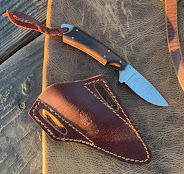
This split braiding is handy for other things as well.  I also cut narrow pieces of leather string to feed through make grommets on my belt knives to make a pull strap to help get the knife out of the sheath when I'm drawing it - see picture at left.


Wednesday, January 13, 2016

Any Problems with Switching between English and Western Saddles?


Ed wrote: "I have learned so much from your blog and it has greatly enhanced my enjoyment of owning and riding my horse, and made me a much more responsible owner. " "Now, I have a specific question for you. When I purchased my horse he had been trail-ridden almost exclusively with western tack, which I got with the purchase. However, eventually I bought a used English saddle, mainly as a decoration; I never really planned to use it. What I did not expect is that when put it on him for the first time, it really seemed to suit me! It felt so right that I have never had the western tack on him since--four years now. But, there are times when I would like to use the western saddle, especially for trail rides or when using saddle bags, etc." "My question is, will it confuse my horse, or compromise his ability to function in English tack if I use the western saddle from time to time, for trail rides or just casual hacks? Should I use the same bridle and bit (D-snaffle) that I always use for foxhunting, or is there some functional difference with the more basic western bridle? Most of our riding is foxhunting, which to the horror of my purist friends, I usually do on a loose rein. He just seems to know what I want him to do most of the time, and any instructions are generally just simple touches of the rein and bit. I don't want to ruin that! Thanks in advance for your wisdom and perspective."

Hey Ed, good to hear from you again and thanks for your comments, although wisdom is something I do not associate with myself.....just ask my wife. Good for you to have such a good relationship with that draft cross of yours. You may ought to look into Cowboy and Western Dressage as well as regular dressage with that horse. My take on western dressage is that it is basically dressage with a western saddle. I believe Cowboy dressage on the other hand stresses riding on a loose rein or anyway not always being in contact with the horse’s mouth. I have to say up front that I know nothing about fox hunting and only ridden a english saddle twice (that I'll admit to) and at least one of those times may have been an alcohol induced incident, so really someone who rides both english and western should be answering this question, but since you asked I'll give it my best shot of making sense.    

As long as your Western saddle fits well, it should present no problem to you or your horse going back and forth from fox hunting or eventing to western pleasure or trail riding. Even though I use the same saddles on the same horses for years, I always check to make sure they are not hurting my horses. Horse's back confirmation can change, just like we do. Fat deposits build up, muscle tone diminishes, and arthritis may become an issue in an older horse.

Many people are now switching saddles, from English to western, back and forth.  In fact, I'm sure some start off with English saddles for dressage, then switch to a western saddle for western dressage test on the same morning. I know several ladies who are primary dressage riders, but who throw a western saddle on their horses and compete in ranch sorting and obstacle competitions,...and do well too.  All this cross training has to be good for the horse.

Anyway, the bit and bridle is the same as well. There is no reason you cannot do everything in a D ring snaffle, nor is there any reason you can't change from a snaffle, to a curb bit, to a correction bit,....although I have yet to figure out what problem a correction bit is correcting.   For the past few years I have had no reason for using anything but a bosal or a snaffle bit, although I did start to use a snaffle with a roller in the center connecting the bars as I thought it would serve a particular horse better. And I prefer a fixed O ring or egg butt snaffle, but that's just my preference and maybe so because it's simple.  Note:  I am often called a simpleton, and for some reason I am not associating that with a compliment.    

Changing bits or riding sometimes in a bosal can give a horse a break from time to time. On my hackamore horse, I have three different bosals I use, changing the pressure up to reduce the chances of soreness and such.

Many top hand clinicians have said words to the effect that dressage is no different than any other riding, and riding is riding and horsemanship is horsemanship.  I think the same principles of horsemanship apply, just the competitive rules may make it seem these disciplines are worlds apart.
         

Monday, June 8, 2015

Riding the Badlands of New Mexico


When singer/songwriter Marty Robbins sang about getting into a gun fight over a girl then fleeing on horseback from El Paso into the badlands of New Mexico, I know exactly where he is singing about or at least what likely gave him the inspiration for that verse. He reportedly actually wrote this song while traveling from El Paso to Arizona in an automobile - that would
be known to you as a car, Bob.


The verse that I'm referring to verse actually went:

Out through the back door of Rosa's I ran
Out where the horses were tied
I caught a good one, it looked like it could run
Up on its back and away I did ride

Just as fast as I
Could from the West Texas town of El Paso
Out to the badlands of New Mexico

You can listen to Marty Robbins' hit "El Paso", which hit #1 in 1959, in the video at the bottom of this post.


My wife and I trailered a couple horses out to the "badlands" of New Mexico, just West of El Paso the other weekend, meeting with a couple of our friends for a several hours of riding on the big flat mesa, which in other parts of the country may be called "buttes".   Coming off the mesa, required find a cut, like a small canyon and avoiding Prickly Pear cactus, Fish Hook Barrel cactus, Cholla cactus, Mesquite and Creosote bushes and the Ocotillo which is the bush in the picture at right.  

The picture at top is on top is on the Mesa where sometimes you can get miles and miles of nothing but Creosote and you can lope or gallop pretty safely.  

This part of the country is actually owned by the Bureau of Land Management (BLM) and managed out of their Las Cruces office. It's just gorgeous out there, offering miles and miles of great riding and good land to train horses on. I'm glad that most of the other people pursuing recreation out here don't trash it so much like you find in areas closer to, or directly on the border wilderness areas where illegal immigration has taken a severe environmental toll.

Anyway, enjoy the Marty Robbins' "El Paso".


Friday, September 19, 2014

Cross Training for Horses


Serena wrote to ask if doing cowboy events on her horse would degrade her horse's training and ability in Dressage...."Hello, I am wondering if you think trying cowboy events like cow sorting and roping on my dressage horse would teach him bad things and set back his training.  My friend wants me to try both with her."        

Hi Serena.  I think if you go about it right, practically anything you do on your horse, no matter what or how different, would be good for you and your horse.  I think most people would call it Cross Training and would recognize that term.  Cross- training refers to training in activities other than the one event that the person (or horse) primarily competes in with a goal of improving overall performance. It takes advantage of the particular effectiveness of each training method, while at the same time attempting to negate the shortcomings of that method by combining it with other methods that address its weaknesses.....my apologies to Wikipedia.

Some people either recognizing the value of cross training with their horses, or simply for the joy of being horseback will ride in practically anything they can get to. In either case, the results of often the same, a much better horse.

And cannot but be beneficial to the horse and rider. Everything from a trailer ride, exposure to different events and requirements, seeing what you and your horse are weak on and therefore need to work on, learning from other riders,.....the benefits are pretty wide.


I remember being entrusted to take children out on trail rides by their non-riding mothers as I convinced them that this will make their horses safer for the child's hunter jumper or dressage events. The same for barrel racers - taking their horses out on the trail makes for better riders and helps gentle those horses - getting them desensitized to various stimilus and learning to think before reacting.  Just getting outside of the arena and exposing your horse to about anything - from water puddles (picture at top right) to big barking dogs (picture at left) to rabbits jumping up close by or squirrels running up trees can be challenging and make a better and safer horse.

While I think if you go about it right, trail riding can be really beneficial to your horse and you, events like sorting, penning and arena obstacle competitions can likewise be as good. Just taking your horse to these events and not competing can be good, that's why you see people taking young horses and ponying them around or tying them so they can absorb all the stimulus.

Lately I have been ranch sorting. Several practices then a jack pot. I saw horses and riders week by week become more comfortable and confident with sorting cows and the strategy of putting the cows one by one into the adjacent pen, but also with riding in a more settled manner. It's pretty cool to see horses new sport to this figure out what needs to be done. Same for the rider's, as some were being asked to ride one handed in a port bit, according to the ranch sorting rules, and thereby making it necessary to get functional at it.


From basic cowhorse clinics, to competitive trail events, to western dressage, to ranch sorting and team penning, to gymkhanas - all of it potentially increases our skills and communication with the horse. The young lady who sorted cows on her dressage horse as well as the team roper who pretty much only rides his horse in an "go fast and turn left" pattern all benefit from cross training.


The flip side to competition is that it often brings out the negative in people. Rider's wanting to win so much that they demand their horses respond, before their horses reach an understanding of what they are being asked to do, usually by jerking on the reins and banging on their sides.  So I think if you approach everything.....every event, every ride as working on your horsemanship as opposed to focused on winning, these cross training events will make it beneficial to your horse.  Safe Journey. 


Sunday, March 30, 2014

Camping with Horses


Wade wrote to ask "I'm interested in camping with horses and or mules. (and) Their care and feeding, grazing if available, and first aid for the animals. What should I be watchful for etc. Thank you."


Big question, Wade. Assuming you have suitable horses and/or mules for the area you are heading to, much will depend upon the area as far as available grazing and permits. By suitable stock I mean your horses or mules are healthy and conditioned enough for the area you are going and the distance you plan on riding.

Some areas require your horses to have been fed certified weed free hay - to protect against the proliferation of weeds or unwanted grass species. Some areas will require use permits.

I would be considerate of feed issues related to over night changes of feeds. For example from dry grass or alfalfa hay to a forest pasture. I would consider any pasture where I was going to be supplemental feed and plan to bring my own feed which for me is grass and alfalfa hay and a complete pelleted feed from ADM.

Planning on camping in the wilderness, just you, your horse and a bedroll is one thing, but wanting more comforts and certainly staying for an extended time will require a pack horse or pack mule. If you go out with minimal gear make sure you can build a rudimentary shelter and a fire - not only for warmth but as a signaling device if you get lost or hurt. Water would be a primary concern. You take take enough, so you need to go where there are sources, either man made or natural.

There may be some areas near you offer horse friendly campgrounds with pens for your horses, otherwise you'll be looking at high lining or hobbling them. Available water would be important too, as you could easily go through 40 gallons or more a day.  

If you are inexperienced at camping or back country trips on horse or mule back, then maybe you can find an outfitter and sign up for a trip on their animals as it would give you invaluable experience before you set out on your own.

Just so much depends on what you want to do and where you want to go. A great resource would be any state chapter of Back Country Horsemen of America. They would be able to direct you to horse friendly areas and give you an idea on what you would need as well as point to you getting permits if required.

As far as first aid for horses, I have a vet bag in my trailer and carry small items in my saddlebags:

Vet Bag: several rolls of Vet Wrap; 4x4 gauze; medical tape; Nitrofurazone; Anti-septic wound powder; Quik-Clot; tampons (for dressings); Hoof Soaker Boot and Epsom Salt (this is all inclusive list, but minimal essential items);

Saddle Bags: Vet Wrap with tampon stuffed inside the hollow part of the cardboard roll then put in a vacuum sealed bag; Hoof Wrap bandage in case I pull a shoe or have a hoof puncture;
During snake season, I'll carry two eight inch long surgical tubes (same type you use to tube horses), coated on the outside with Vaseline or Bag Balm and sealed in a vacuum packed bag - in case my horse gets bit on the nose, where a lot of snake bites occur, I have a chance of inserting them in nostril's to keep his airway open.

If you get all set up and head off for a horse back camping trip, I'd also suggest you let people know where you are going, what route you are taking and when you are planning on coming back. And a cell phone is always a good idea in case you or your horse get into trouble.

These also may be a couple of useful resources for you, Wade. Good luck and safe journey.

"Low Impact Horse Camping" - Video
"Mountain Manners" - Video
Idaho Back Country Horsemen
HC 66, Box 248
Kooskia, ID 83536

"Horse Camping" (1981)
by George Hatley - The Dial Press
1 Dag Hammerskjold Plaza
New York, NY 10017


Saturday, September 21, 2013

West Nile Reminder and Trail Advice from a Reader


Scott wrote to Functional Horsemanship reminding us that West Nile Virus (WNV) is still prevalent in many parts of the country and in addition to annual WNV immunizations, insect repellent is another method to help keep your horse's protected and he added that insect repellent's for rider's are important as well, as people get WNV too.

I've seen one horse who was positive for WNV and it was hard to bear watching horse suffering, stumbling, head down, losing balance, and not eating. WNV in people is fairly rare and sometimes hard to diagnose. The Center for Disease Control says that 1 in 5 people who are infected with WNV will develop a fever with other symptoms such as headache, body aches, joint pains, vomiting, diarrhea, or rash. Most people with this type of West Nile virus will recover completely, but fatigue and weakness can last for weeks or months. Even fewer people will develop a serious neurologic illness such as encephalitis or meningitis which is inflammation of the brain or surrounding tissues. For both people and horses the treatment is to generally manage the symptoms.

I'd add that manure management and ensuring that standing water traps are emptied to take away mosquito breeding grounds is a good preventive practice. Here in West Texas where 8 inches a rain a year is the average, we recently received over 5 inches of rain in a week bringing mosquitos into areas where we usually don't see them. I sprayed insect killer daily on top of the loads of manure dumped into my dumpster, and used a daily application of Pyranha fly spray on my horses until everything dried out.

Another point Scott stressed was to ensure when you trail ride on public, or even private land, to make sure your know the rules for use. A group of riders can eliminate the use of land for other horses and riders by breaking rules. I like the Back Country Horsemen of America's theme which is to "Leave No Trace".  I occasionally run across some horse tracks from time to time who riders have no problem at all littering along their ride with Bud Light cans and bottles. I have a hard time believing that people who have no respect for the land have any respect for horses.

And while I have carried a gun all my adult life, for personal protection or in performance of my duties, and I certainly believe in the 2nd Amendment, if the land use rules for a trail ride included no firearms then I would respect that and wouldn't carry a gun, or more likely not ride at all. Scott reminds us to do our research so we don't trailer to some place only to discover regulations we were unprepared for.

Thanks Scott for your reminder and safe journey to you.


Friday, February 17, 2012

Meet the Burrowing Owl


I was riding one of my horses, Junior, when I heard this squeaking sound. I stopped and started looking around then spotted a Burrowing Owl sitting in a Mesquite Bush. Every time the Burrowing Owl would squeak he (or she) would rise up then sit back down. These owls are a small species often with a body length of only around ten inches but have long legs presumably to help protect them from larger birds of prey.

Burrowing owl nests are basically holes in the ground. Often they build their burrows next to construction sites or other populated areas. They hatch their young around early or middle spring. I have rode up on Burrowing Owl nests before to have an owl fly off from the ground and land in a bush twenty yards away or so to get my attention on them and not the nest they left.

These little guys are about the neatest things you can watch. Burrowing owls are protected under the Migratory Bird Treaty Act in Canada, the United States, and Mexico.

As I turned toward this owl and carefully walked up to him, he hopped to the ground. There was dark, turned up ground near his feet which I suspected was the burrow. I did not get any closer as I didn’t want to spook him, but I was able to shoot this short video on me and Junior’s encounter with this Burrowing Owl. Sorry for the poor quality, but I couldn’t even see the dog gone camera screen due to the Sun.


Wednesday, January 11, 2012

Horse Won't Stand Still


Sam wrote....”I have a quarter horse that I have ridden for 9 years, since he was a 2 year old. Lately I have been attending ACTHA rides. He is calm on the trail and calm during the obstacles, but impatient while waiting for the other riders to complete their obstacle. I took some criticism for circling him last weekend, when he was tossing his head, fighting me and wanted to move on. He even squealed a little. I see this as kind of a spoiled brat behavior and I am not sure how to deal with it. I admittedly did not ride him a lot this year, but he has these moods where he is impatient and might even nip at me when I am leading him. I am considering a vet workup but I think if pain were his issue he would not only act this way when standing still under saddle. Thoughts on how to deal with this?”

Hey Sam, thanks for writing,….actually a problem with the horse not standing still when asked is more common than you would think. Some times it’s feed related. Some times it’s a pain or discomfort issue with the horse relating to bad saddle fit or a physical problem with their hooves or back or instance. A vet check is a good idea, especially if you suspect something.

It is more likely to be a problem that may be alleviated with a lot of wet saddle blankets, or time in the saddle, and, standing tied for awhile to have him teach himself patience. I am not talking about using a snugging post for hours on end,….. I’m simply saying having him tied for 30 minutes is not an unreasonable way to begin and you can go from there.

He may be simply a little buddy sour thinking his herd is moving on without him. I wouldn’t let the criticism bother you. I would think the ACTHA judges are there to judge how you and your horse negotiate an obstacle and not any pre-obstacle schooling of your horse. Of course, if you are standing close to other horses and riders, it is really annoying to have your horse moving around pushing into our horses. But, circling a horse in small circles, or moving his hind end around quickly then offering him a chance to stand still (pressure and release) is a common way to handle a horse who can’t stand still.

If you don't ride him a lot, say only once a week, I think you would see a big difference in his handle by adding a couple of short sessions each week.

Thursday, October 27, 2011

Trail Obstacles


Westy wrote and asked: "I really like the videos on getting your horse to accept strange objects. I will be riding soon in an American Competitive Trail Horse Ride and would like some ideas on what I need to get my horse used to."

Westy, thanks for your question. If I were you I would go to the ACTHA site and download the rules and list of obstacles. This will give you an idea on what you will see. I would not limit my training to these obstacles. I think the point in desensitizing horses to strange (and scary to them) objects to getting then to think through problems as opposed to reacting out of instinct and fleeing. Horses are naturally curious animals,...that is why so many horses get bitten on the nose by snakes,...so you can use that portion of their instinct to make them more comfortable with thinking first.

However, just because your horse has no problem going over an obstacle, say a tarp, at your place does not mean that any tarp, at any place will be just as easy. This may be frustrating to you, but bear with it. It just appears different to the horse. Being at a strange place, away from his herd can also bring in anxiety.


The vibes you give off can also make a difference. If you are nervous about approaching an object, your horse will sense that as well. You are in effect telling him to be wary. Another mistake is pushing your horse too fast on an obstacle. Let him figure it out. That 20 seconds or so, or even 5 minutes, that you allow him to figure it out will go along way towards establish trust in you and teaching him to think.  Cowboy curtain obstacle at left. 


I think another mistake may be the tendency to drive your horse from one obstacle or problem directly to another rather than give him time to absorb that lesson and calm down before you challenge him again. That way you can approach each and every obstacle as a new challenge as opposed to running them all together and over loading the horse. 360 degree pole travel, pin wheel, obstacle at right.


We host riders at our place to go over obstacles and expose their horses to different things, again not primarily to get ready for those exact obstacles, but to expose their horses to different things, teaching them that they can think through a problem. Wooden bridge obstacle at left.


No matter if you are preparing for an ACTHA ride, or have a horse for informal riding, exposing your horse to obstacles will make it a safer horse if you do it right. Western or even English show horses and hunter-jumper horses alike can benefit from trail riding as well. Single log obstacle at right.


Thursday, July 7, 2011

Trail Riding Etiquette


I received this e-mail from Collette: ”Thanks for the article on Trail Riding planning. I ride almost every weekend with my friends and we’re all girls. One of the boys from the barn and sometimes two of them will ride with us but they are always doing things to make us nervous. Sometimes without warning they will race ahead of us or they will go off the trail then come back behind us and race towards us. Two of the girls are fairly new and get really nervous and their horses become nervous as well. Are our horses going to get better (less nervous) where they will ignore this? Should we not be accepting this behavior? Or should we talk to the boys about being more careful around the newer riders? None of us are leaders so it sort of hard to figure out what to do.”

Hey Collette, your horses are acting just like horses…and those boys,..well, they should be schooled in trail riding manners. If you are riding in a group, I think the group should be riding at the comfort level at the least experienced rider. Probably best to talk about this and agree on what your group is going to do and not going to do before you ride out. Over time and with a lot of wet saddle blankets your horses will get better as will the riders.

In a trail riding group it is not acceptable to do anything to place the other riders or their horses at risk. The last thing you need or want is a horse and rider suddenly galloping off and possible spooking another horse, and not riding away then coming back at the group, especially from behind, at a high speed.

When you ride in a group it is a good time to help your horse accept being separated from the group. One way is to stop your horse and let the other riders ride a distance away but still in sight,.....say 50 yards to begin with, then stop. The separated horse and rider then moves toward the group. The separated horse may get anxious and want to increase his speed to get to the group, because they are herd animals and see safety in a group. If so, the rider rates him keeping him at a walk. This is where you have to be a leader. You are leading your horse to a conclusion that he can trust you; that he can be away from the herd and be okay.

As your horse becomes sacked out on being away from the herd when he away from the barn, you can increase the distance and even be out of line of sight. The graduation exercise is where you can ride him alone. Although if you ride alone let someone know where you are going, the route you are taking and when you will be back....having a cell phone is good idea too.

To tell you the truth I had a hard time understanding your questions and I hope I did a decent enough job answering them. But to re-cap, your trail group needs to have a group wide understanding and agreement of safety and how you are going to ride. It would be polite to ask everyone, “everyone feel like loping off?” and if someone is uncomfortable,....well then, you ride to the lowest comfortable level. This is just basic communications,....you communicate with actions to horses and verbally to your fellow riders. Talk to each other as you encounter possible problem spots in the trail and make each other aware of where you are at.

Those boys are also needing to get some manners and maybe you can give them that look,....you know that look at woman are so good at giving menfolk when we get out of line.

Good luck and Safe Journey.