Showing posts with label broke to lead. Show all posts

Tuesday, June 17, 2025

Restarting Monte, Part 1


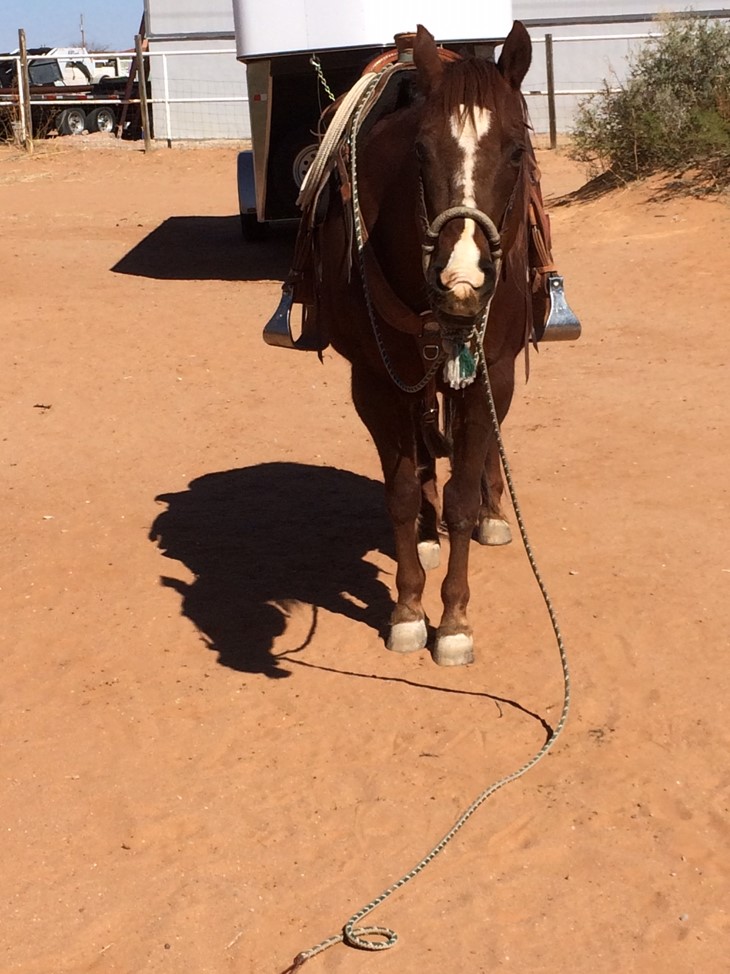
Monte is a registered Arabian from Polish Arab stock and was used an on the track racehorse before my late my wife bought him when he was 15 years old. A really handsome Bay Gelding, she could not pass him up when he became available as she was, then, successfully passing cancer treatment and was looking for an additional trail horse to complement her steady Sorrel Gelding Charlie who was then in his late 20's. But just as soon as we brought him home, my wife's cancer came back. Subsequent brain surgeries and radiation made riding, especially a very reactive Arab, a dangerous proposition. So Monte basically became a companion horse for my wife's two other horses for just over 7 years.

For those seven years, I had been taking Monte out of the pens and turning him out. In doing so I had to get him to lead on a soft feel, rate his speed and position, stopping, and backing. Subsequently he became soft in his face and generally a gentleman. That was the extent of his handling and his understanding. So, that routine along with the farrier trimming his feet every 8 weeks, getting brushed and groomed, and, Vet calls for annual Coggins, health checks and teeth floating, were Monte's life. After my wife passed away late last year, her best friend Arlene, who was holding my wife's other hand when she passed, asked me if I would let Monte go to her. I readily acquiesced as that was a great idea and Monte would go to a great home. So we made plans for me to restart Monte and get him safe for her to ride and ready to ship to his new home. That day has came a few days ago. Although I had a seven day trip away from home followed by a 10 day bout of Sepsis which kind of set me back restarting Monte, I was able to work with him and ride him for almost 2 weeks prior to his ship date.

When Arlene flew in for a few days prior to shipping Monte to get exposed to what I had been doing with Monte and to ride him where I could watch and help. Day One was basically a demonstration on how I approached re-starting Monte, demonstrating both on the ground and in the saddle. Day Two was a repeat of Day One however we filmed much of it in short sessions, which I am including in this five part series, then having Arlene ride Monte so I could watch and help her and him. It was important that Arlene was here riding Monte before he was shipped because in my experience, working with a horse without the owner is much less effective than working with the horses and owner/rider. And Day Three was spent trailer loading, showing how I prepared Monte to load and backout, which would be useful as a basic template for loading other horses in the future.

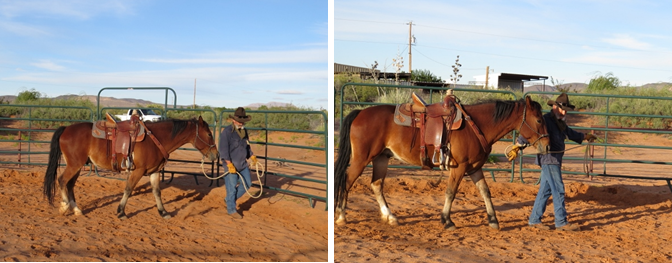
In the beginning Monte was pretty reactive.....big, quick movements with the minimal pressure. It wasn't my first rodeo with an ex race horse as when I ran a large public barn people were bringing in ex racehorses from the local racetrack all the time. Some I helped when asked, others sadly enough were regulated to owners who wanted an immediate trail or roping horse without doing the work or understanding how to go about it. As I worked with Monte on following a soft feel on the reins to lead up I saw right off that Monte could come down emotionally and slow his reactions. And by leading up or becoming halter broke, I mean soft to halter; understands a neutral lead rope to stand and wait for a signal; to move forward on a soft feel; to back up on the same; responds when I start to connect the lead rope to directional control of each individual foot, and, gives to pressure when applied slowly and measurably.

Although seemingly a very basic way to re-start a horse, I think the understanding the horse gets from being softly asked for a response and given the time to respond really sets him up for success, as I'll be asking for the same, in the same way as I progress to the saddle and that occurred on day two. The text article and videos I'm posting through this five part series, are snippets or highlights of the 10-12 rides I put on Monte to get him ready, and safe, for Arlene. And these short videos were intended for Arlene to show I spent the time getting him ready for her. I hope this helps someone else.

We all need a horse to stand still until we direct him, so I worked with Monte understanding what neutral is. That is no feel on the lead rope. I call this neutral as eventually a horse will move, but he'll learn and become more and more responsive to a gradually pulling the slack out of the lead rope (and the lead rope will become a rein or the lead portion of a mecate soon) and move towards me. Many people don't worry about a horse understanding backing until later on in the starting process as forward momentum is so important. However, I like to get that working early on, as backing is useful to positioning a horse up in so many ways.....backing up to get room to open a gate, re-position from crowding you, re-positioning on the shoeing stand, and much more.


As I have on 2 and 3 year old's as well as older horse's being re-started, I can move right to connecting the lead rope to a foot by asking a front foot to step out to the side. This allows me and the horse a better start from the saddle when I ask the same with the rein. Then I move to the back end, standing right by the stirrup, or where the stirrup or front cinch would be if the horse has no saddle, with a loose lead I will rub and pet on him, sometimes making noise with the saddle until I pickup the lead alongside his body maybe slightly tipping his nose until he steps over and away from me, with the rear foot nearest me stepping underneath himself in front of the other rear foot, untracking his back end. This will be more and more useful as we go forward, doing turn arounds, facing up, practically everything.


Thursday, January 10, 2019

Backing and Drawing a Horse from the Ground


Why might you want or need to back a horse from the ground? By this I mean the handler standing still and moving the horse back using a voice command or a feel of the rein. Why would you need to be able to drop the reins and have your horse stand still while you walked away a bit? And why might you need to draw or bring the horse towards you using a voice command or a feel of the reins?

In the annual arena competition I have hosted for the past four years, this year I had a task where the rider had to dismount, step into a 2x2 foot box and ask his horse to back. Riders could use their reins, get down rope, the lead end of a mecate or even just a voice command to get their horse to back but they had to stay in the box. Then the rider had to drop the reins or get down rope and walk around a barrel maybe 20 feet away, demonstrating the horse's ability to ground tie (even if it is momentarily), then walk back to the box, pick up the rein and draw their horse to them. The riders had the option of tying the reins up after they dismount and solely use voice commands if they wanted.

There were 42 entries in this competition and I believe only 3, maybe 4 riders/horses could do all three - backing the horse; horse ground tying and not moving off; and drawing the horse back to you. No offense to the competitors, but a few of these tries were not pretty. Horse's flying backwards with head's high and pushing with their front end; horse not ground tying even for a moment; and even a few horse's not wanting to come back to their rider having the reins jerked to get them to back up. I didn't see alot of jerking on the reins but even once is too much and I'm going to address that in a different article.

The reason for not doing these things well is that some riders don't have a use for their horses to do this. While I consider it an extension of being broke to lead and necessary for my horses to stand still as you dismount and move forward, move to you on command or through the change in feel of a rein, and back up on command or through the change in feel of a rein when you have a loop on a calf and have to dismount to reposition the loop needing slack on the rope then having it re-tightened.

Backing a horse on the ground comes in handy when leading a horse to a gate and it opens towards you so you have to back the horse up. Or when you are throwing feed and the horse wants to hang his head over the feeder. Or when you are on the ground and checking someone else's saddle or bridle and don't want your horse pushing you into the other horse.....and there are dozens of other situations.

Having a horse ground tie is very handy when you are changing bridles or have to dismount to do something like check on a float valve. It is just a natural follow on from having your horse lead up well. In the video below I brought out a horse towards the end of a session with some riders that we were filming and one asked me if I could show her how I get my horse to back, ground tie and come to me on command. Getting a horse to back away from you on a lead line, or rein, is the easier part. Having them stand still - stay ground tied, and drawing them towards you on the change of feel on the lead/rein is just a bit more difficult. Young horses will want to come to you before you ask them. Don't make it federal offense if they come before being asked, just back them up and ask them to stand again. When drawing the horse towards you, try to see just how little pressure or difference in feel of that lead or rein it will take to get that horse to come to you. As with everything, reward the horse's beginning of that effort - don't give the horse a pause between your asking so he can absorb the lesson.


Wednesday, April 11, 2018

Ground Tying Your Horse


I was talking to a client on the phone about tips using the Functional Tie Ring when he asked me about also teaching a horse to ground tie. Ground tying is simply looping the reins over the saddle horn or neck of the horse, or dropping the lead line on the ground (or both if you using a mecate) and walking away with the horse standing still and not following you or wandering off. Some will loop the mecate over the saddle horn as well when ground tying. This works and would likely be the preferred method if you were using horse hair reins or if the ground was muddy.

Ground tying obviously has many concerns - your horse running off and getting the reins caught on something and jerking the bit through his mouth, often cutting his tounge; the reins slipping so the horse gets a front foot through them with the same results - okay you get the idea. So there are some things my horses need to do well before I start ground tying.

Your horse has absolutely has to be broke to lead and this is where the beginning of ground tying are anyway. Your horse should lead up where you want him at a slow or fast walk; stop when you stop; back off a feel on the lead and move to you on the feel of a lead rope when you ask. What I mean by feel of the lead rope is a change in what the horse feels. If my horse is standing 10 feet away from me on a loose rein, I want to be able to slightly pickup the lead rope, changing the weight slightly on what he feels through the halter. I'll click or whistle as a verbal signal as well, and coil the lead rope up, keeping it slack, as he approaches me. In the beginning the lead line may be taunt, not pulling - just taunt, the horse will eventually step forward releasing the pressure on his poll and this is beginning of himself learning to get the release of pressure on his poll. In some cases, if the horse does not step forward to get a release from the taunt lead line, it helps to have someone stand behind the horse (out of kicking distance) and when you ask him to come forward your helper will put a little pressure on the horse - often it is enough just to step towards the horse. See Figure 1 through 4 below. You can see the difference in the still slack lead rope as the horse moves forward.


I need him to back off a feel as well, and I do that by shaking the lead rope in a back and forth, side to side motion, feeding the rope out as he backs. I use the verbal cue, "back", as well. This is something they learn quick. I'll start up close to the horse and shake the lead rope and when the horse changes his balance as if he preparing to back, I'll stop and give him a few seconds before asking again and building on that asking for one step, then two. The verbal cue comes in real handy when you want to back a horse off the feed bin when you are throwing feed or really anything where you hands are occupied. See Figure 5 through 8 below.


The client from the beginning of this conversation asked what does standing still have to do with moving forward or moving back? Its the feel of the lead rope when asking him to move forward or move back, and the inbetween or the absence of that feel associated with not moving or standing  ground tied. Kind of like not being able to teach a horse to stop, until you have him moving forward.

If my horse leads well then I need him to stand tied well before moving on to ground tying. This is where I use the Functional Tie Ring and stimulating the horse to pull back and getting a release from the pressure of the halter on his poll when his feet are moving in temporary suspension. Once my horses are good with that, I leave them alone tied, using the tie ring, for increasing longer period of time. One minute the first time is not too short. If I'm moving off out of sight, I often put a daisy chain or a simple slip knot in the lead rope so the lead won't pull through.

I think a person will know when the horse is ready for ground tying. It's basics in ground work, so the horse's will be learning it in the round pen or the arena at first. Same deal as being tied,......let him stand ground tied for a short period in the beginning and increasing that time. One time I had a client working on my obstacle course and he called to me for help getting his horse to cross a bridge. I dropped the lead line and left a horse in the round pen and went to help. Thirty minutes later I returned to the round pen and the horse was standing in the same spot. And why not? Nobody was asking anything of him, so he just took a break. So what do you do when the horse starts to walk off when ground tied? I use a voice command to disrupt his thought and focus on me. I won't wait too long before I approach him, rub on him and ask him to stand still again and walk off.

Being broke to ground tie also comes in handy when I have to dismount for a short period of time and be out of range of the lead rope of my mecate even if it's just in the arena so I can change up some poles, cones or barrels. And even though my horses do well ground tying, it just doesn't make sense to me to ground tie them in an uncontained area, at least not walking away from them where is no fence or barrier to contain them if they do run off. That's what using hobbles are good for. This is a story I'm not proud of - I was up in the mountains riding to a historic site, two buildings and cemetery, to check out sign of vandalism. I let a guest ride my good Sorrel horse Junior. When we got to the first old structure, we dismounted and tied the reins to the saddle horns and let the horse graze while I walked around cutting sign for trespassers. We spooked a small groups of Mule Deer in the brush and they in turn spooked the horses who ran down the trail. After a three mile jog, I got to the horses to discover the reins has slipped off Junior and he had stepped on the bit cutting his tongue badly. That happened about 10-11 years ago, and ever since I haven't ridden him in anything but a hackamore - by the way, Martin Black makes great hackamores, most of mine I bought from him.

Getting a horse to ground tie, even for short periods of time, while you walk off and right back, is just a good thing to get a horse to do.     

Friday, October 16, 2015

Groundwork - These Basics Are Under Rated


I'm seeing many people riding horses that are not broke to lead effectively. I see riders competing on, or just pleasure riding on horses that are distracted, can't stand still, or are pushy when in hand. Some are doing pretty well in competition on these horses, but in the more severe cases these horses are barely manageable on the ground and when in the saddle the rider is just a passenger averting bad things because the horse may be marginally directional and stopping only because the horse gets tired on someone pulling on his mouth. Some of these horses are older, have grown dead mouthed and usually have seen many different owners, while others are young horses that just have some holes in their education. For sure, some of these handlers are riding horses that I wouldn't ride,....until I got those problems pretty much fixed.

Saying your horse just has a lot energy or saying that he's a natural leader isn't the reason he is taking control. And just because a horse is the lead horse in your herd doesn’t mean he is a brave horse. Horses usually take control because they are fearful. And in a leadership vacuum, the horse will look out for himself, basically assuming that leadership position. You just can't let him be the leader in the two animal herd consisting of him and you.

I learned the lesson, over and over, that just because a horse is rideable doesn't mean he has ground manners. The funny thing is that I am likely not finished re-learning that lesson. One solution is to start new horses over, from the beginning, rather than try to fix holes in their behavior as they crop up and become a problem.

I had a client bring me a horse the other day and as I walked up to the horse and rider, who was in the saddle, I noticed the horse was distracted. The rider was using a snaffle bit and was in contact with the horse, who feet wouldn't stop moving. The horse then pushed through the bit and tried to walk over the top of me. I said to the rider "I was about to ask you what your issues are with him, but he just told me. Can you dismount and lead him in hand to the round pen?"

That horse didn't lead much better. Walking past or into the handler; not stopping when the handler stopped; and when the handler got the horse stopped moving forward, the horse's feet wouldn't stop moving sideways nor would his head. These are what the FBI calls a clue - an indicator that the horse doesn't have ground manners, nor broke to lead.

Some clinicians will say that if a horse is truly broke to lead, you can lead or send him anywhere,....through a gate, down into a hole, or into a trailer. And that horse won't have his head on a swivel nor trying to eat off the ground all the time. Nor will a horse who is really broke to lead be pulling the lead rope through the handler's hands. You can have a safe horse and not be perfect on the ground, but I certainly want a horse to lead correctly and give to pressure of the lead line.

Leading correctly means not running over the handler or even getting into his space; not be distracted but focused on the handler for the most part. The horse should be able to stand still on a loose lead when asked. When leading in hand the horse should maintain his position where the handler wants him, usually just off the right shoulder a couple feet to the side and to the rear, and maintain the handler's pace when being led in hand's, whether that pace is at a crawl, or a fast walk, or even a jog. I'd want any horse that I was fixing to ride to be sound in these things. If they aren't then trouble is just ahead.


When the horse is distracted, like in the picture at left, he should be directed back to the handler. I don't make a federal case out of it, but if a horse is looking somewhere else instead of on me, I'll bump his head back to where he has two eyes on the me.

  Usually after the third or fourth time that you have to correct a horse's lack of attention, the horse will figure this out and as you go to bump his head over, as soon as the weight on the lead line is different, he'll correct himself - then you know you are making progress.

Again, I don’t make federal cases of him getting distracted momentarily, but you just can't allow him to tune you out to check something out whenever he wants to.


When the horse is stopped the handler should be able to move about without the horse leaving until there is a signal on the lead line. He should simply stand still on a loose lead and not move until you direct him using that lead. If he tries to walk up on you, you get his attention then back him off and make an offer to him to stand still again. This is something you likely have to do over and over, but the horse will get it.  The picture, above left, shows a horse standing quiet on a loose lead.  As I change the weight and therefore pressure on the lead, above right, the horse begins to follow that lead moving towards me. 


When you lead he needs to stay in position, some people like that position right at their right elbow, some like it a step or two back, regardless of where you want your horse positioned when you lead him, when you stop, the horse needs to stop and stand still until directed someplace else. If your paces changes, his needs to change as well. As you are walking him out, if he start to move ahead of you, a bump on the lead line downward or to the read should be a signal to him to mind his pace and position.  The picture above left shows the horse leading correctly on a loose lead.  The picture above right shows my hand moving back on the lead to bump him back into position.    


You should be able to pickup the lead in the direction you want the horse to move and the horse should move off and move of quietly. Like if you open a gate and want the horse to move through it by himself , you should be able to pickup on the lead in that direction and he should walk off.   The picture above left shows he horse quietly moving around me a walk following the lead. If his head becomes oriented outside that arc, I will lightly bump his head back into position slightly tipped to the inside.  You should be able to pickup the lead and pull his head towards you to get him stopped and facing up.  This may require a pull (not a jerk) in the beginning, but as you horse gets softer to the feel of that lead, he'll get softer and more responsive to reacting to that pressure and facing up.  If the horse begins to walk towards you without you asking him to, I don't make a big deal out of it, I just correct him, give him chance to think about it, then ask him to approach me. 

Of course these are all very basic things, but I continue to get surprised at people are riding horses who aren't schooled in these basics.  Many of these people ride much better than I ever will, but I think fixing these holes in their horses will make a better horse and save the some problems down the road.    Safe Journey.  


Tuesday, March 3, 2015

Halter Broke


Justin wrote to ask "Thanks for writing the information and videos.  They help me fine.  What exactly is meant by a horse being halter broke.  I am looking on classified ads for horses and I see ads saying the horse for sale is halter broke."

One of the first things you notice Justin, is that the more people and horses you are around, the greater the differences you'll see in definitions. We all make fun how people use terms to describe their horses, especially if they are selling them. But the term "halter broke" certainly competes with them all for the widest description.   The bottom line and the best circumstance for an ad describing a horse as halter broke, is that it is a very green horse, it is not gentled to ride.

But your question brings up a good topic - what is halter broke?  While fueling up last year in late winter, I ran into a rancher I knew from my Range Rider days when I worked a gather in the grazing unit he leased from the BLM. He told me he had several horses who needed to be halter broke so when he brought cowboys in at springtime, they could ride and gentle them. Apparently the person who previous halter broke his horses had moved on. He said he pay me $100, $20 more than he paid the women, to halter break four horses, ranging from coming 2 to 4 years old, which pretty much told me his idea halter broke was pretty much just getting, and leaving, a halter on the horse.

While I had to think about it. I thought maybe I could show him a good way, and make it easier on the horses when some young men got ahold of them in a few months, but I had to say no.....I now wish I would have asked him what he expected from those horses once "halter broke", but I'm pretty sure his idea halter broke was pretty much just getting, and likely leaving, a halter on the horse.

If I would have taken up his offer, I would have planned to spend a couple days with these horses, getting them used to a halter going on and coming off, accepting a rope or a lead touching them all over especially on their backs, legs and hocks, and under their barrel.   Then progressing to leading.  I just can't associate being halter broke without being broke to lead.


One of the first things I do when the horse is accepting of the halter is to get it used to giving to pressure on the poll (behind the head).  The pictures at left are me applying a little downward pressure on the halter heel knot with my left hand and using my right hand to put a little downward pressure on the poll.  I'm not applying a lot of pressure, just giving a suggestion to the horse.  Once the horse gives me anything (dropping his head), I release that pressure and give him a moment or two to think about it. Then I'll try it again. 

Each time, if your release is exact and complete, the horse will give you more (drop his head more) and they'll be quicker about it too.  This is teaching him pressure and release which is going to be the basis for you continuing on to gentle him to lead in hand - that is leading him on the ground by a lead rope connected to his halter.

Progressing to actually leading starts with giving to pressure from the lead line,  I first start out asking a horse to give to off line pressure and giving me a step.  By off line I mean you are of to the side of their head,  then taking the slack out of the lead and having them give me a step.  When they are good with this pressure from the front and having them get soft and giving you a couple steps at a time is good progress.   If you can get all this down on a green horse, then I think you can move on to actually leading, but I wouldn't call it broke to lead until the horse can lead up properly without being pushy or invading your space.   He should stop when you stop and still be paying attention to you.  I think broke to lead would also include having a horse follow the lead so you can direct him past you which comes in handy loading in a trailer or going through a narrow gate.  

Just because I get a halter on a dead broke horse, I don't take him having basic manners nor believe that leading up right foremost in his mind. When I get a halter on a horse, I pretty much always get them to give to poll pressure, not lead off until I'm ready, disengage the front end then the back  Then I'll usually ask the horse to back.   I have the horse lead off a few steps then have them stop.  I pay attention to them giving me attention, and if they get distracted, I'll gently remind them to give me both eyes.

I have heard professional clinicians say that "if you can't load your horse in a trailer, then he ain't broke to lead".   I not going to argue with my betters, but I am sure there are horses functionally broke to lead well enough that still have problems loading, but you can't get to trailer loading until the horse is halter broke and that means broke to lead safely.