Sunday, May 26, 2013

Horses and Riders - Prevention of Heat Injuries


For humans and horses alike, heat injuries occur when your body temperature rises to dangerous levels, usually during periods of exposure to high temperatures and direct sunlight, aggravated by physical exertion and dehydration - not drinking enough water. The body cools itself by sweating but sometimes sweating is not enough, particulary when the aridity index is a high or at the other end of the spectrum, the humidity level is too high.

Another aggravation of human heat injuries are alcohol consumption, certain medications, heart disease, diabetes, and poor physical condition.

Heat Cramps is usually the beginning indication of a heat injury. Cramping or spasms in muscles, possibly a heat rash, dry mouth and sometimes, oddly enough, a lack of thirst. It is important at this stage to consume some fluids and monitor this person.

Heat Exhaustion is evident in humans by some or all of these symptoms: Weakness and muscle fatigue; profuse sweating; light headedness and/or dizziness; fast-weak pulse; and could include nausea and vomiting. One common way to check for heat exhaustion in a person to have them sit down for a couple minutes then have them stand up. If they are close to becoming a heat causalty their pulse will go up more than 10 beats a minute and they will feel light headed or dizzy upon rising from the seated position.

If you or someone you are riding with have these symptoms then getting out of the Sun and get some fluids, preferably water but gatoraid type drinks are okay - stay away from sodas and especially alcohol. Washing the exposed portions of the skin with a water soaked rag or sponge will help the evaporative cooling process.

Heat Stroke or what we used to call Sunstroke, begins when the body's temperature reaches above 103 degrees. Sweating make be profuse or stop completely. The skin will be hot and the person should have a severe headache and appear confused, and even lapse into unconsciousness. At this point the person's life is very much at risk. This person needs medical treatment now.

Until medical response can arrive, get this person out of the Sun, remove some of the clothing and wetting exposed skin. You can fan air over the person too to help with the cooling process. You probably won't have ice, but ice packs applied to areas of the body were blood vessels are close to the skin would be a good idea. Many medical authorities warn against giving the heat stroke victim water. If that person was conscious, I would feel okay about giving them small amounts of water, but this person really needs is intervenous fluids.

Think about this,....you have supper in the evening, hit the rack later on, get up with or before the Sun, feed the horses, drink a cup or two or coffee, then saddle up and ride. If this is you then you may have just gone 10 hours or more without any fluids besides coffee which is a diuretic..you are already dehyrdated.    

Not drinking water before riding because you don't want to get off your horse to pee is a bad reason to become a heat casualty. Not taking water with you on your trail rides is something a rider needs to reconsider. You can either carry a canteen on your saddle or you can carry a water bladder or hydration pack on your back. When I was riding by myself in remote country I always carried a two quart canteen on my saddle and often I wore a 100 ounce Camel-Bak Hydration Pack just in case I was thrown and broke a leg as it could have been a day or two before anyone found me and I don't crawl very well. 100 ounces of water weighs slightly more than 4 lbs and is relatively un-noticed on your back.  Never got in my way while riding.

Camel-Bak makes smaller bladder/hydration packs as well as belt worn hydration packs. They are available in many colors including yellow and red which would be useful if you were trying to attract a search and rescue unit. Some are available with small or large cargo pockets for storing additional items like a first aid kit, other survival gear, or even lickies and chewies (snacks). Camel Bak's motto is "Hydrate or Die", you can visit them here.


Heat Injuries in Horses I suspect many horses are exercised or ridden when they are not fully hydrated as some riders will feed their horses then pull them, tack up and ride without the horse drinking.

Try this little experiment sometime soon: Rake or smooth over the dirt around your stock tank or water bucket so you can tell if a horse has went to the water. Throw your hay and monitor how long it takes your horse(s) to eat, how long they spend picking up the last pieces of hay spread around, and how long it takes them to get a drink. You may be surprised.......surprised at how long it takes them to drink after starting to eat, and if you can, monitor how much they drink. A couple of my horses will begin to drink about an hour and a half after eating and then each drinks a good three to four gallons of water. And I also have a horse who only drinks a gallon to a gallon and a half at any given time. So they are different and it's a good idea to know each one.


When dehydrated, horses will appear lethargic, have a dullness in the eyes, and may have a dry mouth even though you have your favorite sweat iron bit in their mouth.  They may not have peed or when they do the color is dark and may appear thick. The horse's skin will lose elasticity when dehydrated - you can check by pinching a fold of loose skin along the horse's neck or back then releasing it. A hydrated horse's skin will move smoothly back into place whereas a dehydrated horse's skin will stay tented for a bit.   The picture at left shows pinching the loose skin on the neck.  I will release and the skin should lay flat if the horse is hydrated. 


The picture below right shows the horse's upper gum line.  Using your finger or thumb, pressing into the gum for a second or two will push all the blood away from that spot, once you release the blood should flow back in a second or two.  If it takes more than that then it's a good chance the horse is dehyrdated.


Do the same for a horse as you would for a person you suspect of having a heat injury - get off their back, get them out of the Sun, a water bath can help evaporate cool thier skin and minimize the water the body is sending to their skin, and let them drink water.

Prevention is the key: Access to clean drinking water 24/7, providing a salt block for your horses, considering the horse's eating and drinking schedule - just feed them earlier enough so they can get a drink and be cognizant of the signs of heat injuries will help you have a safe ride for you and your horse.

Monday, May 20, 2013

Horses for Mounted Search and Rescue


I have received e-mails from mounted search and rescue organizations in four different states. Usually they are casting about for different opinions on what horsemanship skills are necessary to safely and successfully conduct search and rescue on horseback.

Most of these organizations are volunteer in nature sometimes affiliated with a County Sheriffs Office or associated with multiple Counties in rural areas where combining resources and skills are necessary. My hat is off to these people who volunteer to spend their own time and sometimes risk their own safety to search for and rescue those lost or injured. When I was involved in search and rescue missions as an Army Range Rider it was part of my job, so unlike these volunteer units I got paid to do it.  

I think the bottom line in mounted search and rescue (SAR) organizations are that the people and horses participating have to be competent enough out in the wilderness to minimize the risks of becoming an object of a rescue themselves.  This means pretty calm horses and fairly experienced riders. Horses who have problems with other horses being close to them, such as kicking, should probably not be part of a horseback SAR unit.

SAR horses should be accepting of new and various stimulus and this is usually accomplished through desensitizing exercises. You may not like the term "desensitizing", so just think of it as exposing the horse to new situations and stimulus where the horse learns to think before panicking. However, this takes a rider who is patient and does not push the horse before he is ready. The key point here is to get the horse to accepting.

The issue with the desensitizing on various objects is that the horse can become really good as recognizing and dismissing various stimulus (objects) at one place, but take him down the road and the same obstacles are different to him. Again, the whole idea in my way of thinking, is that the desensitizing is really getting your horse soft and accepting, and learning to think his way through problems.

I think it would be important to have routine or periodic training events, where the obstacles and rider/horse tasks are different. Some things that would be important to me are:

~ The horse leads up correctly; stops when asked and does not move forward unless cued.

~ The horse stands while mounting and does not move off unless cued.

~ The horse can back when asked, move his front end over and rear end over independent of each other, and both ways when asked.

~ Be able to turn in tight box- this is for dead end trails where you have little room to manuever.

~ The horse should be able to be ridden one handed, and while a reining prospect the horse need not be, being capable to be neck reined or ridden one handed is important, as the rider may have to use a radio or a flashlight, move low laying branches out of the way or do any other tasks with the other hand.

~ The horse should be okay with the rider putting on and taking off a coat or rain slicker. You should be able to spin a slicker around like you would a lariat as yellow slickers are also useful to get an over flying helicopter's attention.

~ Each horse should be broke to be ponied or to pony another horse in case you have to lead a horse out of the wilderness. Imagine one of your SAR team members hurt and having to be being MEDEVAC'ed - somebody will have to lead that horse out.

~ All the horses needs to load and transport in a trailer easily and calmly.   Train on using different trailers.   

~ Think of obstacles that the horses may encounter on a SAR mission: riding into a camp site with a smokey fire, seeing different colored sleeping bags laid out, maybe a tent with someone coming out of the tent as the horse approaches, riding through brush, mud, and water obstacles.

As you do obstacle training consider doing each obstacle as a group to ensure each horse and rider are going to be safe about it then work you way towards one horse and rider completing the obstacles with the rest of the group a significant distance away. For most horses, doing these by themselves, with their buddies not there with them, will be a whole different thing.

One time as an Army Range Rider I was riding in the rare instance where we rode as a team, this time there were three of us. A government agency was training Afghani pilots in large old Soviet Helicopters with flight routes in the remote areas we patrolled. The helicopter (an Mi-17 HIP - think school bus with rotors) spotted us and decided to fly and hover over the three of us. Two of our horses were initially spooked, spinning a circle before settling down,...completely understandable with a large, noisy object hovering 30 feet over our heads. However, the third horse bolted and ran through scrub creosote and uneven terrain. Everything worked out, no wrecks, except us getting on the radio and threatening to shoot down any more helicopters who did the same thing.

So if you could get a helicopter to fly over riders and their horses in a controlled manner that maybe be something to sack them out on especially if you face the possibility of MEDEVACing someone via helicopter. It would take several training passes, at decreasing altitudes, to get the horses understanding the helicopters are no threat.

Good luck and safe journey to all volunteer Mounted Search and Rescue Units.

Monday, May 13, 2013

Question on Horse's Head Position


Jaclyn wrote and asked me, "I am a pleasure rider and sometimes trail ride with a friend of mine who is taking lessons. Some of the time she has good tips to pass off to me but sometimes it makes riding not very fun. The latest thing she is trying to get me to do is to drop my horse's head and try to ride her with her head bowed but not long after I try to get my horse to drop her head she will stop become seemingly frustrated and toss her head. When I just ride her normally everything is fine. My favorite thing to do is to ride her in a big open field and just spend time with her, so how important is it to get my horse to drop her head or is this just for competitions?"

Hi Jaclyn, maybe your friend is just excited to share what she is learning. Your friend is seemingly explaining Collection, where the horse breaks at the poll placing the plane of their head, from forehead through the nose, perpindicular to the ground.  This does a couple things such as rounding the horse's back, helping to get the back end up and underneath the body, transferring weight from the front end, where the majority of the horse's body weight is, to the rear end for balance, quicker turns, stops and back ups. It shows an element of training, or softness on the horse's part that reflects the horse and rider's relationship.

It is most often attained by being in contact with the horse, through the reins and bit. From the pressure of being in contact, a horse will learn to drop it's nose fiding that release from that pressure.  So notice if your friend is riding with a taunt rein when she gets her horse to give his head and notice that she ain't always riding him like that cause it would wear him out, as it isn't a natrual headset or otherwise we wouldn't have to teach it, the horse would already be there.

Think of a boxer who keeps his chin tucked into his chest to protect against an uppercut punch. With his head tipped downwards he has to look out of the top of his eyes as opposed to the center of his eye. The boxer will get into this position as he gets close to his opponent because he has a purpose for that position - to protect his exposed chin, but he can't stay that way all the time, let alone hard enough for an entire 3 minute round as it is too fatiguing and un-natural. Go ahead and try this - stand straight up and look at something eye level. Then tuck your chin into your chest, your back should start to round, and continue looking at the object. See how long it takes for your neck and eyes to get tired. I think it's the same way for a horse. It is natural and more comfortable for them to have their head more forward and be looking through the center of their eyes.


So just like the boxer, the horse breaks at the poll and collects in order to establish a position, again a weight transfer from the front end to the back end, through rounding the back and making it easier to get the back end more underneath the body. This is particularly useful when backing the horse as it allows for the rear legs to be picked up more easily.  The picture above left is a horse standing with his natural head set on a loose rein.  The picture above at right shows a standing horse being asked to drop his head (notice the taunt rein) and collect for which I will reward him with a release of the pressure.  Eventually, the idea is to hold the contact at a point where the horse can bend at the poll, drop his nose to a position where he finds his own release.


The picture above left is a horse at the trot where he takes a natural head set that is comfortable to him.  The picture above right is the horse at the trot being asked to collect - he's not quite there yet but will be when his face is vertical and his poll is about the same level as his withers.  It will be hard to begin to train your horse to do this while he has forward momentum. Normally, the progression is to train your horse to break at the poll in ground training, then with you mounted while she is standing, eventually doing that while she is walking, then trotting and holding that position for longer and longer periods of time. Your mare tossing it's head is showing some frustration, most likely because she doesn't know what you are asking of her. As you are walking her and your friend trys to get you to get her collected through being in contact with her mouth through the reins ands bit, she is probably slowing or stopping because that is similiar to her for how you are getting her to stop.

I think you can ride all your life, not asking your horse to collect and you'll be fine, however getting your horse to be soft, to give and learn how to collect will help in so many other aspects of your riding.  I don't work a lot on collection except when asking my horses to back.  It makes it easier to back on an arc if they are collected and get their back end more underneath their body.  And it sure is pretty to watch a horse and rider screaming down an arena, head lowered and collected, and come to a stop with the back end sliding 20 feet.  Hope this helps you Jaclyn.  Safe Journey.

Tuesday, May 7, 2013

Lonnie's Horse Won't Back Anymore


Lonnie wrote me about her horse who is getting worse on backing up. As she tells it "Hello, I often read your site and decided to write about my horse Yankee. He is an 5 year old gelding who I bought 3 years ago but only really started riding him again late last year. He and I are both still rusty, but he is safe to ride. He re-learned quickly but within the last couple of months he is getting slow or stubborn on backing up. Not only is he slow to backup but now stops after a steo or two and throws his head up.ccCould this be a phase where I need to go to a different bit?"

Hey Lonnie, before you try some different leverage in your horse's mouth, I would start over teaching him to back on the ground then in the saddle. It may be that when you are asking him to back you are not providing enough release so your horse gets confused with what you are asking then just stops - the head tossing is a sign of frustration. It is pretty common actually, not providing a clear release, the late timing of the release or a inadvertant release where you acidentally teach the horse that the wring thing is the right thing.  

I would try to use as little pressure as I could and release upon his try. Be unmistakable on the release.  Then ask for alittle more. Give him time to think between asking.

Your timing on the release is key here. Once a front foot leaves the ground moving to the rear, release the pressure you have on his mouth through the bit. Same with your legs, if you are using them to help move his feet, release the pressure as he starts to move back.

Your release can be subtle and still provide your horse a understanding that he is doing the right thing. Again, this is common.....not providing a release and confusing the horse. Another mistake is the timing of the release as when we do not provide a release, then the horse just plain stops, then we release - we are actually teahes him that he id the right thing by stopping and not continuing to back.

Let me know how it's working out for you and Yankee. Safe Journey.


Saturday, May 4, 2013

Question on Lunging a Horse


Haley wrote to say she has a 9 year old TB gelding, "Macho", previously owned by teenage girl who was given the horse from a racing stables. She wants to use the horse for pleasure riding and maybe start doing Western Showing with him. She is suspect that the girl sold Macho becaue he was too much horse for her. Haley say's that Macho is so hyped up he is hard to control. If she rides him 5 or 6 miles then he will normally be much calmer towards the end of the ride. Haley's friend suggested she lunge Macho before she rides him to "bleed off some energy" but Haley doesn't have a round pen for use, only an arena and a dressage field.

A round pen is a great tool because it has no corners and allows the horse to keep forward momentum and is generally safer than a pen with square corners.  Round pens are really necessary for free lunging horse also called lunging horses at liberty, meaning they are not constrained by a lead rope or lunge line.

I wasn't big on lunging horses on a line, but over the years I have came to recognize that lunging horses on a lead or lunge line is not only valid it is necessary to help them get soft, moving their feet, to face up and to move their hindquarters around.  I am not getting on horse if I can help it that can't be lunge on a line in circle and have some degree of softness.  I'd want to be able to move that horse around on a loose lead or lunge line, without him being bracy and be able to disengage his back end and have him face up at a minimum. 

Lunging your horse is not just to "bleed off excess energy", it also gives you a chance to do some ground work which is often the most neglected area of horse training. It gets the horse tuned to you before you ride him that day, as well as allows you to see any lameness problems.

So if you are using a lead or lunge line, you don't need a round pen. The arena or a flat section of ground will work.  In the photo above I am lunging a horse using the reins on a hackamore, not the best lunge line to use, but I am using it to warm him up and get an idea of where his mind is that morning.  I have seen people lunge their horses with the reins attached to a bit, which I highly suggest you don't do. 
Haley's friend's idea to lunge your horse before you ride him is a good idea. If don't have time to ride him on a particular day, lunging him for for whatever time you do have would be good for you both, providing that you end the ground training session on a good note.  I have 14 foot tie on lead ropes for my rope halters for this purpose.

I would also look at what you are feeding him as too much feed or the wrong types of feed can make him an "energetic horse".  But by far, probably the best thing you can do with him is to create alot of wet saddle blankets - riding him as often as you can and changing up the rides and routines. Ground work should be a part of it.

Sunday, April 28, 2013

How Do I Get A Horse to Stop Pawing?


Clint, as well as a couple other people, have written to ask how do they get their horse's to stop pawing, which is an issue that has plagued many horses and owners over the years. In the past when I have been asked about pawing my usual response was, "If you get it figured out let me know", because this stymied me for quite a while.

Actually, I have had two horses who had pawing issues. I really don't care, nor respond to a horse that paws when I am entering in the pen or beginning to feed as I just don't see it often enough nor choose to make it a big deal. However, I don't like my horses to paw when they are tied. The reason a horse paws is usually because they are impatient, bored (same thing really) or have some anxiety. It can be associated with pain too, such as a gut ache or colic so you have to eliminate this as a cause.

The reason I don't like pawing when tied and especially when I am saddling is that it shows that the horse is not with you or not paying attention to you. Usually when this happens, I just get the horse's attention or make him move over to distract him. Sometimes as you are moving around getting tack, picking up grooming tools or prepping the trailer, a pawing horse just isn't cutting it.

I feel like I should be embarrased that years ago I tried pawing chains, which may be best described as dog collar like straps with a six inch piece of lightweight chain, which are intended to strap around the horse's hoof at the coronary band so when he paws the chain whip around and make it uncomfortable when he paws. These did not work for me.

I have seen pawing clamps advertised as well. These appear to be "U" type clamps that are placed around the top of the horse's hoof and also designed to make it uncomfortable when the horse paws. I passed on trying these.

One method to try and stop the pawing process is when the horse paws, pick him up and move his feet making it work and then offer him to stand still and tied again.  You want him to get the idea that standing still is a good thing - that's where he gets his rest.  However, the time it takes to untie him and get him moving makes this less effective.  A tie ring that will feed the rope out in a controlled manner can work, so the pawing problem can be addressed much like you would on a horse that can't stand still when tied. 

However, some horses, mine included, will only paw when you are too far away to address it in a timely manner.  For the two horse's of mine who had pawing problems, one of these horse's would usually not paw until I was 30 or 40 feet away doing something else, so I had to resolve this by tieing him and sitting about eight feet away off to the side and behind him with a lunge stick. When they would start to paw I would make a verbal warning and hit the ground with the lunge stick at the same time. This distracted them from pawing by getting attention on the noise I was making. I can't remember how long it took me on the first horse years ago to get him to stop pawing, but the second horse I only had to do this twice, and both times were also helpful for him to learn to stand tied and be patient.

A word or warning - don't start anything with a horse unless you have the time to see it through. I sat on an old tire behind and to the side of my horse, with my lunge stick, and just waited. This actually workd out for both of us....the horse learned to be patient,...we both got a rest,...........and my wife couldn't find me to tell me to do something.


Monday, April 22, 2013

Night Latches on Saddles


I have had a couple e-mails asking me about Night Latches on Saddles and if I have ever used one. A Night Latch is simply a piece of rope or leather strap ran through the gullet of your saddle and provides the rider something to hang onto as the horn of the saddle is tough to grasp - even tougher to hand onto if you have a wide Wade type horn.

The Night Latch got it's name from night riders watching over cattle herds. The rider would sink one of his hands into the night latch, much like a bull rider does on a bull riding rig, primarily so that if he fell asleep he would not necessarily fall off.

Night Latches have use when riding green broke horses as you can wrap your hand around the night latch, palm towards you and your elbow into your side to give you the best chance of riding out a bronc ride.


I have a Night Latch on my colt saddle and would not hestitate using one on any saddle or any horse if I thought I needed it.  The picture at left shows the part you would be holding onto.  I keep it just lose enough so I can rotate it to the other side of the horn, so if I'm riding in a halter using just the lead rope I can flip the lead rope to the other side and change the night latch to the opposite hand.   


I imagine in the old days Cowboys made Night Latches out of ropes, spare leather straps or even a spare belt. The Night Latches I use are from Craig Cameron, who calls his version a Harness Leather Bucking Strap, which is made out of premium harness leather with a quality buckle, visable in the picture at top right, made out of stainless steel I believe.   I had two of them at one time but I loaned one out and haven't got it back yet.  Again, you can use a belt, but you would not be disappointed in this thick harness leather bucking strap.

Wednesday, April 17, 2013

Riding into Rattlesnake Season


I try to write a annual warning on Rattlesnakes each spring. Much is the same on Rattlesnakes across different geographic areas - such as don't handle Rattlesnakes! - while the predominate species of Rattlesnake may be different across the country, down here in the desert Southwest, we mostly see Western Diamondbacks, Prarie Rattlers and sometimes in the rocky, mountainous areas Rock Rattlers, which are usually much smaller (and harder to see). 

When temperatures begin to warm in April, the rattlesnakes come out of hibernation. They remain near the den entrance for a few days to a couple weeks, hunting at night then moving off usually no more than a few miles from their winter dens.

During the mornings Rattlesnakes will seek the Sun to warm up, moving to shade for the hotter parts of the day, then back out into the Sun at the end of the day before moving off to hunt at night. In periods of higher winds blowing sand and dust, Rattlesnakes will seek protection as they have no conventional eye lids to protect their eyes.

It is a old myth that Rattlesnakes will always rattle if you are close, and always rattle before they strike. Often the first horse and rider, and maybe even the second will pass, before a Rattlesnake may rattle, which is an attempt to warn you off.

A Rattlesnake's young are born alive. The female Rattlesnake doesn't reproduce every year, usually just once every two to three years. An average Rattlesnake litter is anywhere from 4 to 10 babies, usually born as early as late June/early July through as late as September. Born, on average, around 10-12 inches long and without a rattle, only a button, the baby Rattlesnakes are fully venomous and are more dangerous than an adult Rattlesnake since they do not control the load of venom they inject, cannot rattle to warn you off, and are much smaller in size and harder to see.

Rattlesnakes acquire a new rattle each time they shed their skin, called molting. Sometimes this can happen a couple times a year, therefore number of rattles is no indicator of age.

Horses, because they investigate things with their head and nose, are often bitten on their muzzles. One of my horses, years ago, was bitten on the corner of his cheek and jaw which I attributed to his fast but not quite fast enough spook. Being bit on the nose can be life threatening as there is the possibility of the nasal passages swelling shut and cutting off air supply so the horse cannot breath.

I carry a 10 inch length of plastic tubing (nasal-gastric tubing is best but some people use sections of garden hose) so I can keep the air way open is my horse is bit. Ensure that the ends are beveled so as you insert the tubing into the horse's nostrils you won't cut his soft tissue up. Vaseline can be used to coat the tubing. I carry pieces of tubing lightly coated with bag balm and vacuum sealed in a small bag and placed into my saddlebags. If there is a substantial length of time between when the horse was bitten and you accessing some tubing, the nasal passages may be too swollen to emplace the tubes,...or they may not swell very much at all depending upon the amount of venom injected. In any case,...repeat, in any case call your Vet and get him/her enroute to you. I would not hestitate giving any of my horses a dose of banamine, but I suggest if you keep Banamine on hand then to get the advice of a Vet before giving it to your horse.

This will make some reptile lovers mad, but if I encounter a Rattlesnake fairly close to where livestock or people are,....I kill them. If we are far away from civilization, I leave them alone. Last year I did not even see, let alone kill, even one Rattlesnake and I averaged two rides into the desert a week. The year before that I saw and killed two and the year before that 4.

There is a Rattlesnake vaccine available for horses. I have not given it to any of my horses, and don't believe I will in the future. But it is an option. I believe it requires a series of three shots followed by boosters every six months.

Chances are that most people will never encounter a rattlesnake, but there is always the chance, so be careful and have a safe ride.  

Saturday, April 13, 2013

Equine Neurological Diseases


The only experience I have had with horses and severe neurological disease was with a horse brought into the stables I was managing, and while in quarantine the horse became symptomatic for and diagnosed with West Nile Virus (WNV). This was around 2004 when WNV was spreading throughout the southern United States.

This particular horse, a flea bitten colored grade gelding, was not in the best condition coming into quarantine as he was bought from the local horse auction where most of the horses went to the killer market. After several days in quarantine this horse started showing signs of severe lethargy, walking stiff and having balance problems. Almost falling over when he tried to turn around. This makes you heart sick to see a horse in this condition.

Other symptoms of West Nile could have included: muscle twitches or tremors; behavior that appears to be depression - pushing head into a wall or fence; tongue sticking out seemingly paralyzed.

We got a Vet in to take blood and it was confirmed that the horse has WNV. We weren't too worried about infection of the horses in the main barn since WNV is transmitted by mosquitoes, with symptoms appearing in a horse 5 days to two weeks from when bitten/infected and the barn was mosquitoe free. I also had bug people from the hospital set traps just to make sure.  Plus WNV cannot be transmitted from one horse to another. Still, the fact that our quaratine was 300 yards or more from the main barn and arenas was comforting.

So the only thing we could do was provide supportive care....Bute, Banamine, and placing water buckets at various levels so the horse could drink easier. I also put bucket loads of sand in a quarantine stall we moved him to in case he fell over, which would not be uncommon to a WNV positive horse.

This horse actually recovered. I hauled him to a family with two young boys who adopted him and were eventually team roping off of this gelding.  There is a even chance this horse can live asympamatic the rest of his life.  

This bulletin, below, came from Western Horseman advertising a television presentation on Equine Neurological Diseases. You can receive e-mail notifications from Western Horseman as well through contacting Western Horseman at info@mktg.westernhorseman.com

Equine neurological diseases have been on the rise over the last few years. Last year, 618 equine cases of WNV were reported, up from 87 in 2011. And in 2011 the infamous EHV-1 outbreak that started in Utah caused significant nationwide concern. Do you know the signs or what to look for if you suspect your horse may be affected? Join us for a one-hour presentation on what you can do to protect your horse from these devastating diseases.

Neurological Diseases: How to protect your horse. On RFD-TV • Monday, April 15, 2013 • 8 p.m. ET.

The show will be broadcast live from Equine Sports Medicine and Surgery in Weatherford, TX with an in-studio audience. Our experts will discuss:

• Preventing horses from contracting WNV

• Importance of biosecurity to protect against EHV-1

• Diagnosing signs and risk factors of EPM

• Additional neurological diseases

Sponsored by Merck Animal Health, the show features leading experts to answer questions from the studio audience, including:

Joe Manning, D.V.M., M.B.A. Equine Technical Services Veterinarian, Merck Animal Health

Chris Ray, D.V.M., Dipl. ACVS Owning Partner, Equine Sports Medicine and Surgery

and, Reese Hand, D.V.M., Dipl. ACVS Associate, Equine Sports Medicine and Surgery

Tuesday, April 9, 2013

Reins to Bit Connections


Austin wrote to say, "I found your site the other day and I have already read a good portion of it. I have read few horse blogs from time to time and I have found yours to be one of the best. You have some very good info and interesting opinions. Mostly though it is your approach that I really like. Anyway I was hoping that you would way in on what if any effect using metal rein clips vs something that doesn't vibrate like slobber straps. Does it bother the horse or affect command input? Or anything else that comes to mind. Thank you and don't squat with your spurs on. - Austin"

Thanks for your comments and the advice about squatting with spurs, Austin. I have done some dumb ass things in my life, but I have yet to impale my butt with a spur rowel.  Even when I was young where I would often hear my Pa say "Boy, you're so smart you must have two brains,....one the size of a pea and the other a little bitty thing."

Back to your question,.....I don't know if I'm that concerned about vibration, or noise for that matter, coming from metal snaps connecting reins to the bit. I think the biggest reasons people would use metal snaps to connect reins to a bit are that many reins they buy already have them as an attachment, and it is also a matter of convenience.

I would think that the weight of metal snaps connecting reins to a bit would serve as a preparatory signal as the reins are started to be picked up changing the feel of the weight of the bit to the horse. I think that slobber straps serve the same purpose. Look at the picture at top - right showing reins connected to a snaffle bit using metal snaps.  Notice that the reins are loose and the weight of the metal snap allows them to hang down with loose reins.  Once these reins are began to be picked up the weight shift of the metal snaps on the snaffle can be felt by the horse through the bit in his mouth.  So the weight change of the connecting metal snaps hanging down when the reins are loose, then going horizontal as the reins are picked up, would probably be less evident if the rider had really quick hands.    


While I have some reins with snap connectors of various types, they do have springs which eventually get oxidized and sticky, or the spring strength weakens or gets dirty - all of these impacting the integrity of the connection, but fixable with some routine maintenance - a small brush, maybe a can of compressed air and a drop of WD-40 would fix most connector issues.  I wouldn't try to clean my metal snaps with a can of compressed air while they were hooked to the bit in a horse's mouth, though....just saying....  In the picture above you see reins attached using snaps to a curb bit.  In the photo on left the rider has a little contact with the horse and as the reins are picked up the slack in the reins is taken out and the horse begins to collect.  I think the weight provided by metal snaps aids in the subtle signals to the horse.  By the way, that's my lovely wife on the other end of the reins and one of her horses, Charlie, above.
 

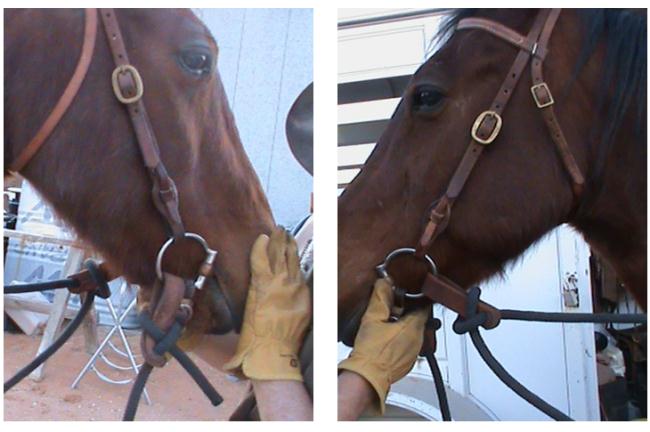
Slobber straps, in the pictures at left are normally used with round reins, like rope reins, or a mecate (also called McCarthy reins), and of course are less quicker to change out than reins with metal snaps. But I prefer slobber straps when I can use them.  You can see in the picture at far left the Slobber Straps are handing down with a loose rein.  Once the reins are picked up, the Slobber strap goes horizontal changing the weight on the bit, which is evident to the horse, so again a preparatory command.  


Friday, April 5, 2013

Going Bitless?


Over the last couple of years I have had several people write me with positive comments about riding in a Hackamore or riding bitless like I am some throwback to the pre-industrial age.  And while I have been accused of being a cave man by my wife,... for the record, I have nothing against bits.  I used to ride my primary horse, Junior, in a broken bit with short shanks that some people call an "Argentinian snaffle" but is really not a snaffle because it had shanks, and of course shanks provide leverage.

Junior will never again be ridden in anything by a Hackamore since he cut his toungue several years ago, and while his toungue is fully healed, I just don't have a need to use anything else with him.  In the picture at top left, I am holding a hackamore on the left and on the right, a bridle with a snaffle bit.  In the picture below, on the left I am holding a broken bit, with shanks - this is what some call the Argentinian Snaffle but it is not really a snaffle at all.  The true Snaffle bit is on the right. 


So I am not going bitless with Junior because I have something against bits. In the past I have used several different types of bits. I think excellent horsemen can actually use the differences in bits, of which some are large differences and some just subtle. I ain't one of them.  Years ago I gave up using a correction bit on a horse when I figured it out that I didn't know what I was trying to correct in the first place.

Bits, even spade bit and sliding gag bits, are not by themselves dangerous. Same as a gun,...just a tool. But any bit in the hands of someone who just doesn't know how to use it or is heavy handed, it can hurt a horse and probably ruin him to a bit, or at least have that horse expecting the worst from people when a piece of metal is shoved into his mouth.

Some people believe, me among them, that horses can get stale riding them in the same bit, so the occassional switch to a hackamore or a different bit can be a good thing, as long as you are fair and judicious in using it.  

If your horse is soft in the bit or rig you ride him in and he does what you ask him to, without bracing or head tossing, then there is nothing to say you ever have to ride him in anything different. Some people can get by in a snaffle bit all their life. Throw in a good hackamore with that and I'm one of those people.

Monday, April 1, 2013

Sharps Carbine as a Saddle Gun


I was asked recently "what I thought of a Sharps Carbine as a Saddle Gun?"

The Sharps Rifle and Carbine are great rifles with a lot of history particularly in the Old West, replacing muzzle loaders and providing a greatly extended range for hunting which made the Sharps Rifle a favorite of Buffalo hunters. The picture at left is the excellent Uberti reproduction of a Sharps carbine, priced at $1,739.

The Sharps is a single shot rifle, using a lever much like a lever action Winchester, to drop a locking block and exposing the chamber to load a cartridge. The most common chambering or cartridge for the Sharps is in .45-70 also called .45 Government.

In 1874, after 700 Comanche warriors attacked approximately 30 buffalo hunters in the Texas panhandle, at a place called Adobe Wells, the buffalo hunters situated here held off the Comanches for 4 days until re-enforcements arrived. This is the famous fight where Billy Dixon made a reported 1,000 yard+ shot on a Comanche Warrior using his Sharps, believed to be in .50-110. The Comanches warriors were killed at ranges they thought they were safe at.

The Sharps rifles are commonly in 32 to 34 inch barrels, although I have one in a 29 inch barrel length. The Sharps carbine has a 22 inch barrel. Weighing in at around 10.5 lbs, and being a single shot rifle, the Sharps carbine may not be the best saddle gun depending on your need to carry a rifle. Even the U.S. Cavalry carrying a similar type carbine, the single shot Trapdoor Springfield, would primarily use their six shot revolvers or sabres before using the carbine on horseback.

More sources for the Sharps rifle/carbine:

C. Sharps Arms Inc.

Shiloh Sharps Rifles

Cimarron Firearms Company


I have never carried my Sharps rifle on horseback. I prefer a lever action, repeating rifle such as the Winchester Model 94 in .30-30 or a Marlin Model 1895 in .45-70. However, many did carry the Sharps or Springfields while in the saddle, sometimes using the saddle ring to secure the gun with saddle strings, which I'm sure gave way to carrying the rifle horizontally between the rider and the swell of the saddle.


Thursday, March 28, 2013

For The Love Of A Horse Benefit


I am posting this in support of For The Love Of A Horse, a horse rescue organization.

Save the Date!

The 2nd Annual "Fore" the Love of a Horse Golf Classic is just around the corner! Registration is now open, Monday, March 4, 2013.

Please join us for a great day of golf, fun and prizes. You don't need to play golf to make a difference in the lives of horses or your community.

Register online at www.fortheloveofahorse.org If you can't join us, please consider one of our sponsorship opportunities, donation to our silent auction, prizes or simply a cash donation. No donation is too big or too small! Thank you for helping us, help them!

Warmest regards, Miaka D. Palmieri, President, "For The Love Of A Horse"  Miaka@fortheloveofahorse.org
Telephone: 404.680.0392

Sunday, March 24, 2013

Hoof Supplements: Carolyn's Question


Carolyn Moore left a comment on this site: "Very informative blog you got here. Ever considered adding a post about hoof supplements? I think it would make a great addition to the site. :)"

Thanks for your comments Carolyn.  Years ago my horse shoer was shoeing Border Patrol horses on contract and met a student at New Mexico State University who was finishing his Doctorate, in some field related to ruminant management or equine nutrition, who was contracted himself to evaluate how the Border Patrol was feeding their horses. The student, Justin, was also a hand with horses having previous worked on a ranch and feedlots in Kansas, so my shoer invited him when it was time to trim and shoe horses at the stables I was managing years ago.

Since, at the time I had three horses to be shod and also held horses for other people, I spent the whole day, every six weeks, at the farrier's stand with these two and was able bother Justin with questions about equine nutrition and supplements. I remember Justin was not too supportative of supplements in general, but did say something to the effect that if any supplements work, then hoof supplements would be it, providing they have the necessary amounts of Biotin, Methoinine and Lysine in the formulation.

I actually contracted Justin at a later date to give a presentation on equine nutrition, which resulted in some people quiting their practice of feeding sweet feed and probably creating some grateful horses as well, as some needed more feed and other less.

Back to horse feet and supplements,.........my 22 year old roping horse turned up three legged lame one day and a subsequent vet check and x-ray revealed that he had broke the wing of his coffin bone in his rear, right hoof. My shoer said that he had only seen that twice before, on much younger horses, and that he had success in getting these horses sound again. If I was willing to try to bring my horse back to soundness, he was willing to try.

My shoer fitted bar shoes on my horse for 9 or 10 months and I kept that horse on Horseshoer's Secret hoof supplement. When the last bar shoe came off we had the same Vet take x-rays again, but the Vet was pretty sure because of the age of the horse that he would not be healed. I had a feeling he was wrong, and I was right as the x-rays revealed a complete heeling of the coffin bone. While my shoer deserves most of the credit, I do believe the hoof supplements provided the necessary nutrients for the hoof to heal as best it could.

Today, my main horse is Junior, just a grade horse out of Mexico. Hoof problems are pretty common in horse's who do not get consistently good feed, but when I bought Junior years ago my shoer said his feet were in terrible shape,......big outside flairs in the bars, thin hoof walls, dropped heel bulbs on one back foot. My shoer did not have much hope of this horse turning out to be a good horse for my horseback law enforcement duties in the back country. But Junior never failed me,..never lost a shoe except the time we were loping and hit a sink hole where he over stepped and sprung a front shoe which I had to finish pulling off....that's were a Hoof Wraps bandage came in handy to protect that foot as we moved back to the horse trailer.

I also put Junior on hoof supplements, alternating between Farriers Formula and Horseshoer's Secret. My shoer did his usual great job, but still today he say's Junior's feet are still terrible, but he also remarks that Junior's soles are healthy and he grows alot of foot between shoeing. I attribute that to good, consistent feed and the hoof supplements.

So Carolyn now that I've bored you to death, the bottom line is that I do believe hoof supplements work. But also believe that not all horses need them, and that a horse would have to be on hoof supplements for 9 months or more to be able to tell a difference. Hoof supplements can't fix conformational problems, but can (I believe) give your horse the nutrients for as healthy of feet that is possible for him - combined with good farrier care and consistent, good feed.  And if you put a horse on good hoof supplements, then consider not telling your farrier and see if he or she notices a difference.

Thursday, March 21, 2013

Equine Soaker - Hoof Soaking Boot


While Hoof Wraps brought out the Equine Soaker quite a while ago, it's a good enough product to cover again, as well as the new Soaker Sacks that can be used with the Equine Soaker or by itself to keep a medicine on a hoof such as treating an infection from a puncture, using with a epsom salt solution for a stone bruise, or treating a really bad case of thrush. 

Hard rubber boot of which there are many designs, are hard to secure and are only as high as around the coronary band, are the traditional method of applying a medicine poultice or soaking the hoof with epsom salts. And I'm sure some of you, as well as I, have placed a horse's foot in a bucket to soak but that requires holding the horse.  On some horses the bucket works well, on other the Equine Soaker may be a better solution.  

The Equine Soaker is a heavy duty nylon sack and comes with two EVA hoof pads for the inside bottom and is secured using two velcro straps and draw cord secured with two cord locks so you can secure the equine soaker above the coronary band and above the fetlock. An additional Velcro EZ strap is provided as well to replace a worn out velcro strap or to additional secure the Soaker Sack. The Equine Soaker is made of thick ballistic nylon and has a coated nylon liner, and is six inches in diameter so it will last a long time and fit all but an elephant's hoof. Priced currently at $34.95 it is an affordable piece of equipment to have on hand.

The Soaker Sack comes in a package of two Soaker Sacks, two Velcro EZ straps and 1 EVA foam pad and are 18 inches tall x 12 inches wide. The Soaker Sacks can be used inside the Equine Soaker to prolong the useability of the Equine Soaker. Currently priced at $18.00 they are another affordable item for your horse medicine bag. Both of these pieces of horse health care items are available from Hoof Wraps.com


Monday, March 18, 2013

Horses Stopping to Eat


Alicia sent me a message on her 12 year old Quarterhorse mare stopping to eat: "Thanks for your information on feeding horses. I have a type of feeding problem with my 12 year old quarterhorse mare who when I have her in hand will stop abruptly to eat grass. It takes me fotrever to get her to quit eating. She also does this when I ride her. It is a drag to ride her with her stopping all the time to eat, but as least when I am riding I can squeeze her and yell at her which usually gets her moving again. My questions are why does she do this and how to I get her to stop?"

Your horse stopping to eat is a obnoxious habit whether it is while you are leading it on the ground or riding. While it is disrepectful you can't fault the horse until you make him aware that this behavior is unacceptable.

Sounds to me like you have found out how hard it is to pull your horse's head up from grazing with the lead line.  If it looks like my tongue in cheek photo at top then you are going about it wrong.  You won't win a pulling war with a horse.  It is easier to pull their head to the side and move their feet - their front end or back end over....or if you bump on the lead rope.  But if you do nothing else then you haven't solved the problem. You have just stopped them from eating after they started,...you haven't got her to understand stopping to eat is unacceptable.

The right thing is having respectful behavior with you, on the ground or in the saddle. So the wrong thing, stopping to eat, has to be difficult. So I think you need to lead her so she has a chance to stop and graze so you can specifically to train her not to stop and eat. Put a halter on her and lead her, anticipating andbeing being prepared for her to start an attempt to stop and eat. As she stops and trys to drop her head, you can re-direct her, with energy, to back up or move her front end or back end around. Then stop give her a pause - it is this pause or rest that helps them figure things out, then contine leading her again and be prepared to repeat.  

This is much like I do if a horse won't stand for mounting or begins to walk off as you get your seat as this,  is unacceptable behavior as well.  My horse Junior often grabs at weeds when we are moving.  I used to not worry about this too much especially at a walk, but lately I have been checking him from doing it because he needs to be with me all the time - not just when he chooses,.....a horse can get out of position going after an occasional nibble or worse yet, the problem could get bigger and develop into a problem of where the horse stops on his own to grab a bite.  Trail or lesson horses with new riders tend to learn this habit (and many other bad habits).  The trick is to get it solved now before it becomes harder to solve.       


Thursday, March 14, 2013

Escape Artist Horse


Escape Artist Horse - we probably have all had one or two. I remember when I was managing a large stables with over 40 horses, we had a large turnout where sometimes there would be as many as twenty to twenty five horses.  We always had to watch when a Buckskin Gelding, named Buck (go figure) was turned out since he could and would work the protected barell latch on the turnout gate and release all the horses.  The first time I saw all the turnout horses loose, I didn't believe the explanation for the escape,...I just thought someone didn't latch the gate,...until I watched Buck nimbly operate that gate latch one time.

Anyway, it still continues to amaze me just how smart and adaptive horses are.  Many people have seen the video of the Mariska a Friesan mare opening stable gates, but in case you haven't I have posted the article and video below.   

A stocky Friesian horse at a farm near Midland, Michigan is forcing her owner's to be extra vigilant after developing an amazing knack for opening gates and stable doors.

Farmer's wife Sandy Bonem says she wouldn't want to change Mariska's mischievousness nature but admits it can be infuriating when the horse breaks out of her stable and then opens the doors for the other horses.

Sandy and husband Don Bonem live at Misty Meadows farm along with their four Friesians, two quarter horses, two cats, six chickens and with one Friesian foal on the way.

Last month Sandy posted a Youtube video of some of Mariska's greatest escapes and to her delight it has already been viewed by over 600,000 people in more than 167 countries.

The video shows Mariska first open her own stable door then those of the other horses. She is equally adept at opening both top and bottom locks and even opens a chest freezer.

'Did we teach her to do this?,' writes Bonem on her blog. 'No, we most certainly did not, it makes life such a challenge for us. Especially as we have only to forget just one of the backup latches or chains and she finds the weak link.'

Mariska is clearly an extremely smart animal who has developed her jail-breaking skills since she was a young foal.

Mariska has always been fascinated with trying to open things and over time has progressed to more complicated escapes using her nose and teeth to push and tease at even the most stubborn of locks.

As well as enjoying the freedom of the farm, chunky Mariska - who is a bit on the hefty side for her height - is also on lookout for food.

The Bonem's used to store their grain in an old white freezer until the greedy horse discovered a way to open it. The grain was then moved to an empty stall but once again that proved no problem for the wily horse.

To keep a tighter reign on Mariska and ensure the safety of all of their horses, the Bonems have had to drill holes into their stall doors and add extra pins to try and prevent Mariska from going walkabout.

This year the couple have an extra special reason to keep close tabs as Mariska is pregnant and expecting in July. 'She is very sweet and loving and intelligent. We can't wait to see her new foal this year, she is an awesome mother and we are so glad she is ours,' writes Sandy Bonem.

In preparation for pregnancy, Mariska has been put on a diet which has so far failed to result in any weight loss. Despite reducing the horse's daily hay intake she remains a hefty 1280lbs.

Perhaps Mariska has discovered another way to break out and eat grain when the Bonems aren't looking.


Saturday, March 9, 2013

Cowboy Humor - Old Blue


A young cowboy from Wyoming goes off to college. Halfway through the semester, he has foolishly squandered all his money. He calls home.

"Dad," he says, "You won't believe what modern education is developing! They actually have a program here in Laramie that will teach our dog, Ol' Blue how to talk!"

"That's amazing," his Dad says. "How do I get Ol' Blue in that program?"

"Just send him down here with $1,000," the young cowboy says. "I'll get him in the course."

So, his father sends the dog and $1,000.

About two-thirds of the way through the semester, the money again runs out. The boy calls home.

"So how's Ol' Blue doing, son?" his father asks.

"Awesome, Dad. He's talking up a storm," he says, "but you just won't believe this - they've had such good results they have started to teach the animals how to read!"

"Read!?" says his father, "No kidding! How do we get Blue in that program?"

"Just send $2,500, I'll get him in the class."

The money promptly arrives. But our young cowboy friend has a problem. At the end of the year, his father will find out the dog can neither talk, nor read.

So he shoots the dog.

When he arrives home at the end of the year, his father is all excited. "Where's Ol' Blue? I just can't wait to see him read something and talk!"

"Dad," the boy says, "I have some grim news. Yesterday morning, just before we left to drive home, Ol' Blue was in the living room, kicked back in the recliner, reading the Wall Street Journal, like he usually does.

Then Ol' Blue turned to me and asked, "So, is your daddy still messing around with that little redhead who lives down the street?"

The father exclaimed, "I hope you shot that SOB before he talks to your Mother!"

"I sure did, Dad!"

"That's my boy!"

The young man went on to law school, and now serves in Washington D.C. as a Congressman......

Monday, March 4, 2013

Correcting Your Horse versus Disciplining Your Horse


Kayden wrote and asked about disciplining her horse: "I don't want to be unnecessarily rough with my horse but I am confused on not only what I should be disciplining my horse for but how to do it. I know that some behavior doesn't necessarily mean the same level of discipline or punishment. I think I would want to err on the side of caution though, your thoughts?"

Well, the first thing I would do is start thinking in terms of correcting your horse, helping him find the right answer, as opposed to disciplining him which is more akin to punishment. Correction has a positive connotation while discipline often seems to be a negative approach. In the world of training humans some people would call punishment as a motivation to learn as “negative re-enforcement”.

Horses are not going to rationalize the why on punishment. You run the risk of proving your horse right when he thinks he can't trust you, which he has an instinct for anyway.

An example of helping him find the right answer is - if a horse won't stand still for mounting I may make him move around in a circle a couple times with some energy, then offer to let him stand still - and he often will right away. Sometimes I may have to do this a couple times before the right answer is apparent with him. The right answer in this case is standing still. The point here is that you are correcting him by helping him find the right answer. This is often expressed as making the wrong thing difficult, the right thing easy. This is simple enough to understand but difficult to do when we let our emotions especially frustration and anger get in the way. You just can't take it personally. And honestly, this is something I've struggled with as I'm ashamed to say I always didn't think this way..

Another example could be if the horse walks off as I am getting my seat, I’ll back him up a few steps with energy then offer to let him stand still. Again, correcting him and helping him find the right answer. Imagine mounting and the horse moves off on his own accord then you jerk on his mouth then whack him, what will he do?. He may bolt or maybe not, but you have increased his anxiety. Now he may be thinking that his moving was justified because of having his mouth jerked on and being whacked or whipped. This is counter-productive. 
Yet another example may be trimming or cleaning a horse’s hoof. How often have you seen a horse try to take back his foot jerking a person, sometimes the farrier off balance. An impatient horse shoer will get mad and try to hit or kick the horse which only increases the horse’s anxiety and justifies him not wanting to give his foot and diminish his ability to run away. If you would hold onto the horse’s foot even if he is jumping around a little you would soon get to a place where the horse’s relaxes, then you immediately give him back his foot. He begins to learn that when he gives his foot to you, he’ll get it back.

Again, correction as opposed to punishment, and using the practice of making the wrong thing difficult, the right thing easy, is going to be your best bet to solve most all of your horse related behavior issues.


Saturday, February 23, 2013

177 years ago at the Alamo


177 years ago today the Mexican Army seige of the Alamo in San Antonio (then called Bexar or Behar) began. A few months early Texians under Ben Milam took the town from Mexican Cavalry under General Cos, but on February 23, 1836 General Antonio Lopez de Santa Ana arrived outside San Antonio with thousands of soldiers and surrounded the Alamo and the less than 200 men within it's walls. Among the Texian force were Jim Bowie, Davy Crockett and the Alamo Commander Lt. Colonel William B. Travis.

The flag at top right is called the Alamo flag. It is a Mexican flag with the seal in the center removed and the numbers "1824" instead. The year 1824 was significant to the Texians as the ruling Mexican government's Constitution of 1824 granted Texas settlers rights that were in subsequent years revoked in some manner which was one cause of the Texas Revolution.

Today, featured on display at the Alamo is the "Victory or Death" letter written by Lt. Col. William Barrett Travis, who was facing certain death from Santa Ana's forces.

On March 6th, 1836 the final assault by Mexican forces were successful in overwhelming the Alamo defenders. 182 Texians were killed and over 1,500 Mexican soldiers were killed and another third of that number wounded. The Alamo defenders were fighting to protect the rights granted by the 1824 Mexican Constitution never knowing that the Texas Government of Sam Houston had declared their independence 4 days earlier.

The Travis "Victory or Death" Letter

Commandancy of the The Alamo

Bejar, Feby. 24th. 1836

To the People of Texas and All Americans in the World—

Fellow Citizens and compatriots—

I am besieged, by a thousand or more of the Mexicans under Santa Anna — I have sustained a continual Bombardment and cannonade for 24 hours and have not lost a man — The enemy has demanded a surrender at discretion, otherwise, the garrison are to be put to the sword, if the fort is taken — I have answered the demand with a cannon shot, and our flag still waves proudly from the walls — I shall never surrender or retreat. Then, I call on you in the name of Liberty, of patriotism and everything dear to the American character, to come to our aid, with all dispatch — The enemy is receiving reinforcements daily and will no doubt increase to three or four thousand in four or five days. If this call is neglected, I am determined to sustain myself as long as possible and die like a soldier who never forgets what is due to his own honor and that of his country — Victory or Death.

William Barrett Travis.

Lt. Col. comdt.

P. S. The Lord is on our side — When the enemy appeared in sight we had not three bushels of corn — We have since found in deserted houses 80 or 90 bushels and got into the walls 20 or 30 head of Beeves.

Travis

God Bless Texas