Tuesday, April 29, 2014

My Horse Needs to Lose Weight


Barbara wrote to ask about getting her horse to drop weight..."I spent about two months recovering from a broken ankle so I enlisted some friends to feed my horse. I left some detailed instructions and consistently talked to the two ladies who fed for me. Imagine my suprise whern I finally made it out to the barn and discovered my mare looking nine months pregnant! I usually feed alfalfa, smaller amounts of grass and one large coffee can of sweat feed which is about three pounds, but only in the evenings. Can you give me what your ideas would be on how to get my horse to safely drop weight? Thank you, Barbara."

Hey Barbara, I hope you are not writing me thinking I am an expert on horse feeds, because I am  not. I have just experienced many people impacting horses, usually in a bad way, by following feed routines and not knowing either why they are doing or what issues their feed practices can cause.  And many horse issues can feed issues.   

I don't feed sweet feed, primarily because of the high sugar content and chance of the feed to go rancid or mold, and I think my horses' nutritional needs are being met without it. I am not saying that Sweet Feed is dangerous for horses, I just don't use it, and think most horse's don't need it. I do use a pelleted feed from ADM called Patriot.


I'd make sure your horse is over weight, sometimes their looks will just fool you. If your horse can stand to drop some weight, there will normally be fat deposits on the neck and in the shoulder -above the shoulder area.

Other areas to look at would be the ribs - you should feel them with your hand and/or see them when the horse moves - if not your horse is probably over weight. Also the spine area where the fat may be higher than the spine, and the butt-tail head area where fat also usually deposits. The horse in the picture can stand dropping some weight. This mare, in the pictures and bottom right), falls between the fleshy and fat category and needs to lose some weight.    

To your question about getting your horse to drop weight,......safe weight loss is more about activity or exercise than feeds. The more exercise they get, the more calories they burn and given the same amount of feed they will lose weight. A moderate amount of daily exercise, riding, lunging or even turnout can be effective without changing your feed amounts, at least changing them too much.

Changing feeds and/or your fed routine is a gradual process. If you are planning on reducing your horse's feed, without increasing exercise, to get her to drop weight then I would suggest a very gradual reduction in her feed. I had a horse that was a little too heavy that I couldn't get to for a month or so, so I reduced his hay by about 1 to 2 lbs day and within a few weeks, maybe four weeks, I could tell he lost some weight and did so safely.

If you do decide to lower the feed amount, then gradually is the key. 

According to Equine Clinical Nutrition, by Lon Lewis, an average 1,100 lb horse needs 16.4 mega-calories (Mcal) of digestible energy per day just for maintenance. When light work is added that 16.4 Mcal can be multiplied by 1.25 and hard work can increase that factor to 2.0. That doesn't mean after a long hard ride that you need to give your horse twice as much feed, but I'm quoting Lon Lewis to pain the picture that added exercise will often solve the problem.

One more thing,...a good feed resource is a book called The Horse Nutrition Handbook, by Melyni Worth,...might help you pass the time as your ankle fully heals. Good luck Barbara.


Sunday, April 20, 2014

More on Ground Driving


I received a couple of questions on ground driving and thought I would answer them here to clear up any questions from the previous article on ground driving.


Yes, Jack, I think this is something you can do with your colt prior to your first ride. I would make sure your colt was giving to lateral pressure or following your reins or lead line when you ask him to tip his head to one side and the other. The pressure or pull coming from the driving lines, run through the stirrups to either a bosal or halter is going to be different as it comes narrower angle than when you are using a lead line and standing at the horse's shoulder asking him to give to the pressure because you are normally pulling at a much greater angle in a more lateral manner giving the horse a clearly signal.


Lynn asked is she would be able to use her  driving lines just by attaching them to the bottom part of the bosal? Or should be get smaller diameter bosal like I was using in the video? 

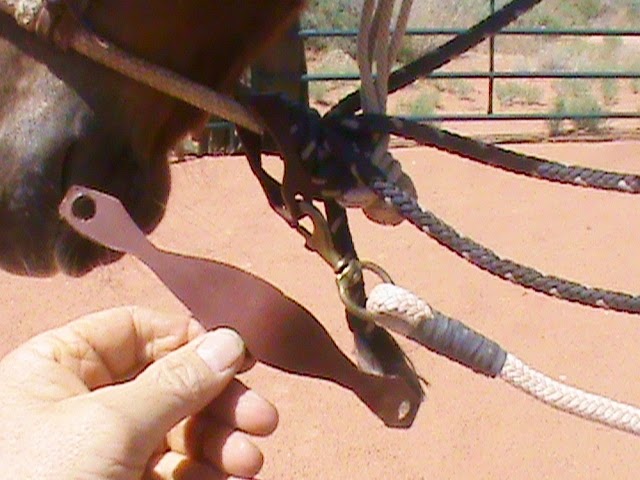
I wrote Lynn separately but did not include any pictures. Sometimes bosals are fairly thick where the bolt or other snap on driving/lunge lines can't connect to them,.....at least the size bolt snaps I use on the lunge lines/driving lines that I make.  So I was throwing feed yesterday morning, thinking about how I would connect driving lines to one of my thicker bosals, when I had what people back east call an epiphany. It's not like I get these often. In fact, I clearly remember my last epiphany when I caught my wife's favorite oven mitt on fire and my epiphany was that "I'm in big trouble."   I ended up blaming it on the cat (believe me - he deserved it) and everything was okay. But back to driving lines,....... I thought of making a small set of slobber straps to go around the bosal where I could connect the bolt snap of the driving lines to.   About 30 minutes later, using some scrap leather, I came up with the connectors in the picture above where you can see the bolt snap on the white driving line is connected to the mini slobber strap around the bosal just above the heel knot.        


As far as tying up the reins, if I had mecate reins, I would loop the reins part of the mecate around the saddle horn, then tie the lead line portion of the mecate around the horn. I use a clove hitch knot for this and snug it down.    

This keeps the rein portion of the mecate from bouncing over the saddle horn and becoming a problem such as the horse stepping through it.


If using spilt reins, I just tie the reins in a square know around the horn.  The picture at right is how I had the reins secured in the ground driving video.
 
However, if you were ground driving with as halter just remove the lead line.


Sunday, April 13, 2014

Ground Driving Your Horse


A computer crash did away with many questions people have sent to me along with pictures and videos that I intended to use to try and answer with. Someone wrote to me several months ago about ground driving their horse, which is basically moving and controlling your horse by using reins from a position on the ground and behind your horse. The first time I saw this was maybe 8 or 9 years ago when Craig Cameron demonstrated it.  It made sense to me then and ever since I have it in my tool bag to use when I think the horse can benefit from it.

Ground driving is something that can help a horse that is troubled by rein control under movement or having an issue with someone his back and trying to accept direction from pressure on the reins. It can be good preparation before that first ride or a tool on a horse that is still a little troubled after the first couple rides.

Using long lead lines or lunge lines, you feed the snap end of the line through the stirrups and connect to the halter. I would not use any bit when ground driving because there is a lot of rope to handle and an increased chance that the horse may get into trouble like stepping on the line and cutting his tongue. So I use either a halter or a bosal and I'll clip the bolt snap of the lunge line to the cheek piece of the halter or to the bosal just above the heel knot. I'm using 25 foot long lunge lines that I make from 1/2 inch diameter yacht braid rope putting a brass bolt snap on one end. Twenty Five feet is a pretty good length for an all around lunge line/driving line but some people ask me to make them shorter ropes in the 20 to 23 feet length,...just personal preference, but it needs to be long enough to allow you to stay at a safe distance from the horse's rear feet.

Before you start ground driving your horse be sure that he is okay with ropes across his butt, hocks and lower legs. Before I get to the point of ground driving a horse, I would have already sacked him out on ropes around his legs, hocks and butt. But it's important enough to check that he is good with it again before you ground drive him. If you have reins attached to a bosal like I do, either remove them or tie them up securely so it won't be an issue coming loose and having the horse step through them.

Make sure when you pickup the ends of the lines that you are far enough away from the horse not to get kicked - sacking him out on ropes across his butt and rear legs will help minimize a reason to kick, but be careful nonetheless. You are only really using one line at a time. The idea is to keep a loose line only putting a little pressure on one line to get his head tipped for a change of direction and using one line to flick it against his barrel, like you would use leg pressure, for a cue to go forward or to increase his gait. Start off at the walk and don't go to the trot until you and your horse are good at changes of direction and stopping at the walk.

Remember that if you or your horse gets into trouble at any time, let go of one of the lines and bend your horse to a stop with the other line.


Wednesday, April 9, 2014

No Time for My Horse


Dorothy wrote me with the following questions: "I think I'm like many people out there having a horse and not having very much time to ride her. My children and husband take up almost all of my time and sometimes when I get a chance to ride it's only for an hour or so. The lady who keeps my horse turns her out almost everyday, but aside from bringing her back from the paddock and feeding her 3 or 4 times a week and riding only a couple days a month, I wonder if I am doing her a disservice by keeping her instead of finding her a good home. A good home would have to include an intermediate rider as my mare has some issues, some of time, LOL. She has her own strong will and the short amount of time I can spend with her doesn't seem to be making that big of difference. "

Hi Dorothy, what mare doesn't have issues some of the time? It says a lot about you to consider your horse and her welfare. At least you are cognizant that your mare needs more time than you can give her. I hope she is being kept with other horses, either stalled side by side or in turnout with others as horses are social animals and most of them need contact with other horses for a good mental state. 

I see many horses not only kept singular, but also kept in small pens. I think keeping a horse in a small pen can be mitigated somewhat when the horse is put in turnout at least a couple times a week, plus has more human interaction other than just feeding once or twice a day.

Some people think if they don't have time to ride their horse then all they can do is throw feed. I think that needs to be looked at from a different angle.........how can you maximize the small amount of time you do have to make your horse better?

I'm convinced that even if you only have 5 minutes to spare, you can do 5 minutes of training or re-enforcement with your horse. Work on having your horse back up and stand still, away from you when you throw feed; get her to drop her head upon voice command or a cue. Work on directing her feet: have her move her front end over; have her move her back end over; have her back up. And these are things you can do with or without out a halter or neckrope.

With a halter leading her to and from the turnout, you can work on her leading up correctly: stopping when you stop; backing up. See how light you can make the cue before she reacts. See how light you can pickup slack in the lead rope before she moves out. Watch for her anticipating and correct her. And when you do stop, watch her to make sure she stays focused on you - giving you both eyes. If she gets distracted just bump her back to two eyes on you.

Under the lead rope you can work on vertical and lateral flexion, and again, moving her front end over or her back end over. Pick her feet up. You can lunge her to and from the turnout working on having her change direction by disengaging her back end and crossing over on her front end. You can get her good at positioning up on the mounting block or the fence so she'll be easier to mount from here.

I'm reading between the lines that your children are not involved with your horse. I know that some children while having a interest in horses when they are young often grow out of it in today's digital world, but getting them involved can at least teach them empathy for animals which is sorely missing in this country today.


Sunday, March 30, 2014

Camping with Horses


Wade wrote to ask "I'm interested in camping with horses and or mules. (and) Their care and feeding, grazing if available, and first aid for the animals. What should I be watchful for etc. Thank you."


Big question, Wade. Assuming you have suitable horses and/or mules for the area you are heading to, much will depend upon the area as far as available grazing and permits. By suitable stock I mean your horses or mules are healthy and conditioned enough for the area you are going and the distance you plan on riding.

Some areas require your horses to have been fed certified weed free hay - to protect against the proliferation of weeds or unwanted grass species. Some areas will require use permits.

I would be considerate of feed issues related to over night changes of feeds. For example from dry grass or alfalfa hay to a forest pasture. I would consider any pasture where I was going to be supplemental feed and plan to bring my own feed which for me is grass and alfalfa hay and a complete pelleted feed from ADM.

Planning on camping in the wilderness, just you, your horse and a bedroll is one thing, but wanting more comforts and certainly staying for an extended time will require a pack horse or pack mule. If you go out with minimal gear make sure you can build a rudimentary shelter and a fire - not only for warmth but as a signaling device if you get lost or hurt. Water would be a primary concern. You take take enough, so you need to go where there are sources, either man made or natural.

There may be some areas near you offer horse friendly campgrounds with pens for your horses, otherwise you'll be looking at high lining or hobbling them. Available water would be important too, as you could easily go through 40 gallons or more a day.  

If you are inexperienced at camping or back country trips on horse or mule back, then maybe you can find an outfitter and sign up for a trip on their animals as it would give you invaluable experience before you set out on your own.

Just so much depends on what you want to do and where you want to go. A great resource would be any state chapter of Back Country Horsemen of America. They would be able to direct you to horse friendly areas and give you an idea on what you would need as well as point to you getting permits if required.

As far as first aid for horses, I have a vet bag in my trailer and carry small items in my saddlebags:

Vet Bag: several rolls of Vet Wrap; 4x4 gauze; medical tape; Nitrofurazone; Anti-septic wound powder; Quik-Clot; tampons (for dressings); Hoof Soaker Boot and Epsom Salt (this is all inclusive list, but minimal essential items);

Saddle Bags: Vet Wrap with tampon stuffed inside the hollow part of the cardboard roll then put in a vacuum sealed bag; Hoof Wrap bandage in case I pull a shoe or have a hoof puncture;
During snake season, I'll carry two eight inch long surgical tubes (same type you use to tube horses), coated on the outside with Vaseline or Bag Balm and sealed in a vacuum packed bag - in case my horse gets bit on the nose, where a lot of snake bites occur, I have a chance of inserting them in nostril's to keep his airway open.

If you get all set up and head off for a horse back camping trip, I'd also suggest you let people know where you are going, what route you are taking and when you are planning on coming back. And a cell phone is always a good idea in case you or your horse get into trouble.

These also may be a couple of useful resources for you, Wade. Good luck and safe journey.

"Low Impact Horse Camping" - Video
"Mountain Manners" - Video
Idaho Back Country Horsemen
HC 66, Box 248
Kooskia, ID 83536

"Horse Camping" (1981)
by George Hatley - The Dial Press
1 Dag Hammerskjold Plaza
New York, NY 10017


Saturday, March 22, 2014

Why Use Tie Downs on Horses?


Ellison wrote to ask about Tie Downs. "Thanks for your information and videos. I remember some topic and often go back to look. I bought an older horse, 15 years old, who was used for team roping. The owner told me that I should use a tie down on him. He showed me how he connects this underneath the bit and head harness. I bought this horse because he seemed really gentle and calm for use as a pleasure horse and want to know if using this tie down is necessary for control?"

Basically the tie down is a nose band connected with a strap to the front D ring on the cinch - which the correct way to rig a tie down.  Although over the years I have seen people rig this differently, from the nose band, through the main  ring on a breast collar to the front D ring on the cinch, and actually a few times rigged straight from the nose band to the main ring on the breast collar.  Team ropers use it on their horses to give the horse something to push or brace against when turning or stopping under the jerk and load of a roped steer.

I have used a tie down before when I was team roping. I quit using it when I didn't think it was helping my horse and just felt it was wrong for me and my horse. Tie downs will work for the purpose of something for the horse to push against and be better balanced for the jerk of a load on the rope otherwise the very best team ropers who are also very good horsemen wouldn't be using them. But is important that the tie down is adjusted correctly which will allow your horse to push his nose out far enough in order to run in a balanced manner, and the nose band should be positioned above the soft cartilage of the nose to keep from doing any damage.

I think I would ride your new horse, maybe first in a controlled area like a round pen or arena, do some transitions, work up against the fence doubling him, and on backing him as to see what he is like without the tie down. Maybe the previous owner didn't know any other way but to use a tie down. If the horse is throwing his head it may not be because of a lack of a tie down,.....it could be an ill fitted bit or a bit that causes pain. Or it could be a learned reaction to get away from rough or quick hands. If you watch a horse that is being ridden with rough hands, as soon as the rider starts to pickup on the reins that horse's head may go up trying to alleviate the pressure and pain that he is expecting to come next.

Good luck to you and I'd like to hear how you are doing with this horse if you ride him without a tie down.

Friday, March 14, 2014

Eclectic Horseman Magazine and Horseman's Gazette


If you don't know about Eclectic Horseman Magazine or their quarterly video series, The Horseman's Gazette, then maybe you ought to.

Although they got started in 2001, I didn't find out about them until around 2005, when I picked up one of their magazines from Kansas Saddlery.

Their bi-monthly magazine features articles from Buck Brannaman, Bryan Neubert, Martin Black, Joe Wolter, Scott Grosskopf, Wendy Murdoch, and many others bringing an eclectic approach to horse training and problem solving. Or what, Emily Kitching and Steve Bell - a husband and wife team and the owners of Eclectic Horseman Communications, call a cross-disciplined approach to horsemanship for students of all experience levels or Just what works.


The Horseman's Gazette is a quarterly video series on DVD which complements the magazine well. Each issue has over 60 minutes of instruction and opinion from well known and respected horsemen and women.


How to video articles and segments on people are something I've watch many times over the years. The latest issues, No. 17 Winter 2013 features videos on: Tying Up Your Mecate with Bryan Neubert; Four Methods of Moving the Hindquarters with Buck Brannaman; Getting Your Horse to Move Out with Paul Dietz; Warmup For the Branding with Scott Grosskopf; and, Leg Yield Part I - the Walk with Wendy Murdoch. Check out the Eclectic Horseman website or give them a call at 1-866-773-3537.


Saturday, March 8, 2014

Opening, Moving Through and Closing Gates on Horseback


Cecila wrote to ask with help negotiating gates. “Hello, my name is Cecila. I wonder if you can help me determine what may be the problems when I am trying to go through a gate on my horse. I usually don’t have any problem going through the gate but lately after we go through my horse will swing or move away from the gate often making me lose my hand grip on the gate."

Hey Cecila, if you and your horse were okay at opening, moving through, then closely gates before and now your horse isn’t as good at it, it’s most likely an anticipation issue with your horse. Maybe your horse is alittle barn sour. You should be able to tell the next time you attempt to open and go through a gate. Does your horse start to move without a cue? Are his feet moving around anticipating the cue to go through? It's always a good idea to occasional open the gate and have the horse stand for awhile before you ask him forward - both on the ground and in the saddle. Sometimes it may be a good idea to open the gate, close it, go someplace then come back and repeat....this will teach the horse that even though you open the gate, you may no be going through it.

If your horse is anticipating the gate, then your horse is probably anticipating other things as well. When being led in hand, does your horse stop exactly when you stop? Does your horse begin to move off before any cues? When you mount, does the horse begin to walk forward without a cue? These are all common anticipation problems.

Here are some things I would do to prepare for and then be able to open, go through and close gates. It’ll also help your horse in many other aspects of riding.

I think that being able to move the horse’s front end and rear end independently of each other, do a side pass and back softly one foot at a time will not only help you position up for the gate and make adjustments when your horse gets out of position, but will be useful in so many other movements.

Many people will practice all different ways of going through a gate. This will help get your horse better all around and also keep from anticipating:

~ opening the gate towards you and your horse, then riding around the gate and pulling it shut. This is pretty difficult since our arms are fairly short and it's easy to pull the gate into the horse's leg. One of my property gates opens only one way (to the inside) so I have a three foot length of rope so I can open the gate while horseback, and close it when I rode through;

~ pushing the gate open and then walking through, then riding around the gate and pushing it shut with your horse making a side pass. Much easier and safer in my opinion, and you should be good at this way before you move on and attempt other methods;

~ pushing open the gate then backing through, then you'll have to move the horse's back end about 180 degrees to then side pass to close the gate.

I hope the video below is of some help to you with your horse negotiating gates.


Saturday, March 1, 2014

Horse That Is Suddenly Spooky


Anonymous has left a new comment on your post "Horse Training – Spooky Horses on the Trail": "My horse has suddenly become afraid of leaving the turn out. She is really dangerous as she totally loses it and runs into you. What can I do. She is really spooky lately."

It would be good to know how and where you are keeping your horse; how much training she has had and how much are you are riding her. Horses are herd animals, relying on the group to be safe, and keeping them by themselves can contribute to spookiness. Sometimes a younger horse can get nervous and spooky, if she is the lowest horse on the totem pole in a herd that is kept together, if she is getting bullied by another horse(es). This can carry over into your interaction with her. Sometimes changes in how you keep her and her environment may help.  

What you can do, when you are with her, either on the ground or riding her, is to work towards her looking to you as the leader at all times. You have to get good at correcting all the behavior which empowers her to exhibit that behavior which can be dangerous to you.  The only reason she is doing that is that she thinks she needs to. 

The frequency in which you work with her also has much to do with her's and your progress. I think the majority of horse owners are 'once a week people' who may provide care for their horse seven days a week, but only work with the horse or ride once a week. I think it's hard to keep a well trained horse tuned up with a once a week schedule, let along trying to correct bad habits.  There is a lot of truth in the old saying that 'wet saddle blankets make good horses'. 

Ground work is often neglected or thought to be largely unnecessary once a horse is being ridden. I beg to differ. Ground work establishes and builds that relationship, needs to be done often, done well and is useful at any stage of the horse's training.

Ground work does not have to be only a formal event in the round pen. Everytime you interact with your horse, asking her to drop her head for the halter, leading her, asking her to move her front end or back end over, and even not to crowd you when you throw feed - are all things some people won't be careful at. So when the horse throws or shakes his head when putting the halter on, invades your space or doesn't lead up correctly,....or, when while leading you stop and your horse is still moving or paying attention to everything but you,....or, when she is feed aggressive or otherwise not respecting your space when you throw feed,.......are behaviors that degrade the leader position you should hold with her, and make it increasingly harder to correct in some cases.

I would work her, both on the ground and, when you feel safe, in the saddle. Start with things she can do well, When she does well, stop and give her a release before moving on, but be ready to re-direct her focus back to you if she becomes spooky or lost. This means moving her feet. Lunge her. Work on backing. Work on turns on the fore end and hind end. Sack her out with a flag. Introduce other obstacles to her such as tarps. Give her time to make it her idea to approach the new obstacle.  You want to be building in her a chance to think instead of just react.

Again, be ready when her focus on you is diverted. If I can see some anxiety building a horse, I'll re-direct that focus onto something I am asking, like lunging or riding in a circle. Work on collection. Practice leg yields.   Doubling on a fence line.  Things like that. I don't make it a federal case if they spook, I just re-direct and concentrate on something positive.

The last thing I'd like to give you to think about is to not be waiting on your horse to spook. Horses are pretty perceptive. I think they can pretty much sense our moods. If you are waiting on them to spook or run you over, they just may feed off of you and prove you right.


Sunday, February 23, 2014

Equine Extravaganza Supports Perfect Harmony Horse Rescue and Therapeutic Horsemanship


Horse people from all over the country conduct local or regional type events each and every weekend simply for the love of horses. These event coordinators put in long hours, make phone call after phone call, coordinate set up and often do much of the labor themselves, mostly without any recognition at all.  Again they simply do it for the love of horses and these events benefit all through the education it provides.   

These events can be shows, competitions, clinics, trail rides or what I attended a couple weeks ago, which was the second annual Equine Extravaganza, hosted on 14 February by the Lower Valley Horsemen's Association (LVHA) of the greater El Paso, Texas area. This event was coordinated and ran by Vicki Maly of the LVHA featured a training demonstration, stallion showcase and bidding for breedings, a Therapeutic Horsemanship demonstration, an auction and raffle, and several vendors offering tack, related gear and western theme goods.  Event proceeds went to support a local horse rescue and Therapeutic Horsemanship organization.  

This year Vicki was able to bring in Rudy Lara of No Strings Attached Horsemanship of La Mesa, New Mexico to give a Cowboy Dressage demonstration.   That's Rudy in both pictures above, with his exceptionally trained Bay Horse.  While most of the people in the area probably have heard of Rudy, it would be an even bet to say that they came away with a higher regard for Rudy's horsemanship skills as he demonstrated tenants of Cowboy Dressage and talked to the crowd about understanding horses to enable a relationship that training can be built upon.  La Mesa, New Mexico is within the greater El Paso, Texas - Las Cruces, New Mexico area. Those people with training issues shouldn't hesitate in contacting Rudy Lara to help out.  You can visit Rudy's website here to get more information.  

Therapeutic Horsemanship of El Paso (THEP) demonstrated the how's and why of matching disabled people with horses to further rehabilitation or to just provide a quality of life to that person's that horses are uniquely suited to provide.  The THEP team in action in the picture at right. Their website is here.


The Stallion showcase featured three stud horses, including this Leopard Appaloosa in the picture above, whose owners auctioned off breedings which all went to support the THEP and Perfect Harmony Horse Rescue, a Chaparral, New Mexico based rescue organization, a 501(c)(3) non profit horse rescue and sanctuary, concentrating on older and/or disabled equine. 

And speaking of Therapeutic Horsemanship, the American Competitive Trail Horse Association (ACTHA) is hosting 1,000 competitive trail rides and arena obstacle competitions in March, to benefit the 850 Therapeutic Horsemanship centers in North America under the Professional Association of Therapeutic Horsemanship International (PATH).  These rides are scheduled on March 15th and 16th all across the country and hope to raise $1 Million dollars for PATH.   If you are interested in supporting this in any way, so to the ACTHA site and find a ride near you and call the event coordinator.     


Monday, February 17, 2014

Arena Obstacles for Horses - The Basic Bridge


I have received quite a bit of mail in the last couple of months asking for some ideas for easy obstacles that can be used in a small arena for training or competition. I think this validates the popularity of arena obstacle competitions.

The American Competitive Trail Horse Association (ACTHA) recently developed a competitive event concept for arenas or small fields for rider's who do not have access to six miles of trail and six people who volunteer to be judges. ACTHA calls these ATHCA Arena Challenges (AOC's).

These arena obstacle challenges are really nothing new. Craig Cameron's Extreme Cowboy Association have been doing these for years, although I reckon many riders would find these events too challenging.

Whether or not you compete in or host a ACTHA challenge or Extreme Cowboy Association Race in an arena you can still set up obstacles for training,....or yourself and your horse, or for a group.  It'll help your horse learn to think and make a safer horse for the trail. 

Consider obstacles that have more than one use. Meaning an obstacle that you can negotiate in several different methods. My example for this article is the simple bridge.

The bridge in the video below is a simple re-inforced wooden pallet (wooden skid) using two additional pieces of 2 x 4 board to re-inforce the existing braces. Then a piece of plywood is cut to size and screwed down. At least 3/4 inch plywood is best to ensure a solid platform to bear the horse's weight. Wood putty can be applied over the screws to help keep them from backing out and catching on a horse's foot or shoe. It would be a good idea to inspect obstacles like this before use to make sure it's safe.

A double pallet (2 pallets high) could be constructed to make crossing it just a bit more difficult - it's going to be heavier and harder to move around, so consider this also. On some of my bridge obstacles, I have tied a rope to it so I can drag it around on horseback. It you attach a rope to your bridge, be sure not to include any loops that a horse can get his feet caught up in.

An even simplier bridge is just a plain piece of plywood. Have some caution, on whatever platform you use, that a horse's foot can't go through it. Worse case, a horse's foot goes through the wood and gets caught up in it.

So now you have a bridge for your horse to cross for one obstacle challenge. You could require the horse and rider to cross the bridge, turn around then cross again. You could stop your horse with all four feet on the platform. You could even have the rider count out loud to five to demonstrate the horse's willingness to stand still, on a loose rein, with all four feet on the bridge.

To could add a turn on the fore-end by having the horse put his front feet on the bridge then side pass a complete circle around the bridge. If a full circle is too much then maybe a quarter or half circle. For the turn on the fore end, ideally the horse's inside front foot, the foot opposite the direction the hind end is moving, stays in place (or relatively in place) as the pivot foot during the turn. In the video below, I'm taking a horse across the bridge, turn around then re-approach the bridge and ask my horse to put his front end on the bridge then side pass a circle keeping his feet in the bridge. Practically speaking, elevated turns on the ore end come in handy. There have been several times I've followed a slight trail on a steep slope only to have that trail peter out where I had to turn my horse upslope to turn around.


Lastly you could do the same with a turn on the hind end. Crossing the bride, the rider stops with the horse's back end on the platform then while keeping the back feet on the bridge, does a quarter, half or full circle turning on the hind end.....pretty much like the spin in a reining pattern.

I am going to do a couple more videos on simple arena challenges and try to have obstacles that are multiple use. For more information of arena obstacles and some videos on how they are judged, go to the ACTHA website.

Safe Journey.


Monday, February 3, 2014

ManTracking - Detecting Speed from Tracks


Rebel wrote me to ask "I found your website from the videos on You Tube. I am not into horses, but was looking for tracking information as I am helping to teach classes to Explorer and Boy Scouts. I also serve as a volunteer on a regional Search and Rescue (SAR) Team. Can you explain how to tell how fast the person who are tracking is going? Thanks, Rebel."

Aside from the obvious extended stride length, there are some pressure release clues. Any one of them could be helpful when the others are harder to discern.

Stride length. From a normal walk on level ground to a man running on level ground, stride length can double. From the picture below you can see the stride stick (aka tracking stick) and the tight fitting rubber grommets I use so I can slide them up and down to measure a stride, track width, off set, etc. of any track I'm on. The picture shows the increase in the stride length from a person walking, to walking fast to running. In this case the stride length from the previous toe to the subsequent heel, which is how I measure stride, is 17 inches for the walk, 24 inches for the fast walk and 31 inches for jog - for example. That will change depending upon the hardness of the ground, weight the person is carrying and the degree of slope. It can be also influenced by the physical condition of the person. Tired people will have a shorter stride and get a little careless on foot falls. Toe gouges and trips may be evident.


With the increased speed and force with a person's foot hitting the ground, the disturbance to the ground soil, vegetation and/or rocks can change significantly. The pressure release would be altered because of the change of pressure on the surface has changed.

The pressure release may be hard to discern on hard soil or ground that is covered by vegetation. Torn pieces of vegetation and bruising on stems, stalks and flowers can be discernible. While you may not be able to see tracks because of ground vegetation, you may be able to feel the pressure-release or gently separate the vegetation in order to get a visual idea on the track.

The picture below shows tracks in sand where it is easy to tell the difference in the pressure releases, changed by speed. The easiest pressure releases to read are toe dirt visible on the fast walk and the wave around the ball of the foot that is created by the foot pushing off. At the print at right, where the person is running you will see a more significant wave and less toe dirt as the person's foot are coming of the ground with the knee bent more, therefore reducing the amount of toe dirt thrown forward. This can change in deeper soil or be indiscernible on much harder ground.


A gouge is another pressure release that is enhanced from speed and sometimes weight being carried. On the above print at the right you will see a gouge created by the heel striking the ground more forcefully at a shallower angle. You will sometimes see a ledge opposite the gouge. This is usually evident on wet soil or soil that was wet when the track was laid then has dried. The ledge visible in the heel of the track at left is due to the foot making a more vertical strike on the ground.  

Hope this helps Rebel.  When you are trying to determine the speed of a track (the person you are tracking), you shouldn't make a determination based on stride along or any one aspect of the pressure release, unless that's all you have. You should pretty much take all the signs together to tell you what that person is doing.


Friday, January 24, 2014

Bitless Bridles


I received an e-mail from a lady asking what my opinion were on Bitless Bridles, such as Dr Cook's Bitless bridle.   It seems she bought a older mare who had a previous severe cut on her tongue so riding in a bit on this horse wasn't an option for her. She has also tried a side pull - I'm assuming a version without the snaffle bit, but was looking for a better option for her horse. If anyone reading this has some experience with or opinions on Dr. Cooks Bitless Bridle, then please drop a comment in the comment box underneath  this post.

My reply was that I understood her reluctance to use a bit in her mare. I have a gelding in the same boat and I'll never put a bit in his mouth again. I am not against bit's, but for the most part I use a rawhide Hackamore, and sometimes a hackamore with a soft or hard rope bosal.   While there are thousands of really good horsemen out there who find use in all sorts of bits, from snaffles to spades, I don't think I'll ever get to the point to competently use any bit but other than a snaffle or broken bit with short shanks.  Better chance of keeping me honest that way I reckon.   
 
I actually prefer to start a horse on a hackamore as opposed to a snaffle bit. For me it makes more sense as it is much closer to the halter. The disadvantage with a hackamore/bosal is that the reins connect under the jaw so the pull on a direct rein is something you need to be patient with to let the horse understand and develop that lateral flexion. On a direct rein you are actually pulling the bosal into his nose on the opposite side of his head/face suggesting that the horse turn in the direction of the pull to gain a release from the pressure. Because the reins of a hackamore connect to (just above) the heel knot of the bosal under the jaw, sometimes the horse will tip his head (less desirable) rather than turn or rotate it at the poll, which is more desirable as it positions the horse in a more balanced position for a turn.

Dr. Cook advertises that his bitless bridle pushes rather than pulls, because the direct rein runs underneath the jaw and connects to the opposite cheek. Well, the way I see it, it is still a pull, like the Bosal or a side pull. A possible advantage with the Bitless Bridle is that the pull is higher up on the cheek and may tend to turn the head as opposed to tipping the nose which positions the horse for a better turn.

At right is a picture of the Bitless Bridle. The reins are connected to the ring on straps that run underneath the jaw.  These straps run through a fixed ring on the side of the nose band. 

When pressure is applied to that rein, it tightens the strap running underneath the jaw, running up the opposite cheek and then over the poll.  In theory this provides a clear signal, but again I haven't ridden using this Bitless Bridle, but I don't think I would have a big problem having any of my horses' accept it as they have been ridden in bosals and understand lateral flexion when asked through a direct rein. that's  However, I'm interested in comments from those who have ridden the Bitless Bridle.   

It is interesting to go to Dr. Cook's website, again it's here, and read about the Bitless Bridle.  I don't agree which his assertion that bits and bosals operate off of pain.  They certainly can when misused.   But I think there is a difference between pain and pressure.     

I do have a question, maybe a concern, about Dr. Cooks Bitless Bridle. When using a bit or a hackamore, the horse has the option of lateral or vertical flexion to move away from the pressure.   I think that's the point as that's how we get our horses to bend or flex in reaction to that cue.   When using the Bitless Bridle and pressure is applied with the reins, it is transmitted to the whole head. When the rider is using both reins to apply pressure, such as for a stop, back or to get the horse to collect,...I wonder if some horses would feel trapped or locked down as they cannot move to get a release and are more dependent upon the rider to provide the release, which may not happen in a timely fashion.

I think that if a horse works well in a side pull, then the transition to a Bitless Bridle, should go okay, as long as the horse is eased into it. It will be a different pressure than the horse is used to, so I might start real soft, reward her smallest effort and build from there.

Thursday, January 16, 2014

Feeder Solutions for Horses


Karla wrote to ask about Horse feeders: "I just finished reading a Western Horseman article about preventing colic. My horse throws her hay around no matter what kind of feeder I use. I have used hanging feeders and large rubber buckets. They (Western Horseman article) suggested mats so the hay will be off the ground when they do throw it around. Do you have a suggestion on where to find large mats? How do you feed your horses? Thanks, Karla."


Hey Karla, I read that good article from Western Horseman as well. Keeping hay off the ground, especially sandy ground, is one of the first step to reduce risk of colic. Horses can have up to 80 pounds of accumulative sand in their gut. And all horses are different so I reckon some do better than others picking hay off the ground and consuming less sand than others.  If you watch closely, you'll see a horse blow through his nose, probably clearing sand away (intentional or not) then picking up a piece of grass.  The problem with some feeders, like the one in the picture above, is that hay gets dropped to the ground out of the feeder by the wind, and we have a lot of wind in West Texas.   

A periodic Sand Clear (psyllium) and/or bran mash rountine is another measure you can consider to help in getting some sand out of the gut. When I throw hay for my horses I break it up so the horse's can't grab a large flake and fling it out of the feeder onto the ground. This also helps me find all sorts of garbage in the hay,....plastic bags, things like that.

Some may use large trailer flooring mats to feed off of, but these can be really heavy to pickup and clean off. You could always use a broom to sweep the mats before each feeding. If you decide to use mats, I would check out an auto parts store for truck bed mats. We have used a couple of these and they have lasted now for 10 years.

I have also tried or seen about all types of feeders being used,....large buckets, hanging feeders, free standing feeders, and even hay nets or bags. Can you imagine the pain in the butt on loading a hay net a couple of times a day? 


What I use now for feeders are large plastic boxes that look like milk crates. Called the Arca Systems Big-Box they are made by Daco Corporation - Arca Systems, phone 1-800-423-3221. I have them in two sizes, the bigger one (see picture above) is 48"L by 44"W by 29"H and weighs 95 lbs, and works great for feeding two horses.  The other Big-Box I'm using is the smaller version (see picture below) 42"L x28"W x 29"H which weighs 69 lbs, and is suitable as a one horse feeder. Both are easy to move around even in heavy sand and have slots to allow using a forklift.

I have these boxes under overhead cover, but it might be a good idea to drill a couple small holes to drain water and help sweep any dirt out every once in while, as well as drain excess water if you feed water soaked hay from time to time. One of the best things about using feeders on the ground is that this is more natural for the horse to eat this way.


Porta-Grazer.  Another feeder solution that someone recently told me about is the Porta-Grazer, which is basically a large bucket with a perforated insert that makes the horse pulls hay through holes with it's front teeth, reducing the amount of hay the horse can grab and drop or throw around. Makes them eat slower too.

From the Porta Grazer site: "Natural grazing slow feeder for hay and pellets. Lets your horse graze hay slowly tearing each bite with the incisors creating more even dental wear thus relieving TMJ problems. Great for the prevention, treatment and elimination of gastric ulcers, colic and many other problem stall vices and bad habits. As the pan rotates the holes lift the ends of the hay stems up so the horse can search, pull, tear while he is chewing and swallowing. This allows him to size each bite as he eats insuring that his food is thouroughly chewed and salivated as it is when grazing.That's grazing and no other product does this. No wasted hay. Travel safe and sanitary. Head down and dust free Also collects sand and dirt from the hay to be thrown away later."

Here is a short video on the Porta-Grazer:


In any event, good luck Karla in finding a feed solution.

Monday, January 6, 2014

Guts and Glory Ride for Veterans


Craig Cameron recently hosted a 100 mile horseback ride to raise awareness and funds for the Special Operations Warrior Foundation. Called the "Guts and Glory Ride for Veterans", this is a worthy cause to support. Craig Cameron, the riders who rode with him and all that supported it, included the horses, are Great Americans. If you didn't get to see it on RFD TV, you can watch the shorter video below. It probably was appropriate that the ride started out in freezing weather.


Supporting wounded veterans and the organizations that provide care and support is a great thing to do. Some of these guys I count among my friends. Men like Chuck Yerry who lost a leg in combat, replaced it with a prosthesis, then was back in the fight. Chuck just retired but spent all his free time in the last couple of years working to make the Special Operations Forces K9 memorial a reality. As Sergeant Major Yerry explained, "for each SOF K-9 lost in combat represented one or more American soldiers saved."

Yet another Veterans organization that supports wounded warriors is the Task Force Dagger Foundation. TF Dagger was the organizational name of the first Special Operations Forces, mainly Green Berets from the 5th Special Forces Group, who entered into Afghanistan one dark night just weeks after the Twin Towers attacks to organize the resistance against the Taliban and drive these Islamic terrorists out of that country. TF Dagger has been immortalized in several books, but probably no more recognizable than the photo of Green Berets on horseback moving to engage the Taliban. You know that horseback warriors in heaven were sitting up watching this one.

Please pass the word on these worthwhile organizations. Safe Journey.

Tuesday, December 24, 2013

Merry Christmas 2013


The year has flown by and now it's time to wish everyone a Merry Christmas.  I hope we all remember the reason for the Holidays which of course is God giving us the hope of ever lasting life through his Son, and we celebrate this incredible blessing in one fashion and that is by giving gifts. I hope everyone enjoys the gifts we given and we in turn appreciate the gifts and blessings we have received.  I hope all the horses all over the world enjoy the gift of respect and a fair life.
But the Christmas we get caught up in sometimes, the spending and the shopping reminds me of a little story.  It's about an old couple, married for 50 years, who rarely went into town but drove into town they did so the wife could do some Christmas shopping for the children and grandchildren.  The husband, as you can imagine, was less than pleased with the whole arrangement. 
 
Soon in the packed shopping center the wife lost track of her husband and after a couple hours became frantic as she could not find him.  Then she remembered that the children have given them cell phones.  So she calls her husband's phone and was relieved to hear him answer.  "Where are you?" she say's, "I've been looking for you for several hours now!"
 
The husband replies "Well, do you remember the Jewelry store where you saw that necklace you so dearly wanted 30 years, but I couldn't afford it then?"
 
As her eyes started to tear up the wife softly says "Yes,...yes I do dear."  And the husband replies, "Well, I'm in the bar next door."
 
Merry Christmas and a Safe Journey into 2014.


Thursday, December 19, 2013

On Bad Days, Just Slow Down


Christine wrote about her training issue: "I have an eight year old gelding who I bought from my friend who moved away. I have been riding him for three years, usually twice a week for 30 to 60 minutes a time. I am not a trainer but I have been doing pretty good with him but now we are not making any progress and it's frustrating. And in some ways he's getting worse. Maybe dull is a better word. There is a local trainer about 45 miles away which is always an option but another friend of mine sent her horse there and the horse came back with a pretty severe skin fungus. I'll take any suggestions. v/r Christine."

I'm not being a smart mouth, but,....join the club. Just the other day I was riding and my horse seemingly forgot everything we've been working on....least it seemed that way.   I know enough now not to get into a fight with him, and even though I know horses have bad days like we do, it was still pretty disappointing. In fact in ruined an otherwise good day. Once I got back to the corral before unsaddling him I did a couple things that he's always been good about, loading himself into the trailer and siding up to me on a fence rail so I can mount, just so I could salvage something out of the day and end on a good note.

I was thinking about that ride and what I did and could have did different, so it became pretty clear that I should have just slowed up.

Two days later, I saddled him just with the thought of going someplace. So we went out into the desert for a few hours, not doing anything but riding and had a great ride. We didn't do anything other than some walk to jog to canter transitions, following coyotes tracks and even found an old brass D ring that came off some unlucky cowboy's saddle probably years ago.

So I'm saying this because sometimes you gotta accept that you're not going to always make progress each day. I have to remember this as well.

Another thing you may do is to break the lesson down in as small of increments as you can. Say for instance you are working on turns on the forehand and your horse is getting smoother and responds to lighter cues. Then all of a sudden he is stiffer and needs more definitive cues,...maybe he's bracing on you as well. Think about starting over like you are teaching him turns on the forehand from the beginning. Ask him as subtle as you can for the slightest movement of his hip, once he gives you that, stop and pet him, let him think on it, then do it again. This isn't really starting over, it's just asking him in a different way and lets him be successful.

You did not elaborate on what things your horse is not progressing through or even regressing in, but riding twice a week on what is still a pretty young horse probably ain't working in your favor. Riding a little bit more often may help solidify those lessons and also give you some room just to ride and enjoy your horse. It can't be all work for him and you know the saying about a lot of wet saddle blankets making a good horse.

One more thing you might try is on those bad days where you think you're not making any progress, be sure to finish with something your horse does well. Somebody said words to the effect 'its not how you start, it's how you finish that counts".


Friday, December 13, 2013

Rough Start Horse Rescue


As has been my practice I'll post articles on Horse Rescues. This one, Rough Start Horse Rescue, is located in Eastern Washington and serves Spokane, Lincoln, Stevens Counties, Northern Idaho and the surrounding areas.

From their Web Site:

Rough Start Horse Rescue, is a 501c3 non-profit organization that works to improve the lives of Neglected, Starved, and Abused horses. We accept owner surrender, abandoned, and police confiscated horses and other animals as the need arises. We provide Rehabilitation, Education, and Adoption Services, as well as Programs for Veterans and Special Needs Children. We promote and teach horse care and humane, natural methods of training for horses.

All adoption fees are put back into the rescue in order to support future horses that need assistance. We are a fully volunteer organization which means all donations go right to the horses no person gets paid for working at the rescue. Once an adoption fee has been set, we will not take less than the listed price. We typically invest far more than what we can adopt such horse/s for and do not have room to barter on adoption fee's.

Remember, you are helping rescued horses. Adoption fees are based upon the amount of treatment and care that went into each horse. Fee's are also based upon the horses age, temperament, registration and whether or not the horse is trained to ride. All adoption fees are due and must be paid, when adopter is approved and has agreed to adopt said horse(s).

Please keep in mind that when you are adopting a rescue horse that you should plan to make this a life long companion. Typically horses that are treated appropriately can live to be 35 years of age and older. We want to find each Rescued Horse a Loving, Forever Home.

Rough Start Horse Rescue is 100% volunteer based, we currently do not have any administrative cost, 100% of your donation will go directly to the horses care.

ROUGH START TO ......GREENER PASTURES
Rough Start Horse Rescue
Phone Number: 509-796-2660
Mailing Address..... P.O Box 141031, Spokane Valley, WA 99214

As we all know, caring for horses is expensive,....feed, vet and farrier care, etc.  Rough Start accepts donations mailed to their address, via Pay Pal on their website, or directly to Ponti Vet Clinic, at (509)-922-7465, who provides the necessary vet care.

If most of us could donate $20 which would buy 50 lbs of feed or $30 which is the cost of a farrier's trim, the horses at Rough Start could be ensured some more quality care. I'll start this off and donate $30 per Pay Pal. Please visit the Rough Start site and consider consider donating.  It's worth it to read their site and see how they got started in the Horse Rescue business. 

Rough Start also has a fund raiser where they are selling t-shirts and sweat shirts with a humorous logo. Go here to see.


Tuesday, December 10, 2013

Routine Dental Care Are Critical to a Horse's Health


An issue came up with a friend's horse showing signs of colic where the horse would stretch out seeming to pee but wouldn't, and appeared to periodically be in a little distress. His appetite was off but not gone. He was drinking small amounts of water, but in colder temperatures horses will typically drink less. Like many horse owners my friend, prior to calling the Vet because of the distance involved and farm call fee, called me to help him work through the possibilities of what could be wrong with the horse and if calling the Vet was necessary.

As I asked about the symptoms the horse was showing as well as what the horse got for his daily feed and when was the last time the horse was wormed. I asked when was the last time the horse had his teeth floated. The horse owner replied that he couldn't remember. I asked within the last year? within the last two years? To make a longer story shorter, the horse hadn't had a equine dental exam nor his teeth floated for at least five years.

Lack of equine dental care may not be the leading cause of colic, but bad teeth can impact on how well a horse chews his feed before it enters the gut and improperly chewed feed can increase the chances of impaction. And while alot of us never saw or maybe never heard of horses having their teeth floated when we were young, I think the fact that horses growing older and living longer today than they were twenty-thirty years ago, and that more horses are being kept to the end of their natural life increases the chances of you seeing a horse with teeth problems. This makes the floating the teeth which is the removing of the uneven or abnormal portions (hooks and points) of the teeth necessary so normal chewing and digestion can take place.

Horses kept in stalls and fed dry feed may be more likely to have teeth problems than horses on pasture for several reasons:

  • The Horse can pull more feed into his mouth from dried feed in a feeder than they can from the pasture
  • Stalled horses are more likely of getting bored and cribbing on rail fences or wood doors and frames
  • Pastured horses have to eat with their heads low slowing the chewing and this is more natural to the horse as opposed to eating out of a feeder off the ground.

It's a good education in horse care when your Vet or Equine dentist can sedate the horse, place a speculum in the horse's mouth and show you or let you feel the hooks, points of other uneven wear of your horse's teeth, or even the callous' and cuts that can be created on the inside of the mouth as well.

My Vet is Amy Starr, DVM, in the pictures, owner of Paw-n-Hooves Mobile Vet Clinic in El Paso, Texas. On a once every 14 to 18 month schedule, we have her do dental exams which almost always require floating the teeth with power float tool - think drill bit with an extended shank and rotary bit. Years ago I remember her floating teeth on 12 horses when she was close to 9 months pregnant and doing it all in the middle of a hot Texas summer.


While routine dental care is important for colic prevention, it can also help reduce other problems like difficulty in carrying a bit, head tossing, head shyness and other behavioral issues. These are clues that your horse may need a dental exam and some work done on his teeth as is when you start seeing the horse drop half chewed bolts of feed on the ground around. So for your horse's sake get a dental exam scheduled when you can. It's part of that fair life you're supposed to be providing him.
 

Sunday, December 1, 2013

Riding in the Sand Dunes of White Sands National Monument


At the Northern end of the Tularosa Basin, some 90 miles North of El Paso, Texas sits the White Sands National Monument just a few miles West of Alamogordo, New Mexico.

White Sands National Monument is bordered to the West by the San Andres Mountains and to the East by the Sacramento Mountains and is ran by the National Park Service. Open to recreation, this park provides over 275 miles of white Gypsum sand dunes that are a great place to ride your horses.

A nominal costs of $3 per rider got six of us through the gate off of US Highway 70 that connects the towns of Las Cruces and Alamogordo, New Mexico. We proceeded a few miles to North to designated horse trailer sites, saddled up and rode into the brilliant white gypsum sand dunes.  Some type of polarized lens sun glasses are advisable riding here.


Most all horses can benefit from being ridden in diverse environments. From backing out the trailers into an all white world, to riding into deep sand - this was good for the horses but you had to be a little careful as the brightness of the sand would sometimes white out the drop offs - best to limit trotting or loping to the low, harder packed areas. These low areas collect what pitiful rainfall drops on White Sands but allows decent clumps of grass to grow and I also saw some type of sage growing in small bushes.

The cresting dunes allow a rider to challenge his or her horse going up or down hills and a rider could also work their way between the dunes to give their horse a break.  Great place to train horses to walk down hill, but in that deep side about every mile you rode was about two to the horse as they had to work pretty hard. Once we made our way back to the trailers and unsaddled, we let the horses have a roll in the gypsum sand.

As we were loading for the return trip George Stone trailered in with Matilda his famous camel. I didn't get a good enough photo, so I thought I'd share one of George's video riding Matilda at White Sands a couple years ago.  If you're traveling close to  White Sands Monument you won't be disappointed stopping in for a look even if you don't have your horses with you.  Who knows, maybe you run into George Stone and Matilda.