Saturday, February 23, 2013

177 years ago at the Alamo


177 years ago today the Mexican Army seige of the Alamo in San Antonio (then called Bexar or Behar) began. A few months early Texians under Ben Milam took the town from Mexican Cavalry under General Cos, but on February 23, 1836 General Antonio Lopez de Santa Ana arrived outside San Antonio with thousands of soldiers and surrounded the Alamo and the less than 200 men within it's walls. Among the Texian force were Jim Bowie, Davy Crockett and the Alamo Commander Lt. Colonel William B. Travis.

The flag at top right is called the Alamo flag. It is a Mexican flag with the seal in the center removed and the numbers "1824" instead. The year 1824 was significant to the Texians as the ruling Mexican government's Constitution of 1824 granted Texas settlers rights that were in subsequent years revoked in some manner which was one cause of the Texas Revolution.

Today, featured on display at the Alamo is the "Victory or Death" letter written by Lt. Col. William Barrett Travis, who was facing certain death from Santa Ana's forces.

On March 6th, 1836 the final assault by Mexican forces were successful in overwhelming the Alamo defenders. 182 Texians were killed and over 1,500 Mexican soldiers were killed and another third of that number wounded. The Alamo defenders were fighting to protect the rights granted by the 1824 Mexican Constitution never knowing that the Texas Government of Sam Houston had declared their independence 4 days earlier.

The Travis "Victory or Death" Letter

Commandancy of the The Alamo

Bejar, Feby. 24th. 1836

To the People of Texas and All Americans in the World—

Fellow Citizens and compatriots—

I am besieged, by a thousand or more of the Mexicans under Santa Anna — I have sustained a continual Bombardment and cannonade for 24 hours and have not lost a man — The enemy has demanded a surrender at discretion, otherwise, the garrison are to be put to the sword, if the fort is taken — I have answered the demand with a cannon shot, and our flag still waves proudly from the walls — I shall never surrender or retreat. Then, I call on you in the name of Liberty, of patriotism and everything dear to the American character, to come to our aid, with all dispatch — The enemy is receiving reinforcements daily and will no doubt increase to three or four thousand in four or five days. If this call is neglected, I am determined to sustain myself as long as possible and die like a soldier who never forgets what is due to his own honor and that of his country — Victory or Death.

William Barrett Travis.

Lt. Col. comdt.

P. S. The Lord is on our side — When the enemy appeared in sight we had not three bushels of corn — We have since found in deserted houses 80 or 90 bushels and got into the walls 20 or 30 head of Beeves.

Travis

God Bless Texas

Monday, February 18, 2013

Handling Horses When Eating


Kaylay wrote and said she "remembered reading something I wrote about a year ago about cleaning a horses feet while the horse was eating but she recently read an article from Monty Roberts who said leave your horses alone when they are eating, to do otherwise would only be detrimental for them and make them mad. He was pretty adament about it in his article."

Monty Roberts is top shelf in the world of horse trainers. His ability to communicate with horses and train others to do so is legendary. If you haven't seen Monty Roberts or read any of his books, then it would be an education to do so. His book "Shy Boy" is a great read.

I have read at least some of what Monty Roberts wrote about leaving horses alone to eat. I'm going to have to disagree with him somewhat. It's not that I think you should make it a point to handle horses, rub on them, clean their feet or otherwise mess with them while they are eating, but I think that your horses should be gentled enough that you should be able to do so, just like horses should not be pushy or crowding when you are feeding, or otherwise be feed aggressive.

I routinely throw feed and while anyone of my horse's are eating I have no problem picking up a foot if I need to, picking a sticker out of their mane, put a blanket on or off, asking them to move over so I can pick manure, or even just giving them a little rubbing on the withers.  I don't see my e horses having any problem with this,....no tail twitching, no flats ears, no other signs of discomfort or anxiety.  In fact, I have one horse who will often come off his feed to come over to the fence to visit.    

Many times I trailer someplace and let my horse eat water soaked hay while I am saddling him.  Again no signs of any issues here.        

Monty Roberts is one of the best horsemen in the world and when he gives advice people should listen,..... I just have never had a problem with handing my horses while they are eating.  I see no anxiety from my horses, nor have I seemed to have created another problem.  But every horse is going to be different, so each individual horse should be read before handling that horse while they are feeding.      

Monday, February 11, 2013

Pack Moose


I was sent a link to this story about a guy who raised an abandoned moose calf with his horses, and believe it or not, he has trained it for lumber removal and other hauling tasks.

Given the 2,000 pounds of robust muscle, and the splayed, grippy hooves, he claims it is the best work animal he has.

He says the secret to keeping the moose around is a sweet salt lick, although, during the rut he disappears for a couple of weeks, but always comes home!

The moose may make a good pack animal,....but probably not for those moose hunting trips.

From Bow Hunting Face Book Page

Wednesday, February 6, 2013

Horse Hoof Health Questions


Emma Cay asked "You make a very good point. I really like that you help us understand what is going on inside the horse's head. I wonder can you recommend any hoof supplements? I don't like shoeing if I don't have to."

Hey Emma, you have to have some realistic expectations with any supplements. While I believe hoof supplements are among the type of supplements that actually work, they won't replace good trimming, fix bad feet or replace shoes when needed.

There are many horses due to their good genetics and/or easy type of terrain they are ridden in who will never need shoes. And I think most people will say that most horses are better off without shoes, after all that's the way they come without our interference, but of course there are some horses who can be helped with shoes or may need corrective shoeing. I have some horses of each type.

I use Horseshoer's Secret which is a pelleted for of hoof supplement and have used Farrier's Formula over the years as well. I can't tell the difference between these products in the two horses I have put on it, but I now opt to use Horseshoers Secret now. I didn't tell my horseshoer about putting my horses on this supplement. I wanted to see if he could tell a difference. So every six to eight weeks I would ask him how those horses' feet were looking. Most often he would say something like "well, he still has a flare on that back right, but he's growing good sole and growing it pretty quick, too."

By the way, holding your horse for your shoer is a good time to increase your education on horses in general and feet in particular.  I'm lucky to have a great farrier and rarely miss a chance to be on hand to talk to him while he trims and shoes my horses.  

Usually supplements have a loading period where you are giving the horse an increased dose for X amount of days or weeks, then a maintenance level. At maintenance level, you'll be paying around $25 a month to feed your horse a hoof supplement.

You have to remember that it takes 8 to 10 months or so for a foot to completely grow out, so you'll have to have your horse on the hoof supplement for a long time to see any results. If you are looking for really tough feet, since you do not shoe your horse, then I don't think a hoof supplement will give you that. I'm using hoof supplements to give my horses the best chance of having healthy feet not tough feet.  You may want to look into hoof boots. Having some hoof boots around in case of a sore foot or to treat an injury is a good idea.


Siddo4 sent an e-mail asking "Do you clean your horse's hooves every day or before and after you ride? One of my friends say not to clean the hooves before you ride as the dirt packed underneath will help protect the hoof."

I usually look at and pick my horse's feet before riding just to make sure the shoe isn't loose or the horse hasn't picked up a rock or thorn. Sometimes if the hoof is packed with sand and manure I'll leave it as a natural pad, depending on where I'm riding or what I'm doing with that horse.  But imagine a rock packed into the manure that you can't see - the constant impact may turn that into a stone bruise.   

I always check and pick his feet after a ride. Sometimes during a ride I'll dismount and check his feet if I think I need to or if I'm riding with someone, a glance at the other horse's feet as they leave the ground will let you see if he picked up a rock.

Different country and climates affect the horse's feet differently.  While I may get away with not checking and picking feet for a few days since I live in the desert, someone in a very wet area may need to clean the feet more often to keep thrush down.  


Friday, February 1, 2013

USDA Implements Animal Disease Traceability Program


If you trailer your horses out of state then read this information concerning USDA regulations on movement of horses from The American Horse Council published by the The American Quarter Horse Association (AQHA).

In a move that many thought would never happen, the U.S. Department of Agriculture instituted its Animal Disease Traceability Program on January 9. The system, which will become effective March 11, is intended to improve USDA’s and state authorities’ ability to trace livestock, including horses, in the event of a disease outbreak. The new system applies to all livestock moving interstate.

Under the new federal regulations, horses moving interstate must be identified and accompanied by an Interstate Certificate of Veterinary Inspection (ICVI), commonly called a health certificate, or other state-approved document, such as a Coggins test chart or equine passport approved by the animal health officials in the sending and receiving states.

Horses may be identified by methods currently used in the horse community, such as a description sufficient to identify the individual horse, including, name, age, breed, color, gender, distinctive markings, and unique and permanent forms of identification, such as brands, tattoos, scars, cowlicks, blemishes or biometric measurements. Electronic identification can also be used, as can digital photographs.

“All states now require an ICVI to accompany any horse entering their state. This should make for a smooth transition to the new traceability rule, since most horse owners moving their horses interstate for breeding, racing, showing, sale, etc. should already be in compliance with the provisions of the new rule,” said Jay Hickey, president of the American Horse Council.

This new rule is based on the previous National Animal Identification System (NAIS), which was the original voluntary system proposed by USDA to deal with disease outbreaks and traceability. The NAIS was not supported by much of the livestock industry, requiring USDA to reconsider its approach.

“This more limited and simpler system just adopted is the result. The new system does not require the registration of premises housing livestock or the specific reporting of individual movements of horses,” Hickey said.

Exclusions. From the USDA regulation published in the Federal Register. There are exclusions to the new requirements for the following horses:

~ Horses used as a mode of transportation (horseback, horse and buggy) for travel to another location that return directly to the original location.

~ Horses moved from a farm or stable for veterinary treatment that are returned to the same location without change in ownership.

~ Horses moved directly from a location in one state through another state to a second location in the original state.

~ Horses moved between shipping and receiving states with another form of identification or documentation other than an ICVI, e.g., a horse infectious anemia test chart, as agreed to by the shipping and receiving states or tribes involved in the movement.

However, you can click this link to download a pdf version of the Federal Register No 78 Volume 6, Part IV which covers the new regulations in great detail. Warning, this is 37 page document – during or after reading you may have the urge to gouge your own eyes out with a spoon.


Tuesday, January 29, 2013

Don't Feed The Bears ACTHA Obstacle


A few weeks ago I rode with my wife in an American Competitive Trail Horse Association (ACTHA) competitive trail ride event north of Las Cruces, New Mexico at Isaaks Ranch.

These ACTHA rides features a six mile trail course with six obstacles where judges grade the horse and rider on their ability to negotiate each obstacle.

One of the obstacles we faced was called "Don't Feed The Bears". This obstacle was designed to replicate hanging a food bag high in a tree to "bear proof" it like you would on a pack trip when camping in bear country. The way this obstacle was set up was a lariat rope over a tall gate entrance and connected to a large blue Wal-Mart bag. See picture at right top.

The rider had to approach the gate through a set of cones, retreive the coiled end of the lariat handing on a fence, then back their horse up pulling the blue Wal-Mart bag off the ground a certain distance.

Most of the horses and riders in our group had a hard time at this obstacle, as most horses were a little skittish at the blue bag or had trouble accepting the bag moving and leaving the ground.  This was really a good obstacle to test the brave horse.

The way I thought this obstacle should have been approached was if the horse was having some difficulty accepting the blue bag, then an approach to the blue bag just like any other obstacle.  If your horse has trouble as you approach the bag, then let him stop,.... don't let him back off it and when you can tell by his body language and head set that he is more comfortable with the bag there in front of him, then ask him to move forard. You may have to repeat several times before the bag isn't an issue.

You can then side pass him or otherwise move him to the coiled lariat. When you pickup the lariat, I suggest holding the coils in your rein hand (like when you rope) and use your off hand to manage the running end of the lariat so when you back the horse you can keep the rope off his head. Be careful if you hold the coils in one hand so the coiled lariat won't snug down over your hand if your horse bolts.

The video below is an example of this type of obstacle and how you can practice at home or the local arena. Any obstacles like this, if you take your time - really allow your horse the time, will only make him a better and braver horse.


Thursday, January 24, 2013

Hoof Dressing


Jesse sent an e-mail asking about hoof dressing. Do you use hoof dressing? Do you think hoof dressing helps the horse’s hooves? If you use hoof dressing, what brand do you recommend?”


Jesse, I think that sometimes we as horse owners have a tendency to interfere with nature. Sometimes we can cause damage to the horse’s health, usually with feed and supplements,….sometimes we can manipulate things for the better and sometimes we can’t.

Some horses will never be roping horses, others will never be endurance racers. When it comes to a horse's feet, they are as they is. While a good farrier can make the feet as best as they'll be, there is not a lot you can do to influence hoof health other than to provide good consistent feed, clean the feet regular and get that horse routine farrier care.

I think most of the evidence, as well as opinions, are that topical hoof dressings don’t do as much as advertised. Most horses don't need hoof dressing, and I'm talking about the hoof dressing that is used primarily to add moisture to hooves and not the "shoe black" type used to dress hooves up for shows. Hoof health and soundness is primarily dependent upon genetics and competent trimming. A really good farrier can optimize a horse's feet through regular trimming.


Having said all that, I do have one horse that I have been using hoof dressing on. I wrote a previous article on a coronet band injury that one of my horses had, probably from rolling and clipping-cutting his inside front left coronet band right where the hoof starts to grow out of. This injury created a cleft or cut in the hoof and as it grew out, over many months getting close to the ground and his shoe, it creating a weaker spot.

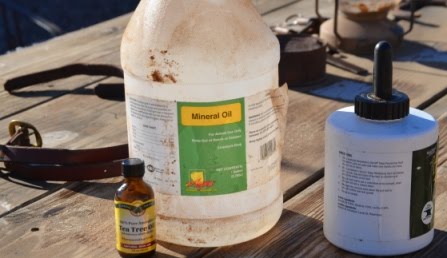
I have been treating this cleft with an expedient hoof dressing made of mineral oil, tea tree oil and lanolin so the hoof (and cleft) doesn’t get too dry and crack more.

Plus this horse has really thin hoof walls, so on one rear foot the hoof starts cracking some where the shoe is nailed. During the driest parts of the year I will treat this with hoof dressing to keep it from cracking or splitting so much.

Am I doing any good with the hood dressing? For that application on that one horse, I think I am, but I think using hoof dressing on my other horses would most likely not do much of anything. 

Friday, January 18, 2013

Rope Halters Are Not Cruel


Rhonda from Pennsylvania wrote to ask about halters: "Hi. I used to ride quite a bit as a kid, now 30+ years later I find myself as a owner for a half Quarter Horse, Half Arab mare. I love her to death, but sometimes she is a little pushy. My friend's farrier told me to get rid of the halter I use and get a rope halter. After the farrier left, my friend told me not to get a rope halter as that is cruel to the horse. I don't know what to think now. Do you have any recommendations?"

I'm predisposed to use rope halters. It's just a personal preference. I think generally it's not the tool that is cruel or harsh to the horse, it is how it is used. Quick or forceful hands can make a lot of common horse handling tools harsh to the horse.

The rope halter because of the small diameter of rope making contact on the horse's nose and poll (think the bridle path behind his ears) puts more pressure than a wider web halter would, so that is probably why your friend thinks a rope halter is cruel. Again, if you use it correctly I don't believe it is cruel.

The idea is still Pressure and Release. If your horse pulls away while under a halter he is going to be putting pressure on himself via his poll, and depending on his head set, maybe the nose. Once he stops pulling that pressure is released. Same as teaching your horse to give to pressure.

I'm sure you understand that it's hard to train a horse if you can't get him to move his feet. So imagine ground training with a halter where you maintain pressure via the lead line on the halter. As the horse moves in the direction of the pressure, you release that pressure and he starts to understand how he gets his release. While I think the rope halter provides a more clearer signal, there are thousands of exceptional horsemen and women who use web halters.

There are some innovative halters out there. One is a web halter that uses an elastic material for the webbing over the poll. I think the idea here is that when when a horse pulls away the pressure is gradual and once the horse quits pulling, and figures out his release, then that release is instant - a lot more quicker than a handler can provide. This is a pretty smart idea but I'll stick to the rope halter and judicious use. This elastic type web halter is from Paul Ortuno of Mane Horsemanship. This is not an endorsement, as I don't own one of these elastic halters. I just list it for your information. Again, I'll stick with quality rope halters from Double Diamond or Craig Cameron.

http://manhorsemanship.wordpress.com

Tuesday, January 15, 2013

CMSA Cowgirl Tammy Sronce Benefit


Multiple World and National Champion Cowboy Mounted Shooting Association (CMSA) Cowgirl Tammy Sronce sustained a head injury in January 2012, as a result of an impact from a drunk driver. The trauma has left Tammy with a permanent nerve condition. This has made it very hard for her to live a normal life and she has been unable to return to the competition arena. Tammy is scheduled for surgery, which hopes to correct this condition, on January 15th 2013.

To read more about Tammy Sronce.

Online Auction. There is an online auction to assist in mounting medical costs is coordinated with the help of Texas Smokin’ Guns, a local Texas chapter of the Cowboy Mounted Shooting Association, and items have been kindly donated by Tammy’s mounted shooting sponsors. Just a few of the items up for auction include Custom engraved stirrups from Straight Time Stirrups, a Custom JW Brooks Hat, Espana SILK Grooming Products and a year’s supply of Enjoy Yums Horse Treats.

Direct Donation. If you would like to donate directly to the medical fund, donations can be made to a benefit fund that has been set up by Texas Smokin’ Guns at:

Texas Smokin’ Guns – Sronce Benefit, 231 LaCosta Circle, Weatherford, TX 76088

If you need assistance please contact Deb Ciferni at dciferni@skybeammail.com or you may contact Tammy Sronce at tammy@hsmarketinggroup.com. Thank you so much for your support and prayers. Photo above from Western Shooting Horse magazine.


Sunday, January 13, 2013

Wyatt Earp Died 84 years ago Today


Today marks the 84th anniversary of Wyatt Earp's death, having passed away at age 80 in Los Angeles having out lived all of his brothers. The photograph at left is thought to have ben taken within a year of his death.
Wyatt did not die in a brothel like how most men want to go out,....he died at home. 

Earp, of course, most famous for his "Shootout at the OK Corral in Tombstone, Arizona in 1881, enjoyed a long and productive life well after that his famous career as a lawman, most notably working in Hollywood mentoring and coaching Actor-Cowboy on the silver screen including Tom Mix and William S. Hart, who he developed a friendship with. 

Wyatt Earp, and his brothers Vigil, Morgan, James, Warren and Bruce,...just kidding - he did not have a brother named Bruce,....were immortalized in many movies, the most recent one's being "Tombstone" and "Wyatt Earp", and if you can forgive the rider's jerking their horses' heads around with the reins, then these movies are enjoyable.

Note to my wife:  No brothel death for me.  I just as soon die in bed,....from natural causes.


Wednesday, January 9, 2013

Sick Horse Experience


While I had, seen or helped with many horses colicing, horse wrecks, injured horses, a case or two of founder, a horse stricken wth West Nile and even a case of strangles, I had never experienced a horse health issue like this, where we could not pin point the cause, so I wanted to share with the Functional Horsemanship readers.

Day One. On Wednesday early morning I noticed one of my geldings, Junior, eating, but not with his normal gusto. I ask my wife to keep an eye on him through the day.


Around noon, Junior still appeared off and hadn't finished his morning feed. We called our Vet, Amy Starr, DVM owner/operator of Paws'n Hooves Mobile Veterinary Clinic. She arrived about 4 pm. Her exam revealed normal gut sounds, normal heart rate and normal temperature. The Vet palipated Junior, no gut tension or inflammation noted. Doc Starr tubed Junior giving water, epson salts and mineral oil into gut. Water for hydration, mineral oil to help lubricate the gut in case of an impaction, and epson salts to help draw body fluids into the gut.

Right after Vet left, horse passed a normal looking pile. And because of this and Junior's gut sounds and physical exam we did not think the problem was colic. My Vet also several vials of bloob for lab analysis.

I watched Junior throughout the night. He still was not eating and did not appear to be drinking.

Day Two.. Thursday morning, Junior still not interested in feed. He had good gut sounds, but still had not passed anymore manure. Vet called me to check on Junior and to give me the blood work results. The blood analysis came back as his organ functioning well but the CBC blood count was down just a little indicating maybe a small virus or a little stress.

The Vet came out again Thursday evening, during a snow storm I might add. My horse had not passed the oil that the Vet gave him over 24 hours earlier. She palipated my horse again, and he appeared normal. Normal gut sounds and normal temperature, but dehydrated. The Vet gave horse a water and detergent enema. Apparently the detergent (Tide) helps break up any impaction. At this time we still did not feel this was a colic but the horse was not drinking water (nor eating) so we were concerned that this could turn into a colic case or have colic a secondary issue.  

Within an hour the horse shot (like a water cannon) the enema mix back out his rectum. The Vet gave Junior 10 litres of fluids IV. It was a very cold night, into the low 20's, so the Vet could not tube Junior again,.....the cold made the tube pretty unflexible and she just could get it into his stomach to adminster more fluids and mineral oil.  Even soaking the tube in hot water did not help as once removed from the hot water the tube would get instantly stiff.  At this point we thought dehydration was the biggest threat.

We had moved the horse into a broodmare stall and put a 17 quart bucket of warm, so I could monitor his drinking. I also gave him a handful of hay to eat since he had not eaten anything in at least 36 hours. I checked on him ever two hours throughout the night.  

Day Three. On Friday morning the horse was still not eating much at all. He would eat a handful of alfalfa but then stop. He did not appear to be drinking either.

Friday mid afternoon, I decided to trailer Junior to the Vet's place so he could be in a hospital stall and be given more fluids and monitored more often.

But once in the trailer Junior passed a pile with mineral oil, this was 47 hours after being tubed with mineral oil (on Wednesday). He appeared to be much better, so we took him out of the trailer and offered some feed. He began to eat a little, so we decided to postpone trailering him to the Vet's.  I put him back into the broodmare stall to monitor feed and water.

But then he stopped eating and did not drink so we loaded him back up into the trailer and took to the Vet's around 7 pm.

So Friday evening found us at the Vet's facility (San Francisco Stables) where he was given 10 litres of fluids IV again, and we got him to eat about 1/8th flake of alfafa and about 1/2 pound of fortified feed (Patriot). We left him late that night in the very capable hands of Doc Starr and her husband Panchito.

Day Four. Saturday morning Junior ate a light flake of alfalfa and was given an additional 10 litres of fluid via IV throughout the day. He also drank around a gallon water throughout the day as well.

In the evening he ate another light flake of afalfa, and was given 30 grams of Pro-Bios probiotic paste as well.

Day Five. On Sunday morning Junior was given a light flake of aflafa and a little grass. He ate that, drank about a gallon of water and was turned out for a couple hours.

Sunday afternoon, Junior ate alittle more afalfa and grass, and drank about a gallon of water. So we made plans on picking him up that evening.

Sunday early evening we arrived at my Vet's. Junior had received and ate an additional 6 lbs or so of afalfa-grass mix just before we arrived. We trailered him home where around midnight we gave him another 4 lbs of grass and a full bucket of water to monitor his water intake.

Day Six. Monday morning. I checked Junior at morning feeding time. He had ate all the hay I had given him the night before and had drank the whole 17 quart bucket of water through the night. I gave him 15 grams of Pro-Bios, re-filled his water and gave him 6 to 7 lbs of afalfa-grass mix and we left him stalled by himself to monitor.

In the early afternoon, Junior was hungry again and needed more water. Plus he had a regular amount of normal looking manure.

Days later he is still doing good. In fact, while through this sickness, virus or whatever it was, he appeared mostly normal. Ears forward, tracking movement with his head and eyes. No normal colic signs like standing extended, biting at his sides, ears back, or trying to lay down.  Really the only indication was the lack of interest in feed and not drinking and that dullish look in his eyes that he was offl - most of you know what I mean. 

We are thinking that this was some sort of virus, not colic. None of our other horses have exhibited anything like it yet. It was probably fortunate that Junior was the affected horse since he is very well conditioned and muscled. This would have taken much more out of a lesser or older horse.

My wife and I have had some damn good vets over the years. But Doc Starr is the first Vet we have had who does not hestiate to give enemas or use IV fluids.   Receiving fluids IV when not otherwise drinking can be vital in giving a horse a chance - I believe it was in Junior's case.     


Friday, January 4, 2013

A Cowboy and His Brothers


A cowboy, who just moved to Wyoming from Texas, walks into a bar and orders three mugs of Beer.

He sits in the back of the room, drinking a sip out of each one in turn. When he finishes them, he comes back to the bar and orders three more. The bartender approaches and tells the cowboy, "You know, a mug goes flat after I draw it. It would taste better if you bought one at a time."

The cowboy replies, "Well, you see, I have two brothers. One is in Arizona, the other is in Colorado. When we all left our home in Texas, we promised that we'd drink this way to remember the days when we drank together. So I'm drinking one beer for each of my brothers and one for myself."

The bartender admits that this is a nice custom, and leaves it there. The cowboy becomes a regular in the bar, and always drinks the same way. He always orders three mugs and drinks them in turn.

Then one day, the cowboy comes in and only orders two mugs. All the regulars take notice and fall silent.

When he comes back to the bar for the second round, the bartender says, "I don't want to intrude on your grief, but I wanted to offer my condolences on your loss."

The cowboy looks quite puzzled for a moment, then a light dawns in his eyes and he laughs. "Oh, no, everybody's just fine," he explains, "It's just that my wife and I joined the Baptist Church and I had to quit drinking......hasn't affected my brothers though."

Monday, December 31, 2012

James Question on Horse Joint Supplements


James wrote to Functional Horsemanship and asked, I don't believe joint supplements for Horses work, as I have tried several different brands for a few years, but if you have had some good luck with a particular brand please let me know as my 20 year old mare, a Tennessee Walking, is really getting stiff.

James, I would have a good horse vet look at your mare to figure out if there are any detectable problems causing your mare to be stiff, but 20 years is a fairly old horse.  Some stiffness and crepitice, which is the creaking and cracking sound in the joints, would be normal.

I have talked to both human and equine scienitists about joint supplements. What I have been told and believe is that,
1 - There are minimal trials and data on joint supplements. The manufacturers of these suppplements are kinda reluctant to fund independent research because there is the chance the research would come back as ther products not helping what they claim - kinda like funding your own funeral.  There is plenty of anecdotal or personal testimony of joint supplements that work, just without the provable data.  
2 - Most of the scientists, both horse related and human, that I have talked to believe that Glucosamine works to strengthen cartilage and actually rebuilds it slowly, but are pessimistic about the two other common joint supplements, Chondriotin and Hyluaonic Acid, having much help on joints.
3 - that quality of the product is the key.

I believe there are some joint supplements that help horses. I think that a horse would have to be on a quality product for at least a month to get any benefit and even then it may be hard to tell if it is helping. I had a similar aged ranch horse who had a front knee injury. I put him joint supplements as I rehabilitated him. He seemed to be doing much better after a couple months where I could team rope off him. I was unsure if the progress was related to his rehabilitation (exercise and good feed) or the joint supplements. I now tend to believe it was a combination of both.

If it doesn't put you out too much, I would try another joint supplement program for a few months and see what it does. Just pick a quality product with a high level of Glucosamine and at least some sort of outside approval, such as NASC or GMP. I think that a product with Vitamin C would be preferable. Vitamin C is an anti-oxidant that is thought to be good for connective tissue health.  MSM or Methylsulfonylmethane is a sulfur compound and another common joint ingredient.  Some think that MSM helps in the organic synthesis possibly helping other joint compounds get into the joints and tissues, and helps reduce inflammation.  I am waiting to be proved if MSM works in any capacity. 

Smart Pak is a company that offers supplements and information on all sorts of products. Click on the link to see a chart of joint supplements broken down by form (pellets or powder), ingredients, seals of approval and cost.  I have one of my horses on a joint supplement presently and I think the small cost is worth the possible benefits to the horse.  

Wednesday, December 26, 2012

Dakota Indians Mark Hangings of 1862 with 300 mile Horseback Ride

I just read a really good Reuters article published on Yahoo by David Bailey. Below is an excerpt from that article. It would be worth reading the entire article - just click on the Reuters article link.

Today, the day after Christmas, will be somber for Dakota Indians marking what they consider a travesty of justice 150 years ago, when 38 of their ancestors were executed in the biggest mass hanging in U.S. history.

Overshadowed by the Civil War raging in the East, the hangings in Mankato, Minnesota, on December 26, 1862, followed the often overlooked six-week U.S.-Dakota war earlier that year -- a war that marked the start of three decades of fighting between Native Americans and the U.S. government across the Plains.

Over the next three years, Americans will commemorate the 150th anniversary of a host of Civil War battles. Almost forgotten are the conflicts with Native Americans that occurred in the second half of the 19th century as the United States rapidly expanded west.

Few of those conflicts are well known, with the exception of "Custer's Last Stand" -- when flamboyant officer George Armstrong Custer and his men were killed by Sioux leader Crazy Horse and his warriors in 1876 -- and the Battle of Wounded Knee in 1890, which many historians consider a massacre and the end of the Indian wars.

Thousands of Native Americans, white settlers and U.S. soldiers were killed in the Indian wars. Native Americans were coerced to cede their lands and then forced onto reservations. In the Upper Plains, that included members of the Great Sioux Nation, which comprises Lakota to the west, Nakota in the middle and Dakota to the east around Minnesota.

Under treaties in 1851, the four main Dakota bands ceded about 35 million acres of what is now southern Minnesota, parts of Iowa and South Dakota. In exchange, the U.S. pledged payments and allowed the Dakota a narrow tract of land about 10 miles wide on either side of the Minnesota River. Settlers swarmed onto the newly opened lands.

In 1858, just after Minnesota became a state, Dakota chiefs were summoned to Washington, D.C., and told they would have to give up the northern half of that narrow reserve, said St. Cloud State University historian Mary Wingerd.

By summer 1862, the Dakota, now largely dependent on government treaty payments that were long delayed, were starving. On August 17, young Dakota men out hunting killed five white settlers. The hunters pressed Chief Taoyateduta, known as Little Crow, to back a war. Some Dakota, but not all, fought soldiers and settlers in the short, bloody war in August and September 1862.

Hundreds of settlers were killed and hundreds more taken hostage in the war during attacks on forts, federal Indian agencies, cities and farms around southwestern Minnesota. Thousands of settlers fled east, fueling a statewide panic, and federal troops marched in to quell the Dakota fighters.

The U.S. was victorious on September 23, 1862, and Little Crow left Minnesota. Afterward, more than 2,000 Dakota were rounded up, whether they fought or not. Almost 400 men faced military trials, which often lasted just a few minutes, and 303 were sentenced to die.

President Lincoln demanded a review limiting the death sentences to those Dakota who raped or killed settlers. The number sentenced to hang was reduced to 38, but even in these cases the evidence was scanty, said Dan Stock, history center director at the Minnesota Historical Society.

The 38 condemned men stood on a large square gallows surrounded by soldiers. Thousands watched as a single blow with an ax cut a rope and dropped the scaffolding.

This month, in an annual event that started in 2005, some Dakota are making a 300 + mile trek on horseback in frigid winter temperatures to revive the memory of this footnote in U.S. history.

This all started in the spring of 2005, when Jim Miller, a Native spiritual leader and Vietnam veteran, found himself in a dream riding on horseback across the great plains of South Dakota. Just before he awoke, he arrived at a riverbank in Minnesota and saw 38 of his Dakota ancestors hanged. At the time, Jim knew nothing of the largest mass execution in United States history,...... "When you have dreams, you know when they come from the creator... As any recovered alcoholic, I made believe that I didn't get it. I tried to put it out of my mind, yet it's one of those dreams that bothers you night and day."

This year's ride began on December 10 in Crow Creek, South Dakota, the reservation the Dakota were exiled to from Minnesota after the executions. It ends on December 26 in Mankato, where riders will attend a ceremony to remember the hangings.

Riders travel east across South Dakota, crossing the border into Minnesota and heading southeast to Mankato. Some ride the entire route, others join as their schedules permit. Support vehicles follow them.

The ride was captured in the documentary film "Dakota 38," which won a special jury award this year at the Minneapolis-St. Paul Film Festival. Take an hour out of your day and watch the video application of "Dakota 38", I don't think you'll regret it.


Monday, December 24, 2012

Merry Christmas From Functional Horsemanship and Friends


My wife organized an impromptu horseback Christmas Caroling event on 23 December. As we gathered at, then left my back gate, it rapidly became apparent that this group of Horseback Troubadors couldn't tell the difference if we were adding to or taking away from people's Christmas joy, so we enlisted a couple of six year old ringers who traveled with us in a pipe trailer towed by a truck.

Those enthusiatic six year old girls are standing underneath our horses in the picture.  Without their voices I'm afraid may have been arrested as a simple nuisance.

Maybe the best thing to come out of our adventure was that the horse's demonstrated good will by wearing antler hats and bells. 

Anyway, while some people were in town doing last minute Christmas shopping or watching football games on television, I think we did entertain a few people, and among our customers were stopped cars, a sleeping buffalo, a curious llama, an unimpressed Great Dane who did not appreciate our rendition of Jingle Bells, and, a Mexican family from nearby Juarez who were lost trying to deliver presents to their friends.

And despite our ear aching rendition of the Christmas classics, I'd like to wish everyone a Merry Christmas. Remember the reason for the season and please be thankful for all the blessings from God that have been bestowed upon us simply by being in this great country. I hope you enjoy your family, friends and particularily your horses, and wish everyone a safe journey into the New Year.


Saturday, December 22, 2012

Blindfold Training for Your Horse


Months ago I wrote an article about organizations and agencies providing equine emergency response training for horse owners and emergency personnel. This training is designed to help get horses to safety during emergencies such as wildlands fires, floods, hurricanes and accidents such as truck and trailer wrecks, and also helps owners get themselves and their horses rescue ready.

I received comments and e-mails on recommendations on getting horses ready for emergencies such as blindfold training your horses in case you had to lead them through fires and smoke or other spooky things, such as statutes of George Soros,......sorry I couldn't resist.

If your horse is pretty sacked on his ears,...meaning your can handle the ears without problems, and your horse has worn a fly mask, then blindfold training will come a little easier. Training your horse to accept being blindfolded is not only good for emergencies, but may come in handy if you are caught in a hail storm or 80 mph sand storms and need to protect this head, face, eyes and nose, but blindfold training also serves to gentle your horse just a bit more and help develop more trust in you.

Once you get your horse okay with the item you are going to use as a bindfold....try using a shirt, as this is what you will probably have available out on a ride or what responder may have,....hold if over your horse's eye's and check his acceptance. Using a halter is a good idea so you can control your horse with the lead line. A few seconds to start is okay. He gets a release when you take the blindfold away and restore his ability to see. Build on this like you would with any task. If he is troubled by the blindfold he will probably try and back out of it.

As your horse becomes more comfortable covering his eyes, you may try to secure the blindfold so you can move him around. A long sleeve shirt is good for this as you can use the sleeves to tie together, using one round turn, underneath his throat latch. Be ready on the halter lead line to control your horse and to pull the blindfold off your horse if he gets too panicky. It wouldn't be good to have a blindfolded horses getting away from you and running into something. But the idea is that if he gets panicky in 6 seconds, remove it in five,....and build upon that. 

Once your horse is okay with this, you can move him around more,.... get to lead up correctly,....and possible lunge him on a line in a small circle. When you need to securing the blindfold better, you can tuck in a portion of the shirt underneath the cheek pieces of the halter or the browband of a bridle.

While I have drapped rain slickers over my horses head while I have been riding him, blindfolding him on the ground and getting him to lead up is much different - at least for him. I think one key during blindfold training is to continue to talk to your horse so he can hear your voice, and pet on him, but again the release is when he stands or leads calmly and you remove the blindfold restoring his vision. Good luck and safe journey.


Thursday, December 13, 2012

Used Saddle Buying


Harold L wrote and asked several questions regarding saddles. "I have an old hand me down saddle with the sewing all worn out on the side and am about ready to buy another one. What ideas can you give me when buying used saddles and do you know about some good mail order places that I can get a good deal on a saddle, new or used, and what type of saddle should I be looking at"?

There are a lot of good used saddles out there from people downsizing their saddle collection (my wife ain't one of them), ....people getting out of the horse business altogether, or upgrading to a newer saddle.

Not counting for the features you like, slick fork versus a medium swell, deep seat, high cantle, California or pencil roll, or what type of riding you are doing, you would do good to buy from a reputable company or person and check to make sure the tree ain't cracked and the fleece doesn't need to be replaced, at least not immediately,..and above all make sure the saddle fits your horse.  It's a good idea on a used saddle to run your hand all over the fleece or sheep skin liner to detect nails sticking out of the tree or any other abnormalities that could affect the fit and your horse's comfort.  

On a used saddle, I would also check to make sure the tree isn't cracked.  Placing your hands on the horn and cantle and twisting, and, doing the same on the skirt should let you know if there are any problems with the tree. 

Note:  The saddle pictured above left is a Santa Fe style saddle made by Sawtooth Saddle Company of Vernal, Utah. 


I am impressed with Cactus Saddlery.  They make a line of saddles for Craig Cameron.  One of the newest saddles in this line is the Ultra Lightweight Trail Saddle, coming in at 34 pounds.  As you can see by the picture at right, the skirt is cut away to reduce weight.  It looks to have a deep ground seat, is built on a wood rawhide covered tree and is advertised with a 10 year warranty.  Priced under $2,100 it looks to be a prety deal deal on a custom saddle.  


There are some good hands at saddle repair, depending on where you live, and you may have the option of taking some pictures sending it to a saddle repair shop for an estimate on what it would cost to make your old saddle serviceable again. I have been pretty lucky with good repair work in the past. In fact one of those fellas was Adan Saenz one of the last of the S.D. Myres saddle makers. Now in his 80's, Adan is not only gifted, but he was stuck in 1970's prices, so it was always a bargain to get him to repair something. Of course it depends on how much you'll willing to spend.  I have did some minor repairs to saddles such as re-stitching the skirt, re- riveting a flat plate rigging.  I won't be doing much of that in the future as I'm here to tell you it is worth it having a saddle professionally repaired.  


If you are really thinking about buying a new saddle, a very good semi-custom or custom saddle starts around $1,800.  I'm pretty sure you can buy a new factory saddles for under $1,400.  So you're pretty much going to have to decide what you are willing to spend to start building a list of saddle makers or sellers.   

Best case is that you can fit any potential saddle buy to your horse and try it out before you buy.  Tucker  Saddles has a Saddle Fit Guide which would be helpful to you.   
Some of the really good custom makers are listed on this website with links.  See the right hand column towards the bottom.  You may want to look at Teskeys to see both new and used saddles.  Good luck and safe journey.


Monday, December 3, 2012

Rough Rider Teddy Roosevelt


Theodore "Teddy" Roosevelt, born October 27, 1858 and died January 6, 1919, was the 26th President of the United States of America from 1901 to 1909. Known for many accomplishments  in the public arena, his experience as a Frontiersman and Cowboy are often over looked even those he was known in his day as "the Cowboy President". 

Perhaps Teddy Roosevelt is best known for as exploits in creating then eventually leading the Rough Riders during the Spanish American War. No matter your opinions of his politics, there is no doubt Roosevelt epitomized the American spirit of rugged individualism and self-responsibility.

Over coming physically aliments and sickness, Roosevelt went west in 1884 following the death of his first wife,  He settled on a ranch in the Dakota Territory and began ranching, later building a second ranch which he named Elk Horn.  

While in the Dakota's he was deputized as a Sheriff’s Deputy.  Roosevelt had several events where he hunted down wanted men,...one incident for stealing a river boat and another for horse thievery. Here he wrote his first of several books about frontier life which shaped the way Americans of the time perceived the West.

In 1898 Roosevelt was serving in the Navy Department when the United States declared War on Spain. Roosevelt resigned from the Navy Department and with help from Army Colonel Leonard Wood created a volunteer Cavalry regiment, mostly comprised of Cowboys, Lawmen and other Westerners, which would become known as the “Rough Riders” or officially as the First U.S. Volunteer Cavalry Regiment. Notably some of this unit was made up of friends of Roosevelt from his Ivy League and political life on the East Coast.

While deployed to Cuba to bring the fight to the Spanish, Colonel Wood was needed to replace the Brigade Commander when illness took him and Roosevelt was promoted to Colonel and placed in charge of the Rough Riders. Colonel Roosevelt and the Rough Riders became famous for a dismounted charge up first Kettle Hill then San Juan Hill, under withering rifle fire from the entrenched Spanish soldiers. Roosevelt begin leading the charge up Kettle Hill while on horseback but due to obstacles he had to dismount.

A little known fact on this battle, which became known solely as the Battle for San Juan Hill, was that a contingent of Buffalo Soldiers of the 10th U.S. Cavalry supported the Rough Riders charge on Kettle Hill, then became the main effort for the subsequent charge of San Juan Hill. While five Buffalo Soldiers would receive the Medal of Honor for actions in the Spanish-American War, oddly none of them were received for the Battle of Kettle or San Juan Hill. For his actions, Roosevelt was nominated for the Medal of Honor, which was disapproved, but later was posthumously awarded in 2001.

After the war and return to civilian life, and later his re-entry in politics, Roosevelt would enjoy a continued relationship with his Rough Rider veterans, who continued to address him as Colonel Roosevelt.  I admire Teddy Roosevelt because he brought his Western values with him whether he went, was plain spoken, and again epitomized the values of individualism and self-responsibility.  

Monday, November 26, 2012

Yucca and MSM in Horse Joint Supplements


Richard wrote me to ask about using MSM and Yucca for his 17 year old Gelding who he had been using as a roping horse but now appears to be having trouble in his joints.

Seventeen years old, on a sound horse, can be yesterday's twelve year old, meaning it seems like more horses are not only living longer but are being used much more into thier late teens and twenties. But hard use can be hard on a horse's joints, more so when combined with less than adequate nutrition.

MSM (Methylsulfonylmethane) and Yucca are common ingredient in Horse joint products.

MSM (Methylsulfonylmethane) is marketed to provide joint comfort and cartilage health. MSM is a type of sulfur and thought to be a ingredient necessary for collagen health or development. MSM is also an anti-inflammatory and therefore probably reduces pain to some extent.

Yucca (see picture at top of post) is a common plant found out here in the desert where I live. It is readily identified by it's stalk and flowers (see photo at right). The flowers,or sometimes called Yucca bulbs, grow in the late spring and are moist. They become dry in the winter and often break apart in the wind, spreading seeds that are almost black in color. The moist bulbs are edible by humans and cows. They taste like lettuce. I had a horse who loved to pick at Yucca bulbs but too much is not good for them so I would only let him eat one or two on any one day.

Yucca is an anti-inflammatpry and pain reducer. Which, like I wrote above, is often found in joint supplements, for humans as well as horses. In fact, if you a section of Yucca base (see picture left) from which the sharp spines grow out of, or what is below that and growing from the ground, you can harvest a section of it and scrap out the inner pulp like material and mix in water. It will make a soapy type of solution. This will make arthritic hands feel better and can be used to rub on a horse's legs after a long ride. I suspect some people figured that out a long time ago and probably did just that.

In any event, both MSM and Yucca can mask the pain from joint issues. Most reports from independent scientists either cannot confirm or don't believe that MSM or Yucca can be consumed with any benefit, but if they are wrong, and you decide to use either, then consider that neither product has much of a chance of helping if you don't get a high quality source of these ingredients.

The scientist's I have talked to do believe that a quality Glucosamine product and Vitamin C work to provide nutrients for joint health and can actually build stronger connective tissue and cartilage. Sure, if you have have a horse with extensive wear on his joints, like race horses and arena roping horses, Glucosamine probably won't give immediate relief. Hence the possible use of the natural pain relievers and anti-inflammatories.

I would get a Vet to check your horse. Sometimes x-rays can give you a good idea on what going on in your horse's joints. I have one horse, 19 year old gelding, currently on joint supplements. It is a Glucosamine based product and I think it is helping him to some extent. But this is a treatment that I think you may have to do for six months or more to see any result.  Let me know if you begin using something and how your horse does on it.  Safe Journey.


Wednesday, November 21, 2012

Best Handgun for Horseback


Russell wrote and asked: "Thanks for the information you have been writing. Don't think I found anything to disagree with. I have been riding for 45+ years and carried a handgun or rifle most of it moving cattle up in mountains and checking fence. I never thought about training my horses to accept gunfire. I now have a pretty broke six year old. I have a .22 revolver and a .30-30 winchester. If I need to get another pistol I will since I ain't fond of thinking of running into anything with four feet and fangs with the .22. What would you suggest for a decent pistol? Your articles and videos are probably good enough for me to get started. Thanks. Russell."

Russell, it looks like you may be in Mountain Lion or Grizzly country. A big bore revolver would be my preference. This means a .44 Magnum, which can also shoot .44 Special, or a .45 Long Colt (LC).  When I was a Conservation Law Enforcement Officer riding up into the mountains looking for poachers or archeological thieves, I did not feel under gunned carrying a double action revolver in .357 Magnum, but I had about as much chance of running into a Grizzly Bear as a smelly, toothless hog farmer has in finding a date for Saturday night.  I would not trust my life or my horse's life to a .357 Magnum if you are riding in Grizzly country. 

The advantage of a .45 Long Colt is, that thanks to the sport of Mounted Shooting, .45 LC blanks are readily available for training. This allows you to train your horse to gunfire at a reduced noise and muzzle concussion. If you have priced handgun ammunition recently then you see that as another reason.

A disadvantage of a handgun in the .45 LC caliber is that most of these on the market are single action, Colt Peacemaker type replicas. While these are great guns, they are single action. Meaning you have to cock the hammer for each shot....takes more than a little practice to do so reliable and quickly. You could get lucky and find a double action revolver in .45 LC. The more common one's would be a Smith and Wesson Model 25, Colt Anaconda, Ruger Redhawk, Dan Wesson and I think Smith and Wesson also makes what they call a Mountain Gun which is a slicked up Model 25 in stainless steel I believe, which they call the M625. As common as these guns once were, it'll be somewhat hard and maybe even more expensive to find one.  Double action revolvers are much faster to re-load as well using several different types of speed loaders. 

I always start shooting .45 LC blanks about 60 to 80 feet away while the horse's are eating. I fire one round. The horses will spook or flinch. Then they go back to eating. I fire another round. They flinch less and so I keep this up until I can shoot several blanks in succession and they ignore it. I move closer and repeat. The hay helps relax them, as horses mostly eat only when they are relaxed or feel safe. And if they leave, let them. Wait for them to come back to the feed and start again.

The pause between fired rounds serves to let the horse think about the stimulus and figure out that he doesn't need to run. The pause may be several minutes in some cases. But it will get shorter.

When I move to shooting while the horse is in a halter, I give the horse some slack in the lead line, stand with my back to him and shoot to the front using my body to break up and diminish the concussion wave and noise a bit. He'll most likely spook somewhat, so I let him settle before I repeat. I'll talk to the horses and rub on them during this pause. Soon enough the horse is settled and I begin again sometimes just cocking the hammer a few times as they will learn that this noise precedes the loud bang. I'll also shoot from the side of the horse away from him and towards his rear obliques.


When you are shooting from his back, use the same concept. Be sure to fire away from his head. Using the clock method. If the horse's head, or really his body, is pointing at 12 o'clock, then it helps to start shooting blanks at the 5 o'clock direction if you're right handed, or the 7 o'clock direction if your left handed. This will reduce the concussion the horse will feel from gas escaping the cylinder gap and from the muzzle, as well as the noise and allow him to get used to.  The pictures above, from Left to Right, are showing shooting from the one o'clock, three o'clock and five o'clock positions.

I would not shoot near the horse's head, say from the 10 o'clock to the 2 o'clock position. This needlessly sends gas and unburned powder from the cylinder gap and the muzzle too close to the horse's head, ears and eyes.

Hope this helps Russell. I think you'll do fine if you take your time. I'd like to hear about your progress. Safe journey.