One morning Big John was planning on heading to the horse auction hoping to find a decent broodmare for his small horse breeding operation. At breakfast he asked his 5 year old son, Little Johnny, if he's like to go along. Little Johnny replied with a resounding "Sure Pa!"
So one hour later Big John and his son were at the sale barn and Little Johnny followed his Pa around the pens, and every once in while Big John would go into a pen and look over a prospective mare, running his hands over the horse's butt, stiple, then down the mare's legs, feeling the tendon, then patting the horse on the rump before he took out his flyer and made notes.
This went on for several more horse's until Little Johnny said "Pa, can I ask you a question?" Big John, beaming with pride as his son seemed to be showing interest with the whole process, replied "Sure son."
Little Johnny then asked "Pa, why do rub your hands all over the horse's butt and legs?" Big John, seeing an opportunity to teach his son alittle something about horse buying said "Well son, I'm checking for good conformation as well as any deformities or sore spots in the horse,....after all I might want to buy this horse."
Little Johnny appeared to think for a bit, then he pursed his lips and said "Pa, I think the milkman wants to buy Mom."
I received two e-mails with alike questions about horses who are kinda nippy to their owners. Horses are curious and with most of them, when they are comfortable, they start exploring around and usually this is with their mouths. My horses, as do most horses, do things like play with a gate latch, nuzzle your pockets in search of treats things like that.......one of my horses can open a gate latch if I don't set it properly, so sometimes I just set it up for him to unlatch then watch him flip the gate open with his nose. Sometimes I'll spend 5 minutes playing this game with him where he gets the gate open, then I back him a step then re-shut it, and so on. I think it's good for his mind.
I generally try to let horses be horses when I can. One of my horses likes to put ropes in his mouth, like the picture at the below left, with him pulling on a rope I had hanging up next to him being tied to a trailer. Every once in a while, when I'm throwing a loop from horseback he will bend to the right and put the rope in his mouth.
He will also pull some slack out of the lead line attached to one of my functional tie rings, just enough so he can get to the alfalfa cubes bucket in the trailer door, in the photo above at right. He can open a bucket, push the lid off and get to the cubes. Sometimes he lifts the bucket with his teeth and drops it on the ground closer to himself. Basically in my way of thinking, he is displaying some intelligence and the ability to think, so I just let him do that sometimes.
Richard wrote: "I have a 8 year old Gelding. He's just used for trail riding. I'm his second owner. He's generally a good natured horse, but sometimes he can be a knothead. Sometimes he will bend around and nip or nuzzle at my boots, always on the left side. He never actually bites and takes ahold of my boot, he just nips. It usually catches me off guard and I flinch. He also picks up grooming brushes if they are too close to him and chews on the handles. Is this something normal and is there something I can do to negate this?"
I think it is normal for a horse to get curious and investigate things with his mouth. It sounds like your gelding is just bored and feels comfortable enough with you to bend around and play bite your boot or to grab brushes. This is sort of a good thing in that he is comfortable with you, but it is annoying and a distraction to him paying attention to you. The trick is to discourage this behavior without making it a federal offense. Don't set the brushes close to his head or mouth for instance.
Maybe the best strategy is to pre-empt the behavior of nipping at your boots. That means to be ready for it and with your response. As soon as you see his head bending towards your boot, try using your voice and be prepared for an immediate follow on re-direction of his head with a bump of the rein. You can also bump the toe of your boot on his nose. I don't mean kicking him in the face - I mean moving your boot in the stirrup forward a little as his head is bending so he makes contact a little sooner than expected. Timing is everything here as the idea is for him to connect bending around to bumping his nose. Again, I wouldn't make a federal offense out of it. I think sometimes it's mentally good for a horse to explore around as long as it isn't dangerous to him or you. So, I try not to limit everything my horses do that is not productive. You can also spend a lot of time trying to limit harmless behavior.....I keep telling my wife that same thing about my behavior.
Paula asked: " I enjoy your website because I can make sense out of what you write. I couldn't find an article on what to do about a horse (my 10 year Mustang) who turns his head seemingly trying to bite me when I am haltering him. It's almost like he thinks I am going to give him a treat. He is a good boy, but this drives me crazy. Once in awhile I reach up high to get a halter on him and sometimes when he turns his head to move his lips on my arm or hand and I'll lose my grip on the halter and have to start over. Can you give me some ideas on what to try? Thanks in advance"
Thanks Paula, for letting me know that I am making sense at least to you. I'm thinking about sending you my wife's phone number. Maybe you can convince her I make sense once in a while.
On one hand it's a good testament to your relationship that your Mustang feels at ease to play bite at your boots. It's likely a game for him. On the other hand this behavior can get out of hand and at first will likely manifest itself it what appears to be distraction when you are on his back. The trick is to discourage this behavior without making it a federal offense. If he is play biting then retreating he knows it is behavior that he is not supposed to do.
You cannot be his pasture mate. You have to be the strict lead gelding. In other words, be the leader both on the ground and on his back.
You can fix it up like I describes to Richard in the above response, but the horse should be running into your hand or forearm. Again, timing is very important, it needs to seem to the horse, that he is running into something. I would also use my voice as a warning also. I've had horses who want to put their mouths on me when I was haltering, so a quick bump with my palm followed by rubbing him on the nose was the way I handled it. Really, the same way you would correct a horse who has been routinely fed by hand and leads with his mouth when addressing you.
If he is mouthy when you halter or saddle, he may also be crowding you when you are leading from the ground. Be cognizant of him getting into your space and always back him off if/when he does this. I had a client with a horse who always wanted to be on top on the handler. I told him to always think 'what if the horse spooked?,....would you be in danger of getting over run?' Sometimes a tool like a riding crop or dressage whip can be used to remind the horse to stay out of your safety bubble....just use it with the lowest energy necessary. I think it's important if you drive a horse away and you also call him back to you so he can think about the different cues. Hope this helps.
Mustangs are such a uniquely American treasure. At least the Border Patrol thinks so. This article is from NBC News by Hannah Rappleye
ALAMO, Texas — Three mustangs stand at the edge of a cabbage field just after nightfall, poised to run. Their riders, all Border Patrol agents, have received word that a group of migrants are trekking across a levee that runs alongside the Rio Grande.
It is difficult to see much aside from the blinking red sensors in the far distance. Except for the cries of killdeer that carry over the farmland in this rural part of the Rio Grande Valley, the busiest sector of the U.S.-Mexico border is quiet. Suddenly, the radio chirps and the horses lurch forward. They streak across the field until they reach a dirt road, where two young men kneel, their hands up.
Twenty and 30 years old, the men unpack their meager belongings — a strawberry soda, an MP3 player wrapped tightly in a plastic bag — and peel off the life preservers they used to swim across the river. The 20-year-old stands beside the horse, and as an agent takes down his information, he explains why he left Rio Bravo, Mexico. "We have no future where we're from," he says.
Were it not for the MP3 player, a similar scene could have played out 92 years ago, when agents on horseback formed the ranks of the newly created U.S. Border Patrol. Despite the rise of high-tech tools like drones and infrared sensors, horses have once again become a key tool in border enforcement.
But the herd that the Border Patrol uses to police the borders isn't made up of just any breed. Many of the mounts are wild horses, also known as mustangs, culled from the hardscrabble rangelands of the American West. And in an ironic twist, the wild horses-turned-law-enforcement agents are trained by an unlikely group: prisoners.
"Here is an opportunity to give something back to somebody who has either fallen on hard times or certainly found themselves in the crosshairs of the law," said Raul Ortiz, deputy chief patrol agent of the Rio Grande Valley Sector, where a herd of about 40 horses, with 30 riders, made approximately 8,000 apprehensions last year. "It's not just a tool for us to use out there in the field. It's got bigger implications for the organization and for the country."
The unique program is part of a multi-million-dollar industry, where the captive labor of prisoners produces products from farmed tilapia to body armor. It is the result of a partnership between the nation's largest federal law enforcement agency, Customs and Border Protection, the Bureau of Land Management, and state correctional agencies from Colorado to Arizona. But rather than profit, the program was conceived as a way to humanely manage wild horse herds.
In addition to selling trained horses to the Border Patrol, prisoners also train horses for private adoption. The BLM estimates over 58,000 wild horses and burros roam public land from Nevada to Oregon, their lineage a mix of Spanish stock and domestic breeds. The federally protected herds remain a national treasure, a symbol of our wild past, but their numbers have to be carefully managed, as population growth has outpaced the ability of public rangeland to support herds.
The program wasn't necessarily conceived as a way to rehabilitate prisoners, said Randy Helm, the wild horse and burro inmate program supervisor for the Arizona Department of Corrections. But the nature of horsemanship, and of the wild horses themselves inevitably changes the lives of many prisoners who come through the program.
"Some of them come in with situations in life where I think they can connect a little more to where that horse is," Helm said. "That horse has to learn to adapt to an environment to be successful. That horse has to learn to deal with its past. The horse has to learn to deal with its fear….I'll try to emphasize to the guys out here, if you fail to learn from these horses, you're missing a great opportunity, because they can teach us a lot about ourselves."
As the dust settles in the shadow of concertina wire, Brian Tierce, 48, slowly brushes his palm down the neck of Justice, a colt born in the stables at Florence State Prison, in Florence, Arizona, about an hour and a half north of Tucson. Lanky and skittish, Justice doesn't quite yet trust Tierce, who is serving a seven-year sentence for aggravated assault. From drug possession to theft, Tierce has spent a cumulative 23 years behind bars. But just as Justice will eventually learn to trust him, Tierce has learned, finally, that he's good at something. "This is my silver lining," Tierce said. "I'm really good at this."
Like many of the prisoners in the program, Tierce's addiction to drugs -- methamphetamine in particular - led to a seemingly unbreakable cycle of incarceration. In 2011, he was convicted of assault after choking his girlfriend during a fight. Before he entered the program at Florence, he thought, "I'm going to be 50 years and four months when I get out this time. You know, it's like, 'Where do I go? What do I do?' I'm not skilled at anything except getting high."
But working with the horses gave him some faith, he said, and he became one of Helm's best trainers. "When I got locked up I had no belief in myself," he said. "I didn't think I could even go fill out an application to get a job…Now I actually have belief that when I get out of here, I can accomplish whatever I want to as long as I put the effort into it."
As Tierce ties Justice to a fence post to be groomed, men in orange jumpsuits work with the horses in pens and on obstacle courses, kicking up dust and, sometimes, tumbling into it. Prisoners working with more advanced horses toss water bottles and other objects their way, intentionally trying to spook them in order to replicate what the animals will experience in the field with the Border Patrol.
At least four other correctional agencies, including the Colorado and Nevada state corrections departments, have wild horse training programs. The first program began in Colorado about 30 years ago, while Arizona launched its program in 2012. Prisoners train and gentle hundreds of mustangs a year.
Supervising some 40 prisoners and more than 500 trained and still-wild horses is Helm, 61, a soft-spoken cowboy who took a few diversions in life. He served as an undercover narcotics officer in Texas, then became a chaplain, then went back to his ranching roots when he adopted a wild horse and became fascinated with the process of training. He began to devote his time to mastering the art of training wild horses, eventually running clinics at so-called "cowboy churches" and other events, and working with both horse and human victims of abuse.
He describes the methods he teaches not as horse whispering, but "natural horsemanship," or "low-resistance" training. A long way from the old ways of "breaking" a horse, Helm teaches prisoners to work with the nature of the horse, rather than against it. "What you're really doing is you're creating an atmosphere where the horse starts identifying you with peace," Helm said.
The wild horse is particularly suited for border enforcement, agents say. While horses were essential to the Border Patrol when it began in 1924 -- all recruits were required to own a horse and a gun -- over the decades advances in technology left the horse behind, and the number of horse patrol units declined.
But in the early 2000s, CBP began investing more money into its horse program. Today in the field, horse patrol units with wild and domestic horses work alongside helicopters, drones, sensors and other high-tech tools. Horse sense is an "old school" technology, said Bobbi Schad, operations director for the Tucson Sector. "Their sight's better, their hearing's better. They can travel further, a lot faster than we can."
The training doesn't stop once the Mustangs are received by a Sector, the individual agents sack their horses out based on their experience from enforcement operations on horseback. The short video below shows agents continuing training at a Station and just how fast a change can come in a Mustang.
Sure-footed and tough, wild horses are built to handle the harshest environments, from the rocky gulches and jumping cholla that cover the ranchland in Nogales, to the sweltering, thorny corridors of the Rio Grande Valley. "They'll give us 10 hours of good work in the south Texas heat," said Ruben Garcia Jr., horse patrol coordinator for the Rio Grande Valley. "And they won't skip a beat."
The horses work in an intense environment. On any given day or night, Border Patrol agents respond to a multitude of high-stress situations, from assisting sick migrants in the desert to apprehending frightened mothers and children, to facing armed and dangerous smugglers.
Agents can also find themselves galloping alongside screeching police cars in dense urban areas or careening through mesquite trees in the dark brush. "You have no idea the capability of these horses," said Joe Ghrist, an agent with the horse unit in Tucson, while sitting atop Geronimo, a product of the Florence program. "It's like the wild West out here."
On a recent Friday in the Rio Grande Valley, the horse unit was dispatched to the parking lot of Jack-in-The-Box in Hidalgo, Texas. A group of young men and teenage boys had been apprehended after scaling the levee with a ladder. They had traveled north for a month, from violent Central American countries like Honduras and El Salvador, before crossing into the U.S.
The group sat against a CBP van, their faces dejected. Helicopters swirled overhead. Without warning, agents galloped from the restaurant, down black tarmac, then cut toward a fenced lot full of semi-trucks. Flanked by horses, agents found another young man, hiding between the trucks.
Nostrils heaving, sweat rising off their flanks, the horses flattened their ears as he was led to a waiting van. "You simply can't replicate their natural instinct," said Garcia, Jr., "Pitch quiet, completely dark, and their heartbeat just accelerates."
QM wrote to ask about flag training. "I have watched several trainers use flags on horses. Hitting the horse with the flag to get the horse to stand still and some times using a flag to get the horse to move away from them. Can you explain or do a video on using a flag on a horse?"
You are actually describing someone using a flag for two different reasons. I can see how it confuses people, but the flag in and of itself isn't a cue to stand or to move unless you are using the flag to move new horses around a pen. In this case, the horses are concerned about the flag and you use that concern to get forward momentum out of them.
You probably shouldn't use a flag to move other horses around while you are horseback unless you first get the horse you are riding accepting of you using the flag from his back. In the picture at left, I am riding a horse and sacking him out to me using a flag while on his back.
When you describe a trainer using flags in ground training, what you are likely missing is how the lead rope is handled when the human uses the flag. Likely, when the handler is flapping the flag around a horse standing still, he/she is holding the lead line loose and using the flag to desensitize the horse to a scary object - the flag. When the horse accepts the flag flapping around them, the flag is taken away. The flag is just an object used to teach the horse to think before reacting.
In the two pictures (above right) I am standing off 45 degrees from my horse's head which is a safe position if the horse bolts. The lead rope is slack and my body posture is pretty neutral telling the horse I am asking him to stand. I am bringing the flag up from the ground to over the horse's withers which is the easiest place for them to accept a moving, noisy flag at first. I usually do this to a horse during initial ground training without a saddle and start with the flag much further away and wait until the horse accepts this before moving closer with the flag. My next step would be the rub him with the flag on his shoulders, butt and then the neck. If the horse did not accept the flag and started moving, I would move with him still using the flag until he stopped and accepted the flag. Then I would wait a few seconds then stop using the flag. If you do this, don't try to stop the horse from moving, just move with him and let him figure it out, but be sure to take the flag away once he stands for just a bit.......and give him some time to think about it.
I have not used a flag on this horse (in the pictures) for many years and he had no problem at all with the flag. it goes to show you how good horse's memories are, and how you can replace some of the instinct to act with thinking first. The only thing with a better memory than a horse is a wife - now that's a fact.
If a flag is used to drive or move a horse around, the handler is providing direction through the lead rope and his body position. In the photos above at left, I am directing the lead rope telling my horse to move in the direction. I have opened my shoulder, basically getting out of the horse's way. If I working with a green horse I would be more careful about moving his shoulder away from me as I was directing him forward to give me more space. Space can equate to safety, unless you are on the Space Station and the oxygen tanks have run out.
I'll use the flag to move the horse as I need. The flag is really just an extension of my arm. I won't be chasing the horse around with the flag. The flag is just to reinforce the cue of direction from the change in feel of the lead rope and to provide momentum.
A flag can be a good training tool. I think the major mistake some people will make with the flag is trying to get their horse to accept the flag too quickly then the horse get spooky and moves away,...maybe even bolts,....then they take the flag away. This is teaching the horse to fear the flag and to move away from it, as once the horse moved away, the flag is gone reinforcing that they did the right things.
With the rise in competitive trail riding, not to mention just trail riding for pleasure, some riders are looking for solutions to carry gear while on the trail. Sometimes a show or barrel saddle isn't set up very well to carry horn/pommel bags or even saddle bags, or may not have saddle strings behind the cantle to tie off a coat or slicker. The picture at right shows the concho behind the cantle. With a D ring emplaced underneath the concho, saddle strings can be added to give the rider a way to tie off bags, coats or slickers.
On one saddle brought to me, I removed the back conchos (behind the cantle) and emplaced a small D ring underneath (like in the picture above) which allows saddle string to be braided or fixed to the small D ring, but because this rider wanted the ability to remove the saddle strings for shows and doing so without going through the trouble of un-weaving the saddle strings, I used a combination O ring snap and split braided saddle strings into the O ring, to make a set of detachable saddle strings that can be snapped on and off the D ring under the concho. Some rider just like fixed saddle strings (below- left) while others may prefer a set of detachable saddle strings (below - right).
Saddle string braiding - see pictures below. We'll call this split braiding for lack of another term. Basically the concept is cutting small slots length wise on the saddle string and feeding the other end of the saddle string through that slot. Then cutting a slot in the saddle string you just feed through so that the first string can be fed through.
Braiding in this way, alternating slits and feeding the string through, allows for a pretty strong connection and it's useful as well. It's actually pretty hard for me to do slit braiding because I have to use a razor knife which if my wife catches me with it, I'll get in trouble because all she thinks of is a blood trail in the house which is usually the pattern of me using sharp instruments.
This is the same spilt braiding technique that I do on wider pieces of leather for leather poppers on the end of one piece roping reins, mecate reins or lead lines that I make. It is also the same way that makers, such as Double Diamond Halters, make poppers on their excellent lead ropes and mecates.
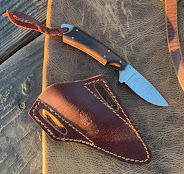
This split braiding is handy for other things as well. I also cut narrow pieces of leather string to feed through make grommets on my belt knives to make a pull strap to help get the knife out of the sheath when I'm drawing it - see picture at left.
A friend of mine told me he was bringing in a young man to demonstrate the TheraPlate on his horses. When he explained basically what it was, I have to admit that I had a recollection of those old television ads where women on stood on a platform with a vibrating belt around their waist.
In any event, it sounded interesting and I said to count me and one of my horses in on the deal as I was primarily interested in seeing one of my react to a vibrating platform. Any affects of the treatment were really secondary at this point as I was unconvinced of any therapeutic value.
So a few days ago, Travis Gonzales from Las Cruces, New Mexico showed up and explained what the TheraPlate and whole body vibration treatment was all about. Not giving my horse a whole lot of time to think about, I led him onto the platform and Travis began the session.
You would think that as cautious horses are to footing, most would have at least an initial issue to a vibrating plate, but Travis said most horses don't have a big issue with the TheraPlate. Even then starting at a low motor speed is the ticket. And judging from my horse licking, I think he liked it...even when Travis dialed up the motor. I think he spent about 20 minutes on the plate and Travis moved his hands and fingers all over the horse trying to find sore spots.
For the next horse, see the video on the gray mare below, Travis used a thermal camera powered by an app on his phone. The thermal camera showed heat differences on the horse which can likely detect where the horse is sore due to the inflammation creating higher heat signature.
The photo above shows the thermal camera attached to the phone scanning the horse in the background. You can make out the hot spots (darker spots) up on the withers and in front of the shoulder bone. Travis can use the camera after the TheraPlate session to show any positive effects of the whole body vibration therapy session.
The TheraPlate website states that their TheraPlate has differences compared to other Whole Body Vibration (WBV) technologies. TheraPlate advertises that their proprietary 4 Zone Vortex Wave design and operation is the result of more than 30 years of working with this same technology in the treatment and prevention of injuries and other debilitating conditions in Horses, and Humans. TheraPlate further states that this therapy does not aggravate injuries and can improve chronic conditions, speed healing, and prevent injuries.
This is not a one time treatment deal. Travis told us that routine therapy is the key, sometimes several times a day, for around 20 minutes at a time, is usually indicated for chronic conditions. My friends said that the two horses they put on the Theraplate seemed to move much freer afterwards so they believe the TheraPlate can help and that they will be brining Travis back - I'm in for that as well. Travis also said that while enhancing circulation, the TheraPlate can help with laminitis and other hoof issues, improve soreness, and reduce pain in joints. You'll have to go to the website linked above to see the complete lists of what conditions and injuries that TheraPlate say's they can help.
Travis Gonzales is based out of Las Cruces, but he travels around with his business called "One Stop Horse Shop", where he also does non-sedation equine and bovine dentistry, and shoes horses. To reach Travis - phone number 575-973-4403 or on e-mail at wildhorse.travis.g79@gmail.com
In Southern New Mexico there has been an outbreak of Equine Herpesvirus (Rhinopneumonitis). As of 10 February 2016, there have been 62 horses confirmed positive for Equine Herpesvirus-1 (EHV-1) at New Mexico’s Sunland Park racetrack. Sunland Park is adjacent to El Paso, Texas. The outbreak was first confirmed on 21 January 2016 at the racetrack which racing seasons runs from 18 December 2015 - 19 April 2016.
The New Mexico Livestock Board said the animals were confirmed positive through the testing of nasal swabs or blood samples. The infected horses are housed across 19 different barns within Sunland Park, meaning two more barns have been affected since the board last gave an update on numbers. There are 1600 horses boarded at Sunland Park.
Two positive horses are from an adjacent training facility called Frontera Training Center, which is close to the Sunland Park track. Frontera has always been included in the original quarantine perimeter. Two other nearby horse-training centers, Jovi and Lazy S, are also included in the quarantine area according to the New Mexico Livestock Board.
According to a local news press release - of the 44 infected horses, five have been euthanized due to neurological problems. “EHV-1 is not a death sentence for a horse,” Dr. Tim Hanosh, director of the Veterinary Diagnostic Services lab, said. “Most horses will get over the fever. Some will develop minor neurological signs they can recover from. And, unfortunately, a few will develop severe neurological problems they can’t recover from.”
According to the American Association of Equine Practitioners (AAEP) EHV-1 can cause four manifestations of this disease in horses, including neurological form, respiratory disease, abortion and neonatal death. Equine herpesvirus myeloencephalopathy (EHM) is another name for the neurologic disease associated with equine herpesvirus (EHV) infections.
Symptoms of EHV.
After getting infected the incubation period may be as short as 24 hours before a horse shows symptoms, however this could be longer, even as long as a week. With respiratory infections there is often nasal discharge but may not be much coughing. There may also be enlargement of the lymph nodes under the jaw.
With the neurologic form there are usually the same respiratory signs but with an increased rectal temperature, greater than 102 degrees, hence the requirement of horses in quarantine having their temps taken twice a day. Other signs of the neurologic form may include: Lack of coordination; Lethargy; tilting of the head; Imbalanced movement; and, if laying down - an inability to rise.
Quarantine and Sanitizing.
EHV-1 is very contagious and spread by direct horse-to-horse contact via the respiratory tract through nasal secretions or horse snot on a person or tack being transferred to other horses. So quarantining of known or suspected infected horses is very important.
Additionally just as important is the sanitizing of any tack, horse trailers, or equipment, e.g.. water/feed buckets, grooming tools, halters and bridles, etc. Regular disinfectants, detergents and hand sanitizers are effective against the virus. Disposable personal protective equipment such as latex gloves, plastic bags for boots, etc., can all help from spreading the virus between horses. And while the virus can be transmitted via the aerial route (ever have a horse sneeze on you?) it is unknown at what distance the virus can be projected. The New Mexico Animal Health Board and Veterinarians also caution that the virus can normally remain alive for a week 7 and up to a month under optimal conditions for the virus.
Vaccinations.
EHV vaccinations are common are included in 6 way immunizations which include protection against Eastern, Western and Venezuelan encephalomyelitis, influenza, tetanus and rhinopneumonitis EHV-1 & EHV-4. Initial immunizations are two shots, usually a month apart, followed by annual shots thereafter. I usually have my horses vaccinated every April, unless it is particularly warm then I move the shots up a few weeks.
There is some belief that a booster for mature horses already on a annual schedule can help increase their immunity to EHV, or decrease the spread of the virus. Owners should consult with their Vet on whether this is a good idea in any particular case. However, there is no version of the EHV vaccine that protects against the neurological strain of the virus.
I have cancelled plans to travel to a couple competitions just to be safe. Basically just waiting out the virus and see when the all clear is given for the infected race track and local training farms. Everybody has to make their own decisions regarding the risks they are willing to take, just understand that the horses are the one's actually at risk.
Melissa wrote to say and ask" "I have been ground training a two year old Morgan-TB cross and doing very well considering it is my first horse I have received that was not already mature and able to ride. When I get to the point, which will be very soon :), to put a saddle on him should I do so at the same time I am introducing him to a snaffle bit? Or should a get him ok with saddle before I introduce a snaffle bit, or introduce to a snaffle bit before I try and put a saddle on him. Thanks in advance. Monica."
There are many ways of getting that horse ride able, Melissa. If I'm understanding you right, you are thinking that a saddle and a bit at the same time is alot for a young horse to accept, and you would be right, but I think it is all about how you go about asking him. I don't have a checklist or a written in stone sequence of events for starting a horse. I would suggest getting a colt starting DVD's from any number of the top clinicians to help guide you. But in the absence of that, what I might do or might have done all along is to prepare that horse to accept and give to pressure, such as bending him or having him give to lateral flexion, and to accept handling around and in his mouth.
Under a rope halter I would work with the horse on lateral and vertical flexion. You want to be able to tip his head for direction and tip his head in order to disengage the back end to get him to stop.
I would also put my fingers in the corners of his mouth so he can feel that in his mouth and on the tops of his bars. See picture at left. The first time it may only be a second or two, then you would progress to longer periods of time. The mistake in this is the timing as with all pressure and release. You want to remove your finger before the horse starts to move, throw or shake his head, as this is teaching him that he can move to avoid that. So again, start with very short increments of time and progress from there.
When I am leading a horse under hand, I might stop and occasionally hold a section of the lead rope underneath his jaw and slide a section of that lead rope into the horse's mouth so the first time he is experiencing something across his tongue it is soft. See picture at right.
In the past I have put a bridle on a young horse with a rubber training snaffle (traditional D ring or Egg Butt snaffle with rubber connecting bars) so he could carry it around for increasing periods of time and getting used to that feel. But now days, I don't do that. No particular reason except I want to be around the young horse while he has that get up in his mouth. I am content now with introducing the saddle to the horse and riding him in a round pen with a rope halter. Riding with a rope halter and using just the regular lead rope only allows the rider to bend the horse (lateral flexion) in one direction at a time.
I would even ground drive him with two lunge lines, each ran through the stirrups and connected to the cheek piece of the halter, before I made my first ride on him. Just be careful not to use both drive lines at the same time. You want your signals to be clear to him. I have a previous post and video on ground driving here: Ground Driving Your Horse.
But it all kind of depends on the horse. I may not always ground drive a horse first before I ride him, but would always ride him first in a rope halter. See photo at left. Again, using the lead rope on a rope halter (in effect riding with one rope/rein) doesn't allow the rider to be pulling on the horse's head and confusing him. Using wide, clear signals to tip the head with the lead rope are a good way to introduce pressure from a siting rider.
So I guess if you put this into a line and block chart, the saddle breaking comes first, then getting the horse comfortable with the bit, but not before the horse understands giving to pressure hence the lateral and vertical flexion work every time your handle the horse and prior to introducing the saddle.
I would make sure the horse received a dental exam and have his wolf teeth removed. Even if you can't see wolf teeth they make be just under the gum waiting to erupt, and sometimes they won't be apparent (or erupt) until the horse is three years old. A bit clanging into them is not going to work to his or your best interests to say the least. So having a Vet dental exam and even rounding some of the teeth (making a bit seat) is a pretty smart thing to do prior to putting a bit in his mouth. Good luck and let me know how it goes for you and your Morgan/TB cross. Safe Journey.
I started this site six years ago with really several purposes in mind. The primary reason to help those horse owners who had no where to turn for help so they could have a resource for a more functional knowledge about horses, develop a better relationship and generally provide a better life for horses.
I ventured into writing about subjects that interest me or I am involved in,....... see "Army Scouts and History", "Mantracking", or "Mustang-Wild Horse Issue", and I have even included some humor along the way - or what passes as humor to me.
One of those subjects that I write about from time to time is Horse Abuse which greatly saddens me. It's hard to describe abuse - it comes in many forms. Sometimes you just have to say, you'll know it when you see it. Sometimes it's poor feeding, evident by a poor body condition (like the horse pictured above) or a lack of fresh water. Sometimes it's very harsh handling where some one else may believe it's just strict training. Some people look at a horse as just property and not a thinking, feeling animal. I think that people who keep horses in a small area, like a 12x12 stall, and especially by themselves is a form of abuse.
In February 2012, I wrote a pretty critical article, Starving Horses in El Paso Texas, on those responsible for abandoning more than 60 horses in West Texas and I received a couple long winded negative replies on that article. I left those comments up in the interest of being fair and letting someone have their say even though they played loose with the facts. In fact, I have only deleted two comments in six years. One time some jerk wrote a reply with filthy language and another time some jackwagon insulted one of my horse. Other than those two comments, I'll let replies stand and let the readers sort it out.
In December 2013, on a request from a reader, I wrote an article about Rough Start Horse Rescue. The reader who asked me to write the article assumed it could provide some (likely not much) exposure for contributions. The requestor was known to me, however the rescue was not. That article has generated many replies, from the gamment of total support for Rough Start, to derogatory comments, accusations of fraud, and personal attacks on the Rough Start management. I have left those comments up for all to read and sort through.
While I do not run a horse rescue, and likely never will, I do have two horses that are basically rescues. One that a lady kept for almost two years and couldn't keep anymore, so I bought him from her, and another horse that was basically abandoned by a border. However, I have a great deal of respect for people who run legitimate horse rescues. By legitimate I mean people who care for horses, provide a fair life, and work on rehabilitation to either find these horses a home or they will keep until a natural death.
My experience with rescue people are that the constant exposure to abuse, suffered by horses at the hands of humans, takes a heavy toll. I see in dog rescues as well. Animal rescue people sometimes don't possess the most refined people skills, but that, if true, an be chalked up to the abuse of animals by man that they see repeatedly. And again trying to be fair, there are some people who fall on hard times which prevent them from giving their animals a fair life. Some of these may not know where to turn to for help.
I have also seen or heard of people who have personal problems with local horses rescue management, who sometimes actively work within the community or on social media to degrade these rescues. So the obvious questions may be "Do you have personal knowledge of immoral or fraudulent practices of the rescue? If so, what are those facts?" Or, if you just disagree with how they manage their horses or facility then "Have you tried to help? What have you done to make things better for those horses?"
More than likely there are some horse rescues who use the façade of a rescue in order to fund their hobby with horses. However, the four local rescues I personally know spend a large portion of their own income, not to mention all their time, towards caring for horses nobody wants. The lack of a humane method to get rid of horses, meaning the ban on U.S. based slaughter, certainly does not help the issue of a growing population of unwanted horses. I have written about this as well and I am on the side of re-opening horse slaughter plants for the humane disposal of unwanted horses.......this is different than the shipping of horses to Mexico where they are cruelly treated and even more cruelly slaughtered. Re-opening U.S. based slaughter plants is in opposition to many rescue people who want all horses to live to a natural death. That is preferred in a perfect world, but not possible in the world we live in, or at least the world as I see it.
When I ran a large public barn, I had to deal with a diverse group of horse owners, from those who thought their version of horsemanship was superior to all others and deserved special waivers to the rules, to owners who would not provide adequate feed, vet care or farrier services. I found myself making assumptions based on the poor care of horses that often stemmed from just a lack of experience. In any event, I could not make a difference in those horses until I figured out the whys of the problem. So I guess I'm saying when it comes to horse rescues, people may want to find out the facts for themselves and volunteer to help if needed before making harsh judgment calls on these organizations.
Jason wrote a comment on a previous article "Functional Horseman's Saddle Guns" where he recommended "a handgun in
44 caliber or 10mm if a semi automatic". Ralph P. sent an e-mail "cautioning me that revolvers were hard to shoot and therefore semi-automatic handguns were best suited." Okay, lets talk about semi-automatics as a horseback gun.
When a cartridge is fired in a semi-automatic handgun the gun powder in the case is turned to gas which propels
the bullet from 0 fps to 800 up to 1400 fps, depending upon what caliber and cartridge you are firing. This is a
controlled explosion which not only propels the bullet downrange but actuates the slide of the semi-automatic
pushing it rearwards so the extractor can grab the empty case and as the slide reaches it's final rearward
position, an ejector hits the empty cases knocking it away from the gun. The slide under spring tension then
moves forward stripping a new cartridge from the top of the magazine and chambering that cartridge (aka round)
into the chamber of the barrel and the gun is ready to fire again,...and repeat that cycle.
When semi-automatic handguns are designed, they are made to function (operate reliably) when the frame of the
handgun is held in a relatively tight grip. A loose grip on the handgun, especially so when shooting one handed
(often called "limp wristed shooting') can often not provide a tight enough grip for the slide to actuate fully
against and often results in a malfunction.
The issue for shooting on horseback with a semi-automatic is that it most often has to be done one handed and bad habits are magnified when you are shooting from a moving platform - a horse.
The picture and sub-set above right show bad habits that retard the movement of the slide of the semi automatic handgun and can therefore more likely create a malfunction. These bad habits include shooting with a less than firm grip on the gun and with a bent elbow. Shooters will often bend their elbows and bring the gun's sights closer to them thinking that it will help them get a better sight picture, when the opposite is the case. With a bent elbow you also reduce your ability to control recoil and muzzle rise. The picture in the sub-set also shows the shooter leaning off his horse's centerline. I can shoot off this horse, but if surprised by the gun shot he may move his feet alittle and if I am leaning as he moves, it will be harder to get a accurate second or third shot off.
The picture above, shooting with an extended arm (elbow locked) and shoulder raised (like hunching your shoulders) provide a firm platform for the handgun to recoil against and operate as designed, and allows the shooter to control the recoil and muzzle more effectively.
Semi-automatics will have a much less trigger weight - the amount of pressure it takes to pull the trigger - than a double action revolver. Another bad habit is to keep your finger on the trigger while trying to control your horse using the reins in the other hand. There is a condition call "para-sympathetic reflex" where under stress if you pull or grab with the off hand, the gun hand may also contract and can pull the trigger causing a unintended and negligent discharge of a round.
When I worked as a Conservation Law Enforcement Officer I carried whatever handgun I wanted as long as I could qualify with it. I chose a Double Action Smith and Wesson Model 686 revolver in a 4 inch barrel in .357 Magnum caliber. When our agency later mandated we carry Beretta Model 92SF semi-automatics in 9mm, I spent some time educating our agency management about the pros and cons of semi-auto versus revolver. I lost the case and to further handicap us, management also mandated we use lanyards connecting the gun to our belts via a elastic telephone cord type of get up. While it may make sense for some people on horseback to have a lanyard for their handgun, the last thing I or my fellow Range Riders wanted was another rope like doodad to get hung up on when mounting or dismounting to riding through heavy brush. Gun retention can be solved by a quality holster and training.
I have worked with other Law Enforcement Officers helping them get their horses sacked out to shoot from and virtually all of them were required to use an agency specified semi-automatic handgun. Eliminating bad shooting habits became important, especially for Border Patrol agents along the Mexico-U.S. border who potentially face heavily armed drug smugglers or bandits each shift.
I'm sure we can agree that not only does a handgun have to be able to be used effectively by a rider - and this is a training issue - the gun needs to be reliable and the cartridge sufficient to do the intended job. The needs of a horseback law enforcement officer, who works mainly in a people populated area are likely different versus a back country guide exposed to dangerous game like mountain lions or grizzly bears. And both maybe be somewhat different from a recreational rider carrying a handgun for personal protection or for snakes.
One of my readers wrote to ask about riding bareback and how much of that would or could be detrimental to the horse.
I would be concerned about too much bareback riding particularly on an older horse with the lack of back muscle that would support weight concentrated on a smaller area that would come from bareback riding as opposed to a saddle with bars to support and spread out the weight.
The friction from your pants or chaps sliding around on his back couldn't be good for him. But I think it all depends on how much and what type of riding you are doing. I have a hard enough time sitting a horse in a saddle to think about challenging myself riding bareback. I don't ride bareback much and haven't been bareback for more than 20 minutes over the past 20 years. And that would be cumulative minutes! But I recognize the training value of learning a bareback seat before moving to a saddle and some people, either because a lack of time or whatever, just like to pull a horse from a pen in halter and get in a quick bare back ride.
I thought of the John Wayne movie "Big Jake" where John Wayne's character's son was getting ready to mount a horse bareback and John Wayne said "put a blanket on that horse". The son replied "I don't need a blanket", and John Wayne said "It ain't for you, it's for the horse!"
I have a very well made bare back pad which I bought at a Craig Cameron clinic for my wife - the picture at right. It's a contoured bareback pad made from suede leather stitched onto a 1" thick 100% wool felt pad. It has D rings and a latigo for securing the bareback pad to the horse's back, and a hand loop near the withers for safety. I would recommend anyone who rides much bareback should have a quality pad such as this one. However, it does cost $250 and that's alot of money to some especially if you don't ride bareback much.
An expedient bare back pad can be made from a old felt pad (a contoured pad likely works best), a cincha and a latigo - see picture at right. I'm sure you can use other type pads, but a contoured pad stays in place better, less so on mutton withered horses. A blanket covered wool pad would be my next choice, but again a contoured pad will work the best.
Simply place the pad on the horse, configure one end of the latigo to one of the D rings on the cincha - you can see that connection in the picture above, then drape the latigo over the pad and connect to the other cincha D ring buckle on the other side - see picture at right.
You may have to punch new holes in the latigo to secure it to the cincha buckle. Your latigo will likely have a lot of excess. You can double it up and store it in the keeper on the cincha, or you can cut the latigo to a more manageable size.
Once you use the expedient bare back pad, you will have an idea on what you need to do to make it more safe and/or easier to use. If you want to get fancy on it you could sew a latigo or an alike strap over the pad, and you could fashion an hand hold with a section of old belt or another latigo strap on the pad near the withers.
Ed wrote: "I have learned so much from your blog and it has greatly enhanced my enjoyment
of owning and riding my horse, and made me a much more responsible owner. "
"Now, I have a specific question for you. When I purchased my horse he
had been trail-ridden almost exclusively with western tack, which I got with the purchase. However,
eventually I bought a used English saddle, mainly as a decoration; I never really planned to use it.
What I did not expect is that when put it on him for the first time, it really seemed to suit me! It felt so
right that I have never had the western tack on him since--four years now. But, there are times when
I would like to use the western saddle, especially for trail rides or when using saddle bags, etc."
"My question is, will it confuse my horse, or compromise his ability to function in English tack if I use
the western saddle from time to time, for trail rides or just casual hacks? Should I use the same
bridle and bit (D-snaffle) that I always use for foxhunting, or is there some functional difference with
the more basic western bridle? Most of our riding is foxhunting, which to the horror of my purist friends, I usually do on a loose rein. He just seems to know what I want him to do most of the
time, and any instructions are generally just simple touches of the rein and bit. I don't want to ruin
that! Thanks in advance for your wisdom and perspective."
Hey Ed, good to hear from you again and thanks for your comments, although wisdom is something I
do not associate with myself.....just ask my wife.
Good for you to have such a good relationship with that draft cross of yours. You may ought to
look into Cowboy and Western Dressage as well as regular dressage with that horse. My take on
western dressage is that it is basically dressage with a western saddle. I believe Cowboy dressage on the other hand
stresses riding on a loose rein or anyway not always being in contact with the horse’s mouth.
I have to say up front that I know nothing about fox hunting and only ridden a english saddle twice
(that I'll admit to) and at least one of those times may have been an alcohol induced incident, so really someone who rides both english and western should be answering this question, but since you
asked I'll give it my best shot of making sense.
As long as your Western saddle fits well, it should present no problem to you or your horse
going back and forth from fox hunting or eventing to western pleasure or trail riding. Even though I
use the same saddles on the same horses for years, I always check to make sure they are not hurting
my horses. Horse's back confirmation can change, just like we do. Fat deposits build up, muscle
tone diminishes, and arthritis may become an issue in an older horse.
Many people are now switching saddles, from English to western, back and forth. In fact, I'm sure some start off with English saddles for dressage, then switch to a
western saddle for western dressage test on the same morning. I know several ladies who are primary dressage riders, but who throw a western saddle on their horses and compete in ranch sorting
and obstacle competitions,...and do well too. All this cross training has to be good for the horse.
Anyway, the bit and bridle is the same as well. There is no reason you cannot do everything in a D
ring snaffle, nor is there any reason you can't change from a snaffle, to a curb bit, to a correction bit,....although I have yet to figure out what problem a correction bit is correcting. For the past few years I have had no reason for using anything but a
bosal or a snaffle bit, although I did start to use a snaffle with a roller in the center connecting the
bars as I thought it would serve a particular horse better. And I prefer a fixed O ring or egg butt snaffle, but that's just my preference and maybe so because it's simple. Note: I am often called a simpleton, and for some reason I am not associating that with a compliment.
Changing bits or riding sometimes in a
bosal can give a horse a break from time to time. On my hackamore horse, I have three different
bosals I use, changing the pressure up to reduce the chances of soreness and such.
Many top hand clinicians have said words to the effect that dressage is no different than any
other riding, and riding is riding and horsemanship is horsemanship. I think the same principles of horsemanship apply, just the competitive rules may make it seem these disciplines are worlds apart.
Teresa wrote in to ask about differences between the jog and the trot: "Hello, I was watching a
friend of mine taking lessons and her trainer was telling her to extend the trot and was telling her in a repetitive fashion to lift and lift. When they were finishing I asked the trainer what the difference
was in the jog and the trot and she replied that they don't jog as it is not a recognized gait? I know
people jog on their horses so can you clarify what the difference's are between the jog and the trot.
Thank you in advance. Teresa."
I use the terms jog and trot interchangeably. Both are a two beat gait, where the horse's right hind
foot and left front foot hit the ground together, then the left hind foot and the right front foot move
together. Or it is usually explained as a two beat gait with diagonals. See diagram below.
Sometimes describing the two beat diagonal gait as a jog or a trot is dependent upon what discipline the rider is. But
that is not necessarily true all the time. Like I said I use jog and trot interchangeably. I have friends
who are dressage riders who also use both terms.
Within this two beat gait, there can be what you may consider different speeds. Sometimes the speed of a horse in the jog or trot can be related to the speed or quickness of their feet (the diagonals) coming off the ground, and sometimes it is the length of the horse's stride as in what you see on the dressage court with horse's trotting with suspension or a delay in the diagonals coming off the ground and re-planting. I think what also impacts the jog/trot and the speed or length of their strides is the individual horse's breed and conformation.
I'm sure people have different terms for the variances or speeds of the jog/trot like "working jog" or "extended jog'. That's basically the terminology I use, correct or not. If I going some place at a working jog and want to get there sooner, I'll just ask my horse to pick it up to an extended jog.
As far as the trainer from your story telling your friend to "lift, lift, lift", that is likely a que to help your friend post the jog/trot. Posting is when the rider's pelvis rotates forward as one of the front diagonals is coming up off the ground and rotating back as that foot hits the ground, and continues that rhythm. If your friend was riding a circle or a big oval, the trainer was likely saying "lift" as the horse's outside diagonal was preparing to come off the ground to que the rider to post on the rising of the outside diagonal - called posting on the outside diagonal.
Most of the time when I am riding a horse at a jog/trot, I will be posting or what passes for posting. Some would say I look like a monkey investigating a football, when I post, but I try to rotate my pelvis forward, keeping my shoulders in the same position and try not to use my feet and legs to raise my body.
Do not be confused with what is sometimes called the "working gait" - that would be the jog/trot. A good cow horse will spend much of the day in the jog/trot, getting his breaks as the Cowboy dismounts to open a wire gate, check a water valve or float, stop to eye ball the country he is traveling to or to locate cows.
As I received Teresa's original question, I thought it would be easy to answer. But it wasn't as simple as I thought. Teresa's story reminds me when we went in to taste some wine and we asked "to try a sip of wine" and the proprietor look down her nose at us and coldly stated "one does not sip wine,......one tastes wine." I'll just bet that some people would see me, a hairy uncouth individual, riding at an un-refined jog on a loose rein with my horse's head at a natural headset, and declare that I was certainly not riding at a trot as my horse's neck was not rounded or his nose vertical, back rounded and back feet underneath himself, nor would I be in contact with his mouth.
While I think a rider should be able to control the speed of each horse's gaits (walk, jog/trot and lope/canter, I think a horse and rider can have functionality, not to mention fun, without getting wrapped up into performing these gaits in narrow acceptable description. It doesn't mean you can't work on getting your horse framed up and collected especially if you are in competitions that seek that type of refinement.
I received an e-mail from Shirley who asked about the viability of, and considerations for using tracking dogs with horseback search and rescue (SAR) teams.
I do not have any experience using dogs for search and rescue. I did all my search and rescue operations on foot, on horseback or in a helicopter. But on the surface it would seem like a no brainer to incorporate trained search dogs with horseback SAR teams. And while at least one Federal agency, the U.S. Border Patrol, is doing so since around 2006 with good success, these are full time teams usually with young, fit handlers and younger dogs as well. A canine-equine-human team is not something that can just be thrown together and expected to work well.
Granted dogs have a very keen sense of smell allowing their use to detect explosives, narcotics, other illegal contraband, and human remains, as well as track a human's scent on the ground and in the air over terrain, and likely have a role in complimenting horseback search and rescue, however most dogs will have a limitation in it's endurance. One of the most experienced search dog handlers I know assured me that most dogs can be conditioned for endurance required for an all day search covering a good amount of ground, but many handlers and dog are not prepared for longer distance search in high ambient temperatures.
Most dog handlers doing rural or remote based search and rescue normally carry water for their canines. The canines can also be outfitted with footgear, much like hoof boots for horses, to minimize the damages from hot sand, sharp rocks and cactus and mesquite thorns. But I would think that most part time search dogs just wouldn't have the endurance that horses do, so a joint role with horses and dogs would have to be managed mainly for the dogs' safety of over heating.
I have known two Cowboys whose dog's have died during gathers conducted over a signficant distance, say 10 to 15 miles. One of these was in fall weather, so extreme tempratures and environmental conditions could not be the biggest factor. Neither one of these dogs were very old, the oldest being around 7 years old as I recall. Even if any of my dogs were tracking dogs - they aren't except figuring out where my wife hides the dog treats - I wouldn't risk them in high heat, rough terrain or longer distance movements.
And while your dogs and your horses may get along together, not necessarily all the dogs and all the horses in a larger group would work well together on the trail or doing a grid search. Just like you likely screen your search and rescue people so they are fit and healthy enough to conduct a search, and even multi-day searches, you would likely have to do rehearsals with the dogs and horses in a controlled area and also in a environment like you would get called to conducted a SAR mission to evaluate just how well the concept works for your SAR Team. The last thing you want to do it for your search and rescue mission to be turned into a dog evacuation mission.
Probably not the answer you were looking for, but if you are still going to try, maybe doing some short exercises with combined horse and dog teams, then incrementally increasing the duration and distance will see if this is viable for your SAR team. Good luck.
Merry Christmas to All! We celebrated this year again on our 4th annual Christmas Ride, through some rural neighborhoods passing out Christmas cheer and treats. This year we posted notices so people would be looking for us. We came across a wheel chair bound gentleman who told us he had been waiting for an hour for our procession to come by and he feared he had missed us. He said we made his day, but actually he made ours.
Besides the normal truck and hay trailer carrying our non-riders, we also enlisted a tractor towing a buggy to serve as Santa's sleigh,...however the Red Suited Jolly Man wanted to ride in the bucket most of the time. Santa was a big hit and not just with the kids. I think people took more photos of Santa did they did our horses.
To see the look on people's faces when you say Merry Christmas or to see the big ear to ear grins of kids getting to sit a horse for the first time makes it all worth it.
After the ride we sat around eating Chili and peach filled empanadas, enjoying the companionship and listening to each others plans concerning their horses for the coming year.
Thanks to Lewis and Nicki, Leonard and Luanne, Arden, Dave and Lisa, Lisa and Ben, Steve and Monica, Farel, Willie and Linda, Janice, Jessica and Tony (Santa), and all the kids who rode with us and served as Santa's helpers.
And a special thanks to my wife Susan who not only drive the truck and hay trailer but made the Chili.




 Posts
Posts


