Thursday, March 28, 2013

For The Love Of A Horse Benefit


I am posting this in support of For The Love Of A Horse, a horse rescue organization.

Save the Date!

The 2nd Annual "Fore" the Love of a Horse Golf Classic is just around the corner! Registration is now open, Monday, March 4, 2013.

Please join us for a great day of golf, fun and prizes. You don't need to play golf to make a difference in the lives of horses or your community.

Register online at www.fortheloveofahorse.org If you can't join us, please consider one of our sponsorship opportunities, donation to our silent auction, prizes or simply a cash donation. No donation is too big or too small! Thank you for helping us, help them!

Warmest regards, Miaka D. Palmieri, President, "For The Love Of A Horse"  Miaka@fortheloveofahorse.org
Telephone: 404.680.0392

Sunday, March 24, 2013

Hoof Supplements: Carolyn's Question


Carolyn Moore left a comment on this site: "Very informative blog you got here. Ever considered adding a post about hoof supplements? I think it would make a great addition to the site. :)"

Thanks for your comments Carolyn.  Years ago my horse shoer was shoeing Border Patrol horses on contract and met a student at New Mexico State University who was finishing his Doctorate, in some field related to ruminant management or equine nutrition, who was contracted himself to evaluate how the Border Patrol was feeding their horses. The student, Justin, was also a hand with horses having previous worked on a ranch and feedlots in Kansas, so my shoer invited him when it was time to trim and shoe horses at the stables I was managing years ago.

Since, at the time I had three horses to be shod and also held horses for other people, I spent the whole day, every six weeks, at the farrier's stand with these two and was able bother Justin with questions about equine nutrition and supplements. I remember Justin was not too supportative of supplements in general, but did say something to the effect that if any supplements work, then hoof supplements would be it, providing they have the necessary amounts of Biotin, Methoinine and Lysine in the formulation.

I actually contracted Justin at a later date to give a presentation on equine nutrition, which resulted in some people quiting their practice of feeding sweet feed and probably creating some grateful horses as well, as some needed more feed and other less.

Back to horse feet and supplements,.........my 22 year old roping horse turned up three legged lame one day and a subsequent vet check and x-ray revealed that he had broke the wing of his coffin bone in his rear, right hoof. My shoer said that he had only seen that twice before, on much younger horses, and that he had success in getting these horses sound again. If I was willing to try to bring my horse back to soundness, he was willing to try.

My shoer fitted bar shoes on my horse for 9 or 10 months and I kept that horse on Horseshoer's Secret hoof supplement. When the last bar shoe came off we had the same Vet take x-rays again, but the Vet was pretty sure because of the age of the horse that he would not be healed. I had a feeling he was wrong, and I was right as the x-rays revealed a complete heeling of the coffin bone. While my shoer deserves most of the credit, I do believe the hoof supplements provided the necessary nutrients for the hoof to heal as best it could.

Today, my main horse is Junior, just a grade horse out of Mexico. Hoof problems are pretty common in horse's who do not get consistently good feed, but when I bought Junior years ago my shoer said his feet were in terrible shape,......big outside flairs in the bars, thin hoof walls, dropped heel bulbs on one back foot. My shoer did not have much hope of this horse turning out to be a good horse for my horseback law enforcement duties in the back country. But Junior never failed me,..never lost a shoe except the time we were loping and hit a sink hole where he over stepped and sprung a front shoe which I had to finish pulling off....that's were a Hoof Wraps bandage came in handy to protect that foot as we moved back to the horse trailer.

I also put Junior on hoof supplements, alternating between Farriers Formula and Horseshoer's Secret. My shoer did his usual great job, but still today he say's Junior's feet are still terrible, but he also remarks that Junior's soles are healthy and he grows alot of foot between shoeing. I attribute that to good, consistent feed and the hoof supplements.

So Carolyn now that I've bored you to death, the bottom line is that I do believe hoof supplements work. But also believe that not all horses need them, and that a horse would have to be on hoof supplements for 9 months or more to be able to tell a difference. Hoof supplements can't fix conformational problems, but can (I believe) give your horse the nutrients for as healthy of feet that is possible for him - combined with good farrier care and consistent, good feed.  And if you put a horse on good hoof supplements, then consider not telling your farrier and see if he or she notices a difference.

Thursday, March 21, 2013

Equine Soaker - Hoof Soaking Boot


While Hoof Wraps brought out the Equine Soaker quite a while ago, it's a good enough product to cover again, as well as the new Soaker Sacks that can be used with the Equine Soaker or by itself to keep a medicine on a hoof such as treating an infection from a puncture, using with a epsom salt solution for a stone bruise, or treating a really bad case of thrush. 

Hard rubber boot of which there are many designs, are hard to secure and are only as high as around the coronary band, are the traditional method of applying a medicine poultice or soaking the hoof with epsom salts. And I'm sure some of you, as well as I, have placed a horse's foot in a bucket to soak but that requires holding the horse.  On some horses the bucket works well, on other the Equine Soaker may be a better solution.  

The Equine Soaker is a heavy duty nylon sack and comes with two EVA hoof pads for the inside bottom and is secured using two velcro straps and draw cord secured with two cord locks so you can secure the equine soaker above the coronary band and above the fetlock. An additional Velcro EZ strap is provided as well to replace a worn out velcro strap or to additional secure the Soaker Sack. The Equine Soaker is made of thick ballistic nylon and has a coated nylon liner, and is six inches in diameter so it will last a long time and fit all but an elephant's hoof. Priced currently at $34.95 it is an affordable piece of equipment to have on hand.

The Soaker Sack comes in a package of two Soaker Sacks, two Velcro EZ straps and 1 EVA foam pad and are 18 inches tall x 12 inches wide. The Soaker Sacks can be used inside the Equine Soaker to prolong the useability of the Equine Soaker. Currently priced at $18.00 they are another affordable item for your horse medicine bag. Both of these pieces of horse health care items are available from Hoof Wraps.com


Monday, March 18, 2013

Horses Stopping to Eat


Alicia sent me a message on her 12 year old Quarterhorse mare stopping to eat: "Thanks for your information on feeding horses. I have a type of feeding problem with my 12 year old quarterhorse mare who when I have her in hand will stop abruptly to eat grass. It takes me fotrever to get her to quit eating. She also does this when I ride her. It is a drag to ride her with her stopping all the time to eat, but as least when I am riding I can squeeze her and yell at her which usually gets her moving again. My questions are why does she do this and how to I get her to stop?"

Your horse stopping to eat is a obnoxious habit whether it is while you are leading it on the ground or riding. While it is disrepectful you can't fault the horse until you make him aware that this behavior is unacceptable.

Sounds to me like you have found out how hard it is to pull your horse's head up from grazing with the lead line.  If it looks like my tongue in cheek photo at top then you are going about it wrong.  You won't win a pulling war with a horse.  It is easier to pull their head to the side and move their feet - their front end or back end over....or if you bump on the lead rope.  But if you do nothing else then you haven't solved the problem. You have just stopped them from eating after they started,...you haven't got her to understand stopping to eat is unacceptable.

The right thing is having respectful behavior with you, on the ground or in the saddle. So the wrong thing, stopping to eat, has to be difficult. So I think you need to lead her so she has a chance to stop and graze so you can specifically to train her not to stop and eat. Put a halter on her and lead her, anticipating andbeing being prepared for her to start an attempt to stop and eat. As she stops and trys to drop her head, you can re-direct her, with energy, to back up or move her front end or back end around. Then stop give her a pause - it is this pause or rest that helps them figure things out, then contine leading her again and be prepared to repeat.  

This is much like I do if a horse won't stand for mounting or begins to walk off as you get your seat as this,  is unacceptable behavior as well.  My horse Junior often grabs at weeds when we are moving.  I used to not worry about this too much especially at a walk, but lately I have been checking him from doing it because he needs to be with me all the time - not just when he chooses,.....a horse can get out of position going after an occasional nibble or worse yet, the problem could get bigger and develop into a problem of where the horse stops on his own to grab a bite.  Trail or lesson horses with new riders tend to learn this habit (and many other bad habits).  The trick is to get it solved now before it becomes harder to solve.       


Thursday, March 14, 2013

Escape Artist Horse


Escape Artist Horse - we probably have all had one or two. I remember when I was managing a large stables with over 40 horses, we had a large turnout where sometimes there would be as many as twenty to twenty five horses.  We always had to watch when a Buckskin Gelding, named Buck (go figure) was turned out since he could and would work the protected barell latch on the turnout gate and release all the horses.  The first time I saw all the turnout horses loose, I didn't believe the explanation for the escape,...I just thought someone didn't latch the gate,...until I watched Buck nimbly operate that gate latch one time.

Anyway, it still continues to amaze me just how smart and adaptive horses are.  Many people have seen the video of the Mariska a Friesan mare opening stable gates, but in case you haven't I have posted the article and video below.   

A stocky Friesian horse at a farm near Midland, Michigan is forcing her owner's to be extra vigilant after developing an amazing knack for opening gates and stable doors.

Farmer's wife Sandy Bonem says she wouldn't want to change Mariska's mischievousness nature but admits it can be infuriating when the horse breaks out of her stable and then opens the doors for the other horses.

Sandy and husband Don Bonem live at Misty Meadows farm along with their four Friesians, two quarter horses, two cats, six chickens and with one Friesian foal on the way.

Last month Sandy posted a Youtube video of some of Mariska's greatest escapes and to her delight it has already been viewed by over 600,000 people in more than 167 countries.

The video shows Mariska first open her own stable door then those of the other horses. She is equally adept at opening both top and bottom locks and even opens a chest freezer.

'Did we teach her to do this?,' writes Bonem on her blog. 'No, we most certainly did not, it makes life such a challenge for us. Especially as we have only to forget just one of the backup latches or chains and she finds the weak link.'

Mariska is clearly an extremely smart animal who has developed her jail-breaking skills since she was a young foal.

Mariska has always been fascinated with trying to open things and over time has progressed to more complicated escapes using her nose and teeth to push and tease at even the most stubborn of locks.

As well as enjoying the freedom of the farm, chunky Mariska - who is a bit on the hefty side for her height - is also on lookout for food.

The Bonem's used to store their grain in an old white freezer until the greedy horse discovered a way to open it. The grain was then moved to an empty stall but once again that proved no problem for the wily horse.

To keep a tighter reign on Mariska and ensure the safety of all of their horses, the Bonems have had to drill holes into their stall doors and add extra pins to try and prevent Mariska from going walkabout.

This year the couple have an extra special reason to keep close tabs as Mariska is pregnant and expecting in July. 'She is very sweet and loving and intelligent. We can't wait to see her new foal this year, she is an awesome mother and we are so glad she is ours,' writes Sandy Bonem.

In preparation for pregnancy, Mariska has been put on a diet which has so far failed to result in any weight loss. Despite reducing the horse's daily hay intake she remains a hefty 1280lbs.

Perhaps Mariska has discovered another way to break out and eat grain when the Bonems aren't looking.


Saturday, March 9, 2013

Cowboy Humor - Old Blue


A young cowboy from Wyoming goes off to college. Halfway through the semester, he has foolishly squandered all his money. He calls home.

"Dad," he says, "You won't believe what modern education is developing! They actually have a program here in Laramie that will teach our dog, Ol' Blue how to talk!"

"That's amazing," his Dad says. "How do I get Ol' Blue in that program?"

"Just send him down here with $1,000," the young cowboy says. "I'll get him in the course."

So, his father sends the dog and $1,000.

About two-thirds of the way through the semester, the money again runs out. The boy calls home.

"So how's Ol' Blue doing, son?" his father asks.

"Awesome, Dad. He's talking up a storm," he says, "but you just won't believe this - they've had such good results they have started to teach the animals how to read!"

"Read!?" says his father, "No kidding! How do we get Blue in that program?"

"Just send $2,500, I'll get him in the class."

The money promptly arrives. But our young cowboy friend has a problem. At the end of the year, his father will find out the dog can neither talk, nor read.

So he shoots the dog.

When he arrives home at the end of the year, his father is all excited. "Where's Ol' Blue? I just can't wait to see him read something and talk!"

"Dad," the boy says, "I have some grim news. Yesterday morning, just before we left to drive home, Ol' Blue was in the living room, kicked back in the recliner, reading the Wall Street Journal, like he usually does.

Then Ol' Blue turned to me and asked, "So, is your daddy still messing around with that little redhead who lives down the street?"

The father exclaimed, "I hope you shot that SOB before he talks to your Mother!"

"I sure did, Dad!"

"That's my boy!"

The young man went on to law school, and now serves in Washington D.C. as a Congressman......

Monday, March 4, 2013

Correcting Your Horse versus Disciplining Your Horse


Kayden wrote and asked about disciplining her horse: "I don't want to be unnecessarily rough with my horse but I am confused on not only what I should be disciplining my horse for but how to do it. I know that some behavior doesn't necessarily mean the same level of discipline or punishment. I think I would want to err on the side of caution though, your thoughts?"

Well, the first thing I would do is start thinking in terms of correcting your horse, helping him find the right answer, as opposed to disciplining him which is more akin to punishment. Correction has a positive connotation while discipline often seems to be a negative approach. In the world of training humans some people would call punishment as a motivation to learn as “negative re-enforcement”.

Horses are not going to rationalize the why on punishment. You run the risk of proving your horse right when he thinks he can't trust you, which he has an instinct for anyway.

An example of helping him find the right answer is - if a horse won't stand still for mounting I may make him move around in a circle a couple times with some energy, then offer to let him stand still - and he often will right away. Sometimes I may have to do this a couple times before the right answer is apparent with him. The right answer in this case is standing still. The point here is that you are correcting him by helping him find the right answer. This is often expressed as making the wrong thing difficult, the right thing easy. This is simple enough to understand but difficult to do when we let our emotions especially frustration and anger get in the way. You just can't take it personally. And honestly, this is something I've struggled with as I'm ashamed to say I always didn't think this way..

Another example could be if the horse walks off as I am getting my seat, I’ll back him up a few steps with energy then offer to let him stand still. Again, correcting him and helping him find the right answer. Imagine mounting and the horse moves off on his own accord then you jerk on his mouth then whack him, what will he do?. He may bolt or maybe not, but you have increased his anxiety. Now he may be thinking that his moving was justified because of having his mouth jerked on and being whacked or whipped. This is counter-productive. 
Yet another example may be trimming or cleaning a horse’s hoof. How often have you seen a horse try to take back his foot jerking a person, sometimes the farrier off balance. An impatient horse shoer will get mad and try to hit or kick the horse which only increases the horse’s anxiety and justifies him not wanting to give his foot and diminish his ability to run away. If you would hold onto the horse’s foot even if he is jumping around a little you would soon get to a place where the horse’s relaxes, then you immediately give him back his foot. He begins to learn that when he gives his foot to you, he’ll get it back.

Again, correction as opposed to punishment, and using the practice of making the wrong thing difficult, the right thing easy, is going to be your best bet to solve most all of your horse related behavior issues.


Saturday, February 23, 2013

177 years ago at the Alamo


177 years ago today the Mexican Army seige of the Alamo in San Antonio (then called Bexar or Behar) began. A few months early Texians under Ben Milam took the town from Mexican Cavalry under General Cos, but on February 23, 1836 General Antonio Lopez de Santa Ana arrived outside San Antonio with thousands of soldiers and surrounded the Alamo and the less than 200 men within it's walls. Among the Texian force were Jim Bowie, Davy Crockett and the Alamo Commander Lt. Colonel William B. Travis.

The flag at top right is called the Alamo flag. It is a Mexican flag with the seal in the center removed and the numbers "1824" instead. The year 1824 was significant to the Texians as the ruling Mexican government's Constitution of 1824 granted Texas settlers rights that were in subsequent years revoked in some manner which was one cause of the Texas Revolution.

Today, featured on display at the Alamo is the "Victory or Death" letter written by Lt. Col. William Barrett Travis, who was facing certain death from Santa Ana's forces.

On March 6th, 1836 the final assault by Mexican forces were successful in overwhelming the Alamo defenders. 182 Texians were killed and over 1,500 Mexican soldiers were killed and another third of that number wounded. The Alamo defenders were fighting to protect the rights granted by the 1824 Mexican Constitution never knowing that the Texas Government of Sam Houston had declared their independence 4 days earlier.

The Travis "Victory or Death" Letter

Commandancy of the The Alamo

Bejar, Feby. 24th. 1836

To the People of Texas and All Americans in the World—

Fellow Citizens and compatriots—

I am besieged, by a thousand or more of the Mexicans under Santa Anna — I have sustained a continual Bombardment and cannonade for 24 hours and have not lost a man — The enemy has demanded a surrender at discretion, otherwise, the garrison are to be put to the sword, if the fort is taken — I have answered the demand with a cannon shot, and our flag still waves proudly from the walls — I shall never surrender or retreat. Then, I call on you in the name of Liberty, of patriotism and everything dear to the American character, to come to our aid, with all dispatch — The enemy is receiving reinforcements daily and will no doubt increase to three or four thousand in four or five days. If this call is neglected, I am determined to sustain myself as long as possible and die like a soldier who never forgets what is due to his own honor and that of his country — Victory or Death.

William Barrett Travis.

Lt. Col. comdt.

P. S. The Lord is on our side — When the enemy appeared in sight we had not three bushels of corn — We have since found in deserted houses 80 or 90 bushels and got into the walls 20 or 30 head of Beeves.

Travis

God Bless Texas

Monday, February 18, 2013

Handling Horses When Eating


Kaylay wrote and said she "remembered reading something I wrote about a year ago about cleaning a horses feet while the horse was eating but she recently read an article from Monty Roberts who said leave your horses alone when they are eating, to do otherwise would only be detrimental for them and make them mad. He was pretty adament about it in his article."

Monty Roberts is top shelf in the world of horse trainers. His ability to communicate with horses and train others to do so is legendary. If you haven't seen Monty Roberts or read any of his books, then it would be an education to do so. His book "Shy Boy" is a great read.

I have read at least some of what Monty Roberts wrote about leaving horses alone to eat. I'm going to have to disagree with him somewhat. It's not that I think you should make it a point to handle horses, rub on them, clean their feet or otherwise mess with them while they are eating, but I think that your horses should be gentled enough that you should be able to do so, just like horses should not be pushy or crowding when you are feeding, or otherwise be feed aggressive.

I routinely throw feed and while anyone of my horse's are eating I have no problem picking up a foot if I need to, picking a sticker out of their mane, put a blanket on or off, asking them to move over so I can pick manure, or even just giving them a little rubbing on the withers.  I don't see my e horses having any problem with this,....no tail twitching, no flats ears, no other signs of discomfort or anxiety.  In fact, I have one horse who will often come off his feed to come over to the fence to visit.    

Many times I trailer someplace and let my horse eat water soaked hay while I am saddling him.  Again no signs of any issues here.        

Monty Roberts is one of the best horsemen in the world and when he gives advice people should listen,..... I just have never had a problem with handing my horses while they are eating.  I see no anxiety from my horses, nor have I seemed to have created another problem.  But every horse is going to be different, so each individual horse should be read before handling that horse while they are feeding.      

Monday, February 11, 2013

Pack Moose


I was sent a link to this story about a guy who raised an abandoned moose calf with his horses, and believe it or not, he has trained it for lumber removal and other hauling tasks.

Given the 2,000 pounds of robust muscle, and the splayed, grippy hooves, he claims it is the best work animal he has.

He says the secret to keeping the moose around is a sweet salt lick, although, during the rut he disappears for a couple of weeks, but always comes home!

The moose may make a good pack animal,....but probably not for those moose hunting trips.

From Bow Hunting Face Book Page

Wednesday, February 6, 2013

Horse Hoof Health Questions


Emma Cay asked "You make a very good point. I really like that you help us understand what is going on inside the horse's head. I wonder can you recommend any hoof supplements? I don't like shoeing if I don't have to."

Hey Emma, you have to have some realistic expectations with any supplements. While I believe hoof supplements are among the type of supplements that actually work, they won't replace good trimming, fix bad feet or replace shoes when needed.

There are many horses due to their good genetics and/or easy type of terrain they are ridden in who will never need shoes. And I think most people will say that most horses are better off without shoes, after all that's the way they come without our interference, but of course there are some horses who can be helped with shoes or may need corrective shoeing. I have some horses of each type.

I use Horseshoer's Secret which is a pelleted for of hoof supplement and have used Farrier's Formula over the years as well. I can't tell the difference between these products in the two horses I have put on it, but I now opt to use Horseshoers Secret now. I didn't tell my horseshoer about putting my horses on this supplement. I wanted to see if he could tell a difference. So every six to eight weeks I would ask him how those horses' feet were looking. Most often he would say something like "well, he still has a flare on that back right, but he's growing good sole and growing it pretty quick, too."

By the way, holding your horse for your shoer is a good time to increase your education on horses in general and feet in particular.  I'm lucky to have a great farrier and rarely miss a chance to be on hand to talk to him while he trims and shoes my horses.  

Usually supplements have a loading period where you are giving the horse an increased dose for X amount of days or weeks, then a maintenance level. At maintenance level, you'll be paying around $25 a month to feed your horse a hoof supplement.

You have to remember that it takes 8 to 10 months or so for a foot to completely grow out, so you'll have to have your horse on the hoof supplement for a long time to see any results. If you are looking for really tough feet, since you do not shoe your horse, then I don't think a hoof supplement will give you that. I'm using hoof supplements to give my horses the best chance of having healthy feet not tough feet.  You may want to look into hoof boots. Having some hoof boots around in case of a sore foot or to treat an injury is a good idea.


Siddo4 sent an e-mail asking "Do you clean your horse's hooves every day or before and after you ride? One of my friends say not to clean the hooves before you ride as the dirt packed underneath will help protect the hoof."

I usually look at and pick my horse's feet before riding just to make sure the shoe isn't loose or the horse hasn't picked up a rock or thorn. Sometimes if the hoof is packed with sand and manure I'll leave it as a natural pad, depending on where I'm riding or what I'm doing with that horse.  But imagine a rock packed into the manure that you can't see - the constant impact may turn that into a stone bruise.   

I always check and pick his feet after a ride. Sometimes during a ride I'll dismount and check his feet if I think I need to or if I'm riding with someone, a glance at the other horse's feet as they leave the ground will let you see if he picked up a rock.

Different country and climates affect the horse's feet differently.  While I may get away with not checking and picking feet for a few days since I live in the desert, someone in a very wet area may need to clean the feet more often to keep thrush down.  


Friday, February 1, 2013

USDA Implements Animal Disease Traceability Program


If you trailer your horses out of state then read this information concerning USDA regulations on movement of horses from The American Horse Council published by the The American Quarter Horse Association (AQHA).

In a move that many thought would never happen, the U.S. Department of Agriculture instituted its Animal Disease Traceability Program on January 9. The system, which will become effective March 11, is intended to improve USDA’s and state authorities’ ability to trace livestock, including horses, in the event of a disease outbreak. The new system applies to all livestock moving interstate.

Under the new federal regulations, horses moving interstate must be identified and accompanied by an Interstate Certificate of Veterinary Inspection (ICVI), commonly called a health certificate, or other state-approved document, such as a Coggins test chart or equine passport approved by the animal health officials in the sending and receiving states.

Horses may be identified by methods currently used in the horse community, such as a description sufficient to identify the individual horse, including, name, age, breed, color, gender, distinctive markings, and unique and permanent forms of identification, such as brands, tattoos, scars, cowlicks, blemishes or biometric measurements. Electronic identification can also be used, as can digital photographs.

“All states now require an ICVI to accompany any horse entering their state. This should make for a smooth transition to the new traceability rule, since most horse owners moving their horses interstate for breeding, racing, showing, sale, etc. should already be in compliance with the provisions of the new rule,” said Jay Hickey, president of the American Horse Council.

This new rule is based on the previous National Animal Identification System (NAIS), which was the original voluntary system proposed by USDA to deal with disease outbreaks and traceability. The NAIS was not supported by much of the livestock industry, requiring USDA to reconsider its approach.

“This more limited and simpler system just adopted is the result. The new system does not require the registration of premises housing livestock or the specific reporting of individual movements of horses,” Hickey said.

Exclusions. From the USDA regulation published in the Federal Register. There are exclusions to the new requirements for the following horses:

~ Horses used as a mode of transportation (horseback, horse and buggy) for travel to another location that return directly to the original location.

~ Horses moved from a farm or stable for veterinary treatment that are returned to the same location without change in ownership.

~ Horses moved directly from a location in one state through another state to a second location in the original state.

~ Horses moved between shipping and receiving states with another form of identification or documentation other than an ICVI, e.g., a horse infectious anemia test chart, as agreed to by the shipping and receiving states or tribes involved in the movement.

However, you can click this link to download a pdf version of the Federal Register No 78 Volume 6, Part IV which covers the new regulations in great detail. Warning, this is 37 page document – during or after reading you may have the urge to gouge your own eyes out with a spoon.


Tuesday, January 29, 2013

Don't Feed The Bears ACTHA Obstacle


A few weeks ago I rode with my wife in an American Competitive Trail Horse Association (ACTHA) competitive trail ride event north of Las Cruces, New Mexico at Isaaks Ranch.

These ACTHA rides features a six mile trail course with six obstacles where judges grade the horse and rider on their ability to negotiate each obstacle.

One of the obstacles we faced was called "Don't Feed The Bears". This obstacle was designed to replicate hanging a food bag high in a tree to "bear proof" it like you would on a pack trip when camping in bear country. The way this obstacle was set up was a lariat rope over a tall gate entrance and connected to a large blue Wal-Mart bag. See picture at right top.

The rider had to approach the gate through a set of cones, retreive the coiled end of the lariat handing on a fence, then back their horse up pulling the blue Wal-Mart bag off the ground a certain distance.

Most of the horses and riders in our group had a hard time at this obstacle, as most horses were a little skittish at the blue bag or had trouble accepting the bag moving and leaving the ground.  This was really a good obstacle to test the brave horse.

The way I thought this obstacle should have been approached was if the horse was having some difficulty accepting the blue bag, then an approach to the blue bag just like any other obstacle.  If your horse has trouble as you approach the bag, then let him stop,.... don't let him back off it and when you can tell by his body language and head set that he is more comfortable with the bag there in front of him, then ask him to move forard. You may have to repeat several times before the bag isn't an issue.

You can then side pass him or otherwise move him to the coiled lariat. When you pickup the lariat, I suggest holding the coils in your rein hand (like when you rope) and use your off hand to manage the running end of the lariat so when you back the horse you can keep the rope off his head. Be careful if you hold the coils in one hand so the coiled lariat won't snug down over your hand if your horse bolts.

The video below is an example of this type of obstacle and how you can practice at home or the local arena. Any obstacles like this, if you take your time - really allow your horse the time, will only make him a better and braver horse.


Thursday, January 24, 2013

Hoof Dressing


Jesse sent an e-mail asking about hoof dressing. Do you use hoof dressing? Do you think hoof dressing helps the horse’s hooves? If you use hoof dressing, what brand do you recommend?”


Jesse, I think that sometimes we as horse owners have a tendency to interfere with nature. Sometimes we can cause damage to the horse’s health, usually with feed and supplements,….sometimes we can manipulate things for the better and sometimes we can’t.

Some horses will never be roping horses, others will never be endurance racers. When it comes to a horse's feet, they are as they is. While a good farrier can make the feet as best as they'll be, there is not a lot you can do to influence hoof health other than to provide good consistent feed, clean the feet regular and get that horse routine farrier care.

I think most of the evidence, as well as opinions, are that topical hoof dressings don’t do as much as advertised. Most horses don't need hoof dressing, and I'm talking about the hoof dressing that is used primarily to add moisture to hooves and not the "shoe black" type used to dress hooves up for shows. Hoof health and soundness is primarily dependent upon genetics and competent trimming. A really good farrier can optimize a horse's feet through regular trimming.


Having said all that, I do have one horse that I have been using hoof dressing on. I wrote a previous article on a coronet band injury that one of my horses had, probably from rolling and clipping-cutting his inside front left coronet band right where the hoof starts to grow out of. This injury created a cleft or cut in the hoof and as it grew out, over many months getting close to the ground and his shoe, it creating a weaker spot.

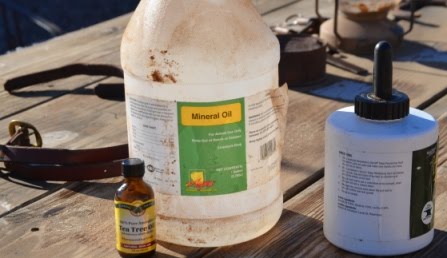
I have been treating this cleft with an expedient hoof dressing made of mineral oil, tea tree oil and lanolin so the hoof (and cleft) doesn’t get too dry and crack more.

Plus this horse has really thin hoof walls, so on one rear foot the hoof starts cracking some where the shoe is nailed. During the driest parts of the year I will treat this with hoof dressing to keep it from cracking or splitting so much.

Am I doing any good with the hood dressing? For that application on that one horse, I think I am, but I think using hoof dressing on my other horses would most likely not do much of anything. 

Friday, January 18, 2013

Rope Halters Are Not Cruel


Rhonda from Pennsylvania wrote to ask about halters: "Hi. I used to ride quite a bit as a kid, now 30+ years later I find myself as a owner for a half Quarter Horse, Half Arab mare. I love her to death, but sometimes she is a little pushy. My friend's farrier told me to get rid of the halter I use and get a rope halter. After the farrier left, my friend told me not to get a rope halter as that is cruel to the horse. I don't know what to think now. Do you have any recommendations?"

I'm predisposed to use rope halters. It's just a personal preference. I think generally it's not the tool that is cruel or harsh to the horse, it is how it is used. Quick or forceful hands can make a lot of common horse handling tools harsh to the horse.

The rope halter because of the small diameter of rope making contact on the horse's nose and poll (think the bridle path behind his ears) puts more pressure than a wider web halter would, so that is probably why your friend thinks a rope halter is cruel. Again, if you use it correctly I don't believe it is cruel.

The idea is still Pressure and Release. If your horse pulls away while under a halter he is going to be putting pressure on himself via his poll, and depending on his head set, maybe the nose. Once he stops pulling that pressure is released. Same as teaching your horse to give to pressure.

I'm sure you understand that it's hard to train a horse if you can't get him to move his feet. So imagine ground training with a halter where you maintain pressure via the lead line on the halter. As the horse moves in the direction of the pressure, you release that pressure and he starts to understand how he gets his release. While I think the rope halter provides a more clearer signal, there are thousands of exceptional horsemen and women who use web halters.

There are some innovative halters out there. One is a web halter that uses an elastic material for the webbing over the poll. I think the idea here is that when when a horse pulls away the pressure is gradual and once the horse quits pulling, and figures out his release, then that release is instant - a lot more quicker than a handler can provide. This is a pretty smart idea but I'll stick to the rope halter and judicious use. This elastic type web halter is from Paul Ortuno of Mane Horsemanship. This is not an endorsement, as I don't own one of these elastic halters. I just list it for your information. Again, I'll stick with quality rope halters from Double Diamond or Craig Cameron.

http://manhorsemanship.wordpress.com

Tuesday, January 15, 2013

CMSA Cowgirl Tammy Sronce Benefit


Multiple World and National Champion Cowboy Mounted Shooting Association (CMSA) Cowgirl Tammy Sronce sustained a head injury in January 2012, as a result of an impact from a drunk driver. The trauma has left Tammy with a permanent nerve condition. This has made it very hard for her to live a normal life and she has been unable to return to the competition arena. Tammy is scheduled for surgery, which hopes to correct this condition, on January 15th 2013.

To read more about Tammy Sronce.

Online Auction. There is an online auction to assist in mounting medical costs is coordinated with the help of Texas Smokin’ Guns, a local Texas chapter of the Cowboy Mounted Shooting Association, and items have been kindly donated by Tammy’s mounted shooting sponsors. Just a few of the items up for auction include Custom engraved stirrups from Straight Time Stirrups, a Custom JW Brooks Hat, Espana SILK Grooming Products and a year’s supply of Enjoy Yums Horse Treats.

Direct Donation. If you would like to donate directly to the medical fund, donations can be made to a benefit fund that has been set up by Texas Smokin’ Guns at:

Texas Smokin’ Guns – Sronce Benefit, 231 LaCosta Circle, Weatherford, TX 76088

If you need assistance please contact Deb Ciferni at dciferni@skybeammail.com or you may contact Tammy Sronce at tammy@hsmarketinggroup.com. Thank you so much for your support and prayers. Photo above from Western Shooting Horse magazine.


Sunday, January 13, 2013

Wyatt Earp Died 84 years ago Today


Today marks the 84th anniversary of Wyatt Earp's death, having passed away at age 80 in Los Angeles having out lived all of his brothers. The photograph at left is thought to have ben taken within a year of his death.
Wyatt did not die in a brothel like how most men want to go out,....he died at home. 

Earp, of course, most famous for his "Shootout at the OK Corral in Tombstone, Arizona in 1881, enjoyed a long and productive life well after that his famous career as a lawman, most notably working in Hollywood mentoring and coaching Actor-Cowboy on the silver screen including Tom Mix and William S. Hart, who he developed a friendship with. 

Wyatt Earp, and his brothers Vigil, Morgan, James, Warren and Bruce,...just kidding - he did not have a brother named Bruce,....were immortalized in many movies, the most recent one's being "Tombstone" and "Wyatt Earp", and if you can forgive the rider's jerking their horses' heads around with the reins, then these movies are enjoyable.

Note to my wife:  No brothel death for me.  I just as soon die in bed,....from natural causes.


Wednesday, January 9, 2013

Sick Horse Experience


While I had, seen or helped with many horses colicing, horse wrecks, injured horses, a case or two of founder, a horse stricken wth West Nile and even a case of strangles, I had never experienced a horse health issue like this, where we could not pin point the cause, so I wanted to share with the Functional Horsemanship readers.

Day One. On Wednesday early morning I noticed one of my geldings, Junior, eating, but not with his normal gusto. I ask my wife to keep an eye on him through the day.


Around noon, Junior still appeared off and hadn't finished his morning feed. We called our Vet, Amy Starr, DVM owner/operator of Paws'n Hooves Mobile Veterinary Clinic. She arrived about 4 pm. Her exam revealed normal gut sounds, normal heart rate and normal temperature. The Vet palipated Junior, no gut tension or inflammation noted. Doc Starr tubed Junior giving water, epson salts and mineral oil into gut. Water for hydration, mineral oil to help lubricate the gut in case of an impaction, and epson salts to help draw body fluids into the gut.

Right after Vet left, horse passed a normal looking pile. And because of this and Junior's gut sounds and physical exam we did not think the problem was colic. My Vet also several vials of bloob for lab analysis.

I watched Junior throughout the night. He still was not eating and did not appear to be drinking.

Day Two.. Thursday morning, Junior still not interested in feed. He had good gut sounds, but still had not passed anymore manure. Vet called me to check on Junior and to give me the blood work results. The blood analysis came back as his organ functioning well but the CBC blood count was down just a little indicating maybe a small virus or a little stress.

The Vet came out again Thursday evening, during a snow storm I might add. My horse had not passed the oil that the Vet gave him over 24 hours earlier. She palipated my horse again, and he appeared normal. Normal gut sounds and normal temperature, but dehydrated. The Vet gave horse a water and detergent enema. Apparently the detergent (Tide) helps break up any impaction. At this time we still did not feel this was a colic but the horse was not drinking water (nor eating) so we were concerned that this could turn into a colic case or have colic a secondary issue.  

Within an hour the horse shot (like a water cannon) the enema mix back out his rectum. The Vet gave Junior 10 litres of fluids IV. It was a very cold night, into the low 20's, so the Vet could not tube Junior again,.....the cold made the tube pretty unflexible and she just could get it into his stomach to adminster more fluids and mineral oil.  Even soaking the tube in hot water did not help as once removed from the hot water the tube would get instantly stiff.  At this point we thought dehydration was the biggest threat.

We had moved the horse into a broodmare stall and put a 17 quart bucket of warm, so I could monitor his drinking. I also gave him a handful of hay to eat since he had not eaten anything in at least 36 hours. I checked on him ever two hours throughout the night.  

Day Three. On Friday morning the horse was still not eating much at all. He would eat a handful of alfalfa but then stop. He did not appear to be drinking either.

Friday mid afternoon, I decided to trailer Junior to the Vet's place so he could be in a hospital stall and be given more fluids and monitored more often.

But once in the trailer Junior passed a pile with mineral oil, this was 47 hours after being tubed with mineral oil (on Wednesday). He appeared to be much better, so we took him out of the trailer and offered some feed. He began to eat a little, so we decided to postpone trailering him to the Vet's.  I put him back into the broodmare stall to monitor feed and water.

But then he stopped eating and did not drink so we loaded him back up into the trailer and took to the Vet's around 7 pm.

So Friday evening found us at the Vet's facility (San Francisco Stables) where he was given 10 litres of fluids IV again, and we got him to eat about 1/8th flake of alfafa and about 1/2 pound of fortified feed (Patriot). We left him late that night in the very capable hands of Doc Starr and her husband Panchito.

Day Four. Saturday morning Junior ate a light flake of alfalfa and was given an additional 10 litres of fluid via IV throughout the day. He also drank around a gallon water throughout the day as well.

In the evening he ate another light flake of afalfa, and was given 30 grams of Pro-Bios probiotic paste as well.

Day Five. On Sunday morning Junior was given a light flake of aflafa and a little grass. He ate that, drank about a gallon of water and was turned out for a couple hours.

Sunday afternoon, Junior ate alittle more afalfa and grass, and drank about a gallon of water. So we made plans on picking him up that evening.

Sunday early evening we arrived at my Vet's. Junior had received and ate an additional 6 lbs or so of afalfa-grass mix just before we arrived. We trailered him home where around midnight we gave him another 4 lbs of grass and a full bucket of water to monitor his water intake.

Day Six. Monday morning. I checked Junior at morning feeding time. He had ate all the hay I had given him the night before and had drank the whole 17 quart bucket of water through the night. I gave him 15 grams of Pro-Bios, re-filled his water and gave him 6 to 7 lbs of afalfa-grass mix and we left him stalled by himself to monitor.

In the early afternoon, Junior was hungry again and needed more water. Plus he had a regular amount of normal looking manure.

Days later he is still doing good. In fact, while through this sickness, virus or whatever it was, he appeared mostly normal. Ears forward, tracking movement with his head and eyes. No normal colic signs like standing extended, biting at his sides, ears back, or trying to lay down.  Really the only indication was the lack of interest in feed and not drinking and that dullish look in his eyes that he was offl - most of you know what I mean. 

We are thinking that this was some sort of virus, not colic. None of our other horses have exhibited anything like it yet. It was probably fortunate that Junior was the affected horse since he is very well conditioned and muscled. This would have taken much more out of a lesser or older horse.

My wife and I have had some damn good vets over the years. But Doc Starr is the first Vet we have had who does not hestiate to give enemas or use IV fluids.   Receiving fluids IV when not otherwise drinking can be vital in giving a horse a chance - I believe it was in Junior's case.     


Friday, January 4, 2013

A Cowboy and His Brothers


A cowboy, who just moved to Wyoming from Texas, walks into a bar and orders three mugs of Beer.

He sits in the back of the room, drinking a sip out of each one in turn. When he finishes them, he comes back to the bar and orders three more. The bartender approaches and tells the cowboy, "You know, a mug goes flat after I draw it. It would taste better if you bought one at a time."

The cowboy replies, "Well, you see, I have two brothers. One is in Arizona, the other is in Colorado. When we all left our home in Texas, we promised that we'd drink this way to remember the days when we drank together. So I'm drinking one beer for each of my brothers and one for myself."

The bartender admits that this is a nice custom, and leaves it there. The cowboy becomes a regular in the bar, and always drinks the same way. He always orders three mugs and drinks them in turn.

Then one day, the cowboy comes in and only orders two mugs. All the regulars take notice and fall silent.

When he comes back to the bar for the second round, the bartender says, "I don't want to intrude on your grief, but I wanted to offer my condolences on your loss."

The cowboy looks quite puzzled for a moment, then a light dawns in his eyes and he laughs. "Oh, no, everybody's just fine," he explains, "It's just that my wife and I joined the Baptist Church and I had to quit drinking......hasn't affected my brothers though."

Monday, December 31, 2012

James Question on Horse Joint Supplements


James wrote to Functional Horsemanship and asked, I don't believe joint supplements for Horses work, as I have tried several different brands for a few years, but if you have had some good luck with a particular brand please let me know as my 20 year old mare, a Tennessee Walking, is really getting stiff.

James, I would have a good horse vet look at your mare to figure out if there are any detectable problems causing your mare to be stiff, but 20 years is a fairly old horse.  Some stiffness and crepitice, which is the creaking and cracking sound in the joints, would be normal.

I have talked to both human and equine scienitists about joint supplements. What I have been told and believe is that,
1 - There are minimal trials and data on joint supplements. The manufacturers of these suppplements are kinda reluctant to fund independent research because there is the chance the research would come back as ther products not helping what they claim - kinda like funding your own funeral.  There is plenty of anecdotal or personal testimony of joint supplements that work, just without the provable data.  
2 - Most of the scientists, both horse related and human, that I have talked to believe that Glucosamine works to strengthen cartilage and actually rebuilds it slowly, but are pessimistic about the two other common joint supplements, Chondriotin and Hyluaonic Acid, having much help on joints.
3 - that quality of the product is the key.

I believe there are some joint supplements that help horses. I think that a horse would have to be on a quality product for at least a month to get any benefit and even then it may be hard to tell if it is helping. I had a similar aged ranch horse who had a front knee injury. I put him joint supplements as I rehabilitated him. He seemed to be doing much better after a couple months where I could team rope off him. I was unsure if the progress was related to his rehabilitation (exercise and good feed) or the joint supplements. I now tend to believe it was a combination of both.

If it doesn't put you out too much, I would try another joint supplement program for a few months and see what it does. Just pick a quality product with a high level of Glucosamine and at least some sort of outside approval, such as NASC or GMP. I think that a product with Vitamin C would be preferable. Vitamin C is an anti-oxidant that is thought to be good for connective tissue health.  MSM or Methylsulfonylmethane is a sulfur compound and another common joint ingredient.  Some think that MSM helps in the organic synthesis possibly helping other joint compounds get into the joints and tissues, and helps reduce inflammation.  I am waiting to be proved if MSM works in any capacity. 

Smart Pak is a company that offers supplements and information on all sorts of products. Click on the link to see a chart of joint supplements broken down by form (pellets or powder), ingredients, seals of approval and cost.  I have one of my horses on a joint supplement presently and I think the small cost is worth the possible benefits to the horse.